

September 9, 2026
How to Care for Surgical Incisions Properly
Expert Guide to Proper Surgical Incision Care
Aug 4, 2026
You've probably done the same thing many patients do. You search Cellulaze before and after photos late at night, scroll through clinic galleries, and keep wondering why some images look dramatic while others barely look different. The problem isn't that the treatment can't work, it's that most galleries don't tell you what you're seeing, when the photo was taken, or how much improvement came from real tissue change versus lighting, swelling, or selective presentation.
Cellulaze can create visible change, but the story sits under the skin. The treatment is designed to address the structural causes of cellulite, and the best published data show that those changes can be measured and sustained over time, not just guessed from attractive photos. In one cited body of evidence, skin thickness increased by 25% and skin elasticity improved by 29% at one year, while another report described average gains of 23% in thickness and 32.5% in elasticity at one month, with one-year values still improved at 27% and 21% respectively (Bizcommunity report on early Cellulaze data).
What follows is a practical way to read those photos like a careful patient, not a marketing audience. You'll see what Cellulaze changes beneath the skin, why the timeline matters so much, how to judge whether a gallery is fair, and why candidacy and provider experience matter just as much as the device itself.
Cellulite can look straightforward from a distance, then become much more complex once you examine what creates the dimples. A patient may see uneven skin on the thighs or buttocks and want a simple answer, yet the photo galleries online often leave out the details that make the image meaningful. Some sets show clear smoothing, some show little visible change, and without consistent lighting, timing, and body position, it is hard to know what the treatment accomplished.
The main problem is assuming every “after” photo shows the same stage of healing. Cellulaze changes gradually, and the strongest results are not an instant cosmetic shift. A 2016 multicenter clinical study of 57 treated patients across five centers found that a single three-step Cellulaze procedure produced sustained improvement for at least 12 months, with 90% of evaluable treatment sites showing at least a 1-point improvement at the 12-month visit. That study gives useful context for reading galleries, even if the full data are discussed later in this article.
Timing can change the story as much as the treatment itself. A photo taken too early may make the result look smaller than it will eventually be, while a carefully staged “after” image can make the change look larger than it really is. The most useful gallery shows the same person at a true baseline and at a late follow-up, with the same camera angle, lighting, and body position. Without those details, the image may still be authentic, but it is not a reliable way to judge outcome.
Practical rule: If a gallery does not say when the “after” photo was taken, treat it as a presentation, not proof.
A good Cellulaze gallery should answer three basic questions. Did the skin look smoother over time, or does the difference come from posture and lighting? Does the result match that person's cellulite severity? Can you tell whether the change was subtle, moderate, or more noticeable than average?
That is the standard to use as you review Cellulaze before and after images. The goal is not skepticism for its own sake. The goal is clarity, so you can separate documented improvement from selective presentation and understand how those photos fit with other treatments used for body contouring, like the approach described in this overview of how cellulite reduction treatments complement body contouring.
Cellulaze works because cellulite isn't just a layer of fat sitting under the skin. It's a structural problem. Fibrous bands pull downward, small pockets of fat sit unevenly beneath the surface, and the skin above can be thin or less elastic, which makes the dimples more obvious. A surface cream can't correct that architecture.
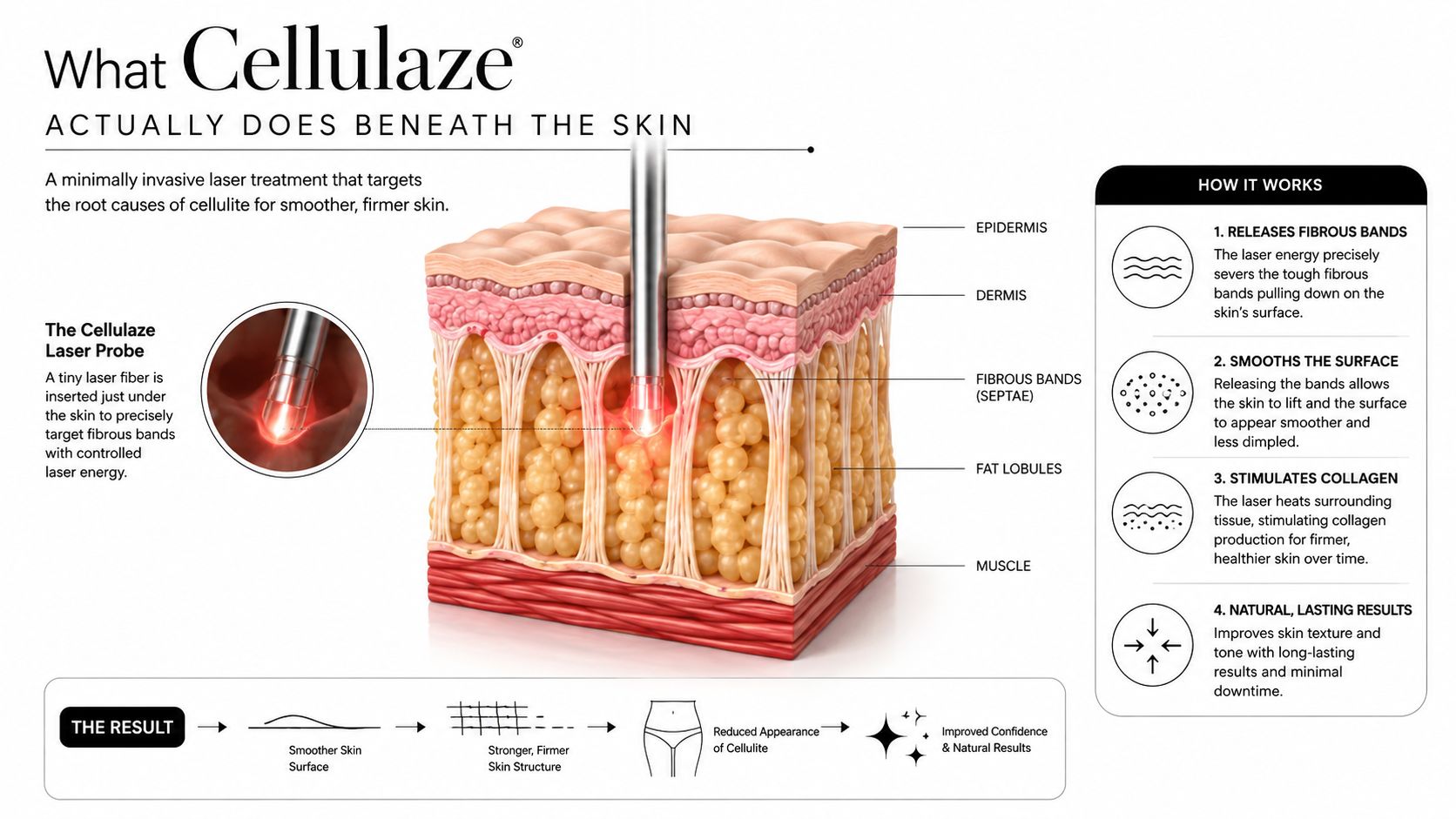
Cellulaze uses a 1440-nm Nd:YAG laser placed under the skin through tiny access points. In clinical materials, it's described as treating the three anatomic contributors to cellulite, fibrous septae, subcutaneous fat, and the dermal layer (RealSelf summary of Cellulaze). That's the core reason it behaves differently from treatments that only smooth the surface.
The easiest way to understand it is to think of a mattress with springs that tug the fabric downward. If the springs are pulling unevenly, the fabric puckers. Cellulaze tries to release those pulling bands, soften small fat pockets, and encourage the skin above to become thicker and more elastic. That combination is what creates the later “after” photo, not a temporary puffiness effect.
The meaningful endpoint is not a glossy surface the day after treatment. It's a skin structure that can resist tethering better months later.
Many readers get confused. If the fat is only lightly treated, why does the skin look better? The answer is that a thicker, more elastic dermis can better resist the shadowing and depression that make dimples look deeper. That's why the before-and-after change often looks most convincing when the skin has had time to remodel, not when it's swollen or freshly treated.
For readers comparing galleries, this is the key interpretive shift. You're not looking for temporary smoothing alone. You're looking for signs that the skin support improved enough to change how the light hits the area months later. For a related discussion of how cellulite reduction can fit into larger contouring plans, see how cellulite reduction treatments complement body contouring.
A Cellulaze appointment is usually simpler than people expect, but it's still a surgical procedure. That's an important distinction. The treatment is minimally invasive, yet it requires planning, local anesthesia, precision, and a surgeon who knows how to treat each dimple systematically rather than randomly.
The visit usually begins with marking the treatment areas while you're standing, because cellulite shows differently when the skin is loaded versus relaxed. After that, local anesthesia is used to numb the area, and the surgeon makes tiny incisions for the laser fiber. Those openings are small enough that they're often described as pen-tip sized in clinic materials, and the procedure is commonly performed in an accredited surgical setting.
The laser fiber is then passed under the skin to treat the tethered bands, address small fat pockets, and heat the dermal layer. The practical result is a controlled sequence of release, smoothing, and collagen stimulation. The treatment time often falls in the 1 to 2 hour range depending on the size of the area being treated, according to clinic and physician materials already summarized in the brief.
Patients are usually awake, numb, and aware of pressure or movement rather than sharp pain. Most of the recovery burden comes after the procedure, when bruising, tenderness, and swelling settle in. That's why the appointment itself can feel shorter and easier than the healing period that follows.
The skill issue matters here. If the surgeon doesn't release enough tethering, the dimples may remain. If the treatment is too aggressive in the wrong place, healing can look uneven. Good execution is what allows the later photos to show smoother contours without looking artificial.
A serious provider will explain where Cellulaze fits and where it doesn't. They should review the pattern of dimpling, talk through your skin quality, and tell you whether the problem is mostly cellulite, mostly laxity, or a mix of issues that need a different plan. If the consultation sounds like a sales pitch, the treatment plan probably will too.
Clinical numbers matter because cellulite photos can be persuasive in ways that hide the full story. A gallery may show smoother skin, but without context it is hard to know whether the change is modest, durable, or just the result of lighting and pose. Data cannot remove every variable, yet it can show whether Cellulaze has produced measurable change in studied patients. That matters, because its reputation grew from early clinical outcomes, not just from polished before-and-after images.
A multicenter study followed treated patients across five centers and found that one three-step procedure produced improvement that lasted at least 12 months. At the 12-month visit, most evaluable treatment sites showed at least a 1-point improvement, and blinded evaluators correctly identified the baseline photographs 91% of the time (multicenter study).
Earlier physician materials also described measurable changes in skin quality. One cited report showed skin thickness increasing by 25% and skin elasticity improving by 29% at one year, while another described gains of 23% in skin thickness and 32.5% in elasticity at one month, with one-year values still improved at 27% and 21% (Bizcommunity summary of early clinical data). Those figures matter because they point to tissue change beneath the surface, not just a visual impression in a photo.
The common mistake is to read published results as a promise. They are not. These findings describe groups of treated patients, not your exact body, your exact cellulite pattern, or your exact healing response. Someone with shallow dimpling and decent skin elasticity may see a clean, subtle improvement. Someone with deeper tethering may see a more obvious shift, but the result can still stop short of perfection.
Key takeaway: The best Cellulaze results are usually meaningful improvement, not complete erasure.
In the same body of evidence, many patients rated their results as good to excellent, and photographic evaluation and 3D surface imaging also showed improvement. That mix of outcomes is useful because it separates two questions. First, how satisfied did patients feel. Second, did the surface contour change in a way that outside observers could detect.
When you review a gallery, ask whether the photo looks consistent with those kinds of outcomes. If it does, the result may be credible. If the result looks much better than the published evidence would suggest, the photo may reflect a particularly favorable case rather than a typical outcome.
Cellulaze does not usually show its full effect right away. That is one of the easiest parts of Cellulaze before and after galleries to misread. The early image may still reflect swelling, compression, or bruising, while the visible benefit depends on collagen remodeling that develops later under the skin.
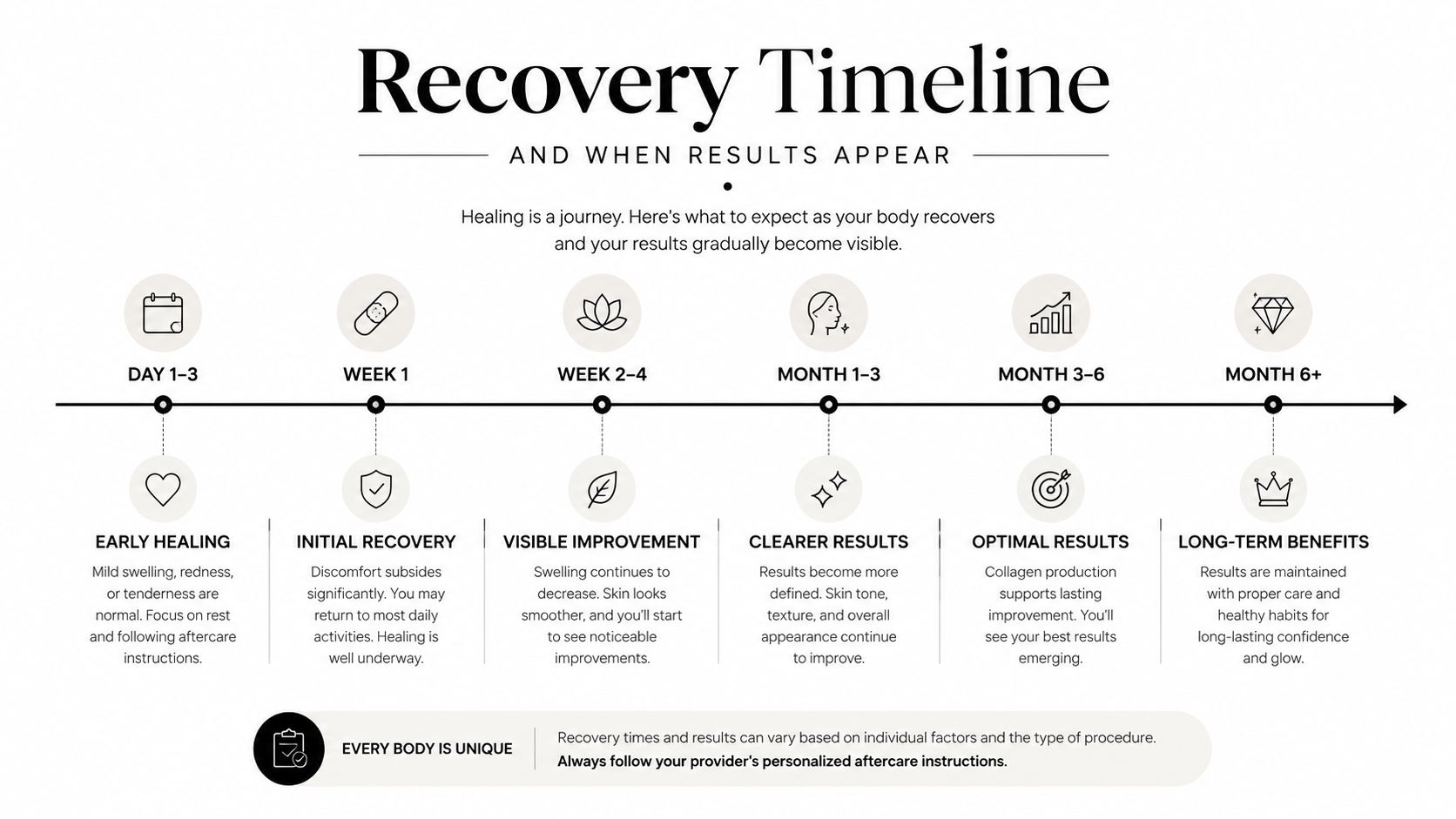
During the first few days, bruising, swelling, and tenderness are common, and a compression garment is often used to support the area while healing begins. The treated skin can look fuller or less defined during this phase. That does not mean the treatment failed. It means the area is still in the inflammatory stage, and the final contour has not settled yet.
By the second to fourth week, the area usually starts to calm down. Bruising fades, tenderness eases, and the skin may feel less tight. Some patients look at that point and assume they have reached the final result, but this stage is still early healing rather than the finished outcome.
Meaningful improvement tends to emerge over the 3 to 6 month window, with continued remodeling through 12 months or longer, according to the physician materials in the brief (Georgia Plastic patient brochure). That timeline matters because Cellulaze works by changing the supporting tissue beneath the skin, and that change takes time to show on the surface. A one-week comparison can be useful for tracking recovery, but it does not show the mature result.
A well-made gallery should make the time point obvious. If the photos are not labeled, it becomes difficult to tell whether you are looking at early swelling, mid-healing, or the later contour change that patients usually care about most. For a broader guide on comparing outcome photos, see how to evaluate before and after images in plastic surgery.
Some patients notice a smoother texture within a few weeks, but early change should still be treated as provisional. The deeper structural benefit comes later, after the dermis has had time to thicken and the treated tissue has settled. That is why an early photo can look encouraging without telling the whole story.
Use the calendar, not the excitement of the moment, to judge progress. The body remodels at its own pace, and Cellulaze results should be read against that healing curve rather than a marketing timeline.
A strong photo is supposed to answer a question. A weak one is supposed to sell a feeling. The easiest way to tell the difference is to slow down and inspect the details that clinics often leave out. If those details aren't consistent, the photo can still be real, but it may not be clinically meaningful.
Start with the basics. Look for the same lighting, the same angle, the same distance from the camera, and the same muscle state. If one image is taken with the patient flexing and the other with the muscles relaxed, the difference can look larger than the treatment created. The same is true if one photo is compressed by clothing or positioning and the other is not.
A reliable gallery should also label the time point. Immediate post-procedure, early healing, and late result are different things, and they should never be presented as if they mean the same thing.
If the “after” photo looks smoother but the lighting is softer and the shadows are flatter, don't assume the laser created all of that change.
Not every patient starts in the same place. Mild cellulite may improve, but the change can be subtle because there wasn't much dimpling to begin with. Deeper structural cellulite can show a more obvious shift, but even then the result may be partial rather than complete.
That's why outcome interpretation has to be severity-aware. A small improvement in a mild case may be a good result. A large improvement in a severe case may still leave some visible texture. Readers often miss that and assume only dramatic “before and after” images count.
A lot of clinic galleries show selected success cases and skip the awkward details. They rarely explain whether the patient was a poor candidate, whether repeat treatment was needed, or whether the lighting and compression were standardized. Those omissions matter because they shape how you interpret the image.
For a deeper look at how cosmetic photo sets can be structured, before and after photos in plastic surgery explains why consistency matters so much in any aesthetic comparison. The same logic applies to cellulite treatment. If the documentation isn't controlled, the conclusion shouldn't be strong.
Cellulaze is only as good as the hands behind it. The device matters, but patient selection, treatment planning, and photo documentation matter just as much. A board-certified plastic surgeon should be able to tell you whether the result you want is realistic, what improvement is likely, and where the limits are.
You want a provider who can discuss body contouring and cellulite as separate problems. A patient with isolated dimpling may be a cleaner Cellulaze candidate than someone with significant laxity, generalized fat, or a weight-change story that's still evolving. The consultation should sound like anatomy, not hype.
You should also expect to see a gallery with labeled time points and varied body types. If every case looks similar, or every photo shows the same lighting tricks, the gallery isn't teaching you much.
Red flag: If the consultation promises a perfect result before examining your skin quality, you're being sold, not evaluated.
About the practice side, Cape Cod Plastic Surgery, led by Dr. Marc Fater, brings over 30 years of experience and an on-site AAAASF-accredited surgical suite to the discussion of aesthetic procedures. That matters because Cellulaze still involves a surgical environment, even though it's minimally invasive. An accredited setting supports patient safety and procedural consistency.
If you're organizing consultations, tools that support responsiveness can help you keep track of questions, callbacks, and appointment reminders. For clinics that want to manage that process more efficiently, an AI receptionist for med spas is one example of the kind of operational support some practices explore, though it doesn't replace physician judgment or a real consultation.
Ask who performs the procedure, how many Cellulaze cases they've handled, and whether they're willing to say when you're not a great candidate. Ask how they standardize photos. Ask what kind of improvement is typical for your level of cellulite. Those answers tell you far more than a polished gallery ever will.
The fastest way to decide whether Cellulaze is worth a consultation is to ask three questions. Do I have visible cellulite that's bothering me more than my overall body size? Am I looking for structural improvement rather than surface smoothing alone? Am I willing to accept better, not perfect, results?
Cellulaze is generally framed for patients with mild to moderate cellulite, stable weight, and realistic expectations. It's not a weight-loss procedure, and it won't correct every kind of contour irregularity. Patients with poor skin quality, major laxity, or expectations of total elimination are more likely to be disappointed.
Durability is one of the reasons the treatment has stayed relevant. The AAD says Cellulaze may reduce cellulite, but more research is needed, and results can last a year or longer rather than being guaranteed or permanent for everyone (AAD cellulite treatment overview). That cautious framing is useful. It keeps you from confusing durable improvement with a promise that every body will respond the same way.
For patients comparing options, the newer Cellfina is often discussed as a competitor because Healthline reports it can reduce the appearance of cellulite dimples for up to 3 years and often shows results within about 1 month (Healthline on Cellfina). The choice isn't just about which photo looks better on a website. It's about invasiveness, longevity, and whether the result matches your anatomy and goals.
For cost context, you can also review Cellulaze cost information before scheduling.
If your main question is whether the improvement is real, the answer is yes, when the treatment is performed well and the photos are read correctly. If your next step is a consultation, bring your questions, your goals, and your tolerance for downtime, and ask for an honest assessment of whether Cellulaze fits your body.
Cape Cod Plastic Surgery offers consultations for patients who want a candid, anatomy-based discussion of cellulite treatment options, including whether Cellulaze fits their goals and skin quality. If you're comparing galleries and want a surgeon to explain what the photos really show, visit Cape Cod Plastic Surgery to explore your options and start with a straightforward evaluation.
September 9, 2026
Expert Guide to Proper Surgical Incision Care
Master dermal fillers aftercare with do's and don'ts, swelling tips, activity limits and warning signs to protect your results and heal smoothly.

September 8, 2026
Ensuring Safety: Why Your Surgeon's Credentials Matter Most

Cape Cod Plastic Surgery offers expert cosmetic and reconstructive procedures in a safe, accredited setting. Led by Dr. Marc Fater, we combine advanced techniques with personalized care to help you look and feel your best.
Monday: 9:00 AM – 5:00 PM
Tuesday: 9:00 AM – 5:00 PM
Wednesday: 9:00 AM – 5:00 PM
Thursday: 9:00 AM – 5:00 PM
Friday: 9:00 AM – 5:00 PM