

October 6, 2026
How to Verify Your Surgeon Before Your Cosmetic Procedure
Your Safety Guide: What to Look for When Choosing a Plastic Surgeon
Jan 7, 2026

Ever caught your reflection and noticed two distinct vertical lines etched between your eyebrows? You're not alone. Often called "11 lines" or glabellar lines, these creases are a classic sign of repeated facial expressions, becoming more permanent as our skin changes over time.
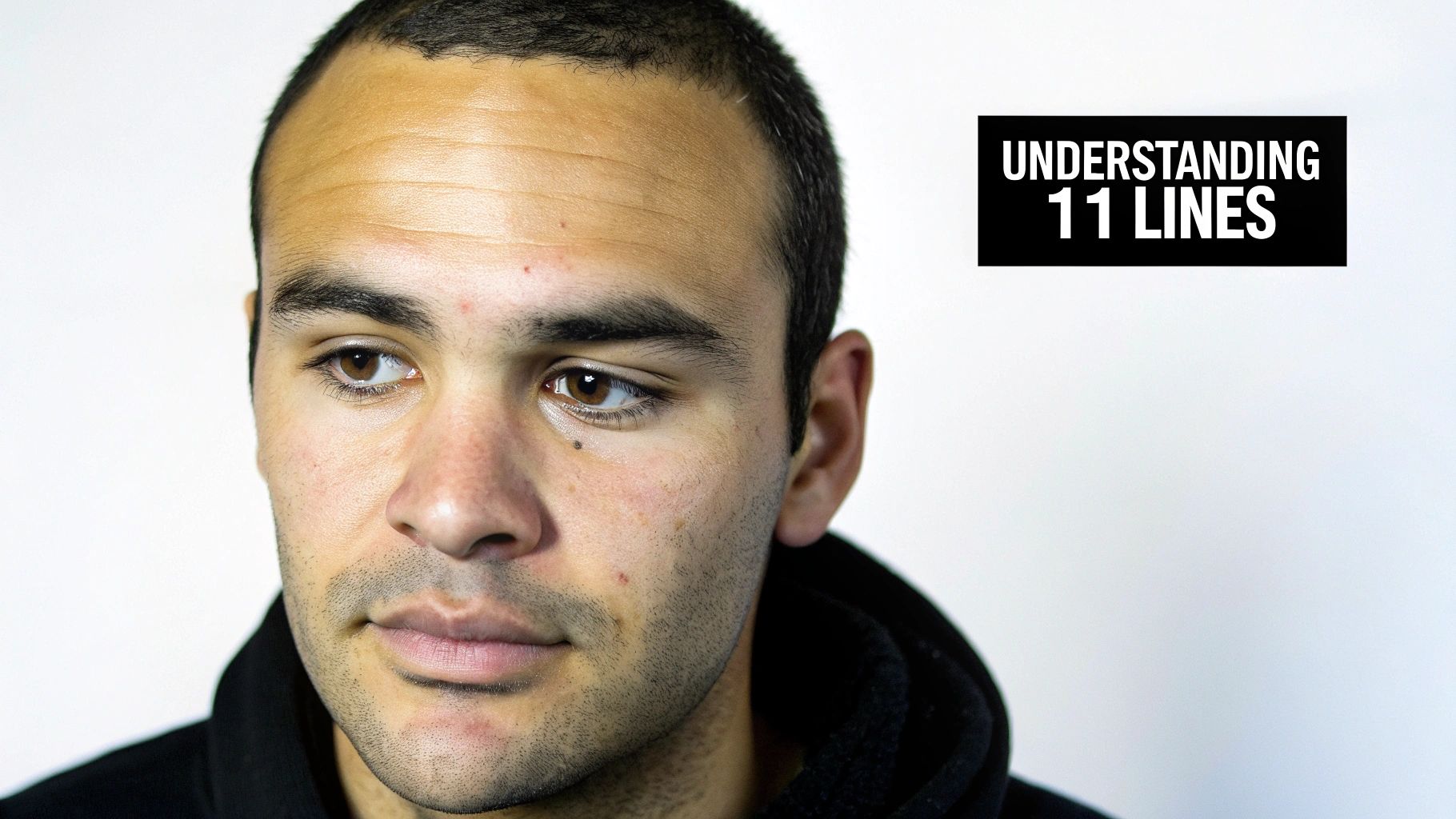
When you see those furrows between your brows, you're looking at a completely different story than the horizontal lines that pop up when you raise your eyebrows in surprise. Those vertical lines are caused by a separate, specific set of muscles.
Think of it like folding a piece of paper. The first time, the crease is faint. But fold it in the same spot again and again, and a deep, permanent line sets in. Your skin behaves in a similar way every single time you frown, concentrate on a task, or squint in the bright sun.
So, what’s happening under the skin? These vertical lines are a direct result of muscle contractions. Two key muscles are the main culprits: the corrugator supercilii and the procerus muscles. When you knit your brows together in that classic "furrowed" expression, these are the muscles doing the work.
Over the years, a few things happen that cause these lines to stick around, even when your face is perfectly relaxed.
Vertical lines on the forehead, known as glabellar lines or ‘11 lines,’ are dynamic wrinkles formed primarily by the repeated contraction of specific muscles during frowning or concentrating. These lines can deepen over time due to UV exposure, genetics, dehydration, stress, and even sleep compression. You can explore the detailed anatomy of these lines in this study from the National Center for Biotechnology Information.
It’s crucial to understand the difference between the two main types of forehead wrinkles because they have different origins and often respond best to different treatments. One isn't "worse" than the other; they're just caused by entirely different movements.
This quick guide breaks down the key distinctions between the lines that run up and down versus the ones that go side to side.
Knowing what causes your specific lines is the essential first step. It empowers us to find the most effective solution, whether that’s preventative skincare or advanced clinical treatments. Ultimately, addressing the root cause—both muscle movement and overall skin health—is how we achieve that smoother, more refreshed look.
To really get a handle on treating those vertical lines on your forehead, you first have to understand what’s going on underneath the skin. These aren't just random creases. They’re the result of a powerful tag team: your facial muscles and your skin's natural aging process.
Think of the muscles between your eyebrows—the corrugator and procerus muscles—as the engines of your expressions. Every time you frown, concentrate, or squint in the sun, these muscles contract, pulling your skin inward and downward. When you're young, your skin is like a brand-new rubber band; it snaps right back into place the moment you relax your face.
But as the years go by, a couple of things happen that change the game. Temporary expression lines start to become permanent fixtures, and it’s all down to two processes: intrinsic and extrinsic aging.
Intrinsic aging is the part of the story we can’t control—it's written into our DNA. Think of it as your skin’s built-in biological clock. Starting around our mid-20s, our bodies begin to slow down the production of two crucial proteins, and the effects on our skin's structure are pretty significant.
As this internal support system gets weaker, the constant folding from muscle contractions begins to etch permanent lines into the skin. The crease that used to vanish when you relaxed your face now sticks around, simply because the skin no longer has the robust framework to smooth itself out.
This loss of structural integrity also means the dermis—the skin's middle layer—gets thinner. The connection is direct: as the dermis thins, wrinkles get deeper. In fact, a JAMA Dermatology study found that the dermis at a wrinkle point is significantly thinner than in the surrounding, uncreased skin.
While we can't stop that internal clock, we absolutely have a say in the external factors that speed it up. Extrinsic aging is damage caused by our environment and lifestyle choices. These factors hit the fast-forward button on the natural aging process, making those vertical forehead lines show up deeper and sooner.
The number one offender here is photoaging—damage from the sun's ultraviolet (UV) rays. UV radiation is a wrecking ball for your skin's support structure, actively breaking down the collagen and elastin you already have. This makes skin sag and wrinkle far faster than it would on its own.
Other major players include:
Understanding these factors is crucial. Beyond just genetics and sun exposure, things like managing chronic stress can play a surprisingly big role in your skin's health. When we tackle both the muscle activity and these aging accelerators, we can build a much more effective strategy for keeping your skin smooth.
Think of the vertical lines on your forehead like a unique fingerprint. They're a direct map of how your specific facial muscles—the corrugator and procerus muscles—tug at your skin every time you frown, squint, or concentrate. Figuring out your personal pattern is the first real step toward finding a treatment that actually works and looks natural.
A one-size-fits-all approach just doesn't cut it here, because not all frown lines are created equal. Some people have those classic parallel "11s," while others might get a single, deep furrow right down the middle. You might even notice more complex "V" shapes or little arrowheads forming between your brows. This is exactly why an experienced practitioner doesn't just look at the line; they analyze the muscle movements happening underneath.
Take a look in the mirror and make a few expressions. You’ll probably see a dominant pattern emerge. While everyone's lines are slightly different, most tend to fall into a few main categories, depending on which muscles are doing most of the work.
Your specific anatomy and even your family history play a huge part in which of these patterns you're likely to develop. The size, strength, and exact placement of your forehead muscles are inherited traits, just like the color of your eyes. It’s the reason certain types of frown lines tend to run in families.
Knowing your wrinkle pattern isn't just a fun fact—it's absolutely essential for getting a great treatment outcome. A skilled surgeon uses this information to place neuromodulators like Botox with incredible precision, making sure to relax only the right muscles to smooth your lines without that unnatural "frozen" look.
In fact, research has shown that these patterns can even differ across ethnic backgrounds, which really drives home how personalized treatment needs to be. For example, one observational study on glabellar wrinkle patterns in Indian populations found that while the "11" pattern was most common at 40%, other complex shapes were also very frequent. This is a bit different from findings in other demographic groups, confirming that your individual facial structure is always the most important guide.
By pinpointing your specific pattern, a board-certified plastic surgeon can create a plan that honors your natural expressiveness while softening those frustrating vertical lines. It's a thoughtful approach that ensures the final result is refreshed, relaxed, and still 100% you.
If you're looking to smooth out those vertical lines on your forehead but aren't quite ready for surgery, you're in luck. There are some fantastic non-invasive options available that get right to the root of the problem. These treatments tackle wrinkles from two different angles: relaxing the muscles that create the lines and restoring the skin's lost volume that makes them stick around.
Think of it this way: the muscles between your eyebrows are constantly working, pulling your skin into a furrow. Over time, that repeated action etches lines into the skin. Non-surgical treatments work by telling those overactive muscles to take a little break, allowing your skin to relax and smooth out.
The go-to treatment for dynamic vertical forehead lines, hands down, is neuromodulators. You probably know them by their brand names, like Botox®, Dysport®, or Xeomin®. They all work in a similar way, using a purified protein to temporarily interrupt the nerve signals that tell your muscles to contract.
When an expert injects these into the specific muscles that cause frowning (the corrugator and procerus muscles, for you anatomy buffs), the effect is incredibly precise. The muscles don't freeze; they just relax. This stops them from creasing the skin, and as a result, those "11 lines" soften dramatically or even disappear when your face is at rest.
Here's what a quick session looks like:
You won't see the change instantly. It usually takes about 3 to 7 days for the smoothing effect to kick in, with the final, beautiful result appearing around the two-week mark. You can expect this to last for about 3 to 4 months. After that, the muscle movement slowly returns, and you can come in for a touch-up to maintain that smooth, relaxed look.
A lot of people worry about looking "frozen" or unnatural. A skilled injector's goal is never to erase your expressions, but to soften them. By using the right dose and targeting only the specific muscles causing the lines, we can give you a look that's refreshed and rested, not stiff.
Neuromodulators are the gold standard for lines caused by muscle movement, but what about the creases that are "stuck" there even when your face is perfectly still? We call these static wrinkles, and this is where dermal fillers shine.
Imagine a deep wrinkle is like a tiny valley in your skin. Dermal fillers, which are usually made from a substance called hyaluronic acid that your body produces naturally, act like a subtle plumping agent. When we inject the filler right underneath the crease, it gently lifts the "valley floor" up, making it level with the surrounding skin again. It's a simple, elegant solution.
Dermal fillers are the perfect choice for:
With a few great options on the table, it helps to see them side-by-side. This quick comparison breaks down the most popular non-invasive treatments, giving you a clearer picture of which one might be the best fit for your goals.
Ultimately, the best treatment is the one that addresses your specific type of line and skin condition. Sometimes, that even means using a combination of therapies.
For many people, the most powerful way to tackle stubborn vertical lines is to use neuromodulators and dermal fillers together. This strategy attacks the problem from both sides, giving you a more complete and longer-lasting result.
First, the neuromodulator relaxes the muscles, stopping them from making the crease any deeper. Then, the filler is used to smooth out the existing line that has already set in. If you want to dive deeper into how these two powerhouses work, our guide on Botox versus dermal fillers breaks it all down.
This diagram helps show the common patterns of vertical lines we often treat.
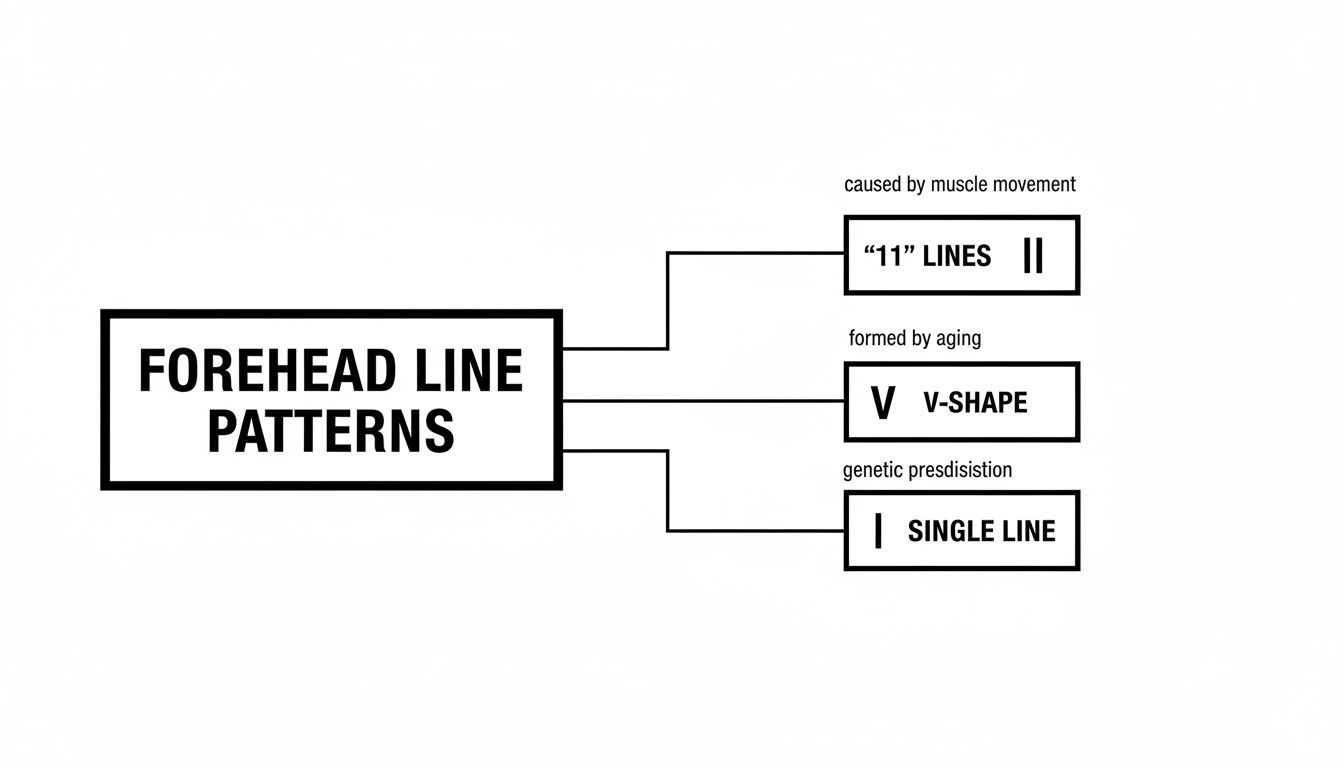
Whether you have the classic "11s," a V-shape, or a single deep line, the pattern is all about your unique facial anatomy—and we can tailor a treatment plan to match.
Beyond injectables, other technologies can help improve your skin's overall texture and reduce the appearance of fine lines, though they aren't usually the first choice for deep, dynamic frown lines. Laser resurfacing, for instance, uses focused light energy to gently remove the damaged outer layers of skin, which triggers your body to create fresh, new collagen from the inside out. This can really improve the overall quality and smoothness of your forehead skin.
To get the best possible results, it helps to think big picture. Combining professional treatments with a great skincare routine and healthy lifestyle is the best way to keep wrinkles at bay. Reading up on a few tips for how to reverse aging can give you a more holistic strategy for looking and feeling your best.
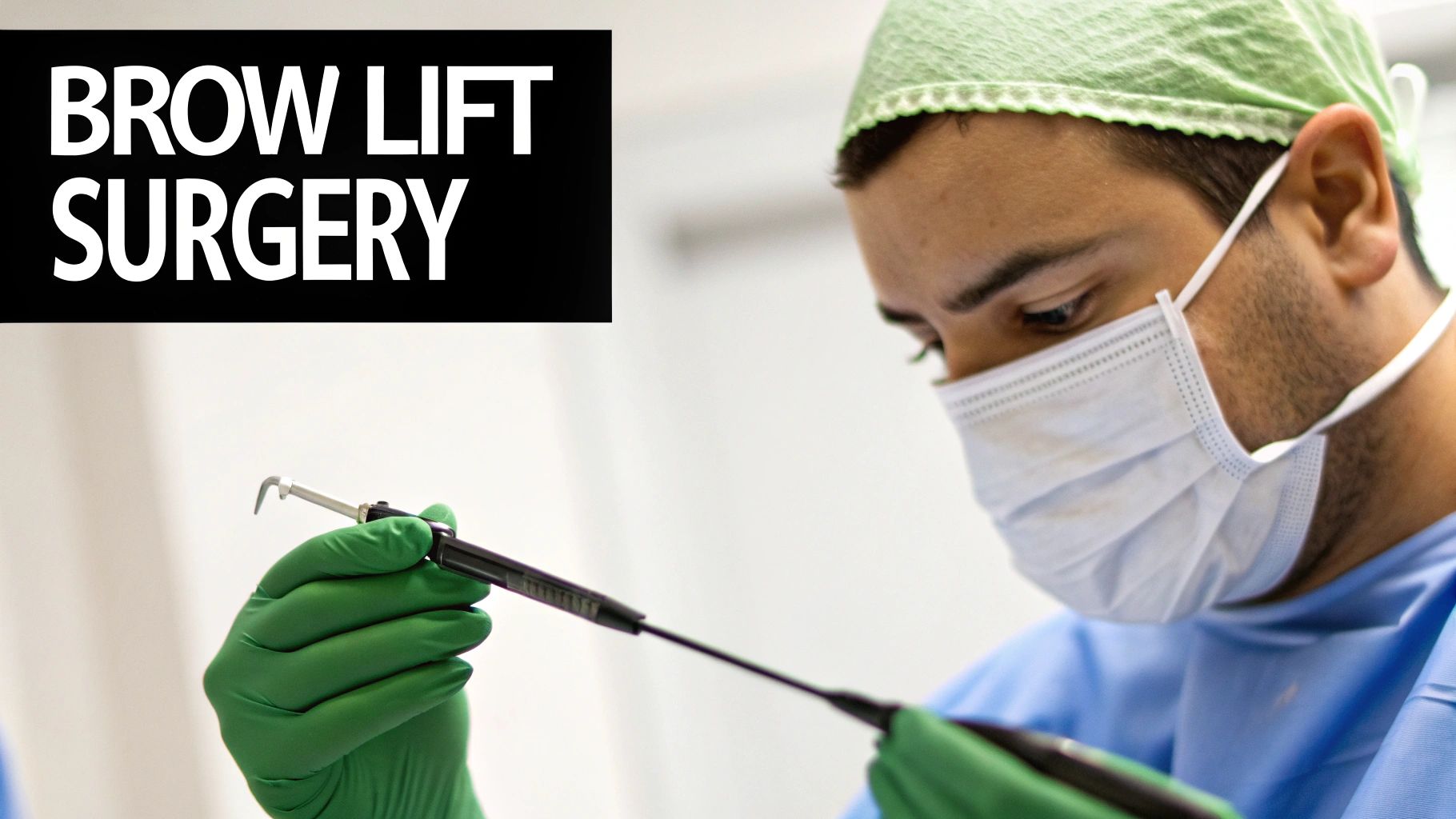
When injectables and fillers aren't quite cutting it anymore, or if your vertical forehead lines are etched in deep, it might be time to think about a more definitive approach. For those looking for a major reset, surgery offers a powerful and long-lasting solution.
While non-surgical treatments are fantastic for managing the symptoms—relaxing muscles or filling in lines—a surgical procedure gets right to the root of the problem. It’s the gold standard for turning back the clock on those stubborn, deep-set frown lines.
The go-to surgical procedure for addressing severe vertical lines between the brows is the brow lift. But this procedure does so much more than just lift a sagging brow. It gives a surgeon direct access to the very muscles responsible for creating those frustrating "11" lines in the first place.
Think of a brow lift as a way to physically release the built-up tension that has been pulling your skin into a frown for years. During the surgery, we can very precisely modify the corrugator muscles, the small but mighty muscles that clench to form those glabellar lines. By carefully weakening or removing a tiny portion of these muscles, we permanently reduce their ability to create deep furrows.
This is the fundamental difference between surgery and injectables. Botox offers a temporary pause button for these muscles, but a brow lift provides a near-permanent release, smoothing the skin from the inside out for years to come.
A brow lift is not just about lifting; it's a foundational reset for the upper face. By addressing the overactive muscles that cause vertical forehead lines, the procedure creates a naturally smooth, relaxed appearance that looks refreshed, not operated on.
The goal is to restore a naturally serene expression—not to create a "frozen" look. It’s about erasing that unintentional look of worry or anger that deep frown lines can project.
Long gone are the days of one long, visible incision across the scalp. Today’s surgical techniques are incredibly refined, designed for minimal scarring and much faster recovery times. The most advanced and common method we use for vertical forehead lines is the endoscopic brow lift.
Here’s a look at how this modern approach works:
The advantages of going endoscopic are huge. Patients experience less swelling, nearly invisible scarring, and a significantly quicker recovery compared to older, more traditional methods.
A brow lift is a game-changer, but it isn’t the right fit for everyone. The ideal candidate is usually someone who checks a few key boxes. You might be a great candidate for surgery if:
Ultimately, choosing surgery is a big decision that should only be made after a thorough consultation with a board-certified plastic surgeon. They will carefully assess your facial anatomy, listen to your goals, and help you understand the results you can realistically expect. To get a better feel for the procedure, you can learn more about brow lift surgery and see how it revitalizes the entire upper face.
Taking that first step to address your forehead lines is a big deal, and the consultation is where your personal goals start turning into a real plan. This isn't just a quick Q&A session; it's a dedicated, one-on-one meeting where we'll map out the best path forward for you.
Think of it as the blueprint phase of a project. It’s a detailed conversation where a board-certified expert will listen carefully to what you'd like to see change. Are you hoping to just soften those lines a bit while keeping all your natural expression? Or are you looking for a more significant correction for those deeper, stubborn furrows? Your vision is always the starting point.
After we understand your goals, we'll shift to a careful assessment of your facial anatomy.
To find the right solution, your surgeon needs to understand what’s causing your specific lines. This is far from a one-size-fits-all process. It involves taking a close look at how your muscles move, the current quality of your skin, and your overall facial structure.
This evaluation breaks down into a few key parts:
The best treatment plans come from a deep understanding of an individual's unique anatomy. It’s all about creating a solution that works with your natural features to leave you looking refreshed, not like a different person.
With all this information, your surgeon can then walk you through the options that make the most sense for you. This is where it all comes together. If your lines only appear when you move your face, Botox is often the perfect fix. But if those wrinkles have started to stick around even when you're relaxed, we might suggest dermal fillers to smooth them out from underneath.
For many people, a combination of different injectables gives the best, most comprehensive result. In other cases, where the lines are very deep and the brows feel heavy, a surgical procedure like a brow lift might be the most effective and long-lasting solution.
This is a partnership. We want you to feel confident and fully informed about your choices. To get an even better idea of what to expect, take a look at our guide on what happens during an initial plastic surgery consultation. It’s designed to help you feel completely prepared and comfortable as you move forward.
It's completely normal to have questions when you're considering treatment for those vertical lines on your forehead. We get it. Below, we've tackled some of the most common ones we hear from our patients every day.
This is probably the number one question people ask, and the honest answer is: it depends. The cost of neuromodulators like Botox isn't a flat fee because it's priced by the unit, and the number of units you need is unique to you. Think of it like a custom prescription—we need to figure out the exact dose for your specific concerns.
Factors like how strong your facial muscles are and how deep your "11s" have become will determine the final number. The only real way to get a firm price is to come in for a consultation. We'll take a close look at your anatomy and talk through your goals to create a plan that's just for you, ensuring you get a great result without paying for anything you don't need.
The dreaded "frozen face" is a valid concern, but it’s absolutely not the goal of a good treatment. A skilled, experienced injector aims to help you look refreshed and relaxed, not expressionless. The idea is to soften the lines, not erase your ability to show emotion.
The secret to a natural-looking result is all about precision. We use a light touch, targeting only the specific little muscles causing those frown lines. This relaxes the area just enough to smooth the skin while leaving all your other natural expressions completely intact. You’ll just look more rested.
There’s no magic number here. The right time to start thinking about treating frown lines is simply when they start to bother you. It's a completely personal decision.
We generally see two different approaches:
Ultimately, the best time to start is whenever you feel ready.
Ready to find out what a personalized plan could look like for you? The team here at Cape Cod Plastic Surgery, led by our board-certified plastic surgeon Dr. Marc Fater, is ready to help. Let's sit down and talk through your options to get you that refreshed, natural look you're after.
October 6, 2026
Your Safety Guide: What to Look for When Choosing a Plastic Surgeon

October 5, 2026
Why Our On-Site Accredited Facility Matters for Your Safety

October 2, 2026
Beyond the Calendar: How to Know You’re Truly Ready for Plastic Surgery

Cape Cod Plastic Surgery offers expert cosmetic and reconstructive procedures in a safe, accredited setting. Led by Dr. Marc Fater, we combine advanced techniques with personalized care to help you look and feel your best.
Monday: 9:00 AM – 5:00 PM
Tuesday: 9:00 AM – 5:00 PM
Wednesday: 9:00 AM – 5:00 PM
Thursday: 9:00 AM – 5:00 PM
Friday: 9:00 AM – 5:00 PM