
October 5, 2026
The Value of an On Site Accredited Facility
Why Our On-Site Accredited Facility Matters for Your Safety
Dec 20, 2025
Ever heard of a facelift that doesn't involve a single cut? That's exactly what a liquid facelift is. It’s a completely non-surgical procedure that relies on a masterful combination of injectables—like dermal fillers and neuromodulators—to bring back lost facial volume, soften lines, and give sagging skin a gentle lift.
Think of it less like a total overhaul and more like an artist carefully restoring a beloved sculpture to its original glory.
In practice, a liquid facelift is a sophisticated technique designed to tackle the common signs of aging head-on, all without the downtime of surgery. As the years go by, our faces lose some of their natural collagen and fat. This is what leads to those hollowed cheeks, deeper smile lines, and a jawline that feels a little less defined than it used to. A liquid facelift works to correct precisely these changes.
An experienced injector doesn't just follow a formula; they create a unique cocktail of injectables designed just for you and your facial structure. It's a truly personalized strategy, not a one-size-fits-all treatment. This strategic combination is what makes it so effective. To get a better feel for the process, you can read how Healthline explains the non-surgical approach.
The idea here isn't to change your face, but to enhance and restore your natural features so you look rested, vibrant, and more like yourself. The main goals are pretty straightforward:
A liquid facelift is a fantastic modern option for anyone looking for real rejuvenation without putting their life on hold. It’s a perfect fit for people with early to moderate signs of aging who just aren't ready to consider surgery.
To really get a handle on what a liquid facelift offers, it's helpful to see it side-by-side with a traditional surgical facelift. Both procedures aim for a more youthful appearance, but they get there in completely different ways, with major differences in results, recovery, and longevity.
As you can see, the choice between them really comes down to your individual anatomy, your aesthetic goals, and how much downtime you’re willing to have.
A liquid facelift isn't about one magic-bullet product. It’s all about the artful combination of two very different types of injectables. Think of it like a master artist using different paints and brushes to create depth and dimension on a canvas. For us, the "paints" are neuromodulators and dermal fillers, and each plays a unique, complementary role in turning back the clock.
To really get what a liquid facelift can do, you have to understand how these two tools work—both on their own and together. One tackles the wrinkles caused by years of facial expressions, while the other literally rebuilds the supportive scaffolding of your face from within. It’s this one-two punch that creates such a natural, balanced, and refreshed look.
First up in our toolkit are the neuromodulators. You’ve definitely heard of Botox, but others like Dysport and Xeomin fall into this category, too. Their mission is to smooth out dynamic wrinkles—those lines etched into our skin from a lifetime of smiling, frowning, and squinting.
Think about folding a piece of paper in the same spot over and over. A deep, permanent crease eventually forms. Neuromodulators prevent that from happening by gently relaxing the tiny facial muscles that cause these repetitive movements. They essentially hit a temporary "pause" button on the muscles that create crow's feet, frown lines, and forehead furrows.
By easing up on those muscle contractions, the skin on top gets a chance to smooth itself out. This softens the lines you already have and helps prevent them from getting deeper, leaving you looking more rested and serene without ever looking "frozen."
The results aren't forever, of course. These treatments typically last about three to four months before the muscle activity slowly comes back online. Sticking with a regular treatment schedule is the key to maintaining that smooth, relaxed appearance.
While neuromodulators relax muscles, dermal fillers rebuild structure. These are the heavy lifters of a liquid facelift, responsible for restoring lost volume, lifting sagging skin, and sculpting facial contours. One of the biggest giveaways of age is the loss of the supportive fat and collagen that gives a face its youthful fullness. This loss is what leads to hollows, shadows, and drooping.
Dermal fillers are smooth, gel-like substances that step in to fill that void. The most popular ones by far are made from Hyaluronic Acid (HA), something our skin produces naturally to stay hydrated and plump. Brands like Juvéderm and Restylane have entire product lines of HA fillers, each with a different thickness and consistency designed for a specific job.
It’s an incredibly versatile toolset:
Because HA is already a part of your body's chemistry, these fillers blend seamlessly into your own tissue. They also have a great side-effect: they draw in water, giving your skin an extra little boost of hydration from the inside out. Depending on the exact filler used and where it’s placed, you can expect results to last anywhere from six months to over two years.
For a deeper dive into how these two powerhouses work, check out our guide on the differences between Botox and dermal fillers. Once you see their individual strengths, it becomes crystal clear how combining them creates such a comprehensive and customized rejuvenation—and that’s the real secret behind a great liquid facelift.
Knowing what's ahead can turn any pre-treatment jitters into genuine excitement. The liquid facelift process is a true collaboration between you and your provider, starting with a detailed consultation where we map out a plan together. It’s all about creating a shared vision for your results.
Then comes the treatment itself, which is often a more comfortable and artful experience than people realize. Let's walk through the entire process, step-by-step, so you feel completely at ease and know exactly what’s coming.
Your journey doesn't start with a needle—it starts with a conversation. Honestly, the initial consultation is probably the single most important part of the whole process. This is your time to talk openly about what’s bothering you, what you'd love to see in the mirror, and to ask every single question you have.
A great injector will do more listening than talking at first. They'll perform a careful facial analysis, looking at your skin's condition, the underlying structure, and where volume has been lost over time. Only then will they walk you through their recommendations, explaining which products would work best for you and, crucially, why. This is where you build trust and make sure their aesthetic eye aligns with yours.
Think of the consultation as drawing up the architectural blueprint for your face. It’s where your goals and your provider’s expertise meet to create a plan for beautiful, natural-looking results that are uniquely yours.
When you come in for your treatment, the first thing we’ll do is get your skin prepped. After a thorough cleansing, we typically apply a strong topical numbing cream. This sits for about 20-30 minutes to make sure you’re comfortable from start to finish. Your comfort is our priority.
Once you’re numb, your injector will begin the facial mapping. This is a critical step. Using a special cosmetic pencil, they'll draw a detailed grid on your face, marking the precise points for each injection. This isn’t just guesswork; it’s a map based on a deep understanding of facial anatomy. It ensures that fillers and neuromodulators aren't just filling a line but are placed strategically to lift, support, and bring back a beautiful, natural balance to your entire face.
This flowchart breaks down the two main tools used in a liquid facelift and how they work together.
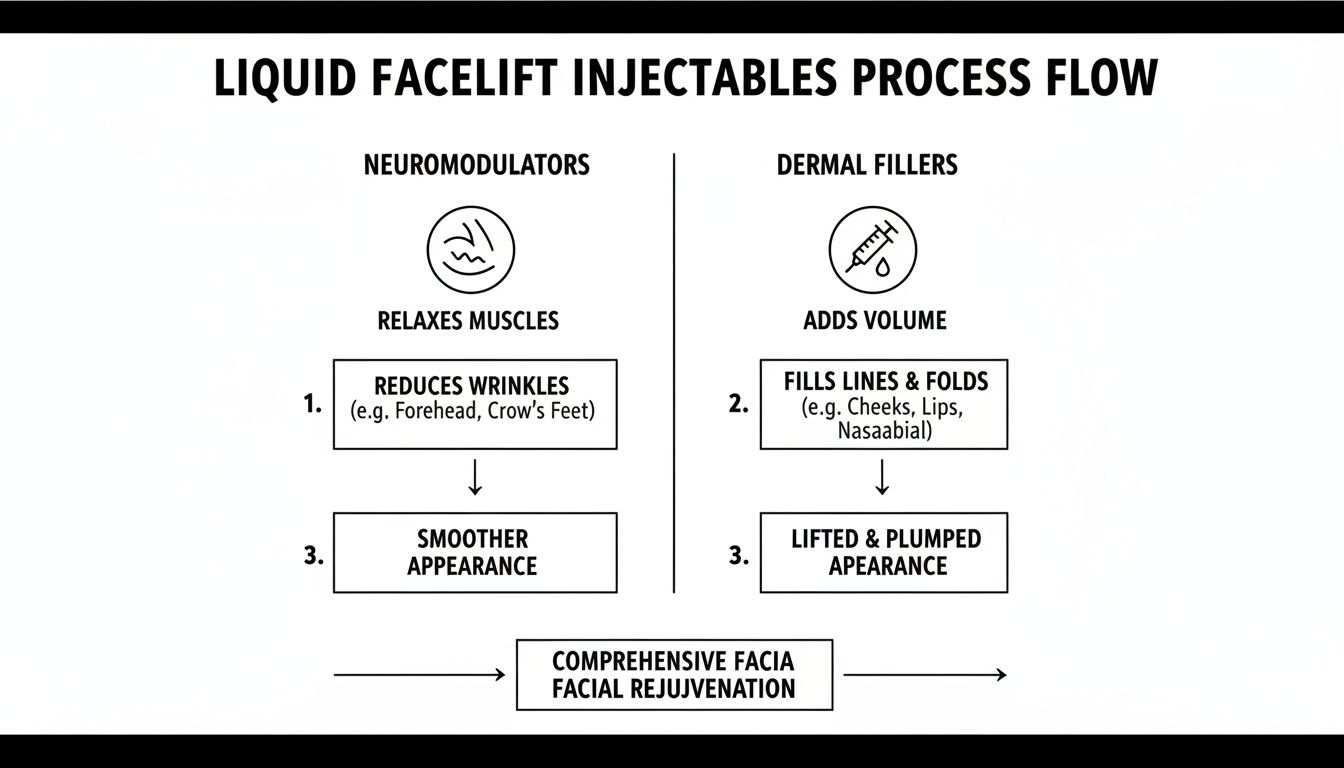
It helps to see how neuromodulators relax the muscles causing expression lines, while fillers work on a deeper level to restore lost volume and structure. Together, they achieve a complete, yet subtle, rejuvenation.
With the blueprint set, the injections can begin. Your provider will choose between two primary tools to place the product: a fine needle or a microcannula. The right tool for the job really depends on the area being treated and the injector's technique.
The cannula technique is a game-changer for delicate areas like under the eyes or for sculpting the jawline. Because the tip is blunt, it gently pushes blood vessels aside instead of piercing them, which dramatically reduces the risk of bruising and swelling.
Many patients also report that this method is more comfortable. In fact, clinical reports have shown that 72% of patients found the cannula approach less painful than traditional needles. The data also showed significantly less bruising with cannulas (7%) compared to needles (17.4%), making it a fantastic choice for an easier recovery. You can read more about these findings to understand the differences in patient experiences.
The entire treatment usually takes about 30 to 60 minutes. Afterward, your provider will gently massage the treated areas to make sure the product settles in smoothly. We'll give you clear aftercare instructions, and then you’ll be ready to go about your day.
Once the injections are done, your liquid facelift journey isn't quite over. Now comes the exciting part: watching your results settle in while following a few simple guidelines for a smooth and comfortable recovery.
The whole point of this treatment isn't to make you look like a different person. It’s about restoring a more rested, revitalized version of yourself. This is where you'll see the artistry of a skilled injector come to life. Let's walk through what you can expect in the hours, days, and months ahead.
The best part of a liquid facelift is how subtle and natural the final outcome is. You’ll notice the volumizing effects from the dermal fillers right away, but the true, beautiful result will emerge over the next week or two as any minor swelling goes down and the fillers fully integrate with your skin's tissues.
So, what does this "refreshed" look actually mean?
The ultimate goal is harmony and balance. Don't be surprised if friends and family just say you look exceptionally well-rested or refreshed, not that you’ve had “work done.”
The longevity of your results really depends on the specific combination of products we use. Since a liquid facelift uses several tools from our toolbox, different parts will need a tune-up at different times. This staggered approach actually makes maintenance simple and efficient.
Your own metabolism, your lifestyle, and even the area treated will influence how long your results hold. We'll work with you to create a personalized timeline for follow-up appointments to seamlessly maintain your fantastic new look.
One of the biggest draws of a liquid facelift is the minimal downtime. Most people are back to their normal routine almost immediately. That said, following a few key aftercare instructions for the first 24 to 48 hours is crucial for keeping any swelling or bruising to a minimum.
Think of these as simple rules to protect your investment and ensure you get the best outcome possible.
Essential "Dos" for the First 48 Hours:
Important "Don'ts" for the First 48 Hours:
Following these simple tips will help make your recovery quick and easy. For a deeper dive, you can explore our guide on common dermal fillers side effects to be fully informed about what to expect.
A liquid facelift can be a game-changer for so many people, but its success really comes down to one thing: making sure you're the right candidate. It’s a fantastic non-surgical tool, but it’s not meant to solve every sign of aging. Figuring out if this treatment is truly the best fit for your unique anatomy and what you hope to achieve is the single most important part of the process.
This procedure is brilliant at tackling very specific concerns, but it does have its limitations. Being realistic about what it can—and can't—do is the key to making a confident, informed decision you'll be happy with.
So, who's the perfect person for a liquid facelift? In my experience, the best candidates are those just starting to see the early to moderate signs of aging. They’re looking to be proactive and get natural-looking results without the downtime and commitment of surgery.
This is likely you if you’re noticing:
Basically, you’re looking for a real improvement and a nice boost in confidence, but you either don't quite need surgery or just aren't ready to take that step yet.
Honesty and transparency are everything when it comes to getting beautiful, natural outcomes. A liquid facelift isn't the right answer for everyone, and a good, ethical provider will be the first to tell you if another approach would serve you better.
This treatment might not be the right path for you if you have:
Sometimes, other non-surgical options can help bridge the gap. For instance, you can learn more about PDO thread lifts, which offer a different kind of lift by using dissolvable sutures to gently pull the skin taut.
The key is matching the right tool to the right job. A liquid facelift excels at restoring volume and softening contours, but a surgical facelift remains the gold standard for correcting significant skin sagging.
Finally, it's important to remember that certain medical conditions can rule you out as a candidate. Things like active skin infections, bleeding disorders, or known allergies to any of the injectable ingredients are absolute contraindications. We’ll go over your full medical history during the consultation to ensure your complete safety and well-being.

Here’s the single most important thing to know about a liquid facelift: the final result has far more to do with the person holding the syringe than the brand of product inside it. Choosing the right provider isn't just a small detail; it’s the decision that will define your safety, your results, and your entire experience.
A truly great injector is part medical professional, part artist. They need a deep, practical understanding of facial anatomy, but also an innate eye for aesthetics, proportion, and balance. Finding someone who blends this technical skill with artistic vision is the key to getting that refreshed, natural-looking result you’re hoping for.
Before you even pick up the phone to book a consultation, a little homework goes a long way. Your goal is to screen for providers who have the right training and background, filtering out anyone who might not be properly qualified. Your injector must be a licensed medical professional with specific, advanced training in cosmetic injections.
Here are the non-negotiables:
Think of the consultation as an interview—you’re interviewing the provider to see if they’re the right fit for you. It’s your chance to assess their expertise, get a feel for their communication style, and make sure their aesthetic philosophy aligns with what you want. A good injector will encourage questions and provide clear, thoughtful answers.
Don't be shy about asking direct questions. A confident and skilled provider will appreciate your diligence and take the time to build your trust by addressing every concern you have.
Make sure to cover these crucial points:
Choosing a provider like Dr. Marc Fater at Cape Cod Plastic Surgery is a perfect example of what to look for. As a board-certified plastic surgeon with decades of experience, his profound knowledge of facial anatomy and patient-first approach ensures you are in exceptionally capable hands.
It's completely normal to have questions, even after learning the ins and outs of a procedure like the liquid facelift. Let's get into some of the most common things patients ask—the practical stuff about cost, comfort, and what you can really expect.
This is probably the number one question, and the honest answer is: it depends. The cost of a liquid facelift varies quite a bit because it's not a one-size-fits-all treatment. The price is based on your unique facial structure, your specific goals, the types of products we use, and the expertise of your injector.
Think of it less like an item with a price tag and more like a custom-tailored suit. The total cost, which can range from $2,000 to over $8,000, is determined by how many syringes of filler and units of neuromodulator are needed to create your ideal result. The only way to get a firm number is to come in for a consultation, where we can map out a treatment plan just for you.
A word of advice: choosing a highly skilled, board-certified provider is the most important investment you'll make. Your safety and the quality of your results are worth far more than a bargain price.
Most people are genuinely surprised at how manageable the treatment is. They usually describe the feeling as a few quick pinches or a bit of pressure, but not outright pain. We also take a couple of key steps to make sure you're as comfortable as possible.
Any discomfort is over in a flash and is typically very well-tolerated.
The side effects you're most likely to see are minor and temporary. We're talking about a little bit of redness, some swelling, or maybe a small bruise right at the injection sites. These almost always clear up on their own within a few days to a week. Sticking to the aftercare instructions we give you is the best way to keep these to a minimum.
Serious complications are incredibly rare. Issues like vascular occlusion are the kind of thing an expert injector is trained to avoid. When you're in the hands of a board-certified provider who has an intimate knowledge of facial anatomy, the risks drop dramatically, making this a very safe procedure.
Here's the best part: a liquid facelift gives you both instant gratification and results that get even better with time. You'll walk out of the office seeing a real difference right away.
After about a week or two, any minor swelling will have vanished, and you'll be seeing your final, beautiful result. It’s a fantastic process—you get an immediate boost, with the final look unfolding over the next couple of weeks.
Ready to see if a liquid facelift is the right choice for your rejuvenation goals? At Cape Cod Plastic Surgery, Dr. Marc Fater combines artistic vision with medical precision to create beautiful, natural-looking results. Schedule your personalized consultation today and take the first step toward a more refreshed you.
October 5, 2026
Why Our On-Site Accredited Facility Matters for Your Safety

October 2, 2026
Beyond the Calendar: How to Know You’re Truly Ready for Plastic Surgery

October 2, 2026
Exploring Your Breast Augmentation Options: Implants, Shapes, and What to Expect

Cape Cod Plastic Surgery offers expert cosmetic and reconstructive procedures in a safe, accredited setting. Led by Dr. Marc Fater, we combine advanced techniques with personalized care to help you look and feel your best.
Monday: 9:00 AM – 5:00 PM
Tuesday: 9:00 AM – 5:00 PM
Wednesday: 9:00 AM – 5:00 PM
Thursday: 9:00 AM – 5:00 PM
Friday: 9:00 AM – 5:00 PM