
September 9, 2026
How to Care for Surgical Incisions Properly
Expert Guide to Proper Surgical Incision Care
Feb 2, 2026

So, what exactly is a liposuction and mini tummy tuck? It’s a specialized combination procedure that zeros in on the lower abdomen, removing that stubborn pocket of fat while also tightening up loose skin below the navel.
Think of it as a one-two punch for contouring. The liposuction sculpts away the unwanted fat, and the mini tummy tuck smooths everything out for a firm, sleek finish. It’s a powerful duo that delivers a result neither procedure could quite manage on its own.
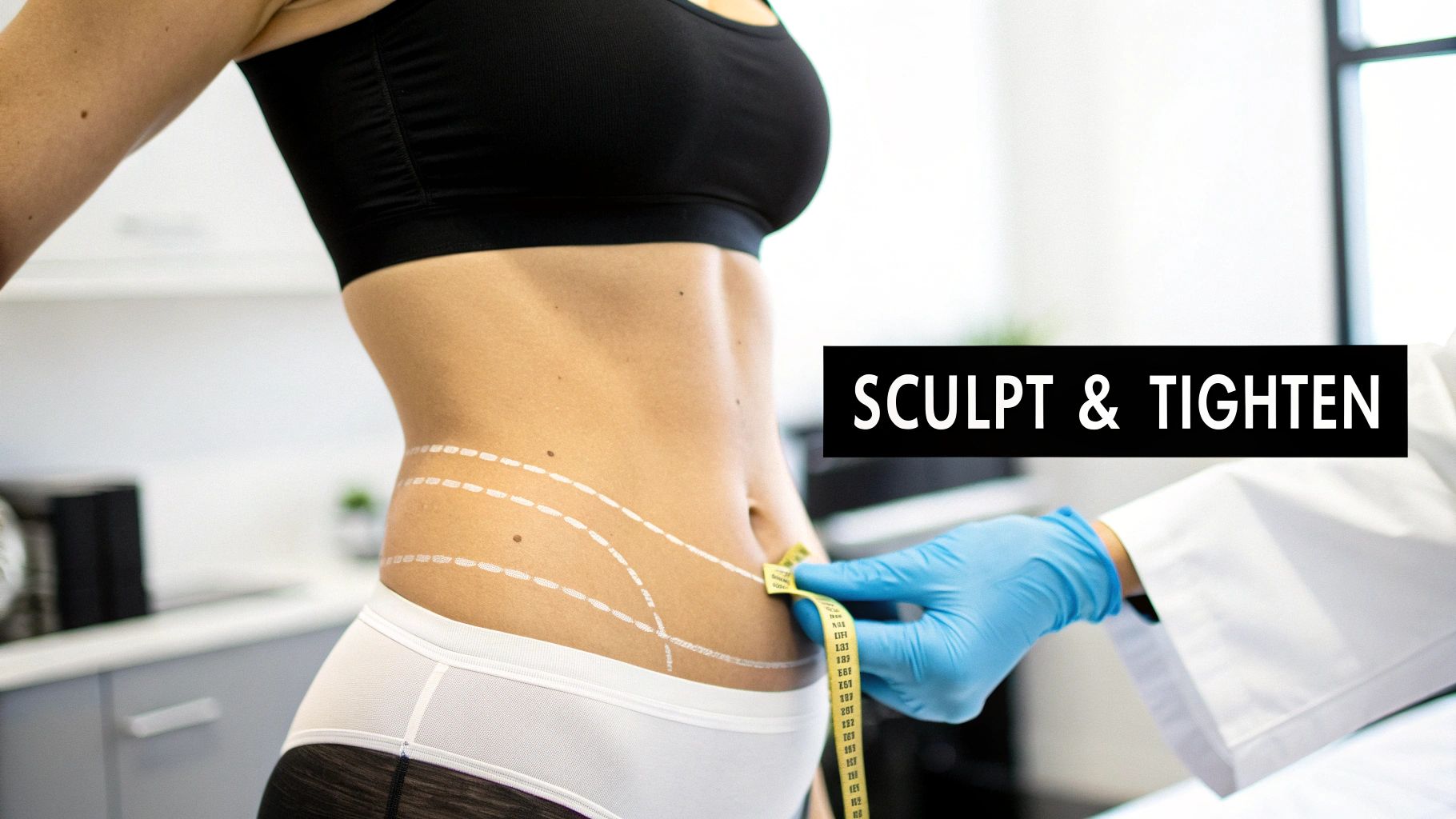
So many of my patients are in great shape and close to their ideal weight, but they’re frustrated by that little "pooch" in their lower belly. It’s the kind of thing that just won’t budge, no matter how clean they eat or how many crunches they do. This is precisely the scenario where a combined liposuction and mini tummy tuck really shines.
Let’s use an analogy. Imagine your stomach is a piece of fabric pulled over a cushion. Liposuction is what removes some of the excess stuffing from the cushion, slimming down the bulge. But what happens then? The fabric on top can look a little loose or wrinkled. That’s where the mini tummy tuck comes in.
The mini tummy tuck is the final, crucial step. It expertly tailors that "fabric." Through a small, low incision—often similar in size and placement to a C-section scar—I can remove a small ellipse of excess skin and tighten what remains below the belly button. This creates that smooth, flat surface that perfectly showcases the new, slimmer contour achieved with liposuction.
It’s important to understand this isn’t a weight-loss operation; it’s a body contouring one. It’s ideal for people who have:
To get a better sense of how the fat removal component works, you can learn more about liposuction at Cape Cod Plastic Surgery.
The real beauty of this combined approach is its efficiency. We can sculpt and tighten in a single procedure, which means one recovery period and a far more harmonious and impressive result than you'd get from doing them separately.
To put it simply, here’s how the two components of the surgery work together to achieve the final look.
Each part of the procedure sets the stage for the other. Liposuction clears out the excess volume, making it much easier to see exactly how much skin needs to be tightened. Then, the mini tummy tuck provides that final, refined shape, pulling the "canvas" taut over the newly sculpted area. The result is a flatter, firmer lower abdomen that looks completely natural.
Deciding if a combined liposuction and mini tummy tuck is the right move for you goes beyond just wishing for a flatter stomach. It's really about matching the right procedure to a very specific set of circumstances. This isn't a catch-all solution; it's a precision tool for a particular type of patient.
The best candidates are people who are already in good health and have kept their weight stable for at least six months. This is non-negotiable, as big weight swings after surgery can undo your beautiful new results. Think of this procedure as the final, perfecting touch on a canvas you've already worked hard to create through healthy living.
So, how do you know if you fit the bill? Let’s break it down. An ideal candidate usually has:
Many people who come to us are frustrated with fat deposits that are stubbornly resistant to a healthy lifestyle. If you're still exploring non-surgical options, this resource on how to lose stubborn belly fat provides some useful insights.
Sometimes, a couple of examples make it all click.
Scenario 1: Meet Jane
Jane is 42 and has two kids. She's fit, eats well, and is at a weight she’s happy with. But no matter what she does, she can't get rid of a small, soft bulge and a bit of lax skin below her belly button left over from her pregnancies. Her abdominal muscles are still in great shape.
Jane is the perfect fit for a liposuction and mini tummy tuck. The liposuction will suction out that stubborn pocket of fat, and the mini tuck will tighten up that small amount of loose skin. The result? The smooth, flat lower stomach she’s been working toward.
Scenario 2: Meet Sarah
Sarah, 48, recently lost a lot of weight—a fantastic achievement! But it's left her with loose skin both above and below her belly button. She can also see and feel a distinct gap between her abdominal muscles (a condition called diastasis recti).
Sarah isn't the right candidate for this specific combo procedure. A mini tummy tuck only tackles the area below the navel. Her concerns are much more widespread. To learn about options for a more comprehensive fix, you can read our guide on what a full tummy tuck can achieve. She needs a procedure that can address skin and muscle laxity across her entire abdomen.
The real takeaway here is about location and scope. A mini tummy tuck is exclusively for the lower abdomen. If your concerns with loose skin or muscle separation creep up above your belly button, we need to look at a different game plan.
It’s no surprise that body contouring is incredibly popular, especially among women. In fact, statistics show that women make up 98% of tummy tuck patients and 94% of liposuction patients. The 40-54 age group is particularly well-represented.
Of course, the only way to know for sure if this procedure will get you the results you're dreaming of is to sit down for a one-on-one consultation.
Thinking about a liposuction and mini tummy tuck is one thing, but knowing exactly what happens from the moment you walk into our office to the moment you wake up in the recovery room can make all the difference. Let's walk through the entire process, step by step, so you can feel confident and prepared for the day of your procedure. It's a journey we've mapped out countless times, always with your safety and your final result as the top priorities.
It all starts with your one-on-one consultation with Dr. Fater. This is far more than just a quick chat; it’s a deep dive into your goals, your health history, and what this procedure can realistically achieve for you. This is your time to ask anything and everything. We’ll build a surgical plan that’s customized just for you. As you start this process, it can also be helpful to understand the broader healthcare landscape, such as the key differences between private healthcare vs NHS, to make fully informed decisions about your care.
Once we’ve scheduled your surgery, our team will give you a complete set of pre-op instructions. Following these is essential for a safe and smooth experience.
When you arrive at our on-site, AAAASF-accredited surgical suite here at Cape Cod Plastic Surgery, our team will be there to welcome you and get you settled. Dr. Fater will see you one more time before the procedure to go over the plan and make precise surgical markings on your abdomen. He does this while you’re standing up—it’s a critical step to ensure your results look natural and symmetrical.
From there, you'll be brought to the operating room. Our anesthesiologist will administer your anesthesia, ensuring you are completely comfortable and asleep for the entire surgery.
The operation itself is a carefully choreographed, two-step process where each part enhances the other.
It's a much less involved procedure than a full tummy tuck. There’s no new incision made around your belly button, and any muscle tightening is focused strictly below the navel, if it’s needed at all.
Once Dr. Fater is finished, you’ll be moved to our recovery room. Our nursing staff will be right there with you, monitoring you closely as you gently wake up from the anesthesia. The first thing you'll probably notice is that you're already wearing a snug compression garment around your middle.
This compression garment is your new best friend for the first few weeks. It's not just for support; it plays a vital role in minimizing swelling, helping your skin adhere to its new contours, and ensuring a smoother healing process.
You’ll feel groggy and your abdomen will be sore—that’s completely normal. We’ll be managing any pain with medication to keep you comfortable. Most patients go home the same day, but it’s an absolute must that you have a friend or family member drive you and stay with you for at least the first 24 hours. Before you head home, we’ll arm you with detailed aftercare instructions covering everything you need to know for a successful recovery.
The success of your liposuction and mini tummy tuck depends just as much on a smooth recovery as it does on the surgery itself. When you know what to expect during each phase of healing, you can take an active role in achieving the best possible outcome. This isn't just about waiting—it’s about actively helping your body heal.
Your recovery journey starts the moment you leave our surgical suite. It’s a phased process, and you'll see real progress each week. Think of it less like a sprint and more like a steady, predictable walk toward your final, beautiful results.
This visual gives you a bird's-eye view of your surgery day, from the morning consultation right through to the start of your recovery.
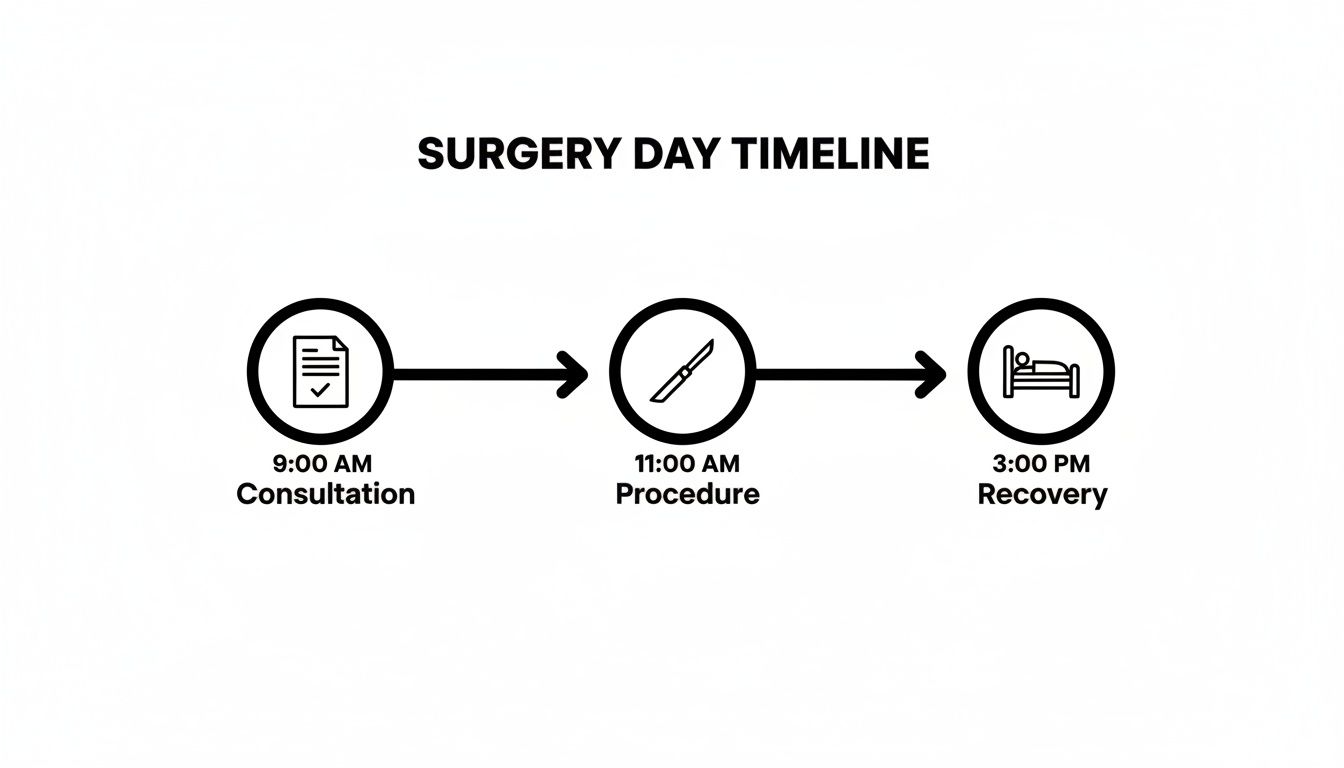
As you can see, the procedure is a well-structured event. We make sure you have a safe and comfortable transition to head home and begin healing.
The first 7 days are all about rest and gentle care. Your main job is to manage discomfort with the medication we provide and get plenty of sleep. You’ll be wearing a compression garment around the clock, which is absolutely essential for controlling swelling and supporting your healing tissues.
Expect to feel sore, swollen, and bruised. That’s a completely normal part of the process. We encourage you to take short, slow walks around the house to promote circulation, but any bending, lifting, or strenuous activity is strictly off-limits. If you have surgical drains, we'll give you clear instructions on how to care for them.
During this time, you’ll start to feel much more like yourself. Swelling and bruising will noticeably fade, and you'll likely be able to switch from prescription pain medication to over-the-counter options if needed.
Most of our patients with desk jobs feel comfortable returning to work after about 10 to 14 days. If your job is more physically demanding, you'll definitely need more time. You’ll continue wearing your compression garment, though Dr. Fater may clear you to take it off for short periods. Light activity is great, but you must continue to avoid heavy lifting and intense exercise.
A crucial takeaway for this stage is to listen to your body. Pushing yourself too hard, too soon, can set back your recovery. The key to a smooth, complication-free healing period is to gradually re-engage with your daily routine.
For a deeper dive, you can get more details from our comprehensive liposuction recovery timeline, which shares many similarities with this combined procedure.
After the first month, a good amount of the swelling will have gone down, giving you a much clearer glimpse of your new abdominal contour. Around the six-week mark, most patients get the green light to gradually resume their full exercise routines—even core workouts.
It's important to know that some minor, residual swelling can linger for 3 to 6 months. Your final, refined results will become fully apparent as this last bit of swelling resolves. During this time, your incision line will continue to mature and fade. Protecting your scar from the sun is critical to help it become as light and flat as possible over the next year. Patience is key as your body completes its healing journey, revealing the smooth, firm contour you’ve been waiting for.
Making an informed choice is everything when it comes to plastic surgery. So, when you're thinking about a combined liposuction and mini tummy tuck, it's vital to have a realistic, 360-degree view. You need to know what this procedure can do, what it can't, and what's involved. For the right person, the results can be fantastic, but matching your expectations to the actual outcome is the key to being happy with your new look.
The biggest win? A beautifully contoured lower abdomen. By removing stubborn fat and tightening up that little bit of loose skin at the same time, we can create a flat, firm result that just looks natural. It’s the perfect one-two punch for tackling that persistent "pooch" that just won’t budge, no matter how much you diet or exercise.
The appeal of this combination procedure is pretty clear, especially when you stack it up against more involved surgeries. Here’s what you can look forward to:
Mini tummy tucks are definitely having a moment, and for good reason. People are drawn to the smaller incisions, the less complex surgery, and the faster recovery times. When you add liposuction into the mix, you get that extra bit of sculpting for a truly defined look. If you're interested in the trends, you can get more details on cosmetic surgery statistics here.
Let's be clear: every surgery has risks. A mini tummy tuck with liposuction is no exception. The most important step you can take to protect yourself is choosing a board-certified plastic surgeon, like Dr. Fater, who operates in a fully accredited facility. This one decision dramatically lowers your chances of running into any issues.
While they aren’t common, potential risks can include:
When you come in for your consultation, Dr. Fater will walk you through all of these possibilities. He'll be completely open about the risks and explain the exact safety measures we take to make your procedure as safe as it can possibly be.
This might be the most important part of the conversation. A great result starts with knowing what a procedure is not designed to do. Managing expectations is truly the secret to patient happiness.
A liposuction and mini tummy tuck is a contouring procedure, not a weight-loss tool. It’s for fine-tuning your shape, not for a major overhaul.
Keep these key limitations front and center:
By understanding these boundaries from the get-go, you can decide with confidence whether this is the right path for you and your aesthetic goals.

When it comes to a liposuction and mini tummy tuck, the single most important decision you'll make isn't about the procedure itself—it's about who you trust to perform it. This is where art truly meets science. Getting a natural, beautiful result requires more than just technical skill; it demands a deep understanding of human anatomy and an artist's eye for contour and proportion.
Your surgeon's experience is the biggest factor influencing not just how you'll look, but how safe you'll be every step of the way. An experienced, board-certified plastic surgeon has spent thousands of hours in the operating room, honing their craft. It's that seasoned expertise that elevates an outcome from just "good" to truly exceptional. They know how to read the unique landscape of each patient's body and adapt their approach to create a result that looks like it belongs to you.
Board certification is more than a credential hanging on a wall. It's your assurance that a surgeon has gone through intense, specialized training and is committed to the highest standards of safety and patient care. It means they've mastered incredibly complex procedures and are dedicated to staying on top of the latest, most effective techniques.
At Cape Cod Plastic Surgery, Dr. Fater’s decades of experience mean he doesn't just follow a textbook. He tailors every liposuction and mini tummy tuck to the individual, sculpting a final contour that's not only flattering but uniquely your own.
Liposuction is one of the most popular surgical procedures in the world for a reason. In fact, the plastic surgery market is on track to hit around $83 billion by 2034, with liposuction being a major contributor. Its popularity makes it even more critical to find a surgeon with proven mastery. If you're curious about the numbers, you can discover more insights about global plastic surgery statistics on MadisonPS.com.
The "where" of your surgery is just as important as the "who." A practice that has its own fully accredited surgical suite, like we do here at Cape Cod Plastic Surgery, offers a huge advantage. It means our facility meets the same rigorous, hospital-level standards for safety, equipment, and staff.
Having everything under one roof provides a much better experience:
Choosing a local practice that combines deep expertise with a long-standing reputation in the community gives you confidence from start to finish. We invite you to schedule a one-on-one consultation to talk about your goals and find out if this is the right path for you.
It's completely normal to have a lot of questions when you're considering a procedure like a liposuction and mini tummy tuck. To help, I've put together some straightforward answers to the questions my patients ask me most often.
This is usually the first question people ask, and the honest answer is: it depends. There isn't a simple, one-size-fits-all price tag. The final cost is actually a combination of a few key factors: my fee as your surgeon, the operating room fee, and the cost for anesthesia.
What really shapes the price, though, is your specific surgical plan. The amount of liposuction you need and the degree of skin tightening required are unique to you. That's why the in-person consultation with me is so important. It’s my chance to understand your anatomy and your goals, which allows me to give you a clear, all-inclusive price with no surprises.
Yes, any procedure that involves an incision will leave a scar. The key, however, is where we place it and how we care for it. The scar from a mini tummy tuck is a thin, horizontal line that I place very low on the abdomen—usually right along the bikini line, similar in placement to a C-section scar.
Over the months following your surgery, that scar will mature and fade quite a bit. I’ll give you very specific instructions on how to care for it, often recommending things like silicone sheets or gels to help it heal as flat and light as possible. With proper care, most of my patients find their scar is easily hidden by just about any underwear or swimsuit.
It helps to think of the mini tummy tuck as a targeted fix, while the full tummy tuck is a more comprehensive overhaul. The biggest differences come down to the scope of the procedure, the length of the incision, and how long recovery takes.
A liposuction and mini tummy tuck is all about addressing the lower abdomen—that area below the belly button. In contrast, a full tummy tuck tackles the entire abdominal area, both above and below the navel.
The easiest way to remember the difference is to focus on the belly button. With a mini tummy tuck, your belly button stays exactly where it is. With a full tummy tuck, I make an incision around it to reposition it after tightening the skin of the upper abdomen.
Here’s a quick side-by-side look:
The results you get can absolutely last a lifetime, but it comes with a condition: maintaining a stable weight. The fat cells we remove with liposuction are gone permanently, and the tightened skin won't just reappear.
However, the procedure doesn't make you immune to the effects of future weight gain. Gaining a significant amount of weight or a future pregnancy can stretch the skin and muscles all over again, which could undo some of the great results we achieved. The best way to protect your investment in yourself is to stick with a healthy diet and a regular exercise routine. Think of this procedure as the final, sculpting touch on all your hard work, not a replacement for it.
Ready to see what a personalized body contouring plan could do for you? Here at Cape Cod Plastic Surgery, my team and I are ready to walk you through every step. Schedule your consultation today to get started.
September 9, 2026
Expert Guide to Proper Surgical Incision Care

Master dermal fillers aftercare with do's and don'ts, swelling tips, activity limits and warning signs to protect your results and heal smoothly.

September 8, 2026
Ensuring Safety: Why Your Surgeon's Credentials Matter Most

Cape Cod Plastic Surgery offers expert cosmetic and reconstructive procedures in a safe, accredited setting. Led by Dr. Marc Fater, we combine advanced techniques with personalized care to help you look and feel your best.
Monday: 9:00 AM – 5:00 PM
Tuesday: 9:00 AM – 5:00 PM
Wednesday: 9:00 AM – 5:00 PM
Thursday: 9:00 AM – 5:00 PM
Friday: 9:00 AM – 5:00 PM