

October 7, 2026
What to Expect During Your Breast Surgery Recovery
A Practical Guide to Healing After Breast Surgery
Mar 7, 2026

When you're looking at microneedling vs. laser treatment, it’s easy to get bogged down in the technical details. The main difference really comes down to the tool used: one uses ultra-fine needles, the other uses focused light. Both are fantastic at stimulating new collagen and rejuvenating your skin, but they get there in completely different ways.
So, how do you decide which is right for you? It really boils down to your primary skin concerns, how much downtime you can handle, and your budget.
Choosing between these two powerhouse treatments doesn't have to be complicated. Let's break down the key differences to give you a clear starting point. While both can dramatically improve your skin's appearance, their distinct methods make them better suited for different goals.
This high-level look will help you see which path aligns best with your needs before we dive deeper into the specifics of each procedure.
For most of our patients, the choice hinges on the severity of their concern and the recovery time their lifestyle allows.
Microneedling is a fantastic workhorse for broad improvements. It's our go-to for refining overall skin texture, shrinking the appearance of pores, and softening many types of acne scars. Its biggest advantage for many is the minimal downtime—usually just 1-3 days of redness, almost like a mild sunburn.
Laser treatments, on the other hand, offer a more powerful and targeted approach. Lasers truly shine when we need to correct specific issues with precision, like significant sun damage, deeper wrinkles, and stubborn spots of hyperpigmentation. This power can mean a longer recovery, especially with the more intensive ablative lasers.
Think of it this way: Microneedling is like a comprehensive tune-up for your skin's surface, improving overall tone and texture with very little interruption to your daily life. Laser therapy is more like a specialist, called in to perform a precise and powerful repair on more advanced concerns.
For a quick side-by-side view, this decision guide is a great place to start.
Use this table for a fast, at-a-glance comparison to see which treatment better suits your primary concerns and lifestyle.
This table gives you a solid snapshot, but the best decision always comes from a personalized consultation where we can assess your unique skin.
When you're weighing microneedling vs. laser treatment, it helps to know exactly what’s happening beneath the surface. While both are fantastic for kickstarting collagen, they get there in completely different ways. One is mechanical, and the other is based on light energy.
Getting a handle on the "how" is the first step. It’s what allows a skilled clinician to confidently recommend one treatment over the other for your specific goals, whether that’s softening fine lines, tackling deep-set acne scars, or evening out your skin tone.
At its core, microneedling works through a process called controlled micro-injury. We use a specialized tool with dozens of sterile, hair-thin needles to create thousands of minuscule punctures across the skin. It sounds intense, but it’s incredibly precise.
Your body immediately perceives these tiny channels as injuries that need fixing, which activates its powerful, natural healing abilities. This response delivers two key benefits:
Because microneedling is mechanical and doesn't rely on heat, the risk of triggering post-inflammatory hyperpigmentation is much lower. This is a huge advantage, making it a go-to choice for a wide variety of skin tones, especially darker complexions that can be more reactive to heat-based treatments.
We've seen this technique get even better with the addition of radiofrequency (RF). Systems like Genius® RF Microneedling combine the classic micro-injuries with controlled heat for a powerful one-two punch.
As the needles enter the dermis, they deliver a pulse of radiofrequency energy. This gentle heat gives the collagen-building process an extra boost, resulting in more significant skin tightening and textural improvements than you’d get from microneedling alone. You can learn more about how this powerful combination works to remodel skin from within at https://www.ccplasticsurgery.com/non-invasive-procedures-service/genius-microneedling.
Laser treatments use a completely different tool: focused beams of light. The biggest differentiator here is whether the laser is "ablative" or "non-ablative," which really just dictates the treatment's intensity and how much downtime you can expect.
Non-Ablative Lasers: Think of these as the gentler approach. They work by heating the tissue deep in the dermis to trigger collagen growth without ever breaking the skin's surface. Since the top layer of skin stays intact, recovery is usually quick—just a bit of redness for a few days.
Ablative Lasers: For more dramatic results, we turn to ablative lasers like the CO2. These are more intensive, working by vaporizing the outermost layer of skin (the epidermis) while also heating the underlying dermis. This removes damaged surface cells and forces a major healing response, leading to incredible improvements in wrinkles and scars. The trade-off, of course, is a longer recovery period.
Some people also look into complementary products like the Life Force Anti Aging Skin Rejuvenator as part of their broader skin health plan. By understanding how all these different tools work, you and your provider can put together the perfect strategy for your unique skin.
Let's be realistic—how much downtime can you actually afford? For many of our patients, this is the single most important question when weighing microneedling against laser treatments. The answer often comes down to your personal and professional schedule, and the difference between these two options is significant.
With microneedling, the healing process is incredibly quick. Most people just look a little pink and feel sensitive for 1-3 days, much like a mild sunburn. This is why we often call it a "weekend procedure." You can have it done on a Friday and be back to your routine by Monday morning with no one the wiser.
It really helps to walk through what the days following your treatment will look like. Do you need to clear your calendar, or can you get right back to it?
Microneedling Scenario: You come in for a session on a Friday afternoon. By Saturday, your skin might be a bit flushed and feel tight. By the time you wake up Monday, that redness has almost completely vanished, and any lingering pinkness is easily covered with a bit of makeup.
Non-Ablative Laser Scenario: After a Friday treatment, expect more noticeable redness and some swelling that lasts through the weekend. This "sunburn" look can hang around for several days, and you might feel a little self-conscious on video calls for most of the following week.
The core difference lies in how the skin heals. Microneedling creates a purely physical injury, so the redness resolves quickly and predictably. Lasers, on the other hand, introduce heat, and that thermal effect can lead to redness and swelling that lingers for quite a bit longer.
Laser treatments aren't all the same, and neither is their recovery. The intensity of the laser directly dictates your downtime, creating a huge range of experiences. For instance, non-ablative lasers work by heating the tissue under the skin without breaking the surface, which typically means about a week of recovery.
Ablative lasers are in a completely different league. These are much more intensive treatments that remove the outer layer of skin, requiring a serious healing commitment. This is where the contrast between microneedling and lasers becomes crystal clear. While microneedling’s side effects are mild and fade fast, even a fractional ablative laser requires 1-3 weeks of healing, complete with crusting and peeling. A fully ablative laser demands an even longer recovery with raw, weeping skin.
Thinking through these real-world scenarios is crucial. It ensures you choose a treatment that not only gives you the beautiful skin you want but also respects the very real demands of your life. You can discover more insights about these recovery timelines and what they might mean for you on our site.
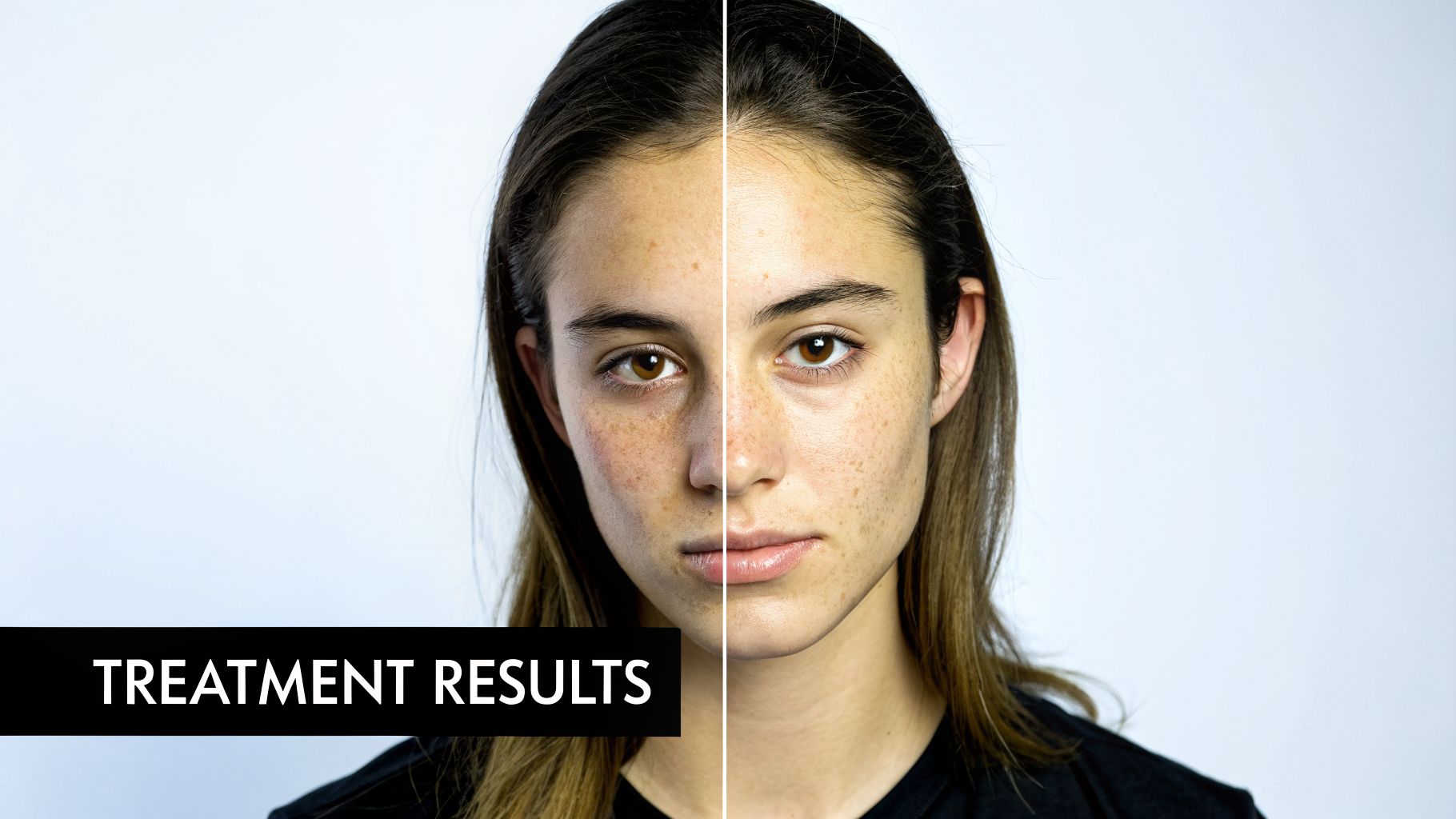
When patients ask me whether microneedling or a laser treatment is "better," my answer is always the same: it’s not about the device, it's about your skin. The best results come from matching the right tool to your specific aesthetic goals and skin condition.
The first step in any effective treatment plan is figuring out exactly what we're trying to fix. Are we dealing with fine texture and pore size, or are we targeting deep-set sun damage and wrinkles? The answer points us in the right direction.
For anyone looking to improve the overall quality of their skin—smoothing out texture, minimizing pores, and softening those first fine lines—microneedling is a fantastic starting point. It works by creating thousands of tiny, controlled injuries that kickstart a widespread healing response, refreshing the skin's entire canvas.
This makes it an ideal choice for a global improvement in radiance and smoothness. The results build gradually over a series of sessions, leaving you with a complexion that looks and feels healthier and more refined.
That said, non-ablative lasers can also be excellent for fine lines and texture. A gentle, fractionated treatment like the MOXI laser uses light energy to boost collagen and even out skin tone with very little downtime. It’s a great alternative if you prefer a light-based approach. You can get a better sense of the experience in our guide on what to expect from a MOXI laser treatment.
When we’re facing more advanced concerns, like deep static wrinkles (the ones you see even when your face is perfectly still) or significant sun damage, we often need to bring in more powerful tools. This is where aggressive lasers, particularly ablative ones like the CO2 laser, really shine.
These lasers work by vaporizing the damaged, outermost layers of skin while delivering powerful heat deep into the dermis. This triggers a massive collagen remodeling process that can dramatically smooth out deep-set wrinkles and correct severe textural problems. It's an intensive approach, and it requires more downtime, but the results can be truly remarkable.
Key Takeaway: Think of microneedling as a way to "airbrush" the skin, improving overall texture and health from the inside out. In contrast, ablative lasers are the precision tools we use to resurface the skin, effectively sanding down deep-seated damage and lines.
Acne scars are tricky because they come in different shapes and depths. Choosing the right treatment depends entirely on the type of scar we're looking at.
Rolling Scars: These are shallow, wide depressions with soft edges. Microneedling is often my go-to for these, as the needles effectively break up the fibrous bands pulling the skin down. The new collagen that forms then helps lift the depression from underneath.
Boxcar and Ice Pick Scars: These scars have sharper, more defined edges and can be quite deep. While microneedling can certainly help soften them, ablative fractional lasers tend to deliver a more significant improvement. The laser's energy can precisely vaporize the scar's sharp "shoulders" and trigger a more profound collagen response to level out the skin.
Clinical studies back this up. For more severe acne scarring, these clinical findings on NCBI show that fractional CO2 lasers often outperform microneedling because of their ability to achieve much more significant scar remodeling.
This is one of the most important distinctions between the two treatments. Because microneedling is a purely mechanical process—it doesn't use light or heat—it is exceptionally safe for darker skin types (Fitzpatrick IV-VI). The risk of triggering post-inflammatory hyperpigmentation (PIH), or dark spots, is significantly lower.
Many lasers, especially older ablative models, rely on light energy that is absorbed by melanin (the pigment in our skin). In darker skin tones, this can create an unintended reaction and lead to discoloration. Thankfully, modern laser technology has come a long way, and newer devices are designed to be much safer for a wider range of skin tones, delivering great results with a much better safety profile.
Let’s be honest, budget is a huge factor when deciding on any cosmetic procedure. When you’re weighing microneedling against laser treatments, it’s easy to get sticker shock from one and feel relief with the other. But the true cost isn't just about a single session's price tag.
To really understand the investment, you have to look at the total cost to get the results you want and consider what makes the most sense for your skin in the long run.
On the surface, the numbers seem pretty clear. Microneedling has a much lower cost of entry, while powerful laser treatments require a bigger upfront investment. This is mainly due to the advanced technology and intensive training required for laser procedures.
Here’s a typical breakdown of what you can expect:
As you can see, the total financial commitment can vary dramatically. You can discover more insights about these cost structures to help plan your aesthetic journey.
For many of our patients, the ability to spread the total cost of microneedling over several months is a major plus. It makes budgeting for a full treatment course feel much more manageable.
The best "value" isn't always the cheapest option. It's the treatment that gives you the results you want in the most efficient and lasting way. Sometimes, that means investing more upfront.
For example, if you're dealing with deep, stubborn sun damage or significant acne scarring, one or two ablative laser sessions might give you a far more dramatic and definitive result than half a dozen microneedling treatments. In that case, the laser is the better long-term value.
On the other hand, if your goal is to boost collagen, refine texture, and just keep your skin looking fresh and healthy, a consistent series of microneedling sessions is an incredibly effective and cost-efficient strategy for long-term maintenance.
Ultimately, this is an investment in your skin's health and your confidence. During your consultation, we'll talk openly about all the costs involved and map out a plan that works for your skin, your goals, and your budget.
At the end of the day, the choice between microneedling and laser treatments isn't just about the technology. It’s about you. Your specific skin goals, your budget, how much downtime you can handle, and your skin type all play a huge role. Understanding where you stand on these points is the first step, but the most critical decision comes next: finding the right person to perform your treatment.
The success of any skin procedure, whether it’s a series of gentle microneedling sessions or a more intensive laser resurfacing, truly rests in the hands of the practitioner. A great provider isn’t just an operator. They’re a diagnostician who can accurately assess your skin and build a plan that delivers beautiful, natural-looking results safely.
This simple guide can help frame your initial thinking by connecting common goals with their typical price points.
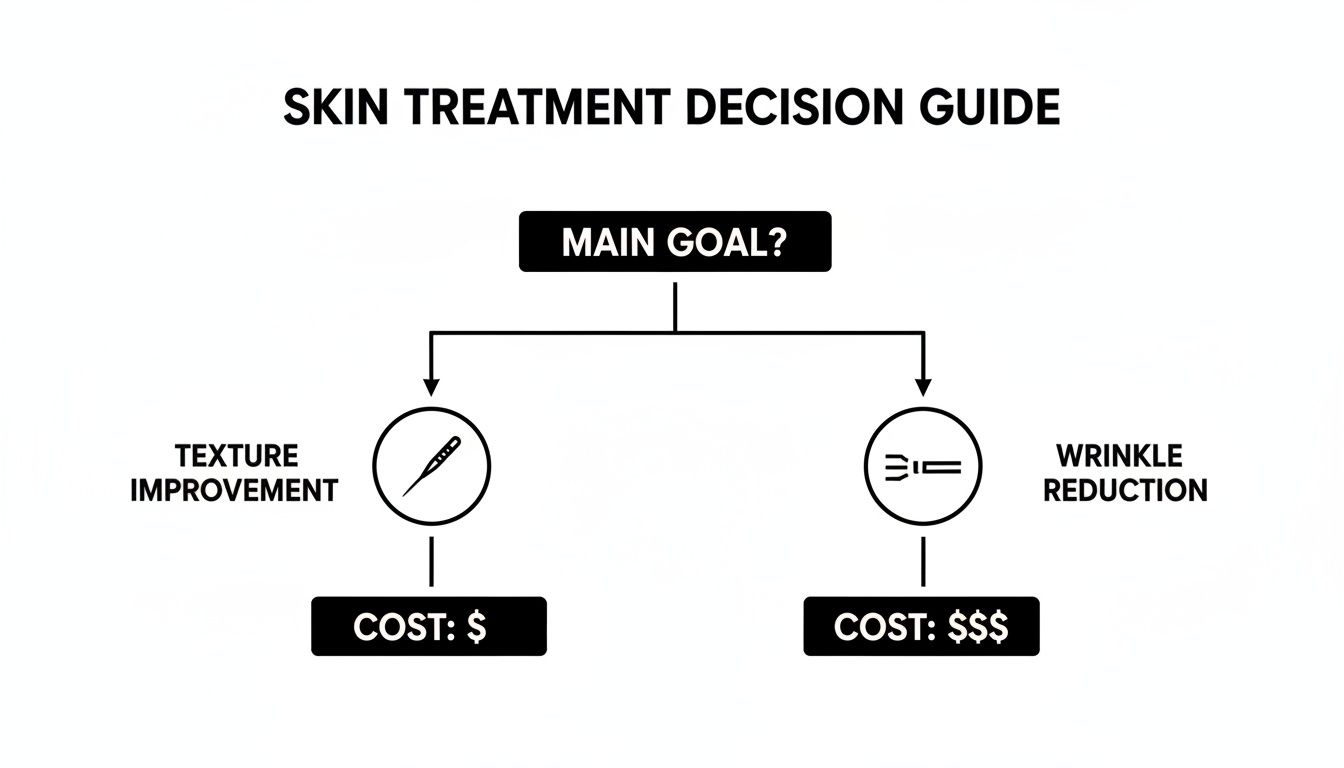
As you can see, microneedling often provides an accessible path for improving texture, while lasers are a bigger investment for tackling more significant wrinkles and sun damage.
Think of it this way: the device is just a tool. It's the clinician's expertise—their ability to correctly read your skin and fine-tune the treatment parameters—that makes all the difference. An experienced professional knows exactly which tool to use for the job. More importantly, they know when a certain treatment is the wrong choice for a patient.
This is precisely why a formal consultation is so non-negotiable. It’s your chance to get a professional evaluation and have a real conversation about what you hope to achieve.
A consultation is where the abstract debate of microneedling vs. laser treatment becomes a concrete, personalized plan. This is the moment when general information turns into your specific path forward.
When you start looking for a provider, put qualifications and deep experience at the top of your list. You want to see a board-certified plastic surgeon or dermatologist who specializes in aesthetic skin procedures. Their advanced knowledge of facial anatomy and skin health is essential for both your safety and your final results.
During a proper consultation, a qualified expert will:
This collaborative approach is the hallmark of excellent care. If you're looking for more guidance, our article on how to choose the right plastic surgeon offers some great practical advice for making this vital decision.
When you're weighing your options between microneedling and lasers, a few key questions always come up. Here are some straightforward answers based on what we see in our practice every day.
Let’s be honest, this is often the first thing people want to know. The good news is, we take comfort seriously. For both treatments, we start by applying a topical numbing cream to make the experience as comfortable as possible.
Most of our patients find microneedling quite tolerable, describing it as a light vibrating or gentle sanding sensation. Lasers, on the other hand, are commonly compared to a quick rubber band snap against the skin. The feeling is fleeting, but it's there. It's also worth noting that the intensity varies—a gentle, non-ablative laser feels very different from a more powerful, corrective ablative laser.
Absolutely. In fact, combining these treatments is one of our favorite strategies for achieving truly remarkable, well-rounded results. An experienced clinician can design a long-term plan that alternates between the two, playing to the strengths of each technology.
For instance, we might use a laser to go after stubborn pigmentation and deep-set sun damage first. Then, in later appointments, we can use microneedling to work on overall texture, shrink pores, and build that beautiful, uniform firmness. It's a one-two punch for total skin rejuvenation.
By combining treatments, you really do get the best of both worlds. The laser provides targeted correction for specific issues, while microneedling enhances the skin’s overall quality and resilience.
The results from both treatments can be quite long-lasting, but nothing is truly permanent. Your skin will continue its natural aging process, and life happens. The good news is the new collagen your body built in response to the treatment can keep your skin looking great for many months, sometimes even for years.
To protect your investment, a solid at-home skincare routine is non-negotiable, and the single most important part of that is daily, broad-spectrum sunscreen. Many patients also find that scheduling a maintenance treatment—maybe one or two microneedling sessions a year—is a great way to keep their results looking fresh.
Ready to find out which treatment is the perfect fit for your unique skin? At Cape Cod Plastic Surgery, Dr. Marc Fater and our expert team are here to guide you. Schedule your personalized consultation today to create a plan that aligns with your aesthetic goals. Visit us at https://ccplasticsurgery.com to get started.
October 7, 2026
A Practical Guide to Healing After Breast Surgery

October 6, 2026
Your Safety Guide: What to Look for When Choosing a Plastic Surgeon
October 5, 2026
Why Our On-Site Accredited Facility Matters for Your Safety

Cape Cod Plastic Surgery offers expert cosmetic and reconstructive procedures in a safe, accredited setting. Led by Dr. Marc Fater, we combine advanced techniques with personalized care to help you look and feel your best.
Monday: 9:00 AM – 5:00 PM
Tuesday: 9:00 AM – 5:00 PM
Wednesday: 9:00 AM – 5:00 PM
Thursday: 9:00 AM – 5:00 PM
Friday: 9:00 AM – 5:00 PM