

October 7, 2026
What to Expect During Your Breast Surgery Recovery
A Practical Guide to Healing After Breast Surgery
Jun 5, 2026
Brow bone reduction in the United States usually costs $12,000 to $20,000. That range often includes the surgeon's fee, anesthesia, and facility costs, and the final number varies based on the complexity of the surgery and the experience level behind it.
If you're researching brow bone reduction cost right now, you're probably trying to answer two questions at once. First, what will this cost me? Second, what am I paying for beyond the obvious fact that it's surgery?
That second question matters more than most patients realize. Brow bone reduction isn't a medspa treatment or a simple office procedure. It's facial bone surgery. The quote reflects far more than time in an operating room. It reflects planning, judgment, anesthesia support, the standards of the surgical facility, and the skill required to reshape a prominent brow safely while protecting the surrounding anatomy.
A good financial decision in cosmetic surgery isn't always the lowest quote. It's the quote that makes sense once you understand what's included, what isn't, and where cutting cost can create avoidable risk.
Cost is often the first concern patients bring up, and that's reasonable. Patients don't begin this process with a perfect understanding of how facial contouring is priced. They start with a goal. They want a softer forehead contour, a less prominent brow ridge, or a face that feels more balanced in profile and from the front.

The mistake I see most often is treating all quotes as if they describe the same operation. They don't. Two patients may both ask for brow bone reduction, but one may need limited contouring while another needs more extensive frontal bone reshaping. Those are different procedures with different demands on the surgeon, anesthesia team, and facility.
Before scheduling a consultation, individuals often try to sort out a few practical points:
A useful way to think about brow bone reduction cost is this. You're not buying a product off a shelf. You're paying for a carefully planned medical procedure with permanent structural changes.
A reliable quote should match the reality of the procedure. It should account for the surgeon's training, the setting where surgery is performed, and the fact that recovery support matters. If a number seems unusually low, the right question isn't “How did they get such a deal?” It's “What has been excluded?”
Patients usually feel more confident once the price is connected to concrete categories. That's where the discussion becomes much less abstract and much more useful.
The most helpful way to understand brow bone reduction cost is to stop looking at it as one mysterious number. Think of it the way you'd think about building a custom home. You're not paying only for the finished exterior. You're paying for the architect's judgment, the materials, the skilled labor, the site, and the systems that make the structure safe.
In the United States, brow bone reduction surgery is commonly priced at about $12,000 to $20,000, and that figure usually bundles the surgeon's fee, anesthesia, and facility costs, according to this brow bone reduction cost overview. At the upper end of that range, patients are often paying for a highly experienced surgeon and a top-tier surgical facility.
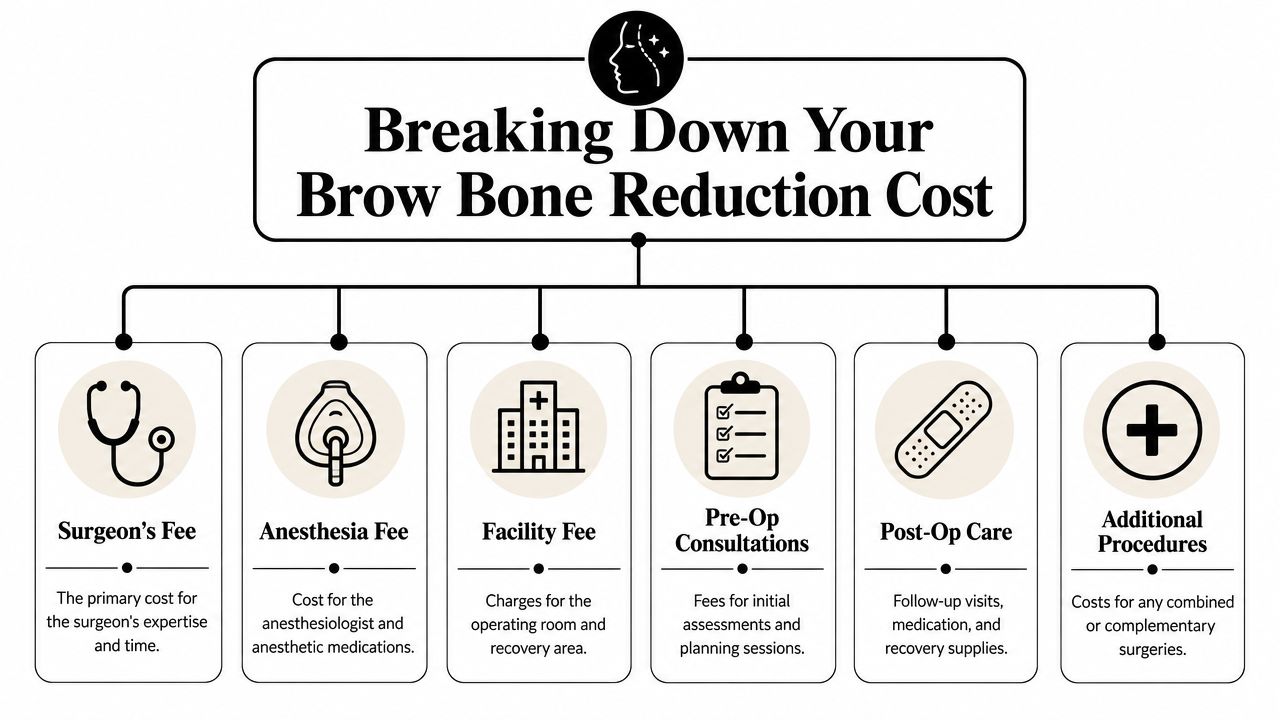
Here's what usually makes up the total:
Not every practice bundles these items the same way. Some present a more inclusive quote. Others separate categories. That's why patients shouldn't compare totals without asking what the number includes.
A short visual overview can make that easier to grasp:
Many patients focus on the surgical quote and forget the surrounding expenses. If you're comparing facial procedures more broadly, it can help to contrast major surgery with the lower entry point of non-surgical care such as the cost of skin treatments. They occupy very different categories of treatment, which is why direct price comparisons can be misleading.
The same issue comes up when people compare one cosmetic surgery estimate to another without looking at scope. A useful reference for how practices discuss bundled and itemized pricing is this guide to cosmetic surgery cost.
Practical rule: Ask for the quote in writing and ask what would cause it to change. A clear answer usually tells you a lot about how carefully a practice plans surgery.
The strongest quotes are transparent. They show you where the money is going, and they tie each cost to safety, judgment, and the quality of care rather than to marketing language.
Two patients can ask for the same outcome and receive very different quotes. That isn't automatically a red flag. With brow bone reduction, price changes because the operation itself may be very different from one person to the next.
The biggest drivers are case complexity and region. One international comparison places brow bone reduction at about $3,000 to $4,000 in Iran, while another benchmark starts at roughly €7,200 in the United Kingdom, with major U.S. markets often higher, as noted in this international brow bone reduction pricing comparison. Those differences reflect overhead, surgeon fees, anesthesia costs, and the surgical technique required.
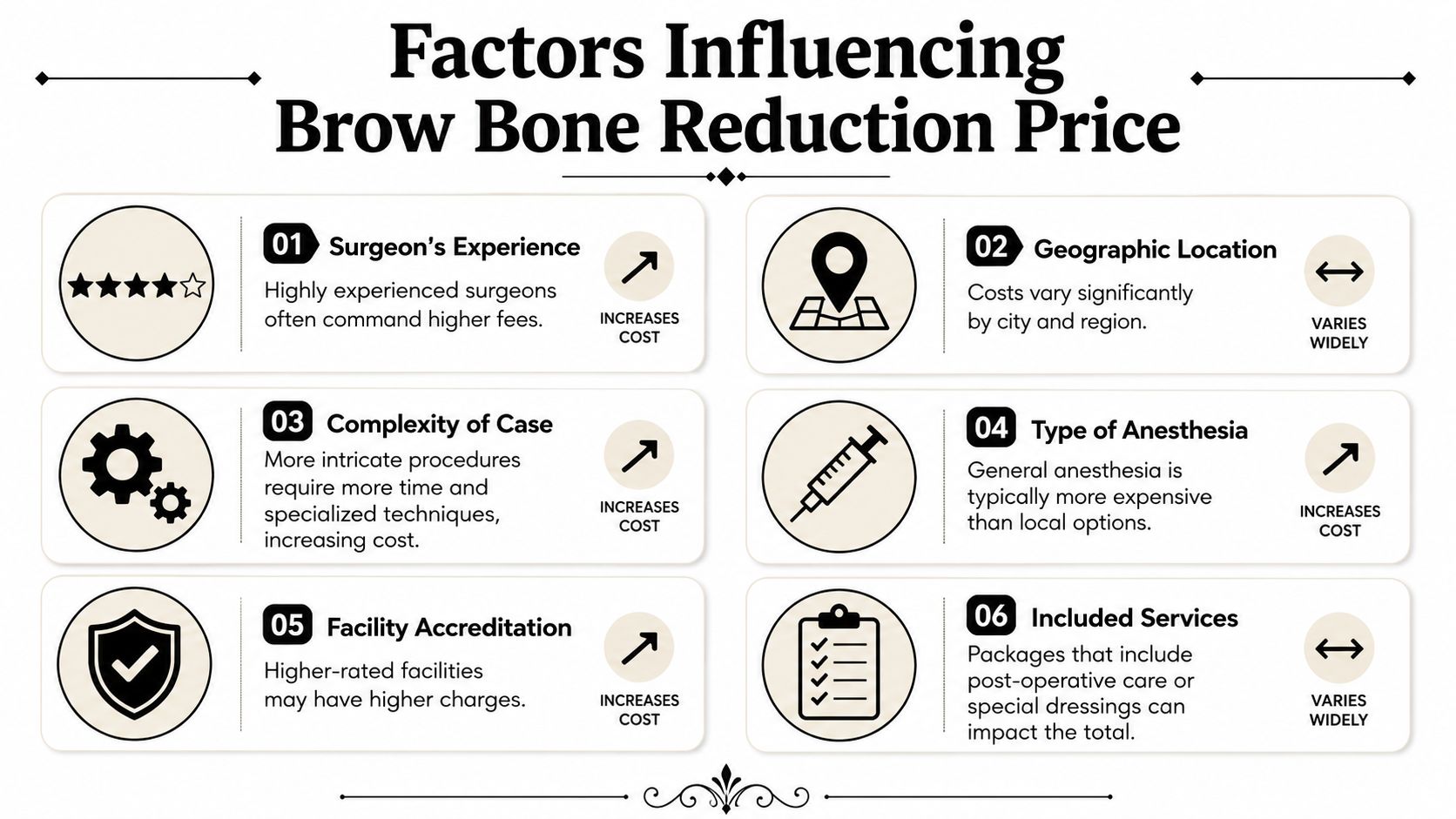
Brow bone reduction isn't one uniform operation. Some patients need limited contouring. Others need more extensive reshaping of the frontal bone area. That difference affects surgical time, planning, and the degree of technical precision required.
A more involved case usually raises cost for straightforward reasons:
This is why the cheapest quote may not accurately reflect your anatomy. It may reflect a simpler version of the surgery than the one you genuinely need.
Experience matters more in facial bone surgery than patients sometimes assume. A surgeon who performs advanced facial contouring regularly may charge more because the fee reflects training, judgment, consistency, and the ability to handle complexity when anatomy doesn't follow the textbook.
That doesn't mean the highest fee is automatically the right one. It does mean that “lower price” and “same value” should never be assumed to mean the same thing.
A consultation should leave you with answers to questions like these:
| Question | Why it matters |
|---|---|
| Is this a limited contouring case or a more extensive reshaping case? | It helps explain the scope of surgery. |
| Is the quote for a standalone procedure? | Combined procedures can change the pricing structure. |
| Where is the surgery being performed? | Facility standards influence both cost and safety. |
If the consultation never gets specific about anatomy, the quote probably isn't specific enough either.
Region changes price because every part of surgery has a local cost base. Surgeon fees, facility overhead, staffing, and anesthesia costs aren't the same from one market to another. Internationally, that gap can be dramatic. Even within the same broad category of facial surgery, pricing also changes when brow bone reduction is performed alone versus combined with other forehead or facial feminization procedures.
For some patients, bundling procedures makes sense because it consolidates anesthesia exposure and recovery. For others, it creates a bigger financial commitment than they need. The right answer depends on anatomy, goals, and tolerance for downtime, not just on whether a package appears more efficient at first glance.
Most patients should assume that brow bone reduction for aesthetic purposes is an elective procedure. In practical terms, that means you'll usually be planning for out-of-pocket payment unless your situation is being handled under a very specific reconstructive or medically documented pathway.
That reality can feel discouraging at first, but it often becomes manageable once the numbers are organized around a timeline rather than treated as a single immediate hurdle.
Practices often discuss several paths for covering the cost:
If you're looking into practical budgeting, this guide on how to finance cosmetic surgery is a useful starting point for the questions to ask before committing.
Patients sometimes ask whether fillers can create a similar effect. In select situations, filler can change how the upper face reads by adding volume around nearby areas to soften contrast. But it doesn't reduce bone. It doesn't permanently flatten a prominent brow ridge. It works by camouflage, not structural correction.
That distinction matters because temporary treatments can still have value, but they answer a different problem. Someone seeking a true change in brow projection usually wants a permanent structural result.
A broader look at advanced anti-aging facial solutions can help if you're also comparing resurfacing, skin-quality treatments, and other facial investments that address texture or aging rather than bone contour.
Temporary treatments can improve the surface or shift visual balance. They can't substitute for bone surgery when bone projection is the core concern.
The most effective financial strategy is honesty about your goal. If you want a permanent reduction in brow prominence, repeated spending on treatments that can't produce that outcome often becomes frustrating. Patients are usually happier when they separate two questions clearly: “What can improve appearance for now?” and “What will solve the structural issue?”
That's where a detailed consultation is worth more than a price sheet alone.
The most important decision in brow bone reduction isn't the date on the calendar. It's the surgeon you trust with your face.
Price matters, but facial contouring is not a category where shopping by the lowest quote serves patients well. The right surgeon needs the training to evaluate bone structure, the judgment to recommend the correct scope of surgery, and the discipline to operate in a setting built for safety.

When patients compare surgeons, I recommend keeping the checklist simple and strict:
A consultation shouldn't feel like a sales presentation. It should feel like a medical assessment with aesthetic goals at the center.
Travel changes the budget more than many patients expect. Travel and lodging can add $1,000 to $3,000 for patients who need to go to a distant surgeon, as noted earlier in the pricing discussion. That means a lower quoted surgical fee elsewhere may not translate into a lower real total once flights, hotel stays, and the logistics of follow-up are added.
For patients weighing local versus out-of-town care, this guide on how to choose a surgeon is a practical framework for evaluating more than price alone.
At Cape Cod Plastic Surgery, patients meet with Dr. Marc Fater, a board-certified plastic surgeon with more than 30 years of experience, and the practice has an on-site AAAASF-accredited surgical suite. Those details matter because they directly affect two parts of the decision patients often underestimate: continuity of care and the safety standards behind the facility fee.
That's not a marketing detail. It's part of what the quote is purchasing. A qualified surgeon in an accredited surgical environment gives patients a clearer chain of responsibility from consultation through recovery.
The strongest value in surgery usually comes from alignment. The right surgeon, the right facility, and the right plan for your anatomy.
Patients should also pay attention to how a surgeon talks about outcomes. Good consultations don't promise perfection. They define what's achievable, what the trade-offs are, and what combination of technique and restraint will create a result that fits the rest of the face.
Brow bone reduction cost makes more sense once you stop treating it like a single sticker price. The real question isn't just how much surgery costs. It's what the fee includes, how well the plan matches your anatomy, and whether the team behind the procedure is protecting both your safety and your outcome.
Patients usually make better decisions when they focus on three things:
If you're still comparing options, that's a good sign. Thoughtful patients tend to do well because they ask better questions. They want to know what works, what doesn't, and what corners should never be cut.
Brow bone reduction is a meaningful investment because it's permanent structural surgery. Done well, it can bring the forehead and upper face into better balance and help your features feel more aligned with how you want to look. Done without enough planning, it can create disappointment that's much harder to fix than a high quote.
The next step should be personal, specific, and based on your anatomy rather than on averages. A consultation is where the financial side becomes real and useful. That's where you learn whether your goals call for limited contouring, more involved reshaping, or a broader discussion about related facial procedures.
If you're ready to discuss your options in a private, detailed consultation, Cape Cod Plastic Surgery offers a straightforward next step. You can review your goals with Dr. Marc Fater, talk through the surgical plan that fits your anatomy, and receive a personalized quote based on the scope of care you need.
October 7, 2026
A Practical Guide to Healing After Breast Surgery

October 6, 2026
Your Safety Guide: What to Look for When Choosing a Plastic Surgeon

October 5, 2026
Why Our On-Site Accredited Facility Matters for Your Safety

Cape Cod Plastic Surgery offers expert cosmetic and reconstructive procedures in a safe, accredited setting. Led by Dr. Marc Fater, we combine advanced techniques with personalized care to help you look and feel your best.
Monday: 9:00 AM – 5:00 PM
Tuesday: 9:00 AM – 5:00 PM
Wednesday: 9:00 AM – 5:00 PM
Thursday: 9:00 AM – 5:00 PM
Friday: 9:00 AM – 5:00 PM