

October 7, 2026
What to Expect During Your Breast Surgery Recovery
A Practical Guide to Healing After Breast Surgery
Jul 20, 2026

A lot of people first notice a protruding eye shape in a photo. Maybe you catch your reflection in side lighting, compare old selfies to new ones, or hear someone say your eyes look “bigger” than usual. That can trigger a very specific kind of worry. Are your eyes naturally prominent, or is something changing that needs medical attention?
That confusion is common because most content about protruding eye shape blurs together two very different things: a natural facial feature and a medical sign. The gap matters. A person can have naturally prominent eyes for years with no health problem at all. Another person can develop new bulging of one or both eyes and need prompt evaluation for thyroid eye disease, inflammation, infection, or another orbital problem. The MSD Manual discussion of bulging eyes reflects that distinction and why it matters in practice.
Some readers come to this topic because they want makeup advice. Others are trying to understand a diagnosis. Some are somewhere in the middle, wondering whether cosmetic treatments could help them feel more balanced and rested. All of those concerns are valid.
This guide takes the subject one step at a time. It separates appearance from pathology, explains the anatomy in plain language, walks through the diagnostic process, and compares medical, surgical, and aesthetic options. It also answers the question many patients are really asking: “Do I need reassurance, treatment, or both?”
A patient might say it like this: “My eyes have always been noticeable, but lately I can't tell if that's just my face or if something is off.” That sentence captures the heart of the issue.
Some people are born with eyes that sit a bit more forward. Their family members may share the same look. Their vision is fine, the appearance is stable, and the eye shape is part of their facial identity. In those cases, “prominent eyes” is often the better description.
Other people notice a change. One eye starts to look different from the other. The eyelids don't close the same way at night. Dryness, pressure, double vision, or a staring appearance shows up along with the visible prominence. That pattern belongs in a medical conversation, not just a beauty one.
The trouble is that online advice often mixes these situations together. A makeup tutorial may treat every forward-looking eye as a cosmetic issue. A medical article may describe every prominent eye as a symptom. The result is unnecessary anxiety for some readers and delayed care for others.
Practical rule: If your eye appearance has been stable for years, it may reflect anatomy. If it's new, worsening, uneven, or paired with vision symptoms, it needs evaluation.
Most questions fall into a few buckets:
That uncertainty makes sense. The eyes sit in a small space with important structures packed together, so a subtle outward shift can be either harmless anatomy or a clue to something deeper.
Think of the eye as a globe resting in a bony cup. That cup is the orbit. Inside it are muscles, fat, connective tissue, blood vessels, and the optic nerve. The fit is snug. If the contents of that space enlarge, or if the shape of the orbit is naturally shallow, the eye can appear more forward.
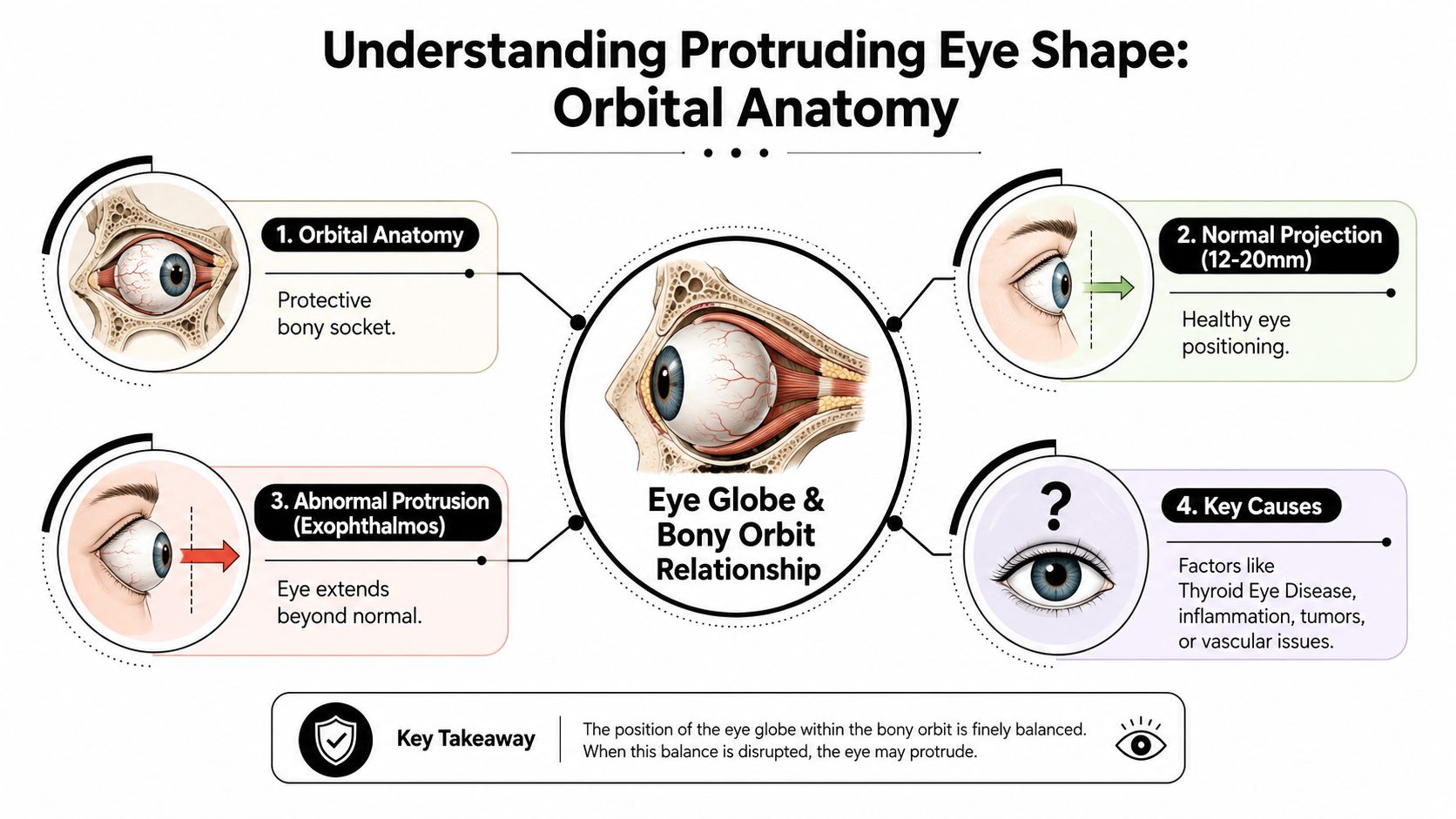
Clinically, normal eye projection usually falls within 12 to 20 millimeters from the edge of the bony socket. A forward displacement of 4 millimeters is the threshold at which most observers detect the abnormality, and projection beyond 21 millimeters from the orbital rim is formally quantified as proptosis, according to this PubMed indexed clinical review.
That sounds technical, but the idea is simple. There's a range of normal. Then there's a point where the eye is measurably too far forward to be explained by routine facial variation alone.
A naturally prominent eye shape can still fall within the normal range. The eye may look large or forward because of eyelid contour, brow shape, the depth of the socket, or inherited facial structure. A person can have this look their whole life.
Proptosis is different. It means the globe has shifted forward in a way that clinicians can measure. For people trying to picture it, compare two drawers in the same cabinet. One may naturally sit a little closer to the edge because of design. But if a drawer suddenly starts sticking out, something has changed behind it.
If you want a broader refresher on how bone, muscle, and soft tissue fit together, Natomy's complete anatomy guide gives a helpful general overview. For facial contour context around the lower orbit, this discussion of the bone under the eye can also help connect what you see externally to the underlying structure.
A naturally noticeable eye shape isn't automatically a disease. Change over time is the detail that often matters most.
A protruding eye shape can come from ordinary anatomy or from disease. The difference usually lies in timing, symmetry, and accompanying symptoms.
Some faces are built with shallower eye sockets or a softer brow projection, so the eyes look more forward. This can run in families. The look is often balanced on both sides and doesn't shift much over time.
A person with this anatomy may mainly notice cosmetic issues. Eye makeup can look stronger on the lid because there's more visible surface. Side-profile photos may emphasize the eye area. Contact lenses may feel more noticeable in windy conditions if the eyes are slightly more exposed.
In adults, the leading cause of protruding eyes is thyroid-associated eye disease, also called Graves' ophthalmopathy. It affects between 25% and 50% of individuals with Graves' disease, and in severe cases, orbital decompression and extraocular muscle repair can improve vision in up to 82% of patients, according to Medical News Today's reviewed summary.
That cause matters because thyroid eye disease doesn't just change appearance. It can create inflammation behind the eye, increase exposure of the cornea, limit eye movement, and in more serious situations threaten vision.
Other medical causes can include:
A simple way to think about risk is to ask three questions:
A long-standing, symmetrical appearance without symptoms is more reassuring. Sudden onset, marked asymmetry, pain, double vision, or reduced vision deserves prompt care.
New asymmetry usually raises more concern than a face that has always looked the same.
In children, the pattern is different from adults. Bilateral protrusion can point clinicians toward conditions such as leukemia or neuroblastoma, while unilateral protrusion often raises concern for orbital cellulitis. That's one reason pediatric eye prominence should never be brushed off as “just cosmetic” when it's new.
The evaluation starts with observation, but it doesn't stop there. Clinicians try to answer two separate questions: Is the eye displaced forward? And if so, why?
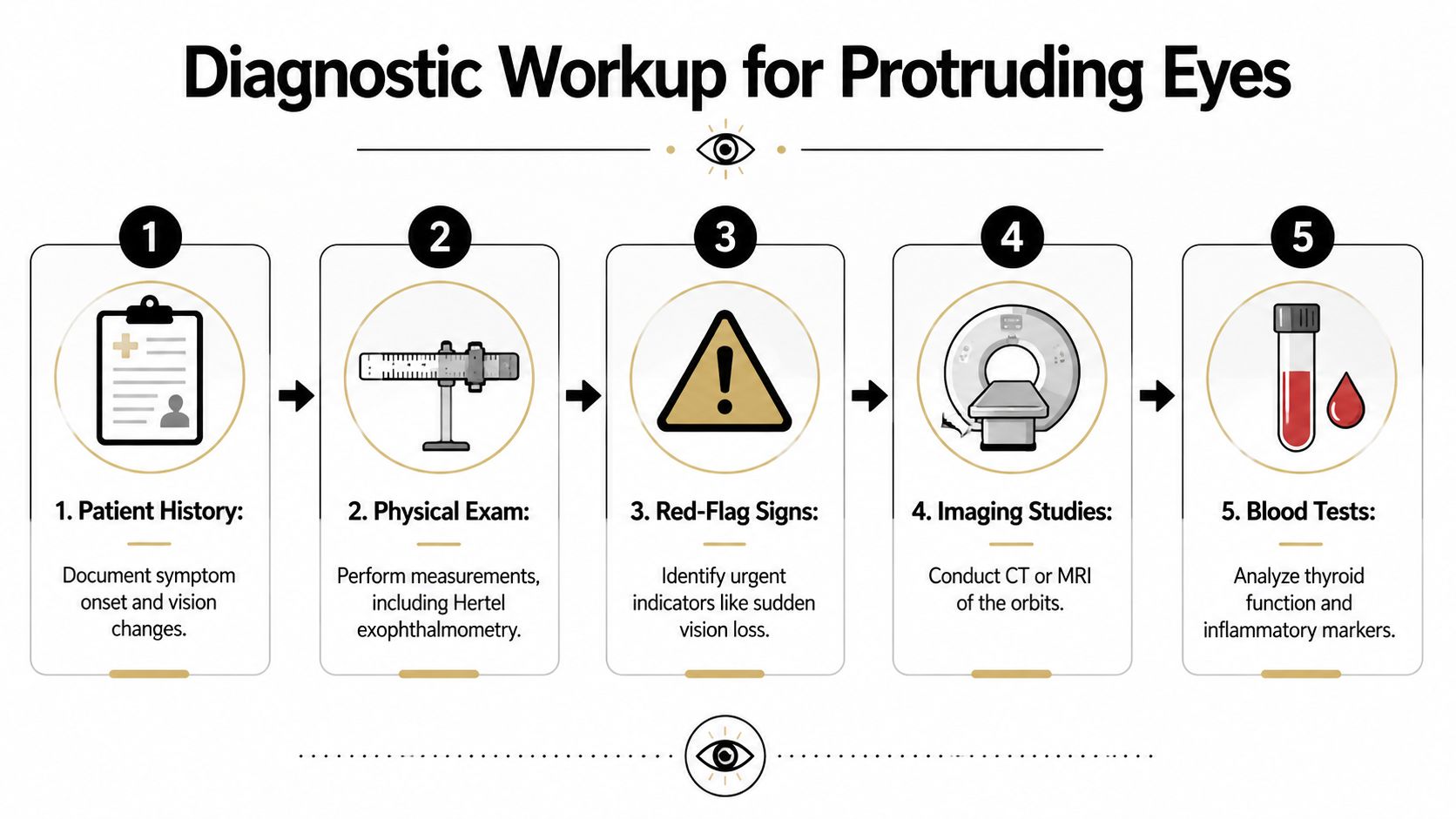
The first part of the visit is usually history-taking and exam. The clinician asks when the change started, whether it's getting worse, and whether symptoms like dryness, pressure, redness, double vision, headache, or vision changes have appeared.
Then comes the physical exam. Clinicians look at eyelid position, corneal exposure, eye movements, and whether one eye sits farther forward than the other. They may use exophthalmometry, often with a Hertel exophthalmometer, to measure projection.
According to Medscape's overview of proptosis, proptosis is defined clinically when the globe displaces more than 21 millimeters from the orbital rim or when there is over 2 millimeters of asymmetry between the eyes, verified by exophthalmometry and imaging.
That measurement matters because the mirror can fool you. Lighting, brow shape, and eyelid position can exaggerate or hide what's really happening.
Aging changes around the eye can also alter appearance in ways that aren't true proptosis. For an example of how surgeons think about lower lid support and age-related contour, Dr. Lipschitz's approach to facial rejuvenation is useful context. If you're trying to understand how lower-lid procedures relate to eye exposure and contour, this explanation of lower eyelid surgery can help.
When symptoms, exam findings, or asymmetry suggest more than cosmetic prominence, imaging comes next. A CT scan may help evaluate bone, sinus involvement, or acute orbital problems. MRI may help when soft tissue detail is especially important.
Clinicians use imaging to look for things like:
A workup may also include blood testing when thyroid disease or systemic inflammation is suspected.
This short video gives visual context for how clinicians evaluate orbital anatomy and eye prominence:
Certain symptoms should move the issue out of the “I'll mention it later” category:
Those signs don't tell you the cause by themselves, but they do signal that timing matters.
Treatment depends on what's causing the protruding eye shape. A person with stable, inherited prominence may not need medical treatment at all. Someone with active thyroid eye disease may need a very different plan focused on protecting vision and reducing orbital pressure. Others fall into a cosmetic middle ground where the eye itself is healthy, but surrounding structures make the area look tired, hollow, or overly exposed.
| Option | Description | Pros | Cons |
|---|---|---|---|
| Orbital decompression | Surgery that creates more room in the orbit so the eye can sit farther back | Can address true proptosis and vision-threatening pressure | Invasive, requires careful patient selection, recovery is more involved |
| Eyelid surgery | Reshapes upper or lower lids to improve exposure, contour, or balance | Can improve lid closure, show less sclera, and refine appearance | Doesn't treat deeper orbital causes |
| Fat repositioning or contour surgery | Adjusts surrounding facial volume and support structures | May soften the “staring” look and improve harmony around the eye | Best for select aesthetic patterns, not for active disease |
| Fillers | Used around adjacent facial areas to improve contour transitions | Nonsurgical, office-based, subtle changes possible | Limited role if the eye itself is truly protruding |
| Makeup strategies | Uses shading, liner, and lash placement to change visual depth | Immediate, noninvasive, flexible | Temporary and technique-dependent |
| Observation and medical management | Monitoring or treating the underlying disease first | Avoids unnecessary procedures and prioritizes safety | Cosmetic concerns may persist during treatment |
Orbital decompression is generally considered when protrusion is driven by disease and creates functional problems, or when the appearance remains significantly troubling after the active disease process has settled. This is a medical procedure first, even if aesthetic improvement is part of the outcome.
Eyelid procedures are different. They may help when eyelid retraction, scleral show, poor closure, or lower-lid malposition make the eyes look more exposed. In some patients, the eye itself isn't the whole story. The lid position is amplifying the effect.
For people with naturally prominent but healthy eyes, treatment is often about framing rather than moving the globe. That can mean eyelid support procedures in selected cases, volume balancing around the brow or cheek, or no procedure at all.
Non-surgical options are often more useful for the surrounding structures than for the eye projection itself. In patients with under-eye hollowing or adjacent volume loss, carefully chosen rejuvenation strategies may improve balance. For readers exploring that category, this overview of how some practices use PRP to restore youthfulness around the eyes offers a related perspective on periocular rejuvenation. For surgical planning around the upper face, it's also helpful to understand the difference between a brow lift and eyelid surgery.
Traditional advice for protruding eyes often focuses on making them look flatter with matte shadows and deeper crease definition. That still works well for many people. But cosmetic style has shifted too. Beauty communities have reported a 35% increase in tutorials using features like halo eye and cut-crease looks to accentuate the roundness of prominent eyes rather than hide it, according to Charlotta Eve's discussion of makeup for protruding eyes.
That matters because not every patient wants correction. Some want reassurance that their feature can be styled beautifully.
A protruding eye shape can be managed in two very different ways. Reduce the prominence, or work with it artistically.
A few practical makeup ideas often help:
The best option isn't “the most treatment.” It's the option that matches the cause.
Choosing treatment starts with choosing the right patient for the right intervention. Not every forward-looking eye should be operated on. Not every cosmetic concern should wait. The key is matching the problem, the anatomy, and the goal.

A strong consultation usually clarifies several points:
Patients often feel more grounded when they bring specific questions:
The right surgeon doesn't start with a procedure. They start by defining the problem accurately.
For patients evaluating a practice, surgeon experience, accredited operating facilities, and familiarity with periocular anatomy matter more than flashy marketing. Eye-area surgery is unforgiving of shortcuts. Small changes in millimeters can alter closure, comfort, and expression.
Any procedure around the eyes demands careful expectation-setting because the eye area heals visibly and function matters as much as appearance.

Patients usually worry about two things. First, “Will I still look like myself?” Second, “Will my eyes feel worse before they feel better?” Both are fair concerns.
Short-term swelling, tightness, and asymmetry during healing are common themes after eye-area surgery. The tissues are delicate, and even precise surgery can look uneven early on while one side settles faster than the other.
Potential issues can include:
Recovery tends to happen in phases rather than one smooth line.
In the first days, patients focus on swelling control, lubrication, prescribed medications, and protecting the eye surface. During the early weeks, bruising and visible puffiness usually improve, but the final contour is still evolving. Longer-term healing is where tissues soften, scar lines mature, and the overall effect becomes easier to judge.
A good result doesn't always mean a dramatic difference. In many eye-area procedures, success looks natural. The eyes appear less strained, the lids close better, or the face looks more balanced without announcing that surgery happened.
For thyroid-related protrusion, prognosis is often encouraging. As noted earlier from the same reviewed source, many mild cases improve without surgery, and most patients recover without permanent vision loss when managed appropriately. The practical takeaway is that timing and diagnosis shape the outcome as much as the procedure itself.
Healing around the eyes is often a patience test. Early swelling rarely predicts the final result.
A protruding eye shape can mean very different things depending on the person sitting in front of you. For some, it's inherited anatomy. For others, it's a sign that the orbit, eyelids, or surrounding tissues need medical attention. The most useful first step isn't guessing. It's determining whether the appearance is stable, symmetrical, and symptom-free, or new, uneven, and linked to discomfort or vision changes.
The cosmetic side matters too. Some people want treatment because the eyes feel too exposed or out of balance. Others want styling options that work with their features instead of against them. Both approaches are reasonable when the underlying cause is understood.
It can be when the procedure is considered medically necessary, especially if vision, corneal protection, or orbital pressure is involved. Coverage depends on the diagnosis, documentation, and payer rules.
No. Fillers can adjust surrounding contours, but they don't move the globe backward. Their role is usually supportive and aesthetic, not corrective for true proptosis.
Many people do well with matte shadow placement, controlled liner, and less reflective product on the most prominent part of the lid. Others prefer to lean into the shape with more graphic styles.
If a child develops new protrusion, especially with redness, swelling, fever, or one eye looking different from the other, urgent medical evaluation is appropriate.
If you're in Cape Cod or the surrounding area and want a professional evaluation of eye prominence, eyelid contour, or related facial balance concerns, Cape Cod Plastic Surgery offers consultations with Dr. Marc Fater, a board-certified plastic surgeon with over 30 years of experience and an on-site AAAASF-accredited surgical suite in Hyannis.
October 7, 2026
A Practical Guide to Healing After Breast Surgery

October 6, 2026
Your Safety Guide: What to Look for When Choosing a Plastic Surgeon
October 5, 2026
Why Our On-Site Accredited Facility Matters for Your Safety

Cape Cod Plastic Surgery offers expert cosmetic and reconstructive procedures in a safe, accredited setting. Led by Dr. Marc Fater, we combine advanced techniques with personalized care to help you look and feel your best.
Monday: 9:00 AM – 5:00 PM
Tuesday: 9:00 AM – 5:00 PM
Wednesday: 9:00 AM – 5:00 PM
Thursday: 9:00 AM – 5:00 PM
Friday: 9:00 AM – 5:00 PM