

September 9, 2026
How to Care for Surgical Incisions Properly
Expert Guide to Proper Surgical Incision Care
Jun 14, 2026
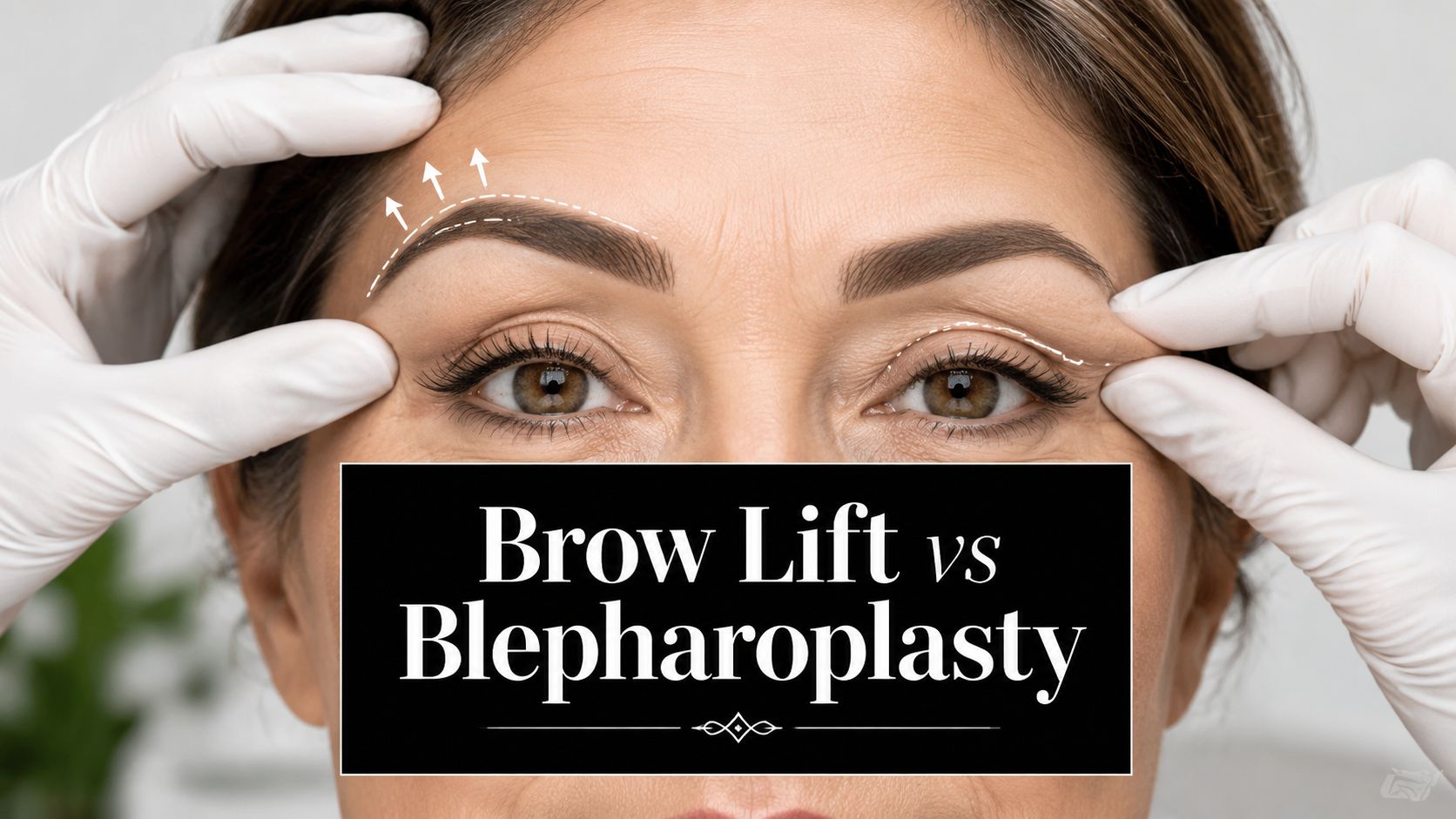
You catch your reflection on a video call or in the bathroom mirror and think, “Why do I look so worn out?” Not sad. Not sick. Just tired, heavy, maybe a little stern around the eyes. That feeling is common, and it's one of the main reasons patients ask me about the difference between a brow lift and eyelid surgery.
The confusion makes sense. Both procedures can make the eyes look more open and refreshed. Both deal with aging in the upper face. And both can help when makeup starts disappearing into hooded skin or when your expression no longer matches how you feel.
But they are not interchangeable.
In a true brow lift vs. eyelid surgery decision, the key question isn't “Which procedure sounds better?” It's “Where is the problem coming from?” Sometimes the eyelid is the issue. Sometimes the brow has dropped and is pushing tissue down onto the lid. Sometimes it's both. There's also a stage many articles skip over entirely, when Botox, fillers, or other non-surgical treatments may still make sense before surgery becomes the better option.
Patients don't usually begin by requesting a brow lift or a blepharoplasty. Instead, their starting point is a specific concern.
They say their eyes look heavy. They look angry in photos. They seem exhausted by late afternoon. Friends ask if they're stressed, even when they feel fine. That “tired look” usually comes from changes in the brow, the eyelid, or both.
Sometimes patients first wonder whether the issue is poor sleep rather than facial anatomy. That's a fair question. If you're also dealing with low energy, tackling persistent morning grogginess can help you sort out whether you're seeing true fatigue, a cosmetic concern, or some combination of both.
Other times, the concern is lower around the eyes, especially when puffiness makes the whole eye area seem older. If that sounds familiar, this guide on what causes under-eye bags can help separate lower-eyelid issues from upper-face heaviness.
The eye area is small, but it changes your whole expression. A low brow can make you look tense. Extra eyelid skin can make you look sleepy. They don't mean the same thing.
That's why choosing the right procedure matters. If the heaviness comes from descended brows, removing eyelid skin alone may not fully fix the problem. If the brow is in a good position and the excess is solely in the lid, a brow lift may be the wrong tool.
Patients often feel relieved when they hear this, because it explains why online before-and-after photos can be so confusing. Two people may both describe “hooded eyes,” yet need completely different treatments.
The simplest way to understand upper-face aging is to think of the brow as the frame and the eyelid as the curtain. If the frame drops, it crowds the space above the eye and pushes tissue downward. If the curtain itself has become too long or loose, the heaviness is coming from the eyelid.
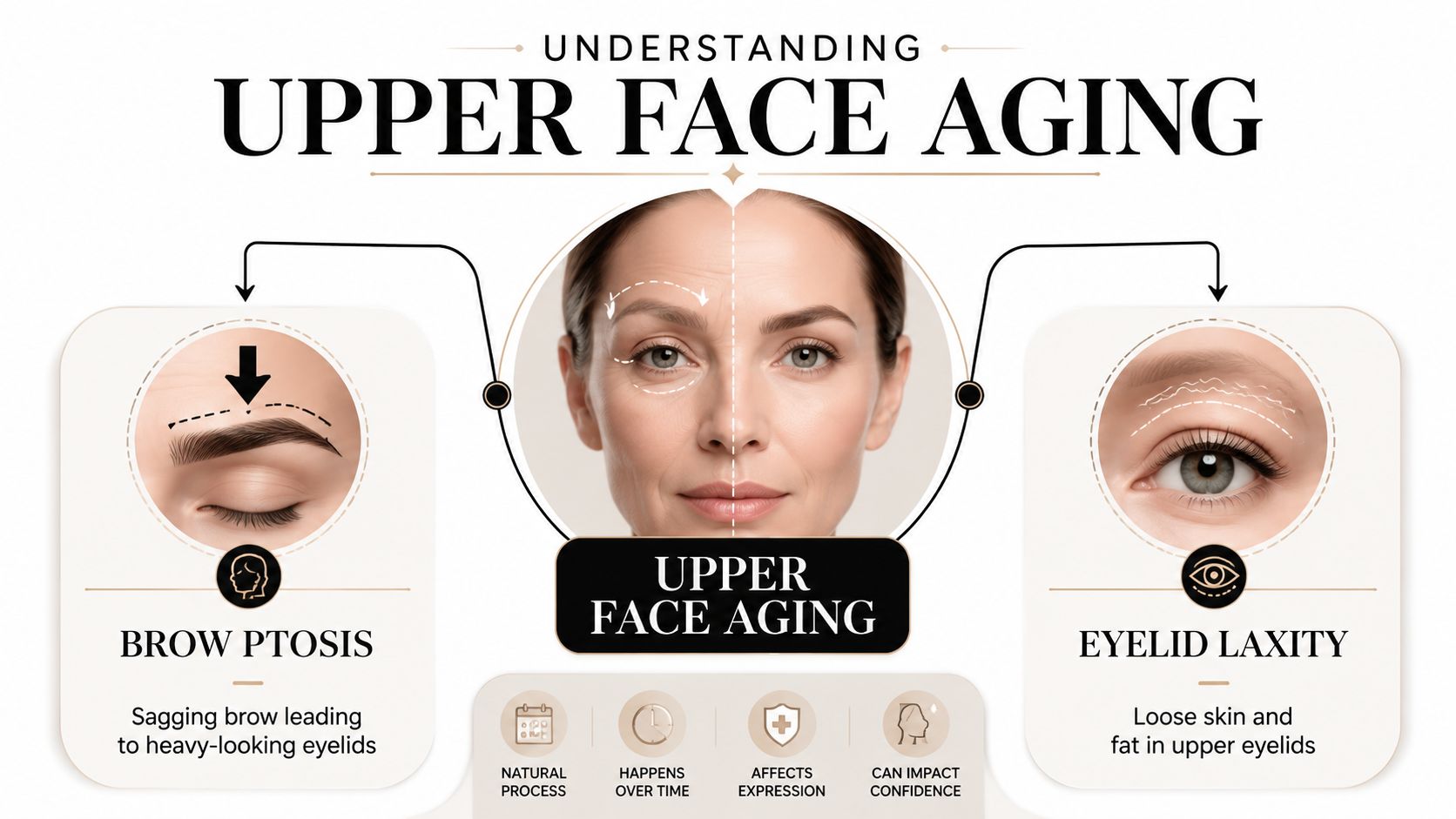
A brow lift treats the forehead and eyebrow complex. Its job is to lift sagging brows and improve the crowding they create above the eye. It can also soften forehead lines, depending on the technique and the patient's anatomy.
A low brow often fools patients into thinking they have “too much eyelid skin.” They do see skin on the lid, but that tissue may be there because the brow has shifted downward over time. In that situation, the brow is the driver.
Blepharoplasty focuses on the eyelid itself. It removes or repositions excess skin, fat, and sometimes muscle from the upper or lower lid margins. According to clinical guidance in the NCBI Bookshelf, blepharoplasty is the better option when the concern is limited to excess eyelid skin without brow descent, and upper lid surgery may take about 30 minutes.
That's a very different target from a brow lift. One procedure repositions tissue above the eye. The other reshapes tissue in the eyelid.
In consultation, I'm not just looking at what appears heavy. I'm looking at what creates the heaviness.
A few clues matter:
Practical rule: If the upper face looks crowded because the brow has descended, the right diagnosis starts above the eyelid, not on it.
This is why anatomy matters more than labels. “Hooded eyes” is a description. It is not a diagnosis.
A simple way to compare these procedures is to ask one question first: are we repositioning the frame around the eye, or are we refining the eyelid itself?
That distinction matters because brow lift and blepharoplasty can produce a similar first impression, a more open, rested eye area, while working on different structures.
| Feature | Brow Lift | Eyelid Surgery (Blepharoplasty) |
|---|---|---|
| Main target | Brow and forehead position | Excess skin and fat in the eyelid |
| Best for | Low or sagging brows, forehead heaviness | True upper-lid skin excess or puffiness |
| Primary goal | Raise the brow and reduce upper-face crowding | Reshape the eyelid itself |
| Recovery and longevity | Clinical comparison guidance notes recovery is often about 10 to 14 days, with results that may last 8 to 12 years | The same guidance notes recovery is often about 7 to 10 days, with results that may last 7 to 15 years |
| Incision location | Usually hidden in or near the hairline, depending on technique | Usually placed in the natural eyelid crease for upper lids |
| When combined | Helpful if brow descent is creating lid hooding | Helpful if true eyelid excess is also present |
A brow lift treats the tissue above the eye. The brow is the awning. If that awning drops, the space underneath looks darker and more crowded even if the eyelid skin itself is not the main problem.
That is why a brow lift can make the eyes look less tired without removing much, or any, eyelid skin. It restores position. It can also soften the strained look that develops when a patient constantly recruits the forehead to help keep the eyes open. For a patient-friendly overview, this article on brow lift surgery and brightening the eyes explains the procedure in more detail.
Blepharoplasty works lower down. It addresses the eyelid layer itself by trimming or reshaping loose skin and fullness that sit on the lid.
The result is usually more precise than broad. If the brow is already in a good position, eyelid surgery often gives the cleaner correction because it treats the exact area causing the fold or puffiness.
Patients frequently receive mixed signals from the mirror.
You may see skin resting on the lashes and assume the lid is the problem. In some faces, that is true. In others, the brow has descended enough to push tissue downward, so the eyelid only looks like the source.
A good comparison is a curtain and the rod holding it. If the rod sags, the curtain bunches. Trimming the curtain may help a little, but it does not correct the reason it bunched in the first place.
I usually sort the options into three practical groups:
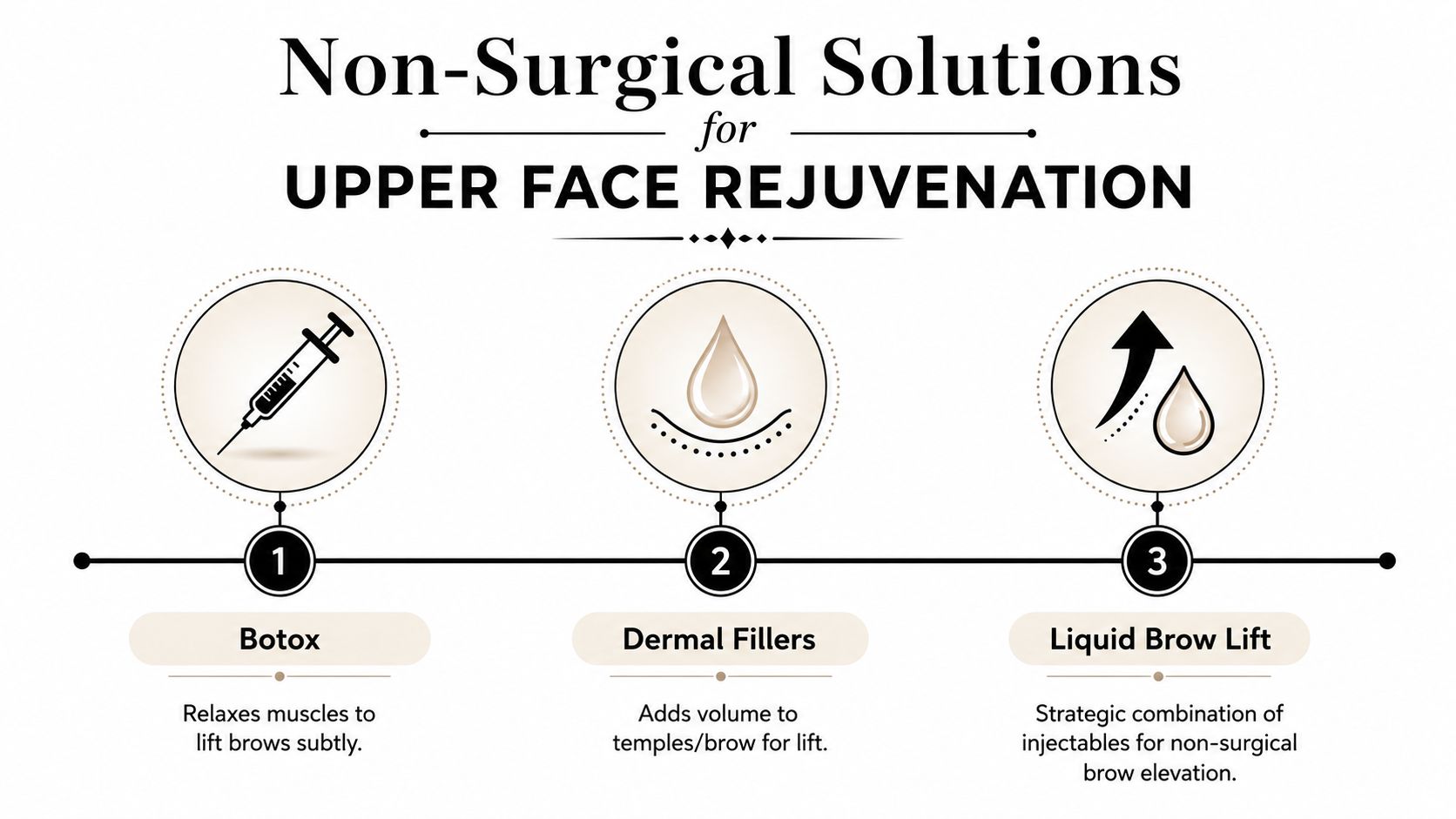
There is also a middle ground that many comparison articles skip. Early on, some patients are not ready for surgery because the changes are mild and dynamic. Botox may soften the downward pull that contributes to brow descent. Filler can sometimes improve support around the upper face in selected patients. Those options do not remove excess eyelid skin or reset a significantly fallen brow, but they can be useful during the transition phase before surgery becomes the more logical next step.
The goal is not a tighter-looking eye area. The goal is to match the treatment to the structure that is aging, so the result looks natural and makes sense on your face.
The best candidates usually recognize a pattern before they know the name of the procedure.

A brow lift may make more sense if your concern starts above the eyelid.
Look for these patterns:
Blepharoplasty tends to fit patients whose issue is more local to the eyelid.
You may fall into this group if:
Stand in front of a mirror and gently lift your brow with a fingertip. Don't pull hard. Just support it into a slightly higher, natural-looking position.
Then ask yourself:
If the answer is yes, the brow may be contributing more than you realized. If almost nothing changes, true eyelid excess may be the bigger issue.
This quick test doesn't replace an exam, but it helps patients arrive at consultation with better questions.
For a visual explanation, this short video can help you think through what you're seeing in the mirror:
Some patients clearly have both problems. Their brow has descended, and the upper lid also has enough excess skin that correcting one area alone would leave the other untreated.
That's why combined surgery comes up so often in facial rejuvenation. It's not about doing more for the sake of it. It's about matching the procedure to the anatomy.
Many patients aren't ready for surgery when they first notice upper-face aging. They want to know whether Botox or fillers can buy time, soften the heaviness, or help them decide later. That's a smart question.
Non-surgical treatment can work well for early changes.
Botox can relax muscles that pull the brow downward, which may create a subtle lift, especially at the tail of the brow. Fillers can sometimes restore support in nearby areas and improve balance in the upper face. If you're new to this category, a basic explanation of anti-wrinkle injections can help frame what these treatments can and can't do.
For broader context on options beyond surgery, this overview of non-surgical cosmetic procedures is also helpful.
This is the part most online articles skip. Non-surgical treatments can be appropriate, but they have limits.
Recent AAFRS-related industry data summarized here reports that 68% of patients under 45 seeking brow or eyelid rejuvenation initially choose non-surgical treatments, while only 22% of surgeon-led content provides comparative efficacy data or crossover timelines. That gap matters because patients often spend years asking the same question: “When am I no longer a good injectable patient?”
A practical answer is qualitative rather than numeric. Non-surgical care usually makes the most sense when the issue is mild, movement-related, or based on early descent. Surgery becomes the more effective option when there is clear excess skin, persistent heaviness despite good injectable treatment, or tissue laxity that can't be repositioned with a syringe.
If a treatment can no longer create a natural result without chasing small improvements every few months, it may be time to discuss surgery.
That's not a failure. It's a change in the right tool for the job.
You have a procedure on Friday, a family dinner the following weekend, and a work meeting soon after. This is usually the point where patients stop asking, “Which operation works?” and start asking, “What will recovery look like in my daily life?”
That is the right question.
A brow lift and upper eyelid surgery can both refresh a tired upper face, but they do not recover in exactly the same way. According to clinical summary data on brow lift versus eyelid surgery, major complications are rare, at under 1%, while the more common short-term issues are swelling and bruising that usually improve over 7 to 14 days. The same summary reports that many patients return to light activities in about a week after upper lid blepharoplasty, while brow lift recovery is more often 10 to 14 days before work and light activity feel reasonable.
A simple way to picture the difference is this. Eyelid surgery works on the curtain itself. A brow lift raises the curtain rod and repositions the fabric above it. Because a brow lift affects tissues higher on the forehead and upper face, the recovery often asks for a little more patience.
The early phase is usually more inconvenient than painful.
Expect puffiness, bruising, mild tightness, and a temporary “not ready for company” period. Brow lift patients often notice a sense of forehead tightness or scalp numbness early on. Eyelid surgery patients usually focus more on swelling around the lids and some temporary dryness or irritation.
That difference matters because it helps you plan realistically. If your goal is the shortest social downtime, upper blepharoplasty often wins. If the heavier problem is brow descent, choosing the shorter recovery over the correct operation can leave you disappointed with the result.
Helpful planning steps include:
Every operation has tradeoffs, and therefore a careful consultation matters.
With either procedure, the discussion should include asymmetry, visible or hidden scar concerns, healing delays, under-correction, over-correction, and the chance that one procedure alone may not fully address the problem. Eyelid surgery also requires close attention to eyelid closure, dryness, and function. Brow lift planning needs equal attention to hairline position, forehead shape, and the direction of brow lift so the result does not look surprised or unnatural.
Patients are often surprised by this point. The main risk is not only a medical complication. It is choosing a procedure that treats the wrong structure.
If Botox once gave you a nice opening of the upper face but no longer does enough, that history is useful. It suggests you may be crossing from a temporary muscle-based fix into a structural problem that surgery addresses better.
Results last longer than injectables, but they do not stop aging.
Upper eyelid surgery usually removes or reshapes excess skin and fat that will not quickly return. A brow lift repositions tissue that has descended over time, so the improvement can be long-lasting, but your skin and soft tissues will continue to age normally. The better the procedure matches the cause of your heaviness, the more satisfying the result tends to feel years later.
That is why this decision should never be reduced to “Which recovery is easier?” The better question is, “Which treatment fits what my anatomy is doing now?”
A consultation should feel like a working session, not a sales pitch. You should leave knowing what is causing your upper-face heaviness, what treatment fits it, and what tradeoffs come with each option.

Write these down before your visit:
These questions shift the conversation from “What procedure do I want?” to “What problem are we solving?”
A careful surgeon will sometimes recommend both a brow lift and upper blepharoplasty. That recommendation isn't unusual. A 2018 review in Plastic and Reconstructive Surgery found that serious complications in cosmetic eyelid surgery are rare, with orbital hemorrhage at about 0.055% and permanent visual loss at about 0.0045%, and it also notes that upper blepharoplasty is often performed together with brow lifting when both conditions are present.
That matters because many patients have a mixed picture. If the brow pushes tissue down and the eyelid also has true excess skin, a combined plan may look more natural than forcing one procedure to do all the work.
Cape Cod Plastic Surgery offers both surgical and non-surgical facial rejuvenation options, which makes it easier to discuss the full treatment path in one place rather than treating each decision in isolation.
By the end of the visit, you should be able to answer three things clearly:
That kind of clarity is what helps patients make calm, confident decisions.
If you're weighing a brow lift, eyelid surgery, or the point where non-surgical treatments no longer do enough, Cape Cod Plastic Surgery can help you sort out the anatomy behind the heaviness and discuss options that fit your goals. A consultation with Dr. Marc Fater should leave you with a diagnosis, a plan, and the right questions answered clearly.
September 9, 2026
Expert Guide to Proper Surgical Incision Care
Master dermal fillers aftercare with do's and don'ts, swelling tips, activity limits and warning signs to protect your results and heal smoothly.

September 8, 2026
Ensuring Safety: Why Your Surgeon's Credentials Matter Most

Cape Cod Plastic Surgery offers expert cosmetic and reconstructive procedures in a safe, accredited setting. Led by Dr. Marc Fater, we combine advanced techniques with personalized care to help you look and feel your best.
Monday: 9:00 AM – 5:00 PM
Tuesday: 9:00 AM – 5:00 PM
Wednesday: 9:00 AM – 5:00 PM
Thursday: 9:00 AM – 5:00 PM
Friday: 9:00 AM – 5:00 PM