

October 7, 2026
What to Expect During Your Breast Surgery Recovery
A Practical Guide to Healing After Breast Surgery
Jul 27, 2026
You've chosen the operation, you're excited about the result, and then the quieter question shows up at night, what keeps an implant soft, natural, and stable years from now? That question is exactly where capsular contracture prevention starts. The honest answer is that prevention is not one trick, one pill, or one brand of implant. It's a layered plan that begins before surgery, is enforced in the operating room, and continues through the healing period.
A patient often walks into consultation thinking about size, shape, and recovery. The harder conversation is the long game, because every implant creates a capsule of scar tissue around it, and that capsule is supposed to stay thin and flexible. Capsular contracture happens when that normal healing response tightens, hardens, and starts to distort the breast or cause pain.
That's why prevention matters so much. A large plastic surgery review reported an overall incidence of 10.6% after breast augmentation, with studies ranging from 2.8% to 20.4% in the literature, and another review summarized the condition as affecting about one in six women with implants. Those numbers are from the same body of evidence that emphasizes controlling inflammation and bacterial contamination from the start, not after the capsule has already thickened. A review of capsular contracture risk and prevention
A capsule itself is normal. The body forms it around any foreign object, including an implant, as part of the healing response. The problem begins when that scar tissue becomes thick, tight, or uneven enough to push the implant upward, change shape, or create discomfort.
Clinically, surgeons often use the Baker grading system to describe severity. Grade I feels soft and looks normal, while Grade IV is hard, distorted, and usually painful. Patients don't need to memorize the grading system, but it helps to know that firmness alone isn't the whole story. Shape change and pain matter too.
A soft early recovery doesn't guarantee long-term success, and a little firmness early on doesn't automatically mean contracture.
The best prevention strategies all point to the same biology, reduce inflammation and reduce bacterial seeding. That's why foundational protocols emphasize sterility, pocket irrigation, atraumatic dissection, and minimizing the chance that bacteria ever settle around the implant. The modern approach is layered because no single step solves the problem by itself. If you want a practical pre-op checklist, this breast augmentation preparation guide is a useful companion before you finalize anything.
By the time surgery is scheduled, your most important question shouldn't be, “What can I do if this happens?” It should be, “What is the team doing to make sure it doesn't?”
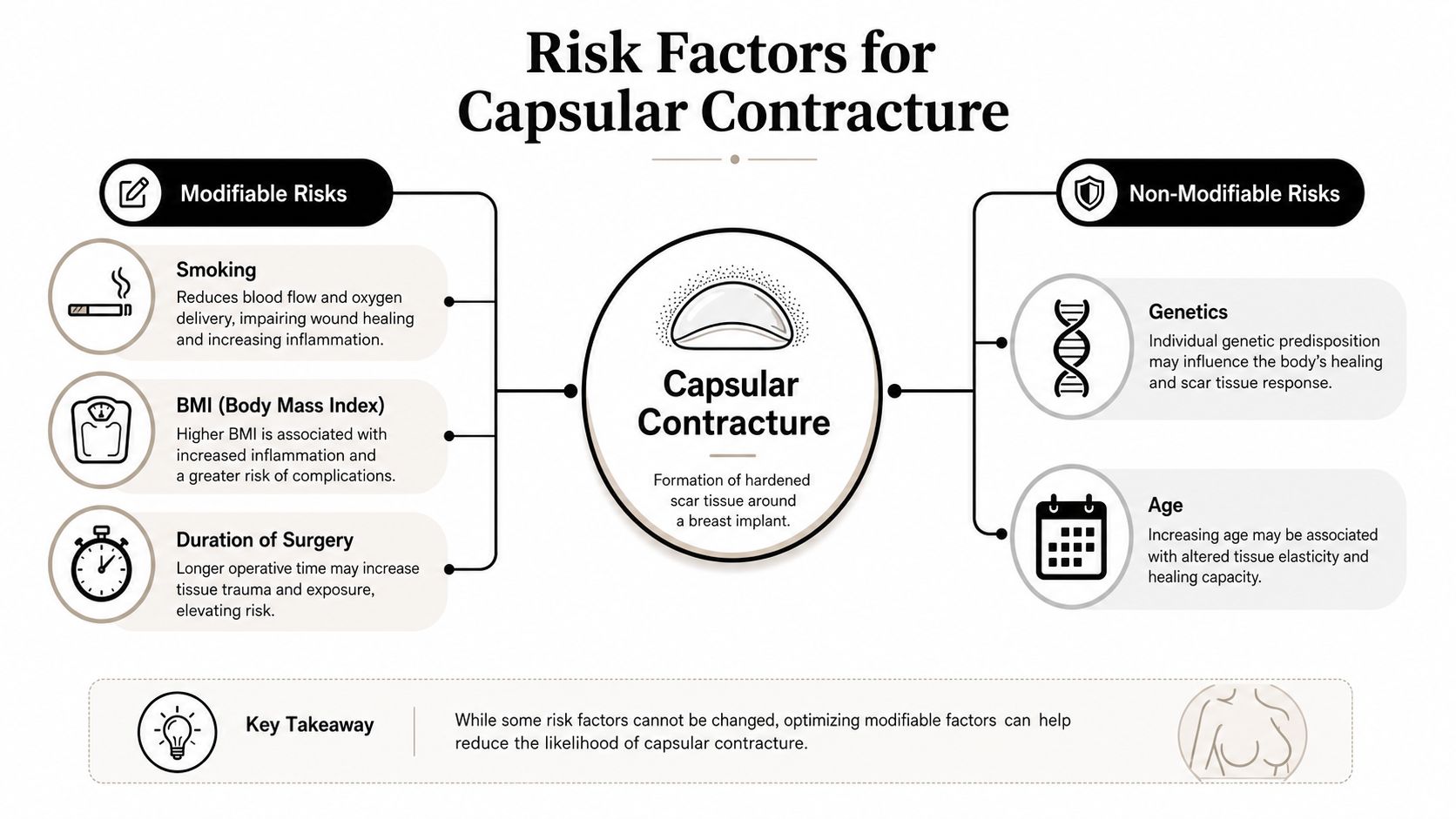
Capsular contracture usually starts with inflammation, then gets reinforced by something that keeps the healing environment irritated. Biofilm, surgical-site infection, bleeding in the pocket, implant characteristics, prior capsular contracture or fibrosis, and radiation therapy all show up in the literature as risk factors. The important part for patients is sorting what can be changed from what needs to be managed.
Biofilm is one of the most important ideas in this topic. It describes bacteria that cling to the implant surface and hide inside a protective layer, which can keep the inflammatory response simmering even when there's no obvious infection. That low-grade irritation is part of why surgeons talk so much about contamination control, not just “keeping things clean.”
Hematoma and seroma matter for the same reason. Blood or fluid in the pocket can amplify inflammation and create a more favorable environment for scar tissue to thicken. The literature repeatedly ties meticulous hemostasis to better outcomes, because once the pocket becomes inflamed, the capsule is more likely to become dense and contracted.
Some risk factors are in the patient's control. Nicotine cessation matters, and that includes vaping. Smoking and nicotine both impair wound healing and increase inflammatory stress on tissue, which is exactly what you do not want around an implant.
The pre-op conversation should also cover any prior radiation, previous implant problems, and whether this is a first surgery or a revision. Revision surgery tends to be more complex because the tissue has already been operated on, and the capsule may already be part of the story. If you have diabetes or another condition that affects healing, that belongs in the same conversation, because the goal is not perfection, it's risk reduction.
If a surgeon doesn't ask about nicotine use, prior radiation, and prior implant history, the contracture conversation is incomplete.
Some risks are not lifestyle choices. Genetic tendency, prior fibrosis, and the effects of radiation don't disappear because you've done everything right. That doesn't mean surgery is off the table. It means the operative plan should be more deliberate, and the prevention bundle needs to be stronger.
The practical takeaway is simple. Make a list before surgery of what applies to you, prior radiation, prior contracture, nicotine use, revision status, and any healing issues in the past. Then ask your surgeon which of those items changes the plan, because that's where prevention becomes personalized.
The operating room is where the strongest prevention work happens, because contamination control is most effective before bacteria have a chance to settle into the pocket. The best-supported prevention approach is a multi-step contamination-control bundle, not a single sterile gesture. That bundle includes pre-op IV antibiotics, strict no-touch handling, pocket irrigation with antibiotic or povidone-iodine solution, glove changes right before implant insertion, and keeping the implant away from unnecessary air and skin contact. Expert prevention guidance on intraoperative technique

Pre-op antibiotics are the opening move, because they lower the bacterial load before the implant enters the picture. They do not replace sterile technique, they work as one layer in a larger bundle.
Pocket irrigation is the next major step. The goal is to wash out the space where the implant will sit, using an antibiotic or povidone-iodine solution depending on the surgeon's protocol. If the pocket is not irrigated, the implant enters a more contaminated environment than it needs to.
No-touch handling is another practical benchmark. The implant should not be handled casually, pressed against skin, or exposed longer than necessary before insertion. A recent review says noncontact prosthesis handling is required to reduce bacteria-related risk, and that wording reflects how strongly surgeons take this step. Systematic prevention review discussing no-touch technique
A glove change right before insertion sounds small, but it matters. Gloves can pick up bacteria during dissection and pocket preparation, so changing them before the implant enters the field lowers the chance of carrying contamination into the pocket. The same logic applies to keeping the implant out of prolonged air or skin exposure. Every extra contact point creates another chance for bacteria to reach the device.
A good surgeon should be able to answer these questions without hesitation.
Do you use pre-op IV antibiotics?
This is part of a modern infection-reduction protocol.
Do you irrigate the pocket?
Ask what solution is used and when it happens.
Do you use no-touch implant handling?
The answer should describe a real technique, not just “we're sterile.”
Do you change gloves before implant placement?
This is a practical marker of attention to contamination control.
If you want to see how a surgical team can think about this level of prevention and safety, this operating room safety overview is worth reading.
Some prevention choices are made before the first incision, and they matter more than most patients realize. The practical question is not which option sounds best on paper. It is which implant, incision, and pocket plan gives you the best balance of appearance, healing, and lower scar risk over time.
| Surgical Choice | Lower-Risk Option | Higher-Risk Option | Why It Matters |
|---|---|---|---|
| Implant surface | Textured or polyurethane-coated implants in earlier reviews | Smooth-surface implants in a 10-year analysis | Surface characteristics can influence how the capsule forms around the device. |
| Implant fill | Saline in one meta-analysis | Silicone in that same review | The literature reported higher contracture rates with silicone in augmentation patients. |
| Incision | Inframammary access | Periareolar access | Inframammary access avoids the ductal and nipple field, which may reduce contamination opportunity. |
| Pocket position | Complete under-the-muscle placement | Over-the-muscle placement | Muscle coverage is associated with lower lifetime risk and a more dynamic pocket. |
A systematic review and meta-analysis found higher capsular contracture rates with silicone implants than with saline implants in augmentation patients, while later reviews identified lower incidence with textured implants, submuscular placement, and polyurethane-coated implants. If you want a broader breakdown of device trade-offs, this overview of silicone vs. saline breast implants is a useful companion to the surgical discussion. Historical implant and placement data
That does not make one implant right for everyone. Silicone often feels more natural to patients, and saline has its own trade-offs in feel and appearance. The point is to discuss device choice alongside scar risk, not after the aesthetic decision is already settled.
Many surgeons prefer the inframammary fold because it stays away from the ductal and nipple area, which may lower the chance of bacterial contamination. Periareolar access can be appropriate in selected cases, but it places the operation closer to tissue that can carry more bacteria into the field. That difference is why incision choice is more than a cosmetic preference.
The strongest practical signal in the literature comes from pocket placement. Plastic Surgery Foundation guidance reports a 4% to 8% lifetime risk with complete under-the-muscle placement, compared with 8% to 12% for partial under-the-muscle placement and 12% to 18% for over-the-muscle placement.
That pattern is why modern prevention tends to favor submuscular or dual-plane positioning when anatomy and goals allow it. Muscle coverage appears to help, and the evidence supports the idea that technique matters as much as device selection.
Patients also need to understand the trade-offs. A tighter pocket can mean less movement and lower contracture risk, but it may also affect upper-pole fullness, recovery comfort, and the shape you can achieve. The best plan is the one that fits your tissue quality, implant size, and long-term priorities, not the one that sounds simplest in consultation.
The work doesn't stop when you leave the operating room. Healing is the phase where patients either support a calm recovery or accidentally stir up inflammation with too much activity, too much nicotine exposure, or inconsistent follow-up. Good aftercare is simple, repeatable, and boring on purpose.

Wear the support bra exactly as directed. It helps stabilize the pocket while tissue heals, and it reduces unnecessary movement that can pull on the early repair.
Respect the activity restriction window. Heavy lifting, upper-body strain, and sudden reaching can disrupt pocket healing and intensify inflammation. That doesn't mean you need to stay sedentary, it means you should follow the surgeon's timeline instead of guessing.
If your surgeon recommends breast displacement exercises or massage, do them exactly as instructed. Some surgeons use them routinely in selected patients, while others don't, so the key is following your own plan rather than borrowing one from the internet.
Avoid smoking and nicotine, including vaping, throughout recovery. That's one of the few patient-controlled factors that directly affects wound healing quality.
Nutrition matters too, but not in a trendy way. Eat enough protein, hydrate, and keep your body in a steady healing state. If you're recovering from breast surgery and also want to understand broader rehabilitation considerations, this lymphedema prevention guide is a useful example of how carefully structured aftercare can support healing after breast procedures.
Mild tightness, swelling, and temporary asymmetry are common during early recovery. What you don't want is worsening firmness, increasing pain, or one side that keeps sitting higher instead of settling. Those changes deserve a call, not a wait-and-see approach.
A good rule is to follow the schedule your surgeon gives you for check-ins and not skip visits once you feel fine. Early follow-up is where small problems stay small.
Once capsular contracture has already happened, the question changes. Patients are no longer asking only how to prevent it, they're asking how to keep it from coming back. The literature is clearer here than many websites are willing to admit, recurrence reduction works best as a system, not as a single remedy. Review focused on recurrence prevention after revision

A revision plan usually includes implant exchange, pocket or site change, no-touch handling, antimicrobial irrigation, and strict nicotine cessation. Those are the components that keep showing up in more serious reviews, because recurrence tends to reflect the same underlying contamination and inflammation problem in a different form.
That's also where revision consultations need to get specific. If the first operation was subglandular, for example, the new plan may need to address the pocket location directly instead of just replacing the implant and hoping for a better result. Revision surgery without changing the environment is often just repetition.
Patients often hear about vitamin E, compression garments, external ultrasound, and assorted home remedies. The neutral reviews don't support those as dependable prevention tools, and some are explicitly described as unproven or needing further study. That matters because revision patients are often more motivated and more vulnerable to false reassurance.
Some surgeons may discuss leukotriene inhibitors in selected cases, especially when trying to soften early recurrence or support a non-surgical bridge. That belongs in a medical conversation, not an internet recipe. The same is true for adjuncts like acellular dermal matrix, mesh, or newer pocket treatments, which can be considered in certain revision settings but aren't universal answers.
The main point is this. If the contracture has returned, insist on a revision plan that changes the biology and the mechanics, not just the implant itself.
The easiest way to catch a problem early is to know what you're feeling for. A soft implant should stay reasonably mobile, feel comfortable, and keep a natural shape as the months pass. If that changes, your body is sending a signal.
Firmness that keeps increasing
Persistent hardening is more concerning than normal early healing tightness.
Shape change or a higher-riding implant
A breast that becomes rounder, tighter, or sits unusually high can signal contracture.
Pain or pressure that worsens over time
Discomfort that doesn't settle deserves evaluation.
New asymmetry
A side that looks or feels different from the other side can be an early clue.
These signs line up with the Baker framework. A change that feels mild might still be worth a routine check, while pain, distortion, or significant firmness deserves a faster call. You do not need to diagnose the grade yourself, you just need to notice the change and report it.
Call promptly if firmness is progressing, if the breast shape is changing, or if you're noticing redness, warmth, or swelling that doesn't fit the expected recovery pattern. The goal is not to panic over every sensation. The goal is to avoid waiting until a problem is much harder to correct.
If the breast feels tighter week by week instead of softer, that's the moment to pick up the phone.
Patients who want a careful, evidence-based discussion about risk reduction can also schedule an evaluation with a board-certified plastic surgeon who understands both primary prevention and revision planning. Cape Cod Plastic Surgery offers that kind of layered approach, with over 30 years of experience, Dr. Marc Fater's board certification, and an on-site AAAASF-accredited surgical suite that supports patient safety and planning. If you're ready to talk through your implant goals and your contracture risk openly, visit Cape Cod Plastic Surgery to request a consultation.
October 7, 2026
A Practical Guide to Healing After Breast Surgery

October 6, 2026
Your Safety Guide: What to Look for When Choosing a Plastic Surgeon

October 5, 2026
Why Our On-Site Accredited Facility Matters for Your Safety

Cape Cod Plastic Surgery offers expert cosmetic and reconstructive procedures in a safe, accredited setting. Led by Dr. Marc Fater, we combine advanced techniques with personalized care to help you look and feel your best.
Monday: 9:00 AM – 5:00 PM
Tuesday: 9:00 AM – 5:00 PM
Wednesday: 9:00 AM – 5:00 PM
Thursday: 9:00 AM – 5:00 PM
Friday: 9:00 AM – 5:00 PM