
September 9, 2026
How to Care for Surgical Incisions Properly
Expert Guide to Proper Surgical Incision Care
Dec 12, 2025
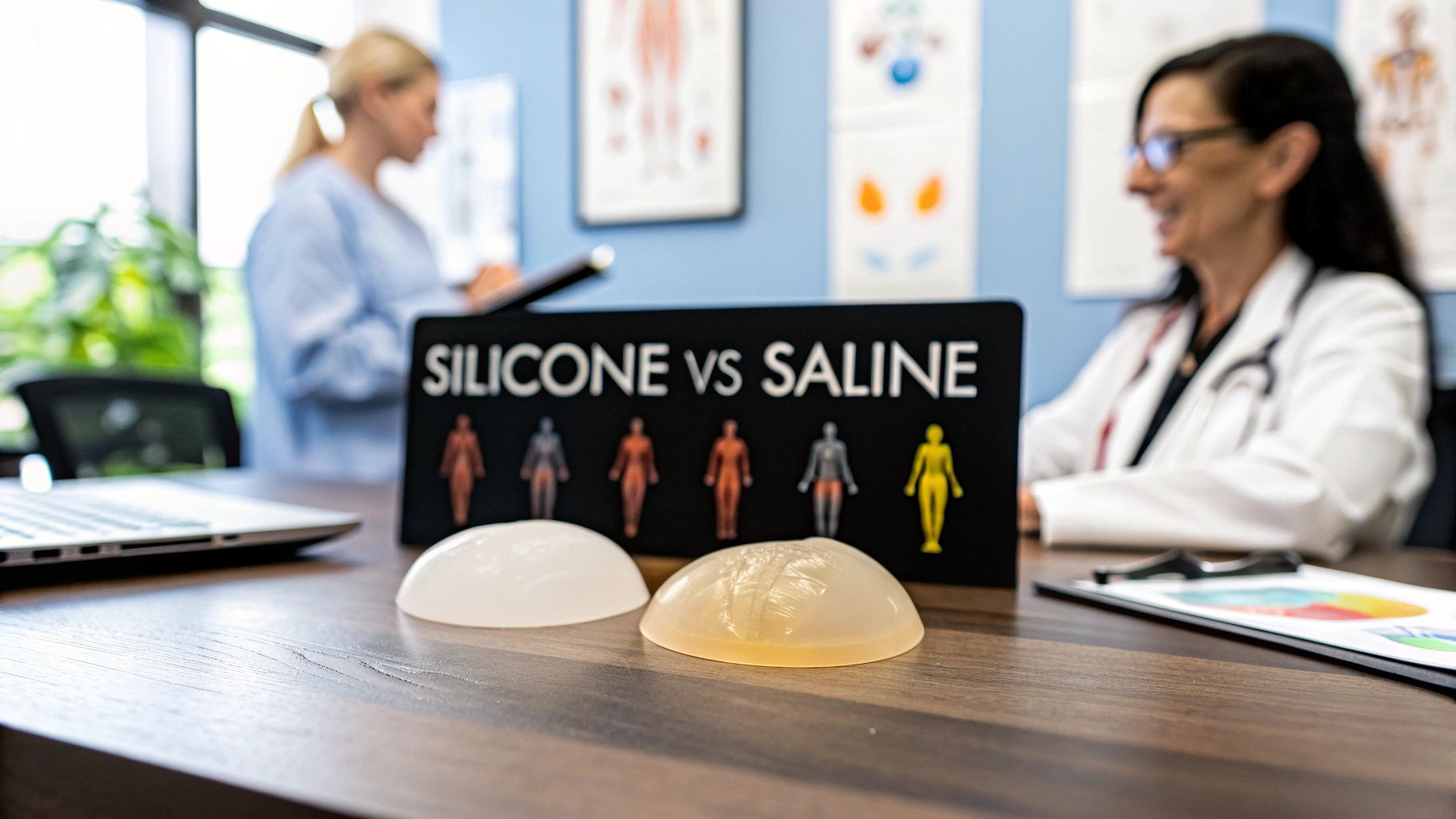
When it comes to the great silicone vs saline breast implants debate, the conversation really boils down to two things: how they feel and how you know if one has ruptured. It's a trade-off. Silicone implants are filled with a cohesive gel that feels remarkably like natural breast tissue. On the other hand, saline implants, filled with sterile saltwater, make ruptures immediately obvious and usually have a lower price tag.
The right choice for you hinges on what you value most—a more natural feel and look, or the straightforward peace of mind that comes with easy rupture detection.
Deciding on the right breast implant is one of the most important steps in your breast augmentation journey. Both silicone and saline are safe, FDA-approved options, but they have key differences that make them better suited for different women, different bodies, and different aesthetic goals. Getting a handle on these foundational differences is where we start.
It all comes down to what's inside the implant shell. This single factor influences everything from the size of the surgical incision to how the implant feels, how much it weighs, and what happens if it leaks. Here at Cape Cod Plastic Surgery, Dr. Fater walks every patient through these nuances to make sure the surgical plan is perfectly aligned with the results they’re hoping for.
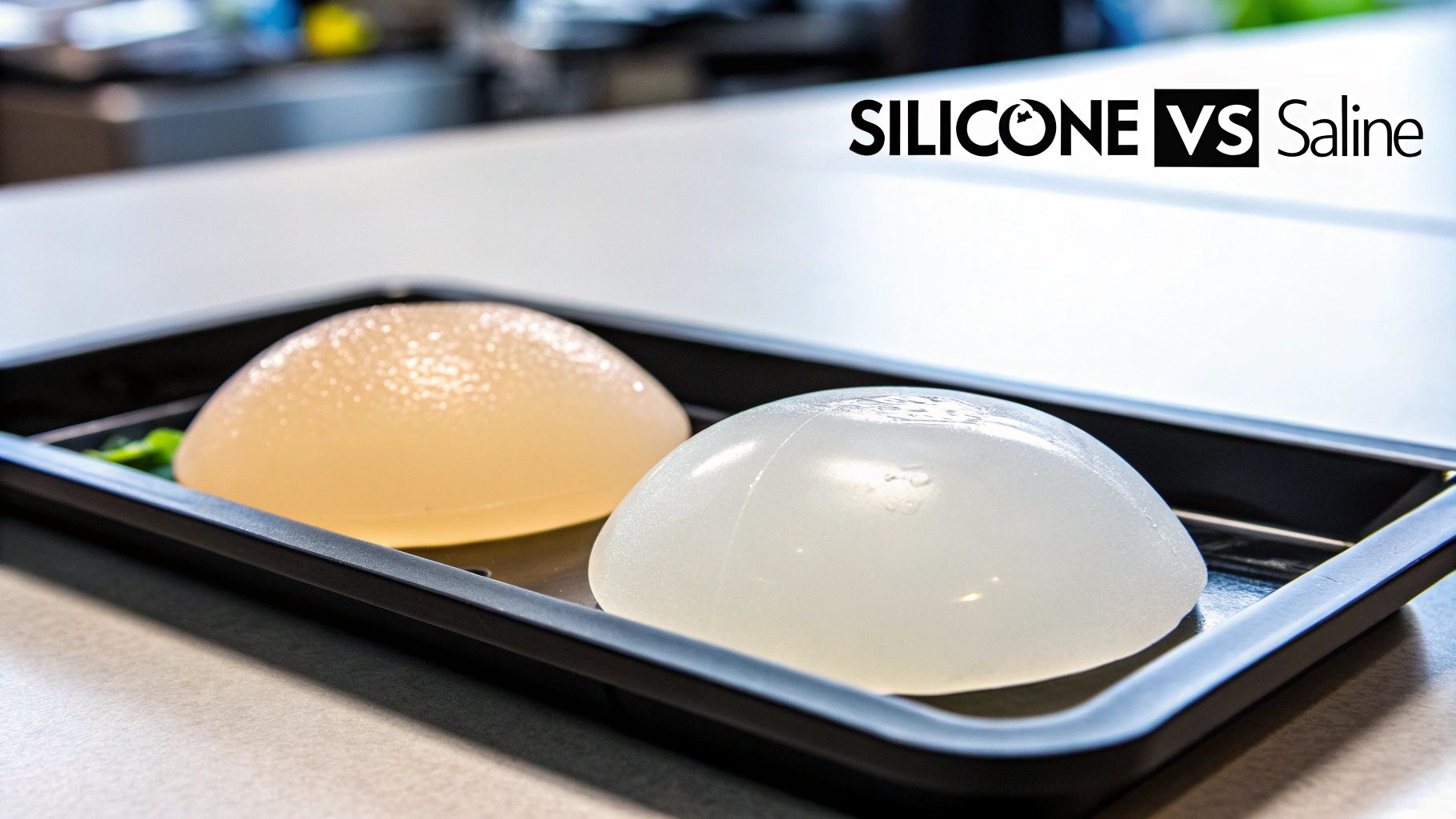
Sometimes, seeing the main points side-by-side is the easiest way to understand the trade-offs. This quick comparison table breaks down the fundamental differences between silicone and saline implants.
Think of this as your starting point. While the table gives you the basics, the best choice often comes down to the finer details, which we'll explore next.
To really understand the silicone vs. saline debate, it helps to know how we got here. This isn't just about picking one over the other; it’s a choice shaped by decades of medical research, safety refinements, and what patients have come to expect. The history of breast implants is a story of constant improvement, and it directly influences the options you have today.
Back in the early days, particularly in the 1990s, there were widespread concerns about the safety of silicone gel. This led the FDA to restrict silicone implants for cosmetic use, which naturally pushed saline implants to the forefront. Saline was considered a straightforward, safe alternative—if one ruptured, the body would simply absorb the sterile saltwater without any harm.
That era solidified saline's reputation for easy rupture detection, which is still a comfort to some patients. But the story didn't stop there. As medical technology moved forward, the conversation started to shift again.
While saline was the go-to option, scientists and manufacturers were busy re-engineering silicone technology. The mission was clear: create an implant that felt more natural and had an even better safety profile. This work gave us the highly cohesive silicone gel implants, which you might hear called "gummy bear" implants.
This new generation of silicone is worlds away from the old versions. The key improvements were game-changers:
These innovations tackled the original safety worries head-on and led to a huge leap in patient satisfaction. Surgeons could finally offer an option that delivered a truly realistic result without the historical risks. It was this technological jump that set the stage for silicone's major comeback.
Today's silicone implants are the result of intense engineering and years of safety studies. They were designed specifically to address past concerns, creating a stable, natural-feeling implant that has become the gold standard for many of us in the field.
The market responded in a big way. As surgeons and patients grew more confident in the new silicone technology, its popularity soared. You can see this clearly in the numbers, which show a decisive trend away from saline.
A turning point came when major studies confirmed there was no definitive link between silicone implants and the autoimmune diseases that had fueled earlier fears. With their safety re-established and their aesthetic benefits obvious, silicone implants rightfully reclaimed their top spot. For instance, by 2016, saline implants were used in only 13% of breast augmentations in the U.S. and a mere 4% worldwide. That’s a massive shift, and it shows just how much modern silicone technology has changed the game. You can dig into these global trends in this detailed study of breast augmentation practices.
Knowing this backstory helps explain why surgeons like myself, here at Cape Cod Plastic Surgery, often recommend silicone implants today. It's not just a personal preference; it’s a decision based on decades of data, innovation, and seeing consistently better results, especially for patients who want the most natural look and feel possible.
This history also puts issues like "rippling" into context. Because saline is just a liquid in a shell, it can sometimes create visible ripples under the skin. This is especially true for very thin patients who don't have a lot of natural tissue to cover the implant. The cohesive, form-stable nature of modern silicone gel makes this far less likely, helping create a much smoother contour.
Ultimately, the journey from saline's dominance to silicone's reinvention gives you better, more sophisticated choices than ever before. It also highlights why it’s so important to work with a surgeon who is up-to-date on these advancements and can help you choose the implant that truly fits your body and your goals.
When it comes to choosing between silicone and saline implants, the most personal—and frankly, the most important—factor is how they will look and feel. This isn't just a technical decision; it's about how you'll feel in your own skin every single day. The goal for most patients is a result that looks and feels so natural that they forget the implants are even there.
The fundamental difference comes down to what’s inside. Both implant types have a silicone outer shell, but the fill material—either a cohesive silicone gel or sterile saltwater—is what truly defines how they feel, move, and look.
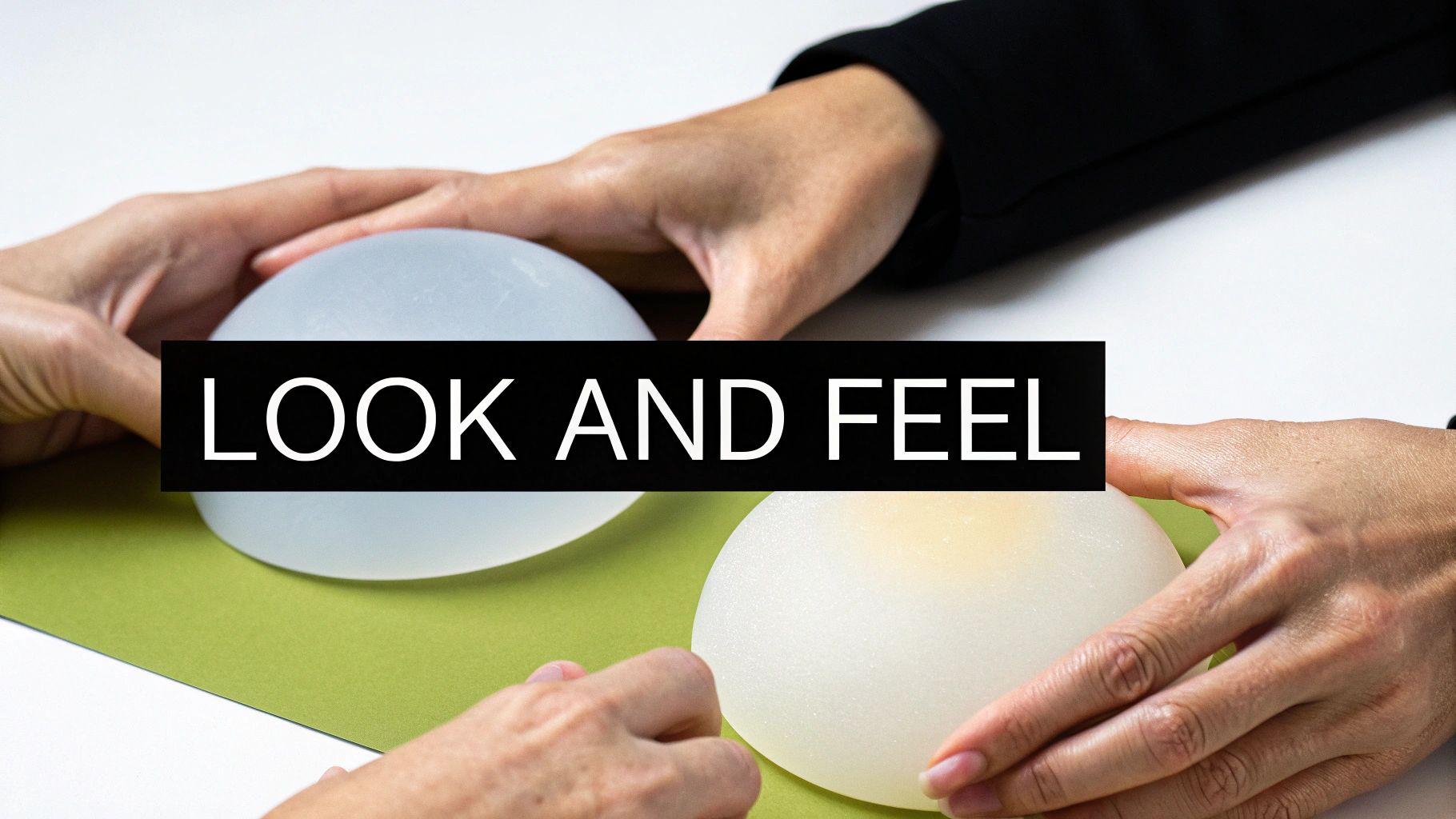
Silicone implants come pre-filled with a thick, cohesive gel that’s been expertly engineered to mimic the weight and softness of natural breast tissue. When you hold one in your hand, you can feel its gentle give and resilience. It feels remarkably similar to the real thing.
This quality makes a huge difference in how your breasts feel after surgery, both to you and to a partner. The realism also extends to how they move. Silicone implants tend to settle and shift with your body's natural movements, creating a seamless look that becomes nearly indistinguishable from a natural breast over time.
The primary goal of modern silicone gel is sensory realism. It is designed to feel soft, move naturally, and replicate the subtle weight and consistency of breast tissue.
Because of this, I often recommend silicone implants for patients who have very little existing breast tissue. The soft, cohesive gel helps mask the implant's edges, preventing that "stuck-on" look and creating a much smoother, more organic transition from the chest wall.
Saline implants, on the other hand, are placed in the body empty and then filled with sterile saltwater. This gives them a distinctly different feel. They tend to be firmer and more uniform in their consistency compared to the softness of silicone. Some patients actually prefer this firmer feel, though most agree it feels less like natural tissue.
The liquid nature of the saline can sometimes feel a bit like a water balloon. In some cases, it can even lead to "sloshing" or audible sounds with movement, although newer designs have internal structures that help minimize this.
A major aesthetic concern with saline is the potential for visible or palpable rippling. This is when the implant’s outer shell creates wrinkles or folds that you can see or feel through the skin. Rippling is more likely to happen in a few specific situations:
This chart breaks down how each implant type stacks up in key aesthetic areas.
Ultimately, the right choice really boils down to your personal priorities. If your main goal is a result that's virtually undetectable by both touch and sight, silicone often has the clear advantage. Seeing real-world results is one of the best ways to understand these differences. Take a look at our gallery of breast augmentation before and after photos to see the natural contours we can achieve. This can help you connect your own aesthetic vision with the right implant choice.
It's completely normal to have questions about the long-term safety and durability of breast implants. This is one of the most important parts of making a confident decision. While today's implants are incredibly well-engineered and built to last for years, it's important to remember they aren't lifetime devices.
Understanding how each type of implant behaves over time, especially when it comes to a potential rupture, is crucial for your peace of mind.
The good news is that both silicone and saline implants have come a long way. Manufacturers have developed much stronger, more resilient outer shells designed to handle the normal pressures of an active life. Still, a rupture can happen, and the way it's detected and handled is one of the biggest differences between silicone and saline.

The main distinction in long-term safety isn't really about the risk of a rupture itself—it's about how you find out it happened. The process for identifying a rupture is worlds apart for saline and silicone, which directly affects the follow-up care and surgical plan.
When a saline implant's shell is compromised, the sterile saltwater inside simply leaks out. Your body absorbs it completely harmlessly. The result is immediate and impossible to miss: the breast will visibly deflate, sometimes over just a few hours or days.
Because the visual cue is so obvious, the diagnosis is simple. There's no guesswork or need for expensive imaging. The solution is just as straightforward—we schedule a procedure to remove the deflated shell and, if you'd like, replace it with a new implant.
A silicone implant rupture is an entirely different story. The cohesive gel inside is thick and designed to hold its shape, so it typically stays right inside the implant shell or within the scar tissue capsule that naturally forms around it. We call this a "silent rupture" because it rarely causes any outward symptoms.
You likely wouldn't notice any change in how the breast looks or feels. This lack of obvious signs is exactly why the FDA has established specific monitoring guidelines for anyone with silicone implants. Without regular screening, a rupture could go undetected for years.
These very different rupture scenarios lead to very different long-term monitoring plans. For saline implants, routine imaging isn't necessary to check for ruptures since a leak is self-evident. For silicone, it's a more involved process.
The core difference in long-term safety management is this: Saline provides immediate visual confirmation of a rupture, while silicone relies on proactive imaging to ensure implant integrity.
To manage the risk of a silent rupture, the FDA recommends the following for patients with silicone gel implants:
These screenings are currently the only reliable way to confirm that your silicone implants are fully intact. This ongoing monitoring is a critical factor to consider, as it adds time and cost over the lifespan of the implants.
When you look at the actual rates of rupture, the numbers are surprisingly close. Data from leading manufacturers shows that at the 10-year mark, rupture rates are 13.8% for saline and 13.0% for silicone. The key takeaway here isn't the percentage, but rather the difference in ease and cost of managing that rupture when it happens. If you're interested in the details, you can explore the data on implant performance for a deeper dive.
Beyond ruptures, another long-term factor is capsular contracture. This happens when the scar tissue that your body naturally forms around the implant tightens and hardens, which can sometimes cause pain or change the breast's shape. The risk for this is similar for both implant types; it has more to do with surgical technique and your body's individual healing response than the implant material. Here at Cape Cod Plastic Surgery, Dr. Fater uses specific techniques to minimize this risk for all his patients.
Beyond the look and feel, the practical details of surgery, recovery, and cost are major factors in your decision. How does the choice between silicone and saline play out in the operating room and on your bank statement? Let's break it down.
The biggest difference in the surgical suite comes down to one thing: the incision. Saline implants have a unique advantage here. They are placed in the breast pocket while they’re still empty and then filled with sterile salt water. This smart design means the surgeon can use a noticeably smaller incision, which often translates to a less visible scar.
Silicone implants, on the other hand, arrive pre-filled with their soft, cohesive gel. This requires an incision large enough to fit the entire implant through. While the scar might be a bit longer, a skilled surgeon like Dr. Fater knows exactly how to place it. He strategically hides incisions in the natural breast crease or along the edge of the areola to make them as discreet as possible, no matter which implant you choose.
Healing after breast augmentation is a journey, not a sprint. While the overall timeline is pretty similar for both implant types, you might notice some subtle differences in how you feel. Expect some soreness, swelling, and a feeling of tightness for the first few days—that’s completely normal. We’ll make sure you have medication to manage any discomfort, which usually fades quite a bit after the first week.
No matter which implant you go with, plan on taking about 5-7 days off from work. You'll also need to steer clear of heavy lifting and intense exercise for at least four weeks to give your body time to heal properly. Some patients find that saline implants can feel a little firm or "tight" initially as they settle into place, which can cause a bit more discomfort at the very beginning. Because silicone is inherently softer, it often feels like it integrates with your body's tissues a little more quickly.
For a complete week-by-week guide on what to expect as you heal, our breast augmentation recovery timeline is a fantastic resource that walks you through the entire process.
Let's talk numbers. The financial investment is a crucial part of planning your procedure. When you compare silicone vs. saline, there's a clear difference in the initial price tag: silicone implants cost more upfront. The reason is simple—it comes down to the more complex manufacturing process and the advanced gel material inside.
Here’s a look at what goes into the final cost of your surgery:
It's smart to think long-term. While saline is more budget-friendly at the start, remember that the FDA recommends routine MRI or ultrasound screenings for silicone implants. Factoring in those future monitoring costs gives you the full financial picture.
So, what can you expect? On average, breast augmentation with saline implants typically runs between $5,500 and $7,000. For silicone implants, the price range is usually somewhere between $7,000 and $9,000. These are just estimates, of course. During your one-on-one consultation with Dr. Fater, we'll give you a detailed, personalized quote so you know exactly what to expect. No surprises.
Choosing between silicone and saline implants isn't about finding the single "best" option—it's about discovering the best option for you. This decision is deeply personal, weaving together your unique anatomy, your lifestyle, and the look you want to achieve. Let's pull everything together to help you find your perfect fit.
The conversation often boils down to a few key priorities. If a completely natural feel and appearance is at the top of your list, silicone almost always comes out ahead. The cohesive gel inside mimics the soft, subtle movement of natural breast tissue. This makes it an especially great choice if you have less of your own tissue, as it helps create a smooth, seamless contour without visible rippling.
On the other hand, many patients value straightforward, worry-free monitoring for the long haul. This is where saline implants really shine. A rupture is immediately obvious, which means you can skip the routine MRI or ultrasound screenings required for silicone. For anyone who prefers simplicity and clear-cut confirmation that their implants are intact, saline is an incredibly practical choice.
Let's look at a couple of common scenarios:
This decision tree helps visualize how different priorities—like incision size, cost, and feel—can point you in one direction or the other.
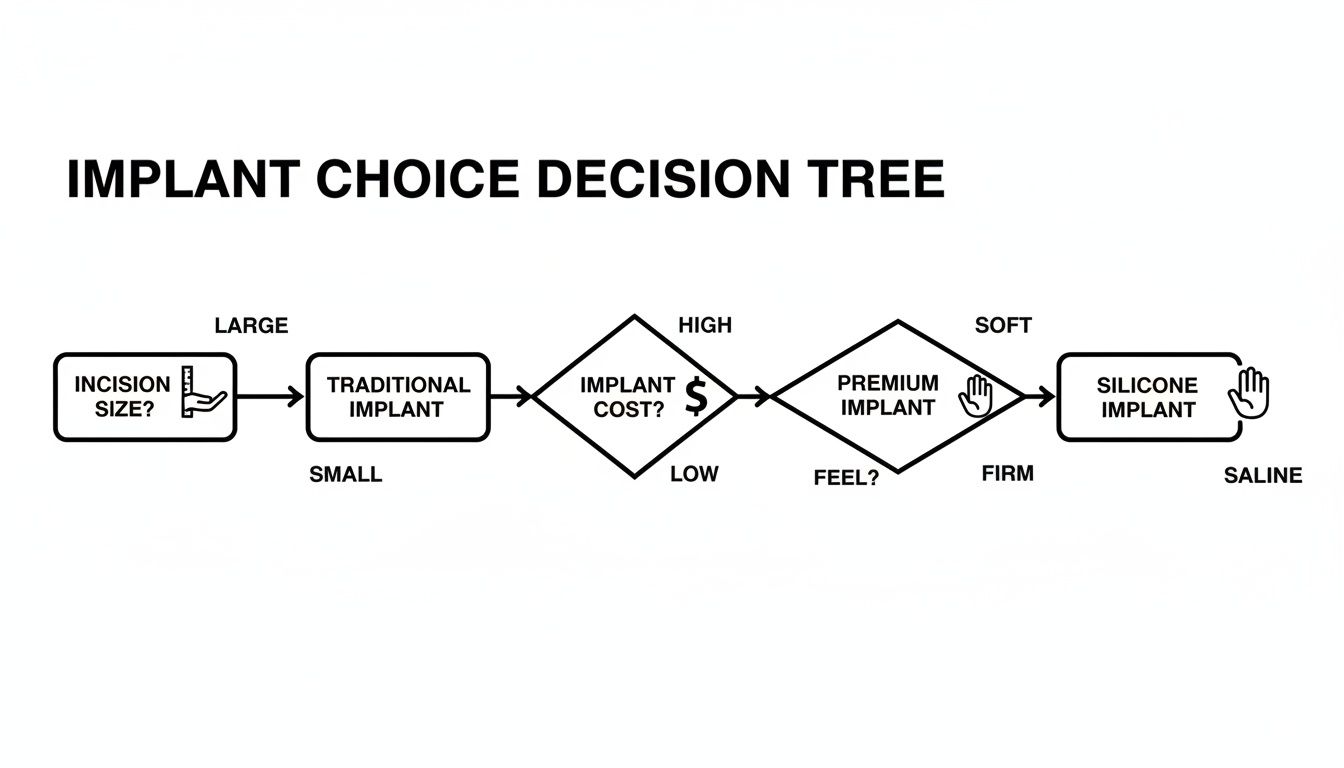
As the graphic shows, if smaller incisions and a lower initial cost are your main concerns, the path leads toward saline. If your focus is purely on achieving the most natural feel possible, silicone is the clear front-runner.
Your final decision should always be a partnership between what you want and your surgeon’s expert guidance. The goal isn't just to get a beautiful result, but to choose an implant that you feel comfortable and confident with for years to come.
Ultimately, this is a conversation you need to have with an expert. A one-on-one consultation with a board-certified plastic surgeon is the most critical step in this process. When looking for the right surgeon, their professional standing is key; you can learn more about how online reviews impact medical practices and the importance of online reputation management for doctors.
During your consultation here at Cape Cod Plastic Surgery, Dr. Marc Fater will take the time to evaluate your unique anatomy, listen carefully to your goals, and give you a personalized recommendation. We're here to ensure your final results are not only beautiful but are also the perfect match for you.
It's completely normal to have a lot of questions when you're thinking about breast augmentation. Deciding between silicone and saline implants is a big step, and I find that patients feel much more confident once they have clear, straightforward answers. Let's walk through some of the most common questions that come up in my practice.
One of the biggest myths out there is that breast implants last a lifetime. While today's implants are incredibly durable, they aren't permanent devices. Most manufacturers estimate a lifespan of about 10 to 15 years, though many women have them for much longer without any issues.
Think of them as long-term, not forever. Sometimes, a replacement is needed sooner due to a complication like a rupture or capsular contracture. Other times, it's simply a matter of a woman's body or personal tastes changing over the years.
The decision to replace implants is highly individual. It's usually driven by medical necessity or simply a personal choice. This is why regular follow-ups with your surgeon are so important—they help you monitor your implants and plan ahead.
For the vast majority of women, the answer is a resounding yes. It's absolutely possible to breastfeed after having breast augmentation surgery, regardless of whether you choose silicone or saline implants.
During the procedure, I'm extremely careful to protect the vital structures needed for milk production and delivery. Implants are typically placed behind the breast tissue or, more commonly, underneath the chest muscle. Both techniques are designed specifically to avoid disrupting the milk ducts and glands so they can function just as they did before. If breastfeeding is important to you, make sure we discuss it during your consultation.
Whenever a foreign object—like an implant—is placed in the body, a natural healing response occurs. Your body forms a soft, flexible capsule of scar tissue around it, which is perfectly normal. Capsular contracture is what happens when that capsule becomes unusually hard and tight, squeezing the implant.
This tightening can make the breast feel firm, look misshapen, or even cause discomfort or pain. It's one of the primary reasons women seek revision surgery down the road.
The risk of developing capsular contracture is pretty similar for both silicone and saline implants. The bigger influences on your risk are things like:
This is where the experience of your surgeon truly matters. Working with a board-certified plastic surgeon is your best strategy for minimizing this and other potential risks.
Your journey to achieving your aesthetic goals is a deeply personal one. Here at Cape Cod Plastic Surgery, my team and I are dedicated to guiding you with the highest level of expertise and care.
To explore your options and create a plan that's right for you, I invite you to schedule your consultation with me, Dr. Fater, today.
September 9, 2026
Expert Guide to Proper Surgical Incision Care

Master dermal fillers aftercare with do's and don'ts, swelling tips, activity limits and warning signs to protect your results and heal smoothly.

September 8, 2026
Ensuring Safety: Why Your Surgeon's Credentials Matter Most

Cape Cod Plastic Surgery offers expert cosmetic and reconstructive procedures in a safe, accredited setting. Led by Dr. Marc Fater, we combine advanced techniques with personalized care to help you look and feel your best.
Monday: 9:00 AM – 5:00 PM
Tuesday: 9:00 AM – 5:00 PM
Wednesday: 9:00 AM – 5:00 PM
Thursday: 9:00 AM – 5:00 PM
Friday: 9:00 AM – 5:00 PM