

October 7, 2026
What to Expect During Your Breast Surgery Recovery
A Practical Guide to Healing After Breast Surgery
Jul 19, 2026
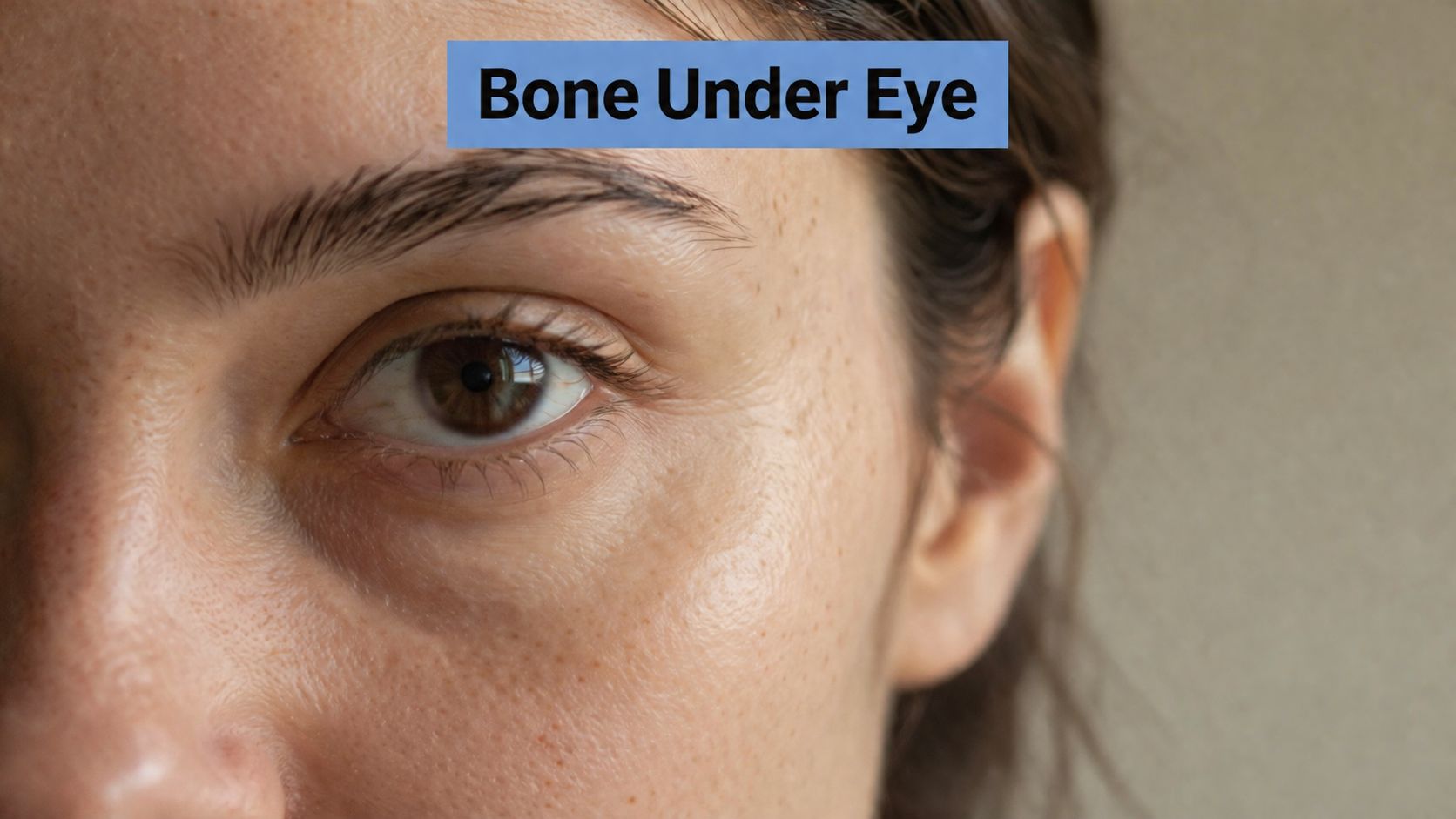
You wake up feeling fine, catch your reflection in the bathroom mirror, and wonder why your eyes look exhausted anyway. Many patients describe the same thing. They're sleeping reasonably well, drinking water, using eye cream, and still seeing a shadow or hollow that makes them look older, sadder, or more worn down than they feel.
That mismatch is frustrating because it feels like a simple problem, but the under-eye area rarely is. What people call the bone under eye, the hollow, or the tear trough often reflects changes in skin, fat, ligaments, and the facial skeleton underneath. If you only look at the surface, the treatment can miss the underlying cause.
As a plastic surgeon, I try to make this area less mysterious. Once you understand the support beneath the eye, why that support changes, and how a specialist evaluates it, the treatment choices start to make more sense. Just as important, you can avoid chasing temporary fixes for a structural issue.
A common story in consultation goes like this: “I'm not tired. I just look tired.” That sentence tells me a lot. It usually means the problem isn't poor sleep or a rough week. More often, it's a contour issue. Light hits the under-eye hollow, creates shadow, and your face reads as fatigue.
People often blame themselves first. They assume they need better sleep habits, less screen time, or a stronger concealer. Those things can help the skin look better, and a practical guide on skincare for tired eyes can be useful if puffiness and surface texture are part of the picture. But skincare can't rebuild structural support beneath the eyelid.
The lower eyelid sits at the junction of several different tissues. The skin is thin. The transition into the cheek is complex. A small change in contour can create a large visual effect.
That's why two people with similar lifestyles can look very different under the eyes. One may have smooth support from lid to cheek. Another may have a visible depression along the rim of the orbit, and that depression catches light in a way that looks like darkness.
The under-eye area often looks “dark” because of shape before color. A hollow creates shadow, and shadow reads as fatigue.
It is commonly believed that under-eye hollows come from only two things:
Once patients understand that the problem may involve bone, not just skin or fat, they stop asking for a quick fix and start asking for the right one.
I tell patients to think of the eye socket as a window frame built into the face. The eye sits within that frame, and the lower part of the frame helps support the soft tissue you see from the outside. If the frame is well positioned, the lid-cheek transition tends to look smoother. If the support is weaker or recessed, the hollow is often more visible.
The anatomy is more intricate than commonly assumed. The bony structure beneath the eye is part of the orbital cavity, which is composed of exactly seven distinct bones: the maxilla, zygomatic bone, frontal bone, ethmoid bone, lacrimal bone, sphenoid bone, and palatine bone, with the maxilla forming the primary floor of the orbit directly under the eye, as described in Kenhub's eye anatomy overview.
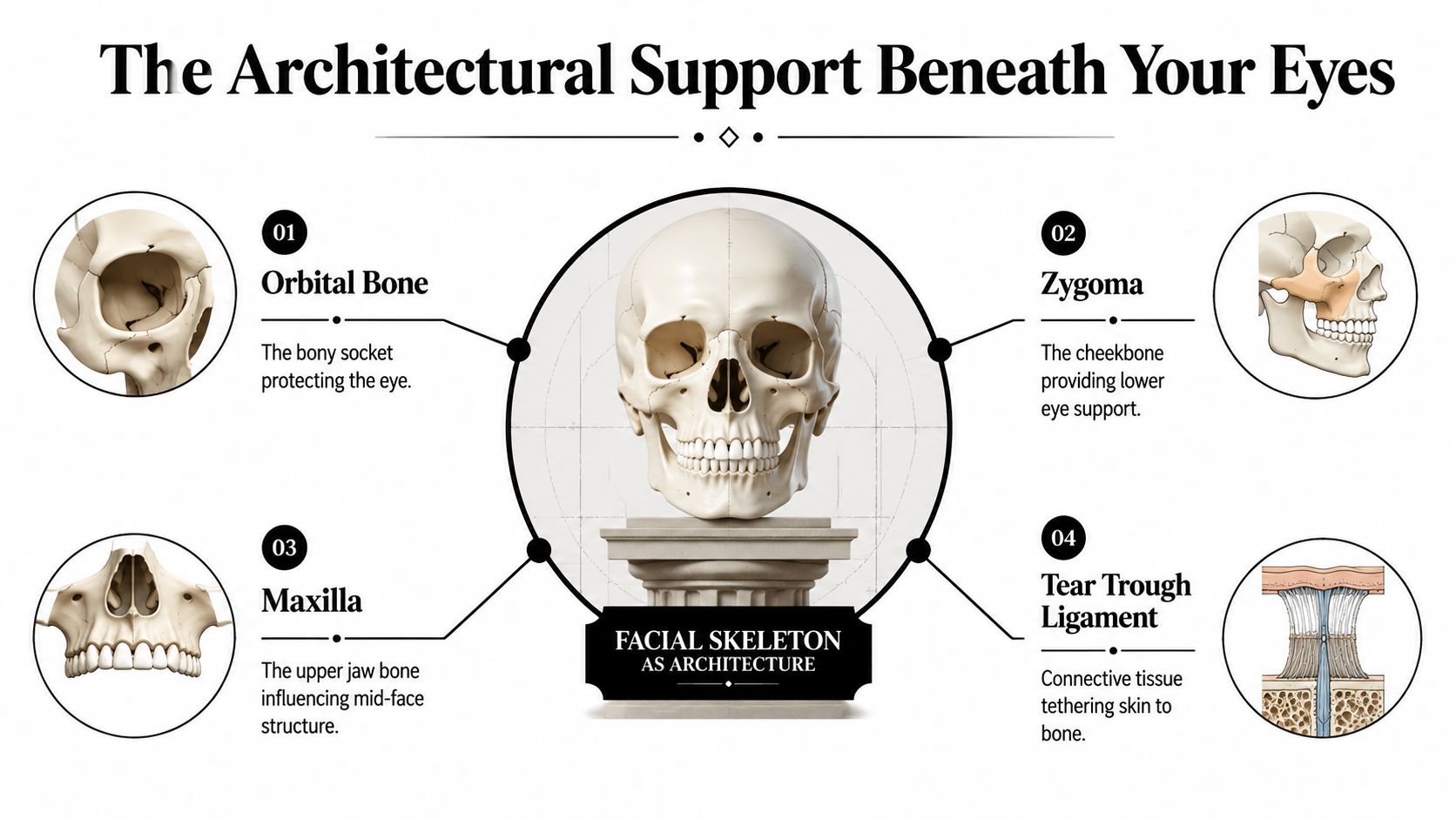
For day-to-day understanding, most patients only need to remember a few names.
These bones don't work in isolation. They create a curved socket with openings for nerves, vessels, and supporting structures. The surface isn't flat like a shelf. It's contoured, which is why under-eye correction requires nuance rather than simple “filling.”
When patients say, “I can feel the bone under my eye,” they're often noticing the infraorbital rim, the lower edge of this bony framework. In some faces it sits more forward and provides better support. In others it's more recessed, so the soft tissue above it transitions abruptly and forms a trough.
A useful analogy is a mattress on a bed frame. If the frame is broad and well supported, the mattress lies smoothly. If the frame recedes or drops back, the fabric above it dips. The under-eye area behaves similarly.
Practical rule: The under-eye contour isn't just skin stretched over emptiness. It's soft tissue draped over a shaped bony foundation.
This region also contains delicate structures tied to vision, sensation, and tear drainage. The small bones on the inner side of the orbit, particularly the lacrimal and ethmoid bones, are fragile and clinically important. That's one reason experienced injectors and surgeons treat the lower eyelid with caution. A few millimeters matter here.
Most online explanations stop too early. They say under-eye hollows come from fat loss or thinning skin, then jump straight to filler. That's only part of the story.
For many patients, the more important issue is skeletal change. Recent anatomical reviews confirm that orbital bone shrinks and recedes with age, creating a tear trough deformity that fillers alone often fail to correct without addressing the skeletal deficit, sometimes producing a puffy or unnatural look if overfilled, as explained in this review of under-eye hollowing and bone resorption.

This is the part many patients haven't heard before. As the bony support of the midface recedes, the soft tissue draped over it can look less supported, even if you haven't had dramatic weight loss and even if your skin is still in decent condition.
That means the hollow may not be a simple “empty space” that needs more product. It may be the visible result of a deeper framework change. If someone repeatedly adds filler into that area without respecting the shape of the underlying rim, the lower eyelid can start to look swollen rather than smooth.
Used carefully, filler can improve selected under-eye hollows. Used indiscriminately, it can make the area heavier. That's especially true when the main problem is weak skeletal support, prominent fat bulging, or fluid retention.
Patients with bags often confuse them with hollows. If you're trying to sort out whether the issue is shadow, swelling, or protruding fat, this explanation of what causes under-eye bags can help clarify the difference.
An under-eye hollow and an under-eye bag can sit side by side. Adding volume to a bag-dominant lower lid is one of the fastest ways to create an unnatural result.
Another common misunderstanding is that high cheekbones automatically protect you from under-eye hollowing. They don't.
Some people have attractive, high-set cheekbones and still show a deep trough because support under the eye depends on the projection of the infraorbital rim, not just cheek height. A face can look sculpted from the front and still lack forward support where the lower eyelid meets the cheek.
That distinction matters in consultation because it changes what treatment will look natural.
A proper under-eye consultation shouldn't begin with a syringe. It begins with observation. I want to know what bothers you in normal light, in photographs, and at rest. Then I examine where the issue is coming from.
I assess the under-eye area as a junction, not a single spot. That includes skin quality, lower lid tone, fat prominence, the depth of the trough, and the transition into the cheek.
I also look at support. Research indicates that under-eye support depends on the forward growth of the infraorbital rim, not the vertical height of the cheekbones, so someone can have high-set cheekbones and still have poor under-eye support, as discussed in this review of infraorbital rim projection and under-eye support.
During evaluation, I'm usually sorting patients into patterns rather than labels:
A face in motion often tells me more than a still image. Smiling can reveal how the cheek supports the lower lid. Looking up or down can show where a hollow begins and where a bulge becomes more obvious.
Good planning starts with diagnosis. If the surgeon treats every tired-looking eye as a filler problem, some patients will leave fuller but not fresher.
The best treatment plan is usually the one that names what not to do as clearly as what to do.
Treatment should match the anatomy. Mild hollowing in a younger patient with good skin is very different from an older patient with lid-cheek separation, bagginess, and reduced support. I usually discuss options in two groups: non-surgical and surgical.
To make the comparison easier, here's a visual overview.
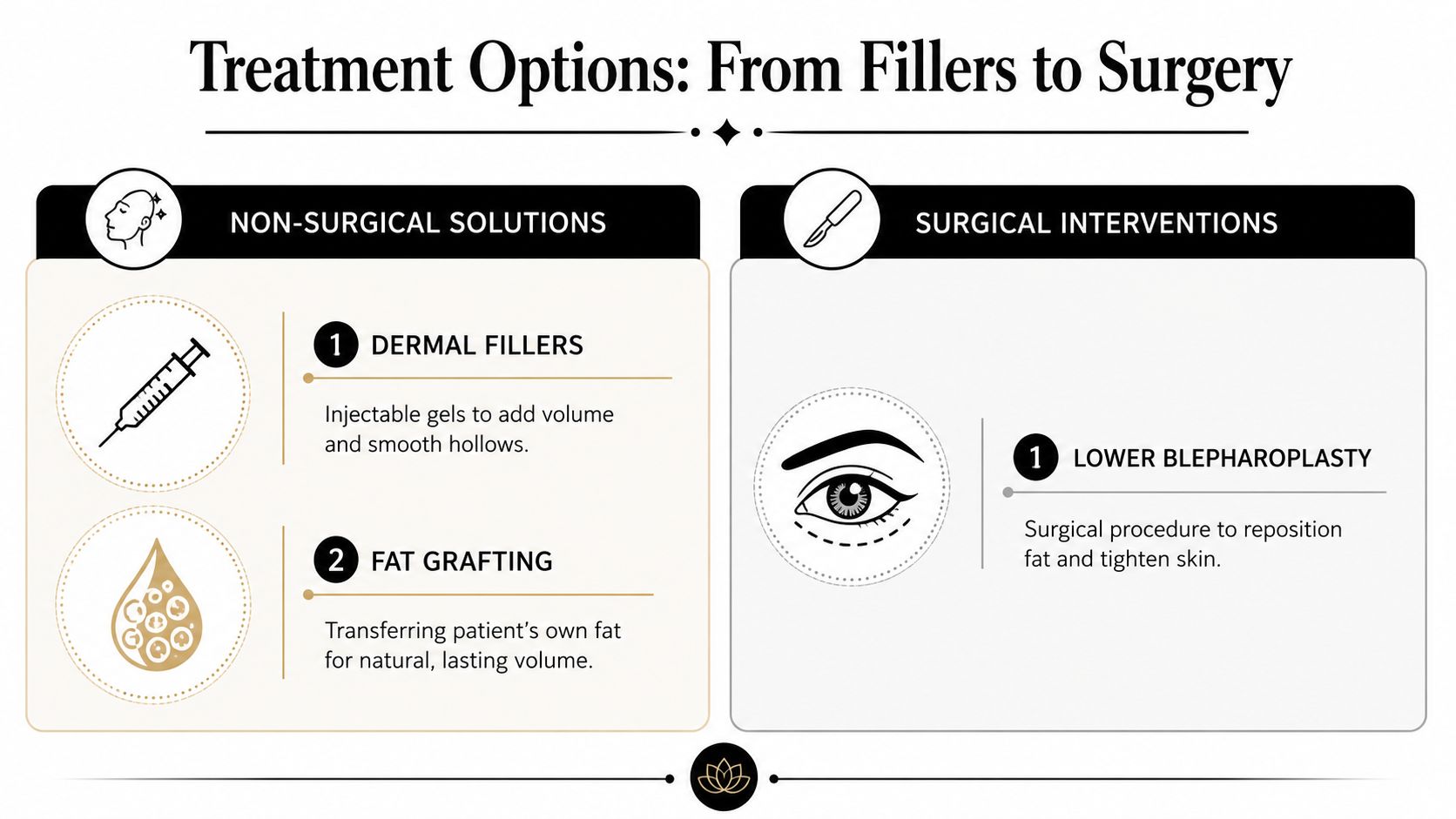
Hyaluronic acid filler can soften a true hollow in carefully selected patients. The ideal candidate usually has a visible depression without major bagging or excess skin. The injector must place small amounts with restraint because the lower lid is unforgiving.
Fat grafting uses your own tissue to restore volume. In the right patient, it can create a softer transition from eyelid to cheek and may be useful when a person wants a more structural, tissue-based approach rather than repeated filler sessions.
If you're comparing injectable approaches across facial aging concerns, this overview of non-surgical jowl lift options is a useful reminder that not every lower-face or under-eye problem responds equally well to non-surgical treatment. The principle is the same. Anatomy determines the ceiling of improvement.
For a broader patient-friendly overview, Cape Cod Plastic Surgery also offers information on dermal fillers, types, results, and safety.
Lower blepharoplasty is often the better choice when the issue is prominent fat, skin laxity, or a heavy junction between the eyelid and cheek. Surgery can reposition or address tissue in a way fillers cannot.
Structural augmentation may be considered in selected reconstructive or aesthetic cases when support under the eye is a major part of the problem. This requires careful planning because the bone itself is delicate. For orbital floor augmentation or fracture repair, the average thickness of the orbital floor bone in adult patients ranges from 0.4 mm to 0.7 mm, according to this orbital floor anatomy review. That thinness is one reason precision matters so much around the lower orbit.
A brief video can help you visualize how specialists think about this area during treatment planning.
| Approach | Best suited for | Limitation |
|---|---|---|
| Filler | Mild true hollow with good skin and minimal bagging | Can look puffy if used to compensate for poor support or bags |
| Fat grafting | Volume loss where a tissue-based approach makes sense | Requires careful technique and thoughtful patient selection |
| Lower blepharoplasty | Bags, skin laxity, mixed aging changes | It's surgery, so recovery and candidacy matter |
| Structural repair or augmentation | Selected cases with support issues or reconstructive needs | Demands high anatomical precision |
The safest treatment is not the least invasive one. It's the one that actually matches the problem.
Choosing treatment for the bone under eye area shouldn't feel like ordering from a menu. A consultation should be a conversation about anatomy, goals, tradeoffs, and safety.
At Cape Cod Plastic Surgery, that process starts with listening. Some patients want to look less tired on video calls. Others are bothered by a hollow they've noticed for years. Some arrive after filler elsewhere and feel the area looks swollen but still not right. Those are different problems, and they deserve different recommendations.

The visit should include a careful facial exam, discussion of prior treatments, and an honest explanation of what can and can't be improved. If the concern is mostly bags, you should hear that. If the issue is hollowing with limited skin change, you should hear that too.
Dr. Marc Fater is a board-certified plastic surgeon with over 30 years of experience, and the practice includes an on-site AAAASF-accredited surgical suite, which are important practical details for patients considering either non-surgical care or surgery. If you'd like a clearer picture of the process itself, this guide to what happens during a plastic surgery consultation is a useful starting point.
A thoughtful plan usually sounds measured, not dramatic. It may include one treatment, a staged approach, or no treatment at all if the likely improvement doesn't justify the risk.
In this area, “natural” usually means one thing: the result doesn't call attention to itself. The eye should look less hollow or less heavy, but still look like your eye.
Patients generally feel calmer once they understand that tired-looking eyes aren't always a skin issue and aren't always fixed with more volume. Good outcomes come from matching the plan to the structure underneath.
If you're concerned about a persistent hollow, visible bone under the eye, or a tired look that doesn't match how you feel, schedule a consultation with Cape Cod Plastic Surgery. A careful evaluation can help determine whether the issue is skin, fat, bags, support loss, or a combination, so the treatment plan fits your anatomy rather than a trend.
October 7, 2026
A Practical Guide to Healing After Breast Surgery

October 6, 2026
Your Safety Guide: What to Look for When Choosing a Plastic Surgeon

October 5, 2026
Why Our On-Site Accredited Facility Matters for Your Safety

Cape Cod Plastic Surgery offers expert cosmetic and reconstructive procedures in a safe, accredited setting. Led by Dr. Marc Fater, we combine advanced techniques with personalized care to help you look and feel your best.
Monday: 9:00 AM – 5:00 PM
Tuesday: 9:00 AM – 5:00 PM
Wednesday: 9:00 AM – 5:00 PM
Thursday: 9:00 AM – 5:00 PM
Friday: 9:00 AM – 5:00 PM