

October 6, 2026
How to Verify Your Surgeon Before Your Cosmetic Procedure
Your Safety Guide: What to Look for When Choosing a Plastic Surgeon
Jul 8, 2026

You finally did the hard part. The fullness is gone, your shape is changing, and the areas that never seemed to respond to diet or exercise look more refined.
Then a new question shows up in the mirror.
What will happen to the skin?
That concern is common after liposuction. A patient might be thrilled that the lower abdomen looks flatter or the flanks look more sculpted, but then notice that the skin seems soft, wrinkled, or not quite settled yet. That can feel confusing, especially if no one has explained the difference between fat removal and skin tightening.
Liposuction removes volume. It does not automatically guarantee that the skin above that volume will shrink perfectly. Sometimes the skin retracts beautifully on its own. Sometimes it needs support. Sometimes the right answer is a device-based treatment. And in some situations, surgery is the most honest and effective way to create a smooth final contour.
The key is understanding why skin behaves the way it does. Once you understand the biology, the recommendations start to make sense. Compression garments stop feeling like a nuisance and start feeling purposeful. Energy-based treatments stop sounding like buzzwords and start sounding like tools with a specific job. Even excisional surgery becomes easier to understand when you see what problem it's solving.
A patient comes in after liposuction and says something I hear often: “I can tell the fat is gone, but my skin doesn't look the way I expected.” Usually, what they're seeing is not a bad result. It's an unfinished healing phase.
Think of body contouring as shaping the frame first and then waiting for the outer layer to settle over it. Liposuction changes what sits underneath the skin. After that, the skin has to adapt to a new foundation. In some people, it tightens gradually and drapes smoothly. In others, it lags behind.
That's why skin tightening after liposuction matters so much. The final appearance isn't defined only by how much fat was removed. It's also shaped by how well the skin retracts, how much swelling remains, and whether the tissue underneath heals into a smooth, even layer.
The mirror often shows a recovery process, not a final result.
At this point, patients can get discouraged too early. A newly contoured area may feel firm, swollen, or slightly uneven. The skin may look loose in the morning and different by evening. That doesn't always mean something is wrong. It means healing is active.
What matters most is matching the treatment to the biology. If the skin still has good elasticity, time and supportive care may be enough. If laxity is mild but persistent, non-surgical tightening can sometimes help. If there's a true excess of skin, removing that skin may be the clearest path to a refined result.
The best decisions come from understanding the reason behind each option, not just the menu of choices.
Skin is often described as if it were just a covering, but it's more like a living fabric. It has structure, memory, and limits. Two of the main players are collagen and elastin. Collagen acts like the woven framework that gives skin strength. Elastin acts more like tiny springs that help it recoil.
When fat is removed with liposuction, the skin suddenly has less volume beneath it. The body then begins a healing response. Swelling develops first. Later, the tissues start reorganizing, fluid clears, and the skin begins to contract over the new contour.
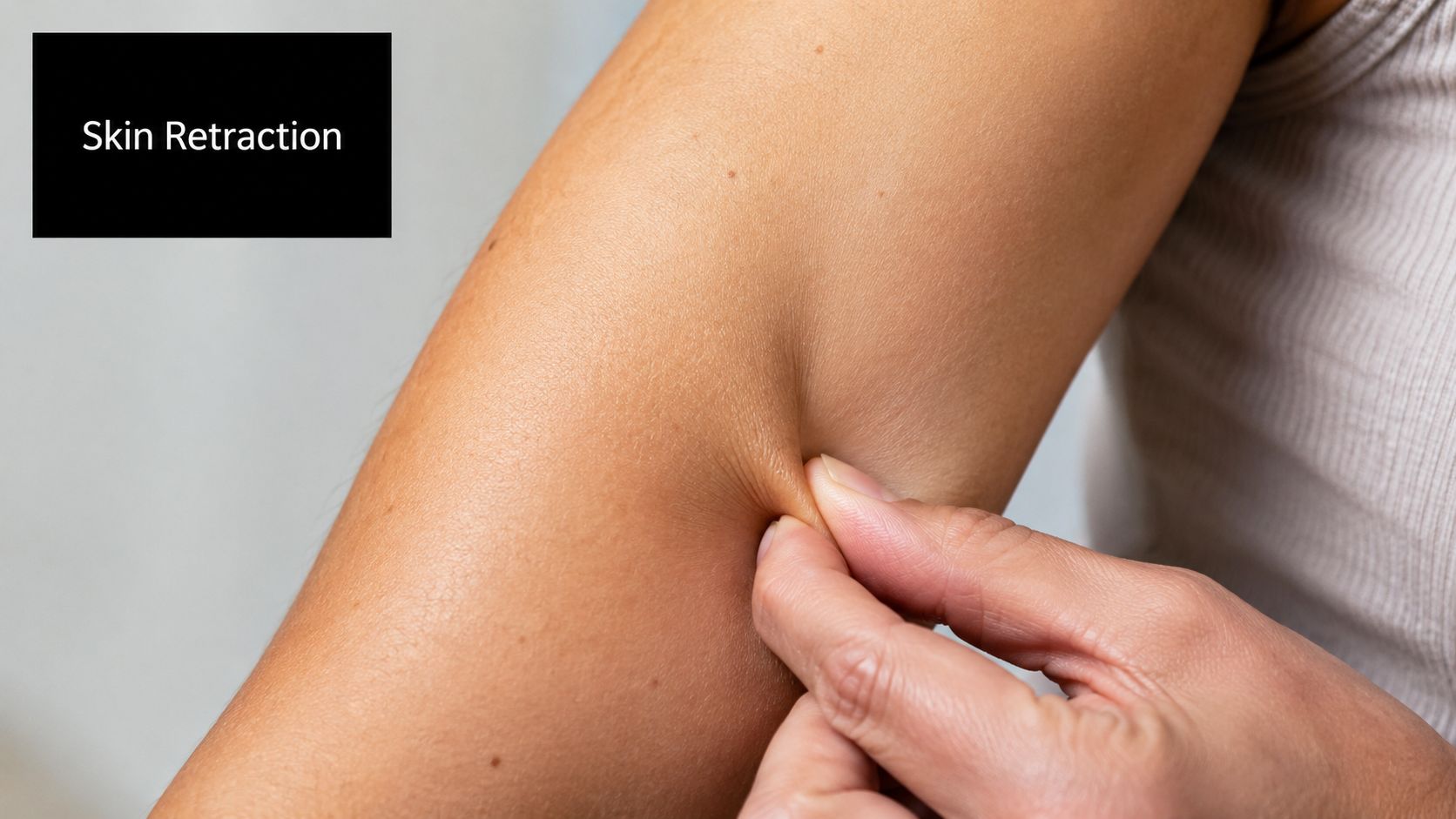
A simple way to think about this is a fitted sheet on a bed. If the mattress gets smaller overnight, the sheet won't lie perfectly flat right away. If the fabric still has strong elastic, it can pull inward and smooth out. If the elastic is worn out, the sheet bunches and sags.
Skin behaves in a similar way.
After liposuction, the body is trying to “shrink-wrap” that skin back down. Younger, thicker, healthier skin usually does this better than skin that has been stretched for a long time, damaged by sun exposure, or changed by aging, pregnancy, or weight fluctuations.
Most patients want to know when they'll see the final result. The honest answer is that skin tightening after liposuction is gradual. Early on, swelling can hide skin retraction. Later, scar tissue beneath the skin can make the area feel firmer before it softens and settles.
A fuller discussion of the healing stages can help if you're tracking daily changes during recovery. This overview of the liposuction recovery timeline gives useful context for what tends to happen as swelling improves and contour becomes clearer.
Here's the usual pattern patients notice:
Practical rule: Don't judge skin quality too early in recovery. Early swelling and tissue firmness can make skin look looser, not tighter.
Natural retraction is real, but it has limits. Skin can contract. It cannot always erase true excess. If the skin has lost too much recoil, there may be more envelope than the body can tighten on its own.
That distinction matters. It explains why some patients improve dramatically with patience and support, while others need a more active tightening strategy.
Two patients can have liposuction in the same area, by the same surgeon, and heal very differently. That isn't random. It reflects the quality of the skin going into the procedure and the demands placed on that skin afterward.
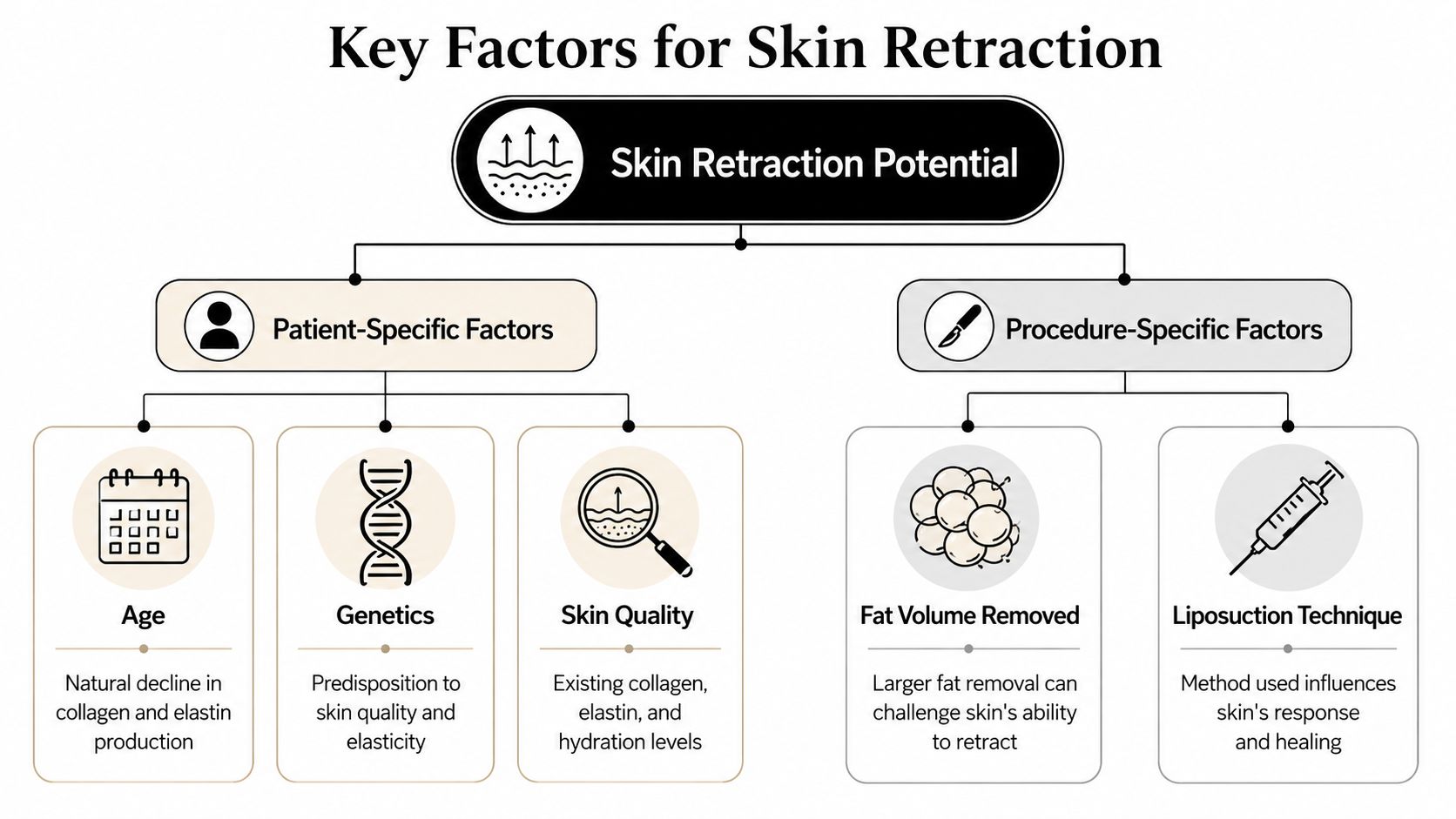
If I had to simplify the conversation into one idea, it would be this: the skin can only retract according to the elasticity it has left.
Most important point: Good skin elasticity is the single strongest predictor of a smooth result without additional tightening procedures.
Age affects this, but age isn't the whole story. Some people in midlife have excellent skin tone. Some younger patients already have laxity because of weight changes, stretch marks, or inherited skin qualities.
Three patient-specific factors often carry the most weight:
Not all skin is built the same way. Some areas have thicker dermis, better support from surrounding tissues, or naturally stronger recoil. Other areas are notoriously less forgiving.
A simple comparison helps:
| Area | Typical skin behavior |
|---|---|
| Upper back or flanks | Often retracts better because the skin tends to be thicker and better supported |
| Abdomen | Can vary widely, especially after pregnancy or weight loss |
| Inner thighs | More prone to laxity because the skin is thinner and often less elastic |
| Upper arms | Common trouble spot when skin has already begun to loosen |
That's why two areas on the same patient can respond differently. The lower back may tighten nicely, while the inner thigh may still look crepey or loose.
The skin isn't only reacting to the presence or absence of fat. It's reacting to the size of the change.
When more volume is removed, the skin has more distance to travel inward. If that skin already has limited recoil, larger changes can make laxity more visible. Sometimes a modest fat reduction gives a better contour than aggressive fat removal in an area with poor support.
Other procedure-related details also matter:
Smoking, poor nutrition, and unstable weight all work against healthy tissue repair. Skin that's trying to retract needs blood flow, building blocks for collagen, and time without repeated stretching.
If a patient continues to gain and lose weight after surgery, the skin keeps getting pulled in opposite directions. That makes a crisp final contour harder to maintain.
Patients often feel powerless during recovery, but this is the part where your day-to-day habits matter. You can't change your genetics after surgery, but you can support the environment your skin needs to heal and settle well.
Compression isn't just about “holding everything in.” A well-fitted garment applies consistent pressure to a healing area. That pressure helps control swelling, limits fluid accumulation, and supports the skin while it adheres to the tissues underneath.
Think of wallpaper being smoothed onto a wall. If there's air or fluid trapped beneath it, it won't lie flat. Compression helps reduce that gap so the skin can re-drape more evenly.
Patients sometimes stop wearing their garment because it feels annoying once the first phase of recovery passes. That's understandable, but this is often when support still matters.
A compression garment doesn't tighten skin by itself. It creates conditions that help the skin settle better.
Skin tightening after liposuction depends on healing. Healing requires protein, micronutrients, and hydration. Your body has to repair tissue, reorganize collagen, and clear inflammation. It can't do that well if it's underfed or dehydrated.
You don't need a complicated recovery diet. You need consistency.
Exercise doesn't shrink loose skin directly, but building the muscle under an area can improve how that area looks. A firmer foundation can make mild laxity less noticeable.
This is especially relevant in the abdomen, arms, and thighs. If the skin has only a small amount of looseness, improved muscle tone can make the contour look tighter and more athletic. The important point is timing. Exercise has to match your surgeon's recovery instructions so you don't create more swelling too early.
Some patients heal well after liposuction but are left with a little extra looseness. Not enough skin for a lift. Too much to ignore. In such cases, non-surgical or minimally invasive tightening can make sense.
The basic principle is controlled energy. These treatments deliver heat or focused energy into deeper layers of tissue. That heat causes collagen fibers to contract and can stimulate a longer remodeling response. The result is gradual tightening, not an instant dramatic shrinkage.

| Treatment | How it works | Best fit |
|---|---|---|
| Radiofrequency | Heats deeper skin and soft tissue to encourage collagen contraction and remodeling | Mild to moderate laxity with decent baseline skin quality |
| Ultrasound | Delivers focused energy at targeted depths beneath the skin | Patients who need deeper tissue support without skin excision |
| Advanced laser treatments | Use light-based energy to heat tissue and stimulate renewal at surface and deeper levels | Patients who want textural improvement along with some tightening |
Radiofrequency is one of the most common categories patients hear about, and for good reason. It's designed around heat. Heat changes collagen. That makes RF especially relevant when the goal is to firm skin that still has some ability to respond.
Ultrasound works differently. It can target tissue at specific depths, which may be useful when the laxity isn't only superficial. Laser-based treatments vary more widely, but some can improve both skin texture and a modest degree of firmness.
For patients who want a plain-language explanation of one device-centered approach, this Plastic and Cosmetic Center Tightlase guide is a helpful example of how practices describe non-invasive tightening technology and who may benefit from it.
A broader look at non-invasive skin tightening options can also help you sort out where these treatments fit relative to surgery.
The best candidate usually has mild to moderate laxity, not hanging excess skin. The skin should still have some inherent elasticity. These treatments are helpers, not magicians.
Patients get frustrated when they expect a device to do the job of a lift. That's the wrong matchup. A device can stimulate contraction and remodeling. It cannot remove a true fold of extra skin.
This short video gives a useful visual overview of how energy-based tightening is often discussed in practice.
These treatments tend to improve firmness gradually over time as collagen remodels. The improvement is often best thought of as a refinement. Smoother. Tighter. Better supported.
Non-surgical tightening works best when the problem is tissue laxity, not excess tissue volume.
That distinction protects patients from disappointment. If your skin only needs a nudge, energy-based treatment may be appropriate. If your skin needs to be physically removed, no heating technology can substitute for that.
There are times when the most compassionate answer is also the most direct one. If there is a meaningful excess of skin after liposuction, surgery is often the best solution.
That doesn't mean liposuction failed. It means liposuction addressed the fat, and now a different tool is needed to address the skin.

Skin excision changes the equation because it removes the extra envelope. A tummy tuck removes excess abdominal skin and can tighten the deeper abdominal layer at the same time. An arm lift removes loose skin that hangs from the upper arm. A thigh lift addresses skin that won't shrink adequately on its own.
That's distinctly different from asking the skin to contract. Instead of hoping the fabric pulls tighter, surgery tailors the fabric to fit.
This is why surgery remains the gold standard for significant laxity. It solves the problem at its source.
A few patterns tend to point toward a surgical answer:
Some patients also explore technology-assisted options that combine fat reduction and internal tightening. If you're trying to understand where these fit on the spectrum, this overview of how surgeons achieve natural-looking BodyTite results offers a useful example of how one practice discusses that category.
For patients specifically considering excisional treatment, this explanation of excess skin removal surgery can help clarify how these procedures differ from non-surgical tightening.
Surgery for loose skin isn't a backup plan. In the right patient, it's the right plan from the start.
The tradeoff is straightforward. Surgery can deliver the most visible improvement for excess skin, but it does so by creating scars. That tradeoff is often worth it when the loose skin itself is the feature that bothers you most.
Most patients do well when they stop asking, “What's the least invasive thing possible?” and start asking, “What will solve the problem I have?” Those are not always the same question.
A few questions come up in nearly every consultation.
Usually, it's wise to let the initial healing phase declare itself before judging the final skin result. Skin tightening after liposuction often continues as swelling subsides and tissues soften. If laxity still seems present later in recovery, that's the time for a focused evaluation.
Exercise can improve muscle tone and make mild laxity look better, but it won't remove extra skin. It helps the foundation. It doesn't cut away the excess cover.
Yes. Any excisional procedure creates scars because skin has to be removed through an incision. The main question is whether the improvement in contour is worth that tradeoff for you personally.
The easiest test is this. If the skin seems mildly loose but not hanging, a non-surgical option may be reasonable. If there is visible excess that folds, drapes, or bunches, surgery is often the more honest answer. For another patient-friendly overview of ways to tighten loose skin following liposuction, it can help to see how another practice frames that same decision.
The most important takeaway is that there isn't one standard path. The right plan depends on your skin quality, the area treated, your goals, and how your body heals.
If you're weighing your options and want a personalized recommendation, schedule a consultation with Cape Cod Plastic Surgery. Dr. Marc Fater can evaluate your skin quality, contour goals, and recovery stage to help you decide whether time, non-surgical treatment, or surgery is the best next step.
October 6, 2026
Your Safety Guide: What to Look for When Choosing a Plastic Surgeon

October 5, 2026
Why Our On-Site Accredited Facility Matters for Your Safety

October 2, 2026
Beyond the Calendar: How to Know You’re Truly Ready for Plastic Surgery

Cape Cod Plastic Surgery offers expert cosmetic and reconstructive procedures in a safe, accredited setting. Led by Dr. Marc Fater, we combine advanced techniques with personalized care to help you look and feel your best.
Monday: 9:00 AM – 5:00 PM
Tuesday: 9:00 AM – 5:00 PM
Wednesday: 9:00 AM – 5:00 PM
Thursday: 9:00 AM – 5:00 PM
Friday: 9:00 AM – 5:00 PM