

October 7, 2026
What to Expect During Your Breast Surgery Recovery
A Practical Guide to Healing After Breast Surgery
May 31, 2026

The surgeon's fee is only the starting point. In cosmetic surgery, the final bill is often 50% to 100% higher once anesthesia, facility, and related fees are added, which is why a quoted fee can look far lower than what you will pay.
If you're researching cosmetic surgery cost right now, you've probably already run into the same problem most patients do. One site lists a single number, another gives a wide range, a third says “starting at,” and none of them make it clear what's included.
That confusion isn't accidental. Cosmetic surgery is not a single item with a shelf price. It's a medical service built from several parts, and the true cost depends on the procedure, the surgical setting, the materials used, the anesthesia plan, and the care wrapped around the operation.
On Cape Cod, many patients want something simple and reasonable. They want a clear quote, a safe setting, and no unpleasant surprises later. That's a sensible way to approach surgery.
A typical search starts with a practical question: “How much does a tummy tuck cost?” or “What does breast augmentation cost near me?” The answers online often look precise at first. Then you notice the fine print. One figure refers only to the surgeon. Another excludes anesthesia. Another says implants are separate. Another doesn't say anything at all.
That's why online price lists so often frustrate patients. They appear to answer the question, but they usually answer only part of it.
Cosmetic surgery cost is usually a bundle, not a single charge. A facelift, breast procedure, or body contouring operation involves professional judgment before surgery, the operation itself, anesthesia, the surgical facility, and follow-up care afterward. If a website shows only one piece of that bundle, the number may be technically true but practically misleading.
Patients often assume they're comparing equal quotes when they aren't. One practice may quote only the surgeon's fee. Another may include the facility but not garments or implants. A third may present a “starting price” for the simplest version of a procedure, even though your anatomy or goals call for something different.
Practical rule: If a quoted price doesn't clearly state what it includes, it isn't a reliable basis for comparison.
A personalized consultation isn't just about aesthetics. It's the only way to price surgery responsibly. Two patients asking for “liposuction” may need very different operative plans. The same is true for rhinoplasty, breast surgery, or facial rejuvenation.
That's also why generic online lists should be treated as rough orientation, not as a final answer. They can help you understand the market, but they can't tell you what your surgery will cost until someone evaluates your goals, medical history, and treatment plan in detail.
For most patients, the most useful quote isn't the lowest number online. It's the quote that explains the full investment clearly and up front.
National averages can be helpful if you use them correctly. They give you a starting point, but they don't tell you what your actual quote will be. The biggest reason is simple: many published averages focus on the surgeon's fee, while patients pay the total cost.
Here's a practical way to read the national data.
| Procedure | Average Surgeon's Fee | Estimated Total Cost |
|---|---|---|
| Breast augmentation | $4,875 | $6,992 |
| Liposuction | $3,637 | $8,774 |
| Tummy tuck | $6,154 | $11,917 |
These figures come from plastic surgery cost statistics and average prices by procedure, which compares surgeon-only fees with fuller estimates that include items such as implants, anesthesia, and facility expenses.
The lesson is more important than any one number. A breast augmentation may be quoted around $4,875 for the surgeon's fee but estimated around $6,992 overall. Liposuction may average $3,637 for the surgeon and reach $8,774 total. A tummy tuck may be $6,154 for the surgeon and $11,917 overall. Those gaps are not small add-ons. They change the final budget by thousands of dollars.
Patients sometimes ask whether these averages are “good” or “bad.” The better question is whether the quote in front of you is complete. A lower headline number can mean more costs are being left out until later.
That pricing problem isn't unique to medicine. If you've ever compared personal care services, home improvement, or automotive work, you've seen the same issue. A posted base price doesn't always reflect the full appointment or final invoice. Even outside medicine, resources like understanding manicure expenses for your salon can be useful because they show how listed prices and real-world totals often differ once service details are clarified.
National averages are useful for context. They're poor tools for making a final decision unless you know exactly what the quote includes.
If you're comparing procedures online, train your eye to look for three things:
Patients make better decisions when they stop asking, “What's the cheapest number I can find?” and start asking, “What is the full cost of doing this safely and properly?”
A cosmetic surgery quote works a lot like the budget for a custom home. The architect's fee matters, but it's only one part of the final price. You also need the site, the builders, the materials, the support team, and the finishing work that makes the project complete and safe.
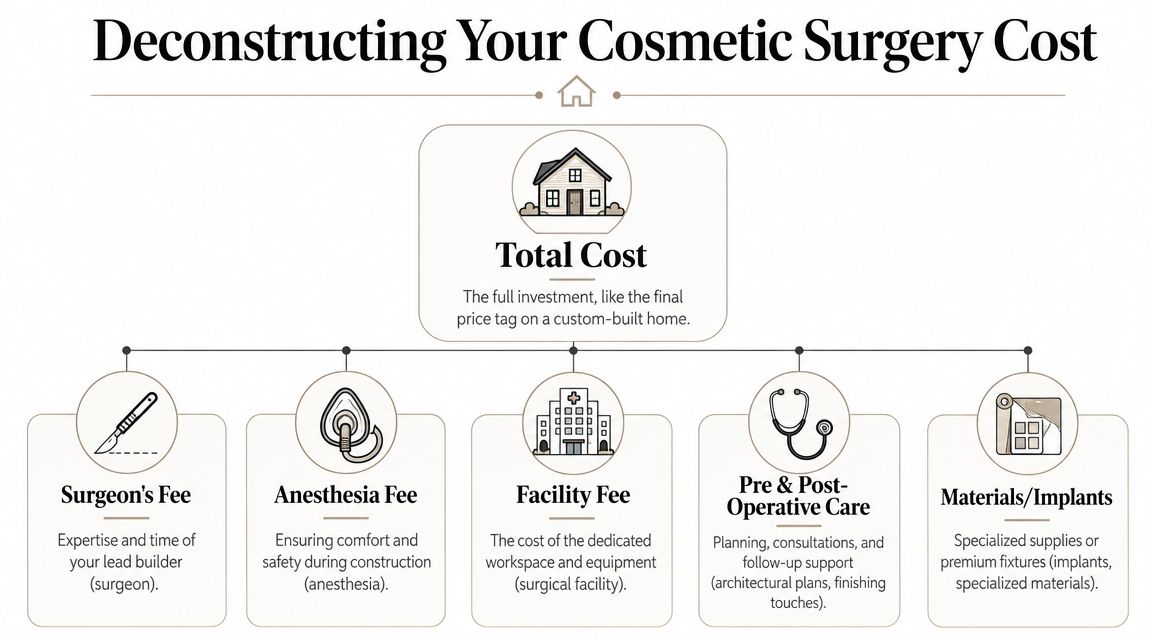
The surgeon's fee covers the physician's training, judgment, operative planning, and technical execution. Patients naturally focus on this number because it's the one most often advertised. But it is not the whole project.
According to WebMD's overview of financing cosmetic surgery, the total bill is often 50% to 100% higher than the surgeon's fee because anesthesia, operating-room or facility charges, and related expenses are added. The same source cites ASPS data showing typical U.S. surgeon fees such as $9,281 for facelift and $6,324 for rhinoplasty. That's exactly why a headline fee can create false expectations if the facility model isn't explained up front.
A complete quote usually includes several layers of care:
When one practice presents these items as a single all-inclusive number and another breaks them into separate moving parts, the first quote may look higher even when it is clearer and easier to budget.
What works is a quote that states exactly what the patient is paying for. What doesn't work is a low base fee that leaves room for surprise charges later.
Here's the simplest way to evaluate a quote:
| Quote style | What it tells you |
|---|---|
| Single surgeon's fee only | Very little about the final bill |
| “Starting at” pricing | Only a rough entry point |
| Itemized but incomplete estimate | Better than a headline fee, but still limited |
| Personalized all-inclusive quote | The clearest basis for decision-making |
A clear quote protects the patient as much as it informs the patient.
When patients understand each component of cosmetic surgery cost, they stop feeling like the numbers are arbitrary. The quote becomes easier to evaluate because they can see what is being purchased, and why.
Even when two patients ask for the same procedure, their quotes may differ. That doesn't mean someone is being overcharged. It usually means the treatment plan, setting, or surgical complexity is different.

One of the clearest cost drivers is where surgery takes place. An analysis summarized in the economics of plastic surgery cost trends and value found that between 2009 and 2017, total expenses for outpatient plastic and reconstructive surgeries rose by 23%, while average out-of-pocket spending increased from $121 to $184, a 52% jump. The same analysis found that procedures performed in outpatient hospitals added about $1,999 to total costs compared with office-based surgery, and ambulatory surgical centers added about $1,698.
Those differences matter. The surgical setting affects staffing, equipment overhead, scheduling logistics, and the final amount a patient sees on the bill.
When quotes differ, these are often the reasons:
A safe office-based surgical suite can be an efficient option when the patient and procedure are appropriate for that setting. Cape Cod Plastic Surgery uses an on-site, AAAASF-accredited surgical suite, which is one example of how a practice can offer privacy, control, and cost clarity without routing every patient through a hospital facility model.
The right setting is not always the lowest-cost setting. Safety comes first. The question is whether the quote reflects the appropriate environment for your procedure and medical needs.
Some patients also look beyond the local market and consider traveling. This short discussion may help if you're weighing procedure options and price variables before consulting a surgeon:
The most useful comparison is not surgeon versus surgeon in isolation. It's surgeon, setting, anesthesia, support, and follow-up as one package.
Patients usually feel more comfortable once the pricing process becomes concrete. A reliable quote doesn't start with a discount or a vague range. It starts with a careful evaluation.
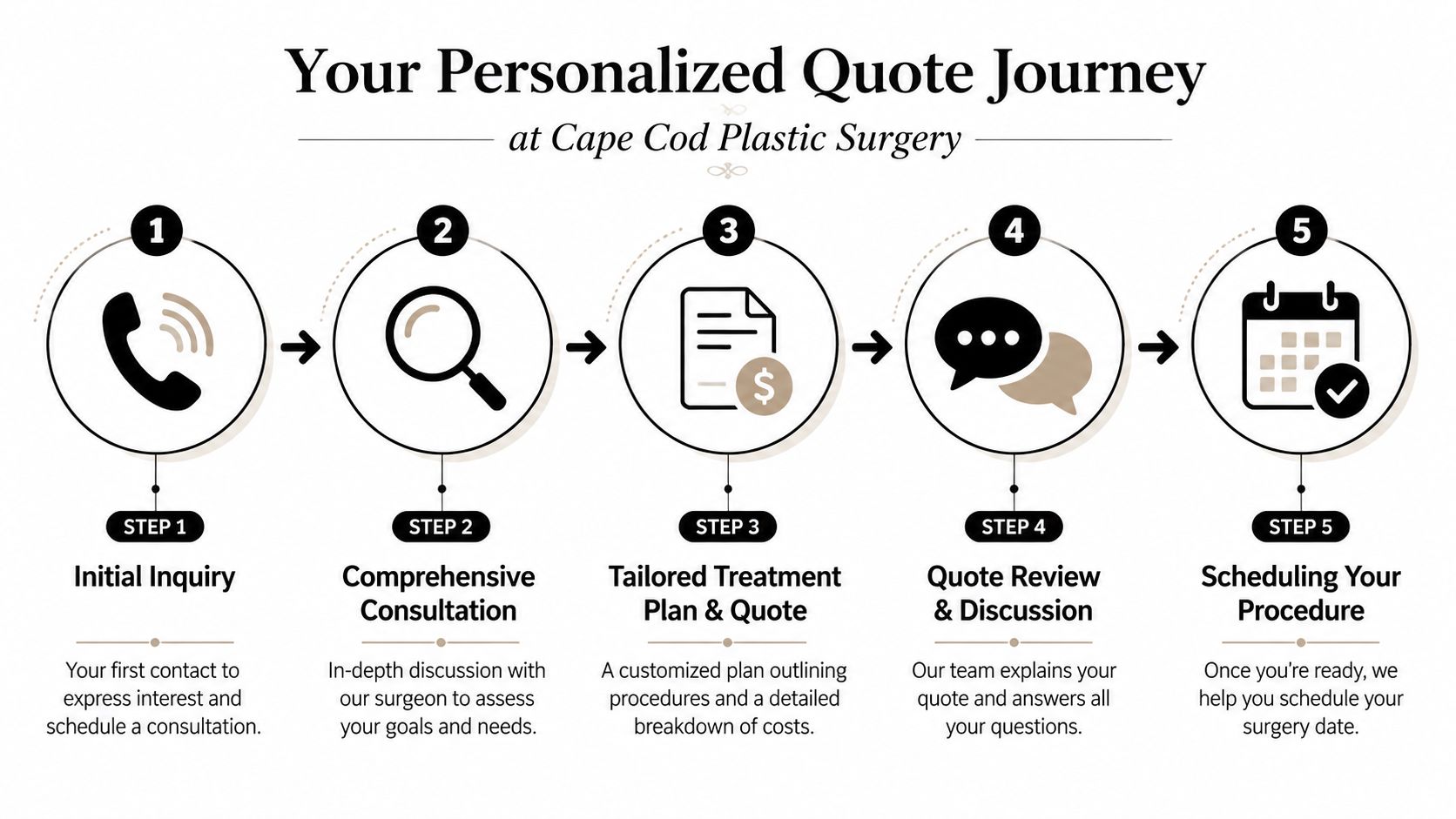
A sound quote process usually follows a clear sequence:
Initial inquiry
You describe the procedure or concern you're considering, and the office helps determine whether a consultation is the right next step.
Detailed consultation
The surgeon evaluates your anatomy, goals, medical history, and whether surgery is appropriate.
Personalized treatment plan
The procedure is defined in practical terms. That may include details about technique, implants or materials, anesthesia, and expected recovery support.
Quote review
The financial discussion should match the treatment plan. Patients should understand what is included, what is not, and what questions still need to be answered.
Scheduling when you're ready
Surgery should be booked after the medical and financial pieces make sense, not before.
Patients who want to know what happens before the pricing discussion often find it helpful to review what happens at an initial plastic surgery consultation and how to prepare.
One of the most important financial truths in cosmetic surgery is that a low upfront price can hide larger risk. An academic-center analysis discussed by UT Southwestern reported complication-management costs ranging from $15,000 to $150,000, typically paid out of pocket, in cases involving discount cosmetic surgery and related follow-up treatment, as described in their discussion of discount surgery and travel risks.
That doesn't mean higher cost automatically means better care. It does mean the cheapest quote can be misleading if it leaves out the quality of the surgical plan, the credentials of the surgeon, the facility standards, or the support available if recovery doesn't go as expected.
A personalized quote is not a sales formality. It's part of risk management.
A patient who receives a complete quote from a trusted local practice is in a stronger position than a patient trying to reverse-engineer a bill from scattered online numbers. Transparent pricing won't eliminate every variable in surgery, but it does reduce confusion and helps patients make deliberate choices.
Most elective cosmetic procedures are paid for out of pocket. That surprises some patients at first, especially if they're used to medical care flowing through insurance. Cosmetic surgery usually works differently because the purpose is aesthetic improvement rather than treatment of a covered medical condition.
Insurance may be relevant when a procedure has a reconstructive or medically necessary component. That can happen in selected situations, but coverage depends on documentation, medical criteria, and the insurer's own review process.
For purely cosmetic surgery, it's better to start with the expectation that you'll be responsible for the cost yourself. That mindset leads to clearer planning and fewer last-minute surprises.
Most patients approach payment in one of three ways:
If you're exploring that route, financing options for cosmetic surgery can help you understand how practices commonly structure the process and what questions to ask before applying.
Before choosing a payment path, ask these questions:
Financing can be a practical tool. It works best when the surgical plan is settled, the quote is transparent, and the patient has enough room in the budget to recover comfortably.
Because you're not always comparing the same thing. The surgeon's training, the setting, the anesthesia model, and the complexity of the operation all affect the number. Some quotes are also more complete than others.
No. Price alone doesn't guarantee anything. The better markers are board certification, a thoughtful consultation, appropriate facility standards, a clear plan, and honest communication about limitations and recovery.
That depends on why the revision is needed and on the practice's policies. Routine follow-up is usually part of standard postoperative care, but revision surgery is a separate issue and should be discussed directly before surgery. The most practical step is to ask how revisions, facility charges, and anesthesia charges are handled if additional surgery is ever needed.
Ask about revision policy before you book, not after you're disappointed.
Occasionally a lower quote reflects efficiency and a lean practice model. More often, a very low quote reflects omitted costs, a narrower service package, or a setting that doesn't offer the same continuity of care. Value comes from transparency, safety, access to your surgeon, and a plan that fits your needs.
Travel can look attractive on paper. But distance changes follow-up, convenience, and what happens if concerns arise after surgery. For many patients, having a local surgeon and local postoperative support is part of the value equation, not an extra.
Yes. Cosmetic surgery is elective, so the financing choice should fit your broader financial life. If you're unsure how borrowing may affect future plans, a general resource on how credit impacts your financial future can help frame that decision before you apply.
The most sensible approach to cosmetic surgery cost is not chasing the smallest advertised number. It's understanding the full quote, the quality of care behind it, and the long-term financial implications of the choice you make.
If you'd like a clear, personalized discussion of your options, Cape Cod Plastic Surgery offers consultations that focus on the procedure you're considering, what your quote includes, and whether the plan makes sense for your goals, safety, and budget.
October 7, 2026
A Practical Guide to Healing After Breast Surgery

October 6, 2026
Your Safety Guide: What to Look for When Choosing a Plastic Surgeon

October 5, 2026
Why Our On-Site Accredited Facility Matters for Your Safety
Cape Cod Plastic Surgery offers expert cosmetic and reconstructive procedures in a safe, accredited setting. Led by Dr. Marc Fater, we combine advanced techniques with personalized care to help you look and feel your best.
Monday: 9:00 AM – 5:00 PM
Tuesday: 9:00 AM – 5:00 PM
Wednesday: 9:00 AM – 5:00 PM
Thursday: 9:00 AM – 5:00 PM
Friday: 9:00 AM – 5:00 PM