

October 6, 2026
How to Verify Your Surgeon Before Your Cosmetic Procedure
Your Safety Guide: What to Look for When Choosing a Plastic Surgeon
Dec 8, 2025
A partial tummy tuck isn't a "one-size-fits-all" solution. It's a highly specialized body contouring procedure fine-tuned to remove excess skin and stubborn fat from a very specific area: the lower abdomen, right below the belly button.
Think of it as a less extensive, more targeted alternative to a full tummy tuck. For the right person, it means a shorter, more discreet scar and a much quicker return to daily life, all while achieving beautiful, natural-looking results.
Let's use an analogy. If a full tummy tuck is like reupholstering an entire couch, a partial tummy tuck—often called a mini tummy tuck—is like expertly fixing just the lower cushion. It’s designed to address that one specific problem area: the persistent pouch of skin and fat below the navel that just won't budge, no matter how much you diet or exercise.
A key difference is that this procedure doesn't involve moving the belly button. We also typically don't need to perform extensive muscle tightening, which sets it apart from more comprehensive abdominoplasty techniques. To get a better sense of where this fits into the world of cosmetic procedures, you can explore a complete guide to aesthetic medicine and see the full spectrum of options available today.
Choosing the right procedure is everything, and the success of a partial tummy tuck hinges on careful patient selection. This isn't a tool for weight loss; it’s a refining surgery for people who are already at or near their goal weight but need help with that last little bit.
The best candidates usually have a few things in common:
The very first step is to get clear on what you want to achieve. Take a good look in the mirror. Are you bothered by a small, persistent "pooch" just below your navel? Or do you see loose skin and muscle weakness across your entire abdomen, both above and below your belly button?
This distinction is what will guide our conversation during your consultation. To help you think it through, here’s a quick way to see if your goals align with what a mini tummy tuck can deliver.
The demand for targeted procedures like the partial tummy tuck is on the rise. In fact, the United States accounts for roughly 22% of all cosmetic procedures performed globally. This trend shows that more and more people are looking for effective solutions that offer significant improvements without the extensive recovery and scarring of older, more invasive surgeries.
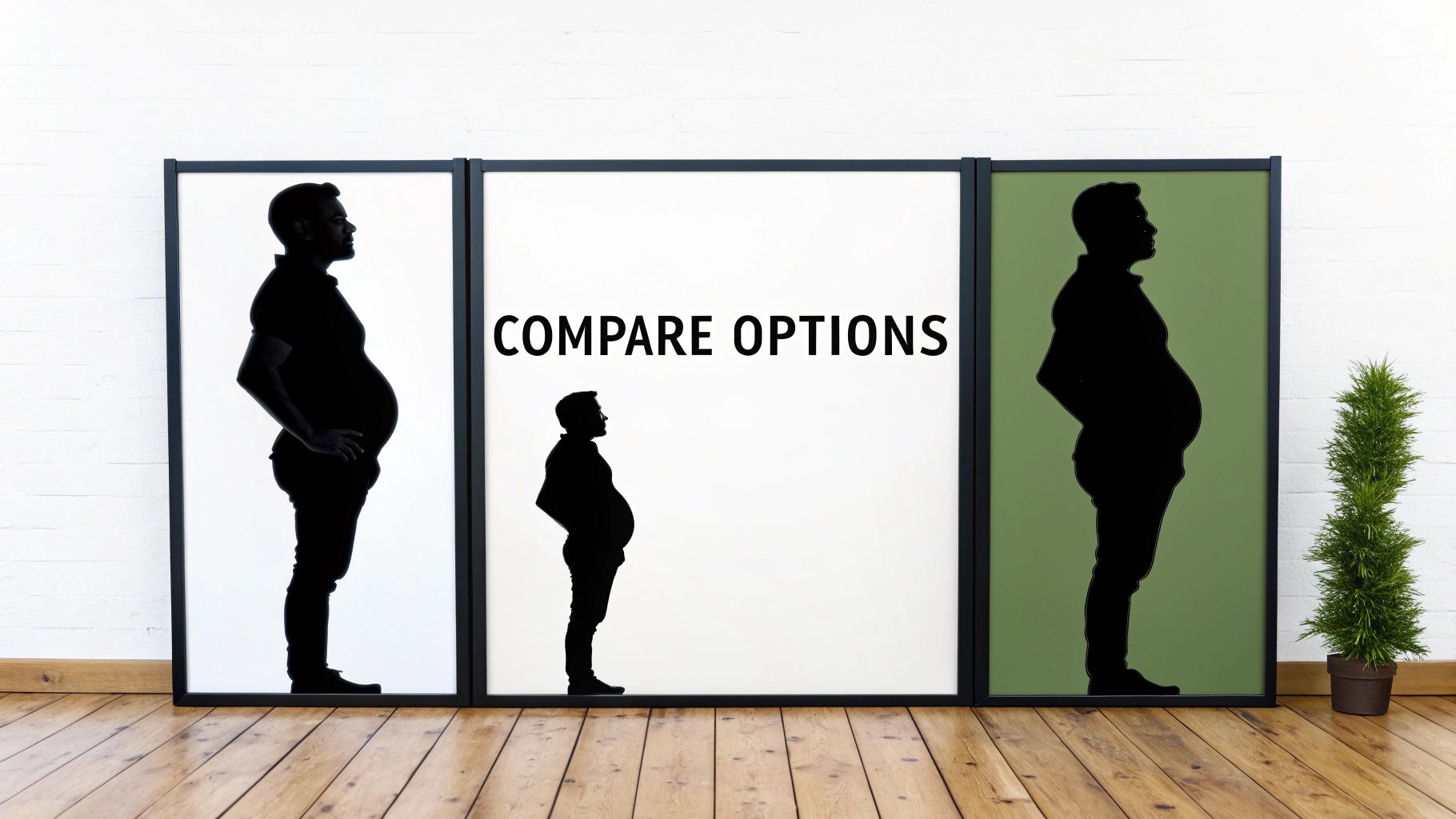
Trying to choose the right body contouring procedure can feel like navigating a maze. With so many techniques available, it’s tough to know which path leads to the results you want. Think of it like a home renovation project—you wouldn't use a sledgehammer where a precision screwdriver is needed. The same logic applies here.
A partial tummy tuck is a very specific tool in a plastic surgeon's toolkit. To truly understand where it shines, we need to compare it directly with two other popular procedures: the full tummy tuck and liposuction. Knowing what each one can (and can't) accomplish is the key to making a confident and informed choice for your body.
While their names sound similar, a partial and a full tummy tuck are two very different operations designed for different degrees of correction. The main difference comes down to how much help you need with loose skin and muscle tone. A full tummy tuck is for a total abdominal overhaul, whereas a mini tummy tuck is for more focused, subtle refinement.
Here’s a quick breakdown of what sets them apart:
A simple way to picture it: A partial tummy tuck is designed to fix the "pooch," while a full tummy tuck reconstructs the entire abdominal wall—skin, fat, and muscle included.
Now, let's bring a completely different tool into the mix: liposuction. This procedure is in its own category. Unlike any type of tummy tuck, liposuction’s only job is to remove stubborn pockets of fat. It does nothing to tighten loose skin or fix separated muscles.
This is a really important point to grasp. If your main concern is unwanted fat but your skin is firm and elastic enough to bounce back, liposuction could be your ideal solution. However, if you already have loose skin, liposuction can sometimes make it look even saggier once the underlying fat is gone.
For an even deeper look at these options, our guide on the top body contouring treatments offers some great additional context.
The table below gives you a clear, side-by-side view of how these three procedures stack up against one another.
Ultimately, seeing these procedures compared in this way helps highlight their unique strengths. Each one is designed to solve a specific problem, and the best choice always depends on your individual anatomy and what you hope to achieve.
Knowing exactly what happens in the operating room can go a long way in calming any pre-surgery jitters. So, let's pull back the curtain on the partial tummy tuck process. We'll walk through the entire experience, from the weeks leading up to your procedure to the moment you head home to recover, so you feel confident and prepared.
Your journey really starts a few weeks before the actual surgery. This is a crucial time to get your body ready and set up a smooth recovery. Think of it as preparing the ground for a beautiful new garden to grow.
During your pre-op appointments, we’ll give you a personalized checklist, which usually includes:
Pro Tip: Your home is your recovery sanctuary. Get it ready beforehand! Set up a comfy spot on the couch or in bed with plenty of pillows, blankets, and your favorite books or shows within arm's reach. Pre-cooking and freezing some simple meals can be a lifesaver.
When you arrive at our accredited surgical facility here on Cape Cod, our team’s entire focus is on you. We’ll get you checked in and settled, and then you’ll have time to chat with both me and your anesthesiologist to go over the plan one last time and answer any final questions. Your safety and comfort are our first and last thought.
Once you’re ready, the procedure itself is a very precise, planned-out process:
The real beauty of a partial tummy tuck is what doesn't happen. Your belly button is left completely untouched—it isn't moved or altered at all. This is a key difference from a full tummy tuck, and it means no scar around your navel and a much quicker, easier recovery.
After the surgery is finished, you’ll spend a little time in our recovery area where our nursing team will monitor you as you wake up. Once you’re ready, you’ll be cleared to have your pre-arranged ride take you home to begin resting.
Getting the best possible result from your partial tummy tuck is a team effort. My surgical skill is one half of the equation; the other half is your commitment to a smooth and steady recovery. While the healing process is definitely faster and easier than a full tummy tuck, you’ll still need to be patient with your body. Following our aftercare plan is the surest way to minimize issues and see your new shape emerge as soon as possible.
The journey to your final look unfolds over several weeks. This simple visual breaks down the major milestones you can expect, from our initial chat all the way through your healing.
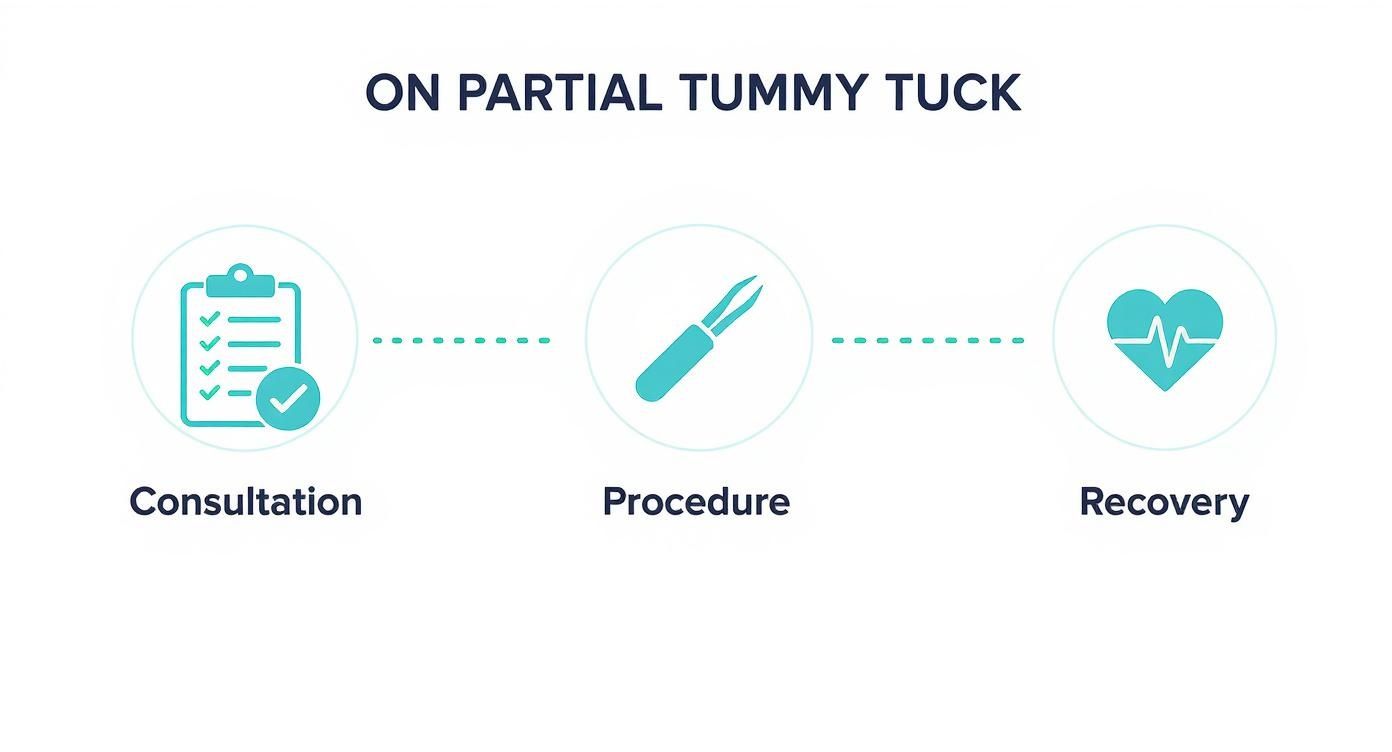
As you can see, recovery is the final, critical step. Knowing what’s coming will help you set realistic expectations and feel more in control as you heal.
The first two days are all about one thing: rest. You’ll probably feel sore and tired, almost like you’ve done a really tough ab workout. This is completely normal, and we'll make sure you have the right pain medication to stay comfortable.
You will be in a compression garment right away—it’s crucial for keeping swelling down and giving your healing tissues the support they need. Some patients might have a tiny drain near the incision to prevent fluid from building up, but we usually take that out within a few days. Your only job is to relax with your upper body propped up slightly.
During this first week, you’ll start to feel a bit more like yourself, but you still need to take it easy. Standing completely straight will feel tight, so it's best to walk with a slight bend at your waist. This prevents any unnecessary strain on your incision line.
By the second week, you should notice a huge difference. Most of my patients feel ready to head back to a desk job or handle light day-to-day tasks. The feeling of tightness will start to ease up, and you’ll find it much easier to stand up straight.
It's important to remember that healing isn’t always a straight line. You’ll have good days and days where you feel more tired. This is a normal part of the process.
It is absolutely vital to continue avoiding strenuous activity, heavy lifting (anything over 10 pounds), and intense workouts. We'll give you the green light on when you can slowly reintroduce your normal fitness routine. For more in-depth advice, our guide on essential tummy tuck recovery tips is a great resource.
Once you hit the one-month mark, you're on the home stretch. The swelling will keep going down, revealing more and more of your final contour. Your incision will also start its journey of maturing, slowly fading from pink to a much less noticeable line over the next year.
Beyond the surgical result itself, many patients are interested in improving their overall skin quality. If you're looking to boost skin elasticity or address pre-existing stretch marks, exploring natural remedies for stretch marks might be a complementary step to consider.
It’s also reassuring to know that modern surgical protocols have made procedures like this incredibly safe. A study looking at 1,363 patients in a private practice setting found complication rates were just 5.5%, which is significantly lower than the 9.7% seen in a broader national database. This really shows how a surgeon's direct experience and focused care can impact patient safety, with the less extensive partial tummy tuck naturally carrying a lower risk profile.
Let's talk about the financial side of a partial tummy tuck. Since this is considered a cosmetic procedure, it's an investment you'll be making in yourself, as insurance will not cover the cost. Understanding what goes into the final price from the very beginning helps make the entire process much smoother.
The total cost isn't just one single number; it's a sum of a few key parts that ensure your procedure is safe, comfortable, and effective.
You'll find that the price for a mini tummy tuck isn't one-size-fits-all. A few things can shift the final number. A major factor is geographic location—costs in a major city are almost always higher than they are here on the Cape.
The specifics of your surgery matter, too. For instance, if we decide to add liposuction to fine-tune the contour of your hips or flanks, that will naturally add to the total cost. The goal is complete transparency, so during your consultation, we’ll give you a detailed, itemized quote. You’ll see every component of the cost with no surprises.
The decision to have a partial tummy tuck is a personal investment in your confidence and well-being. Thinking about the cost upfront helps ensure a stress-free journey from consultation to recovery.
Because this is an out-of-pocket expense, we want to make it manageable. Here at Cape Cod Plastic Surgery, we work with reputable financing companies that specialize in medical procedures. This allows you to break down the cost into affordable monthly payments, so you can fit this investment into your budget without the strain of a large upfront expense. We’re happy to walk you through these options during your visit.
It's also interesting to see where this procedure fits into the bigger picture. The global market for cosmetic procedures was recently valued at around $80 billion, and it’s expected to keep growing. Much of that growth is driven by things like "mommy makeovers" and a rising demand for skin-tightening surgeries after major weight loss. This tells us the mini tummy tuck is a procedure that continues to meet a real need for people. If you're curious, you can review more detailed regional cosmetic surgery statistics to see how these trends are playing out.
Of all the decisions you'll make, picking the person who will perform your surgery is by far the most important. The right surgeon doesn't just deliver a beautiful result; they prioritize your safety and give you confidence every step of the way, from the first hello to your final check-up.
It can feel a bit daunting to find the right expert, but a few key qualifications will help you narrow down the field immediately. Think of these as the absolute essentials for a safe and successful outcome.
First things first: board certification. A surgeon who is certified by the American Board of Plastic Surgery has gone through years of specialized training focused solely on plastic surgery, passed exhaustive exams, and is committed to the highest ethical and safety standards. This is your guarantee of their expertise and dedication.
Beyond that essential credential, you'll want to find a surgeon who specializes in body contouring. Someone who performs the partial tummy tuck regularly will have a much deeper understanding of the subtle techniques needed to achieve a smooth, natural-looking contour.
Your first and most important question should always be, "Are you board-certified by the American Board of Plastic Surgery?" Follow it up by asking about their specific experience with mini tummy tucks.
Once you've verified their credentials, it's time to look at their results. A surgeon's before-and-after photo gallery is their resume—it shows you what they can actually do.
When you're browsing their gallery, keep an eye out for a few things:
Patient reviews and testimonials add another crucial piece to the puzzle. While photos show the surgeon's technical skill, reviews tell you about the human side of things—their bedside manner, the helpfulness of the office staff, and the quality of their follow-up care.
For a more in-depth look, check out our complete guide on how to choose a plastic surgeon. Here at Cape Cod Plastic Surgery, Dr. Fater’s decades of experience and patient-first approach are something we're incredibly proud of, and it shows in the results we achieve together.
It’s completely normal to still have questions, even after learning so much about the partial tummy tuck. Here, we've put together some straightforward answers to the questions we hear most often from our patients. We want you to feel confident and fully informed every step of the way.
The great news is that the results from a partial tummy tuck are built to last a very long time. The excess skin we remove during surgery is gone for good—it can't grow back. This gives you a permanent improvement in the contour of your lower belly.
That said, your lifestyle choices are a big part of the equation when it comes to maintaining that new shape. Big life events, like a future pregnancy or significant weight gain, can stretch the remaining skin and affect your long-term outcome. Of course, the natural aging process doesn't stop, but the improvement you gain from the surgery will always be your new baseline. The best way to protect your investment is to maintain a stable, healthy weight.
Think of your partial tummy tuck as hitting the reset button for your lower abdomen. The surgical changes are permanent, but keeping those fantastic results is a partnership between you and your commitment to a healthy lifestyle.
Some discomfort after surgery is to be expected, but for a partial tummy tuck, it's typically very manageable. Most of the soreness happens in the first few days, and the pain medication we prescribe is usually more than enough to keep you comfortable.
A lot of our patients who have had children tell us the recovery feeling is similar to a C-section, but they often say the partial tummy tuck was noticeably less painful. Because it’s a less invasive procedure than a full tummy tuck—which involves repairing the abdominal muscles and covers a much larger area—the recovery tends to be faster and a lot more comfortable.
You'll see a flatter lower stomach right after you wake up from surgery, which is always exciting! But what you see initially isn't the final product. Your body has a healing journey ahead, and swelling is a totally normal part of that process. It can temporarily hide the refined, final shape.
Patience is your best friend during this phase. Here’s a general timeline of what to expect:
This timeline gives your body the time it needs to fully heal and settle into its new, smoother contour, revealing the beautiful, natural result you’ve been working toward.
Ready to explore if a partial tummy tuck is the right next step for you? Here at Cape Cod Plastic Surgery, Dr. Fater and our team are ready to answer all your questions in a one-on-one consultation. Schedule your appointment today and let's start the conversation.
October 6, 2026
Your Safety Guide: What to Look for When Choosing a Plastic Surgeon
October 5, 2026
Why Our On-Site Accredited Facility Matters for Your Safety

October 2, 2026
Beyond the Calendar: How to Know You’re Truly Ready for Plastic Surgery

Cape Cod Plastic Surgery offers expert cosmetic and reconstructive procedures in a safe, accredited setting. Led by Dr. Marc Fater, we combine advanced techniques with personalized care to help you look and feel your best.
Monday: 9:00 AM – 5:00 PM
Tuesday: 9:00 AM – 5:00 PM
Wednesday: 9:00 AM – 5:00 PM
Thursday: 9:00 AM – 5:00 PM
Friday: 9:00 AM – 5:00 PM