

October 7, 2026
What to Expect During Your Breast Surgery Recovery
A Practical Guide to Healing After Breast Surgery
Dec 1, 2025
When it comes to Botox, the big question I hear isn't really “what age should I start?” but rather, "when is the right time for me?" And that’s the perfect way to frame it, because there’s no magic number.
The best time to start is deeply personal and depends entirely on your unique skin, genetics, and what you hope to achieve. We're shifting the focus from your birthday to the specific signs you see in the mirror.
I like to use a car maintenance analogy. You get regular oil changes to prevent engine trouble down the road; you don't wait for it to break down on the highway. Modern aesthetic medicine thinks the same way. We now look at two main paths: preventive care to slow down wrinkle formation, and corrective action to soften lines that are already there.
Figuring out which path makes sense for you is the real key to deciding when to start.
This conversation has moved well beyond age and landed squarely on proactive skin health. We see this change reflected in who's coming in for treatments. These days, about 24% of Botox clients are in the 19-34 age group. That’s a huge shift from the traditional average age of 43 and shows a growing desire to get ahead of wrinkles, not just chase them after they’ve settled in.
To put it simply, there are two primary strategies for timing your Botox journey, and it all comes down to what you're trying to accomplish. Are you looking to slow down the clock, or turn it back a bit?
Preventive Botox: This is for people, often in their late 20s or early 30s, who are just starting to notice faint lines when they make certain facial expressions (think "11s" between the brows or crow's feet when you smile). The idea is to relax those specific muscles just enough to stop those temporary lines from becoming permanently etched into the skin.
Corrective Botox: This approach is for those who already have visible lines, even when their face is completely at rest. The treatment works to soften and smooth these existing wrinkles, creating a more rested and rejuvenated appearance.
The decision tree below gives you a great visual for thinking through which path might be right for you based on what you see in the mirror.
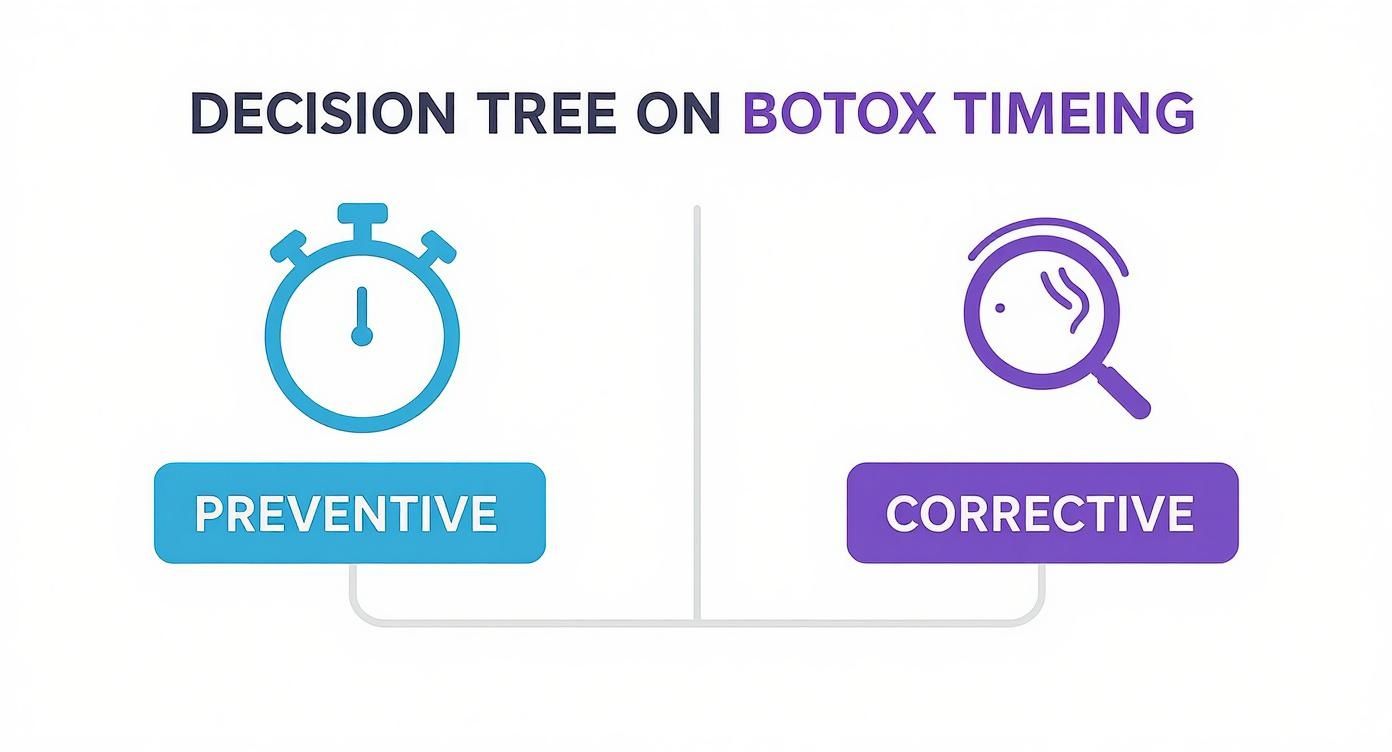
As you can see, it's less about your age and much more about the current state of your skin and your long-term goals.
Here's a quick side-by-side look to make the distinction even clearer.
Ultimately, whether you're taking a preventive or corrective approach, the goal is a natural-looking result that makes you feel confident.
The most effective Botox plan is one that's uniquely yours. It’s a personalized decision made not by the calendar, but by a careful assessment of your skin, genetics, and lifestyle factors with a qualified professional.
It's also worth remembering that Botox is just one tool in the toolbox. For those curious about other methods, exploring natural alternatives to Botox can give you a fuller picture of all the available cosmetic approaches.
At the end of the day, the choice to start Botox is deeply personal. Being well-informed is the most important first step toward achieving results you’ll absolutely love.
Before we can talk about the right time for your first treatment, you need to understand how Botox actually works. It's simpler than you might think.
Imagine folding a piece of paper in the same spot, over and over again. At first, the line disappears when you flatten it out. But eventually, a permanent crease forms that you just can't smooth away. Your skin works the exact same way.
Every single time you smile, frown, or squint, the tiny muscles under your skin contract, folding it. After thousands of these expressions, those temporary folds begin to set in for good.
Botox, which is a highly purified protein called botulinum toxin, essentially tells those overactive muscles to take a break. It doesn't freeze your face; it simply relaxes the specific muscles that are causing the wrinkles. This gives the skin on top a chance to smooth out, which softens the lines you already have and—crucially—prevents new ones from forming.
To really get a handle on how Botox works, it helps to know the two kinds of wrinkles we're dealing with. This is the key to understanding whether you’re looking to prevent or correct, which will guide your decision on when to start.
Dynamic Wrinkles: These are the lines that only show up when you're moving your face. Think crow's feet when you laugh, or those vertical "11" lines between your eyebrows when you're concentrating. They’re caused by active muscle contractions.
Static Wrinkles: These are the lines that stick around even when your face is totally at rest. They are the permanent creases that have been etched into the skin from years of repeated facial expressions.
Botox is incredibly effective on dynamic wrinkles. By relaxing the muscle, it stops the constant folding motion, smoothing the skin and acting as a powerful preventative measure.
When used proactively, Botox can dramatically slow down the process of dynamic wrinkles turning into permanent static ones. This is the whole idea behind 'preventive Botox'—stopping the crease before it sets.
Now, what about those static wrinkles that are already there? Botox is still a fantastic tool. By relaxing the muscle underneath, it keeps the line from getting any deeper and usually softens its appearance quite a bit. For very deep-set static lines, we might pair Botox with other treatments like dermal fillers to completely restore a smooth surface.
This brings us to the logic behind starting Botox in your late 20s or early 30s. It’s not about getting rid of wrinkles you don't have. It's about managing the muscle movements that are guaranteed to cause them down the line.
Let's use an example. Imagine two people who are both expressive and frown a lot. One starts getting a small amount of preventive Botox at age 30. The other waits until they are 45 and already have deep, etched-in frown lines.
The person who started earlier has spent 15 years keeping that muscle from aggressively creasing their skin. As a result, they might have no static lines at all, or only very faint ones. Maintaining their look is simple. The person who waited is now in a position of correcting deep-set lines, which is often a more involved process.
This is exactly why a consultation with an expert like Dr. Fater is so important. He can analyze your unique facial anatomy and expressions to see which areas might benefit from preventive treatment. From there, he can create a long-term plan that lets you age beautifully and on your own terms.
For a lot of people, their 20s and 30s are the perfect time to explore what we call preventive Botox. This isn't about correcting deep-set wrinkles; it's a proactive strategy to get ahead of the aging process before it really settles in.
I often use this analogy: it’s far easier to keep a new white t-shirt clean than it is to get out a stubborn, old stain. Preventive Botox follows the same idea. We treat those faint lines that show up when you make an expression, long before they have a chance to become permanent fixtures on your face.
The goal isn't to erase wrinkles that aren't there yet. It’s about softening the repetitive muscle movements that eventually etch lines into the skin, like crow’s feet from smiling or those infamous “11s” between the eyebrows from frowning.
When treating patients in their late 20s and early 30s, the approach is all about subtlety. We use smaller, strategically placed doses of Botox—a technique often called “baby Botox.”
It’s not about freezing your face or stopping all movement. The idea is to simply dial down the intensity of certain muscle contractions. By doing this, we give the skin a break from the constant creasing and folding, which can delay the formation of permanent, "static" wrinkles for years.
The result is a look that’s refreshed and natural, never "frozen."
The art of preventive Botox is all about precision. A skilled injector knows exactly how to relax the wrinkle-causing muscles just enough to protect the skin, while still preserving your ability to laugh, smile, and show emotion naturally.
So many people worry they’ll look “overdone” if they start Botox too early. That’s a valid concern, but it’s completely avoidable with the right technique. The focus is on a light touch and creating a long-term plan that helps you age gracefully.
So, how can you tell if preventive Botox is right for you? It really has less to do with the year on your driver’s license and more to do with what you’re seeing in the mirror.
Here are a few signs that suggest a preventive approach could be a great fit:
During a consultation, an expert injector like Dr. Marc Fater will carefully assess your unique facial movements. This analysis helps pinpoint which muscles are working overtime and would benefit most from this kind of gentle, preventive treatment.
Think of starting Botox in your 20s or 30s as an investment in your skin's future. By being proactive, you can slow down the visible signs of aging in a way that’s both incredibly subtle and effective.
The payoff goes beyond just preventing wrinkles. We’ve found that patients who start with preventive treatments often need less product and fewer appointments as they get older, compared to someone who waits to correct deep, established lines. Over time, it can be a more efficient and even more cost-effective strategy.
This early intervention helps you maintain a youthful look without ever looking like you’ve had “work done.” To get a better sense of the goal, take a look through our gallery of Botox before and after photos. You’ll see that the goal is always to look like the best version of yourself—just a little more rested.
By the time you reach your 40s and 50s, the focus for Botox often shifts from getting ahead of wrinkles to actively correcting them. This is the age when many of those "expression lines" from your younger years decide to stick around for good. They become static, meaning they’re visible even when your face is completely at rest.
The goal now is to soften these established lines. We're aiming for a smoother, more rested look—not an expressionless one. Botox is fantastic for this because it relaxes the specific muscles that have been holding those creases in place for years, giving your skin a much-needed break.
As we get older, our skin's natural production of collagen and elastin slows down considerably. Think of collagen and elastin as the springs in a mattress; without them, the skin doesn't bounce back like it used to. This is why wrinkles around the eyes (crow’s feet), between the eyebrows (the "11s"), and across the forehead become so much more noticeable.
Botox gets right to the root of the issue: the overactive muscles. By gently telling these muscles to ease up, the skin above them finally gets a chance to smooth out. It’s a bit like un-crumpling a piece of paper that’s been folded for a long time—it allows it to lay much flatter.
This approach is incredibly popular for a reason. People in the 40-54 age range are the largest group of Botox users, accounting for about 2.5 million procedures back in 2020. This number really highlights how effective the treatment is for the visible signs of aging that tend to pop up during these decades. You can dig into more of this data by reading more about Botox statistics.
For many people in their 40s, 50s, and beyond, Botox isn't a standalone treatment. It's the foundation of a bigger anti-aging strategy. While it's a master at handling dynamic wrinkles, it often works best when combined with other treatments for a truly natural and complete result.
Think of it like restoring a beautiful old house. Botox is like smoothing and painting the walls—a crucial step. But to finish the project, you might also need to refinish the floors or update the fixtures.
Here’s how Botox often plays a role in a more comprehensive plan:
It's never too late to start with Botox. Even if you're just beginning to think about it in your 40s or 50s, the treatment can make a remarkable difference, softening lines that have been around for years and helping to stop them from getting deeper.
The ultimate goal isn't to erase every sign of a life well-lived. It’s about restoring a natural energy and vitality to your face. An experienced injector like Dr. Marc Fater understands the subtleties of the aging process and can create a plan that helps you look as vibrant as you feel on the inside—a result that is both stunning and authentically you.
When is the right time to start Botox? It's a question I hear all the time, and the truth is, the answer has far less to do with the year you were born and much more to do with your unique skin, genetics, and even how you live your life. Age ranges are a decent starting point, but they don't tell the whole story.
Think about it: two 30-year-olds can have vastly different skin. One might have spent years soaking up the sun, while the other never leaves the house without SPF 50. To truly know when it's your time, you have to look past the calendar and get to know the personal factors that write your skin's story.
Your genes are essentially the architectural blueprint for your face. If your mom or dad developed deep "elevens" between their brows or noticeable crow's feet early on, there’s a good chance you inherited a similar pattern of facial muscle movement and skin structure. It’s a major clue as to when and where wrinkles might start showing up for you.
Your skin type is another huge piece of the puzzle.
Looking at your family history and understanding your skin type gives you a much clearer picture of your personal aging curve.
There’s a common saying in dermatology: genetics loads the gun, but lifestyle pulls the trigger. Nothing accelerates skin aging faster than unprotected sun exposure. UV radiation is the primary enemy of collagen and elastin—the proteins that give your skin its bounce and firmness. A lifelong sun worshipper will almost always see wrinkles appear years before someone who's diligent about sun protection.
But the sun isn't the only culprit. Other choices add up, too:
Are you the person who squints when you're thinking hard? Do your eyebrows shoot up when you're surprised? Is your smile so big it crinkles the corners of your eyes? How you express yourself plays a massive role in where your lines will form.
The more you activate specific facial muscles, the quicker those temporary "expression lines" will set in and become permanent static wrinkles. For instance, someone with very animated forehead muscles is bound to see horizontal lines develop much earlier than a person with a more stoic expression. This isn't something to suppress—it's part of your personality! But it is a key factor in figuring out if a preventative approach with Botox might be a smart move for you.
Your personal "Botox clock" is set by a combination of factors you can't control, like genetics, and those you can, like lifestyle. Recognizing the signs in your own reflection is far more important than comparing yourself to an age-based average.
The table below breaks down these key influencers to help you better understand your own timeline.
This table gives you an overview of how different personal and lifestyle factors can speed up or slow down the appearance of wrinkles, helping you see where you might stand.
By considering these factors, you can move beyond a generic age and start thinking about a timeline that makes sense for you and your goals.
The popularity of this personalized approach is undeniable. As the world's leading injectable aesthetic treatment, an estimated 9.2 million Botox procedures were performed globally in 2022. That number accounts for roughly two-thirds of all injectable treatments, showing just how many people are using it for customized anti-aging plans. You can dive deeper into these trends and learn more from these global Botox statistics.
While Botox is a master at smoothing wrinkles caused by muscle movement, it's often mistaken for products that add volume back to the face. It’s so important to know the difference, which is why we put together a guide explaining Botox versus dermal fillers.
So, you're thinking about Botox. Taking that first step from just being curious to actually doing something about it starts with a professional consultation. This isn't a sales pitch; it's a conversation. The whole point is to give you all the information you need to feel comfortable and create a plan that’s perfect for you.
The heart of this first meeting is a really thorough look at your face. An experienced injector like Dr. Marc Fater won’t just glance at your lines. He’ll watch how your face moves when you talk and laugh, getting a real sense of your unique muscle movements and skin quality.
This deep dive is critical because everyone's face is different. Your specific expressions are what create your lines, and understanding that pattern is the key to figuring out where Botox will work best. It’s this detailed assessment that allows for a truly personalized treatment.
Think of your first Botox consultation as a partnership. It’s your chance to point out what you see, talk about your goals, and get answers to every single question you have. A good injector is a great listener, first and foremost.
What you hope to achieve is the most important piece of the puzzle. Do you want to get ahead of lines before they start? Soften the ones you already have? Or maybe you just want to look less tired. This conversation sets the stage for everything that follows.
After listening to you and analyzing your facial structure, a plan is built just for you. There's no cookie-cutter recipe here. This plan will map out:
This whole process is designed to take the mystery out of it, giving you a clear, comfortable path forward.
At the end of the day, any trustworthy practitioner has two main priorities: your safety and results that celebrate your natural beauty, not erase it. The goal is for you to look rested and vibrant, not "frozen." A big part of that is making sure you leave your consultation feeling confident and completely in the loop.
The best Botox is the kind no one notices. You just look like a well-rested, happier version of yourself. It's the provider's skill and artistry that makes that subtle, beautiful difference.
As you plan, it's good to know how medical consultations work in general. Botox is a prescription-only treatment, meaning you can't get it without seeing a licensed professional first. Getting familiar with the process of medical consultations—even something general like learning how to get a prescription online—can help you understand the framework. This initial meeting is where a qualified expert confirms you're a good candidate and designs a safe, effective plan built around you.

Even after you've done your research, it’s completely normal to have a few more questions pop up. Deciding if and when to start Botox is a personal choice, and the most important thing is that you feel confident and fully informed before moving forward.
Let's walk through some of the most common questions we hear from patients who are thinking about Botox for the first time.
This is probably the number one fear we hear, but it's also entirely preventable when you're in the right hands. That "frozen" look people worry about is a sign of over-treatment or improper injection technique, not a standard result of Botox itself.
An experienced injector like Dr. Fater knows that the goal isn't to erase expression—it's to soften wrinkles while preserving the natural movements that make you you. You should look refreshed and well-rested, not like a statue. We'll talk through your goals during the consultation to make sure the treatment plan is designed to achieve the subtle, natural look you want.
Botox gives you temporary results, which is actually something many new patients appreciate. On average, you can expect the effects to last for about 3 to 4 months.
As the product naturally wears off, your muscles will slowly start contracting again, and those lines may gradually reappear. To keep things looking smooth, you'll need to schedule follow-up appointments. Interestingly, many long-term patients find that with consistent treatments, their muscles stay relaxed for longer, sometimes allowing them to stretch the time between visits.
A common myth is that once you start Botox, you're locked in for life. That's not true at all. If you ever decide to stop, your muscles will simply go back to their previous level of activity.
This is a fantastic question because it's easy to get them mixed up. Both are injectable treatments that help you look younger, but they go about it in completely different ways and solve different problems.
Think of it this way:
Botox works on muscles. It targets the specific muscles that create wrinkles when you smile, frown, or squint (dynamic wrinkles), like the lines between your brows or crow's feet.
Fillers work on volume. They use ingredients like hyaluronic acid to literally "fill in" wrinkles that are there even when your face is at rest (static wrinkles). They also restore lost volume in areas like the cheeks or lips.
They aren't interchangeable, but they often work beautifully together as part of a total rejuvenation plan for incredibly natural-looking results.
One of the biggest perks of Botox is that it fits right into your busy schedule. The treatment itself is incredibly fast—often just 10 to 15 minutes from start to finish.
You can get right back to most of your daily routine immediately. We just ask that you avoid a few things for the first few hours, like intense exercise, lying down flat, or rubbing the treated spots. You might notice a little redness or a few tiny bumps at the injection sites, but that almost always disappears within the hour. It’s a true “lunchtime procedure.”
At Cape Cod Plastic Surgery, Dr. Marc Fater and our entire team are here to guide you with skill, experience, and genuine care. If you're ready to see how a personalized Botox plan can help you meet your goals, we invite you to schedule a private consultation. Contact us to get started.
October 7, 2026
A Practical Guide to Healing After Breast Surgery

October 6, 2026
Your Safety Guide: What to Look for When Choosing a Plastic Surgeon

October 5, 2026
Why Our On-Site Accredited Facility Matters for Your Safety

Cape Cod Plastic Surgery offers expert cosmetic and reconstructive procedures in a safe, accredited setting. Led by Dr. Marc Fater, we combine advanced techniques with personalized care to help you look and feel your best.
Monday: 9:00 AM – 5:00 PM
Tuesday: 9:00 AM – 5:00 PM
Wednesday: 9:00 AM – 5:00 PM
Thursday: 9:00 AM – 5:00 PM
Friday: 9:00 AM – 5:00 PM