

September 9, 2026
How to Care for Surgical Incisions Properly
Expert Guide to Proper Surgical Incision Care
Dec 31, 2025
Nasolabial folds, those lines that run from the sides of your nose to the corners of your mouth, are a perfectly normal part of our facial anatomy.Nasolabial folds, those lines that run from the sides of your nose to the corners of your mouth, are a perfectly normal part of our facial anatomy. But what causes them to become more pronounced over time?
It’s not just one thing. Think of it as a combination of factors all working together: a natural loss of volume in the cheeks, the slow breakdown of crucial skin proteins like collagen and elastin, and a lifetime of facial expressions. As the scaffolding in your mid-face begins to change with age, the skin above it starts to drape differently, creating those familiar lines.
We often call them "smile lines," but that's a bit of an oversimplification. While smiling certainly contributes, these folds are much more complex. Their visibility is a direct result of intricate aging processes, your unique genetic makeup, and even your lifestyle habits. Getting to the root of why they form is the first step toward figuring out the best way to manage them.
Here at Cape Cod Plastic Surgery, Dr. Marc Fater is a firm believer in patient education. When you truly understand why these folds are appearing, it helps you set realistic goals for treatment and see why a one-size-fits-all approach just doesn't work.
It's helpful to think of the causes not as a single culprit, but as a team of factors that contribute to the final result over many years.
The key takeaway is this: nasolabial folds are not just a surface-level wrinkle. They are a visible sign of deeper structural changes happening in the fat, muscle, and even bone of your face. This is precisely why topical creams often fail to deliver the dramatic results people are hoping for.
Living in a beautiful place like Cape Cod also means we get a lot of sun. That frequent sun exposure can speed up the breakdown of collagen—a process called photoaging—making sun protection and targeted professional treatments all the more important for keeping your skin healthy.
By understanding the true anatomy of how the face ages, we can appreciate why modern cosmetic treatments are designed to tackle these foundational issues, rather than just camouflage a line on the surface.
This quick summary breaks down the primary factors that contribute to the formation and deepening of nasolabial folds, helping you grasp the core concepts instantly.
Ultimately, a combination of these factors is at play for almost everyone. Understanding which ones are the primary drivers for you is key to developing an effective plan to address them.
To really get what’s going on with nasolabial folds, it helps to think of your facial structure like a beautifully constructed tent. When we're young, every part of that tent is in top condition: the poles (our bones) are strong, the padding (our facial fat) is plump and high, and the canvas (our skin) is thick and springy. But time, as it does, starts to change this internal architecture.
The most important changes are happening deep down, well below the skin you see in the mirror. While we blame aging in general, it's really the slow, steady decline of collagen and elastin that kicks things off. Decades of research show that once you hit 30, collagen production drops by about 1-2% every year. That rate picks up speed after 40, leaving skin thinner, weaker, and far less elastic. This is when the underlying fat pads start to sag, and those smile lines decide to stick around for good.
It's not just one thing, but a trio of events working together that deepen these lines over the years.
This diagram breaks down how these key factors—volume loss, skin laxity, and facial expressions—all play a role.
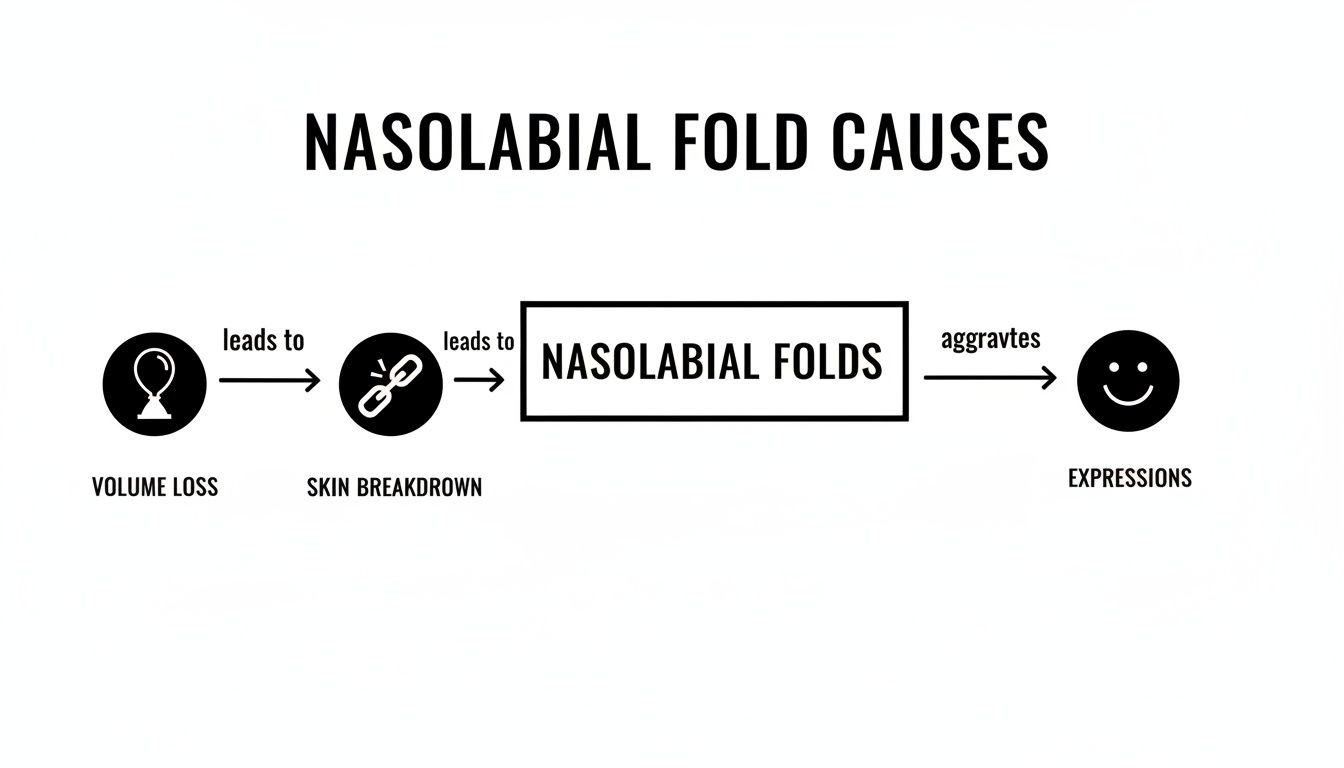
As you can see, it's a chain reaction. The internal support system weakens, allowing the skin to droop, and every smile or laugh makes the crease more prominent.
One of the biggest culprits is the deflation and downward slide of our malar fat pads. These are the cushy pockets of fat sitting high on our cheekbones, giving us that lifted, youthful contour. When we're young, they’re perched right where they should be, holding up the whole mid-face. But as we get older, these pads lose volume and start heading south, pulled down by gravity and weakening facial ligaments.
Think of it as a tiny, slow-motion landslide. As that fat pad shifts downward, it creates a bulge just above the smile line, forcing the skin to fold over and casting a shadow that makes the crease look much deeper.
Here’s something most people don’t realize: our bones age, too. Our facial skeleton actually loses volume over time through a process called bone resorption. The very bones of our cheeks and upper jaw—the foundational structure holding everything up—begin to subtly recede.
It's like the main frame of that tent we talked about starting to shrink. What happens to the canvas? It sags and folds, of course. This loss of deep, structural support is a major reason why creams and serums alone can't fix significant nasolabial folds.
Lastly, the canvas itself—our skin—loses its bounce-back. The breakdown of collagen (the protein that provides firmness) and elastin (the fiber that lets skin snap back into place) leaves the skin lax and loose. It simply doesn't have the strength anymore to resist gravity or smooth out completely after we laugh or talk.
This loss of elasticity is the final blow. The skin can no longer hold up the descending fat or mask the effects of a shrinking bone structure. For those wanting a true, long-term fix, understanding how a facelift surgically addresses these deep structural issues is key. It’s all about rebuilding the support from the inside out.

While genetics and the natural aging process lay the foundation for nasolabial folds, your daily habits can hit the accelerator, determining just how quickly and deeply those lines settle in.
The good news? These are the factors you can actually control. Making smarter choices today can have a huge impact on your skin for years to come.
If there’s one external factor that wreaks havoc on your skin, it's the sun. Unprotected sun exposure—what we call photoaging—dismantles your skin’s supportive collagen and elastin network far more aggressively than time ever could.
Think of UV rays as tiny wrecking balls for your skin’s internal scaffolding. With every exposure, they create a storm of free radicals that systematically break down the very proteins keeping your skin firm. In fact, research points to chronic UV radiation as the cause of 80-90% of visible skin aging.
This damage is cumulative. Every minute spent in the sun without protection adds up, contributing to that gradual deepening of facial lines.
Expert Insight: Diligent, daily sun protection is the single most effective anti-aging strategy there is. This isn't just for beach days—it's for running errands, driving, and even sitting near a sunny window. A broad-spectrum SPF of 30 or higher is your absolute best defense.
Smoking is another major player in premature aging, attacking your skin’s health from multiple angles.
First, the nicotine in cigarettes causes your blood vessels to constrict. This drastically reduces blood flow, essentially starving your skin of the oxygen and nutrients it needs to repair itself and build new collagen. Over time, this leads to a dull, sallow complexion and skin that just can’t bounce back.
On top of that, the thousands of toxic chemicals in tobacco smoke directly assault your collagen and elastin fibers, causing the skin to sag and fold much earlier than it should.
Rapid or significant changes in your weight can also have a very noticeable effect on your facial contours, especially your smile lines.
Dramatic Weight Loss: When you lose a lot of weight quickly, the fat pads in your cheeks can shrink away. Your skin, which may have lost some of its elasticity, can't always snap back to fit this new, smaller facial volume. The result is often sagging and more prominent folds.
Weight Gain: On the flip side, gaining a significant amount of weight can increase the size and heft of those same cheek pads. This added weight can push down on the skin below, deepening the crease of the nasolabial fold.
Maintaining a stable, healthy weight is one of the best ways to preserve your natural facial volume and skin tone. If you're looking for other ways to manage signs of aging, our guide on how to reduce wrinkles naturally offers some great lifestyle tips. By getting a handle on these controllable factors, you can play an active role in keeping your skin looking smoother for longer.

When creams and at-home routines no longer give you the results you’re looking for, it might be time to explore clinical options. Today's procedures are incredibly sophisticated, designed to tackle the structural reasons behind nasolabial folds, not just the surface-level lines.
The real art is in matching the right treatment to the root cause. An experienced plastic surgeon won’t just look at the fold itself; they’ll assess your entire facial anatomy to see if volume loss, skin laxity, or a bit of both is the main culprit. That diagnosis guides the entire treatment plan.
For most of us, those deepening lines from the nose to the mouth are a direct result of our cheek fat pads losing volume and starting to droop. Dermal fillers are, by far, the go-to solution for this, and the improvement is almost immediate.
Think of it like adding air back into a deflating pillow. By skillfully injecting a hyaluronic acid (HA) filler into specific areas of the mid-cheek, a practitioner can physically lift the entire structure. This subtle lift props up the sagging tissue, which in turn smooths out the fold below. It’s a brilliant approach because it fixes the problem at its source rather than just trying to spackle the crease.
This isn’t just a cosmetic trick; it’s based on fundamental anatomy. As we age, our facial volume naturally decreases, but studies show that filler augmentation can effectively restore 80-90% of that youthful contour. Want to dive deeper into the science? You can explore a full analysis of facial volume changes. And if you're curious about different types of injectables, we break down the differences between Botox and dermal fillers here.
A Quick Look at Fillers:
- What They Do: Restore lost volume in the cheeks and mid-face.
- How They Work: Hyaluronic acid gels physically lift and support the skin from underneath.
- Best For: Folds caused primarily by deflated or descending cheek fat.
- Longevity: Results typically last anywhere from 6 to 18 months, depending on the specific product.
What if your issue is less about volume loss and more about your skin losing its firmness? When skin laxity is the main driver, the treatment goal shifts from filling to tightening. To tackle this, we turn to powerful, energy-based devices.
Advanced laser skin tightening treatments, along with technologies like radiofrequency (RF) and ultrasound, work by sending controlled energy deep into the skin's dermal layer. This process creates a gentle, therapeutic heat that kickstarts your body's own collagen-making factory. Over the next few weeks and months, your skin gets the signal to build new, strong collagen and elastin fibers, gradually becoming firmer, tighter, and more resilient.
For those with more significant sagging and deeper folds, a surgical facelift offers the most dramatic and long-lasting correction. This is where we go beyond the skin and address the face's foundational support system.
A facelift is so effective because it repositions the deeper layer of tissue known as the SMAS. By lifting and securing these underlying structures back into a more youthful position, the procedure essentially hits the reset button on facial aging. It’s the gold standard for correcting deep nasolabial folds, jowls, and neck laxity all at once, delivering a refreshed look that can last for years.
It’s easy to get lost in the world of aesthetic treatments. You're constantly bombarded with ads for creams and serums that promise to turn back the clock. The first, and most important, step in this journey is cutting through that noise to understand what's actually possible and what's just marketing hype.
Let's be clear: a great skincare routine is your first line of defense. High-quality topicals can absolutely make a difference in your skin's overall health and appearance. Ingredients like retinoids are proven to boost cell turnover and kickstart collagen production, while certain peptides can help firm things up. They are fantastic for improving skin texture and giving you a healthy glow.
But we have to be honest about where their power ends.
When you're dealing with deep, established nasolabial folds, no cream—no matter how expensive—is going to physically refill lost volume in your cheeks or lift sagging skin. Topical products work on the surface, but the real drivers of these folds are happening much deeper.
Thinking about this correctly is crucial. It's like the difference between polishing a car and fixing a major dent. Your skincare routine is the polish. It keeps the paint job looking fantastic, but it can't reshape the bent metal underneath.
At-Home Skincare (The Polish): This is your daily maintenance. It protects your skin, improves its quality, and can certainly soften the look of very fine, superficial lines. Think of it as preserving the canvas.
Clinical Treatments (The Repair): This is the bodywork. These procedures get beneath the surface to fix the underlying structural issues. Dermal fillers restore the "cushioning" that has deflated, while other treatments work on repositioning the "scaffolding" of your face.
Once you grasp this distinction, you can build a strategy that actually works. A dedicated skincare regimen is non-negotiable for keeping your skin healthy and maintaining the results of any procedure you might have. But when your main concern is that deepening shadow running from your nose to your mouth, that's a sign that the solution isn't in a bottle.
This clarity saves you from wasting time and money on products that were never designed to fix a structural problem. Instead, you can focus on treatments that directly address what causes nasolabial folds at their source. Knowing when it's time to step away from the bathroom mirror and into a consultation with a board-certified plastic surgeon is the most empowering decision you can make.
Trying to choose the right treatment by scrolling through websites and before-and-after photos can be completely overwhelming. Your journey toward getting natural, beautiful results shouldn't start with picking a procedure from a menu; it should start with a conversation.
This is why a face-to-face consultation with a board-certified expert, like Dr. Marc Fater, is the most important step you can take.
Think of it like getting a custom blueprint made just for your face. An in-person assessment is the only real way to figure out what causes nasolabial folds in your specific situation. Is the main issue volume loss in your cheeks? Is sagging skin the bigger problem? Or is it a mix of several factors? The answer to that question dictates the most effective way forward.
A professional consultation gives you a clear understanding of your own anatomy and a realistic idea of what different treatments can truly accomplish for you.
Sitting down with an expert allows you to:
At Cape Cod Plastic Surgery, our philosophy is simple: prioritize patient safety and deliver results that enhance your natural beauty. A consultation guarantees your treatment plan is designed for you and you alone, so you can move forward with total confidence.
Even after diving into the causes and treatments for smile lines, a few key questions always seem to pop up. Let's tackle some of the most common ones to help you navigate your options with confidence.
This is the big question on everyone's mind, and the honest answer is that most solutions are not a one-and-done fix. Why? Because the aging process that creates these folds in the first place never really stops.
The longevity of your results really depends on the path you choose.
Dermal Fillers: Think of these as a temporary, but highly effective, solution. Most fillers are made from hyaluronic acid, a substance your body naturally breaks down over time. You can typically enjoy the results for 6 to 18 months before you'll need a touch-up.
Surgical Facelift: For those seeking the most significant and durable correction, a facelift is the gold standard. The results can last for many years, but it's important to remember that even surgery can't completely stop the clock on aging.
There's no magic number here. The decision to treat your nasolabial folds is completely personal and should be based on when you start to feel bothered by them. Genetics and lifestyle play a huge role in when that might be.
Some people notice their smile lines deepening in their late 20s or early 30s and decide to start with preventative measures or a light touch of filler. Others may not think about professional treatments until their 40s or 50s, when volume loss and skin sagging become more noticeable.
Ultimately, the best time to start is whenever you feel ready.
This is a very common point of confusion, but it gets to the heart of how different treatments work. For nasolabial folds, dermal fillers are almost always the go-to solution, not Botox.
The reason is simple: nasolabial folds are caused by a loss of volume and sagging skin, not by overactive muscles. Dermal fillers are designed to physically restore that lost volume, which lifts the overlying skin and softens the crease.
Botox, on the other hand, is a neuromodulator. Its job is to relax the specific muscles that create dynamic wrinkles—think crow's feet from squinting or forehead lines from raising your eyebrows. While it’s not the primary tool for smile lines, a highly skilled injector might use a tiny amount strategically to soften a muscle pulling down the corner of the mouth. Even then, fillers are doing the heavy lifting.
If you're looking to explore these options in more detail, you can find a detailed guide on nasolabial folds and their treatment that covers the topic from A to Z.
At Cape Cod Plastic Surgery, Dr. Fater can provide a personalized assessment to determine the best approach for your unique facial anatomy. Schedule your consultation today to create a plan that aligns with your aesthetic goals.
September 9, 2026
Expert Guide to Proper Surgical Incision Care
Master dermal fillers aftercare with do's and don'ts, swelling tips, activity limits and warning signs to protect your results and heal smoothly.

September 8, 2026
Ensuring Safety: Why Your Surgeon's Credentials Matter Most

Cape Cod Plastic Surgery offers expert cosmetic and reconstructive procedures in a safe, accredited setting. Led by Dr. Marc Fater, we combine advanced techniques with personalized care to help you look and feel your best.
Monday: 9:00 AM – 5:00 PM
Tuesday: 9:00 AM – 5:00 PM
Wednesday: 9:00 AM – 5:00 PM
Thursday: 9:00 AM – 5:00 PM
Friday: 9:00 AM – 5:00 PM