

October 7, 2026
What to Expect During Your Breast Surgery Recovery
A Practical Guide to Healing After Breast Surgery
Nov 30, 2025

Deciding to remove your breast implants is a big step, but it's one that can be incredibly empowering. For many women, it's about taking back control and making a choice that feels right for their body right now. The path that follows—both the physical recovery and the emotional journey—is all about rediscovering comfort and confidence in your own skin.
Choosing to have your breast implants removed, a procedure we call explant surgery, is more common than you might think. This is a deeply personal decision, and women come to it for all sorts of reasons. Some are facing medical issues, while others have simply decided they want a change.
If you're thinking about this, you're definitely not alone. There's been a huge shift in recent years. Between 2008 and 2021, the number of women choosing to have their implants removed skyrocketed by an incredible 653%. This isn't just a statistic; it's a powerful statement from women who are actively deciding what's best for their bodies and their lives.
Every woman's story is unique, but many of the reasons for choosing explant surgery fall into a few key categories. While some women are dealing with specific medical problems, others find their personal style has evolved, and their implants just don't fit their self-image anymore.
Let's look at some of the most common motivations behind this decision.
As you can see, the "why" behind explantation is incredibly varied. It's a valid choice whether you're motivated by a medical diagnosis or a simple desire to feel more like yourself.
Here are some of the most common reasons women pursue implant removal:
For many women, the decision to undergo breast implant removal, particularly due to breast implant illness (BII), can involve processing significant emotional experiences. Exploring resources on accelerating your trauma healing journey can be an important part of your overall explant experience and what to expect during this transformative time.
The first couple of weeks after your breast implant removal surgery are all about giving your body the time and space it needs to heal. It’s less of a sprint and more of a slow, steady walk. The absolute best thing you can do for a smooth, successful outcome is to prioritize rest and follow your surgeon's instructions to the letter.
Right after surgery, your main focus will be on managing your comfort and keeping activity to a minimum. You can expect some pain, but we’ll make sure you have the right medication to keep it under control. Swelling and bruising are also part of the deal—this is just your body’s natural way of healing, so don't be alarmed.
Seriously, your only job this week is to rest. Limiting your physical activity is non-negotiable; it's what allows your incisions to start healing properly and helps keep that initial swelling down. You’ll be wearing a special surgical bra or compression garment 24/7, and it’s there for a good reason.
This garment is more than just a bra; it’s a medical tool designed to:
You’re going to feel tired, and that’s okay. Listen to your body. We encourage you to take short, gentle walks around your home to get the blood flowing, but that’s it. No lifting, no pushing, no pulling. Most of our patients find they need at least one to two weeks off from work, particularly if their job involves any physical activity.
Deciding to have your implants removed is a big step, usually capping off a journey of questioning, careful research, and finally, a consultation with an expert.
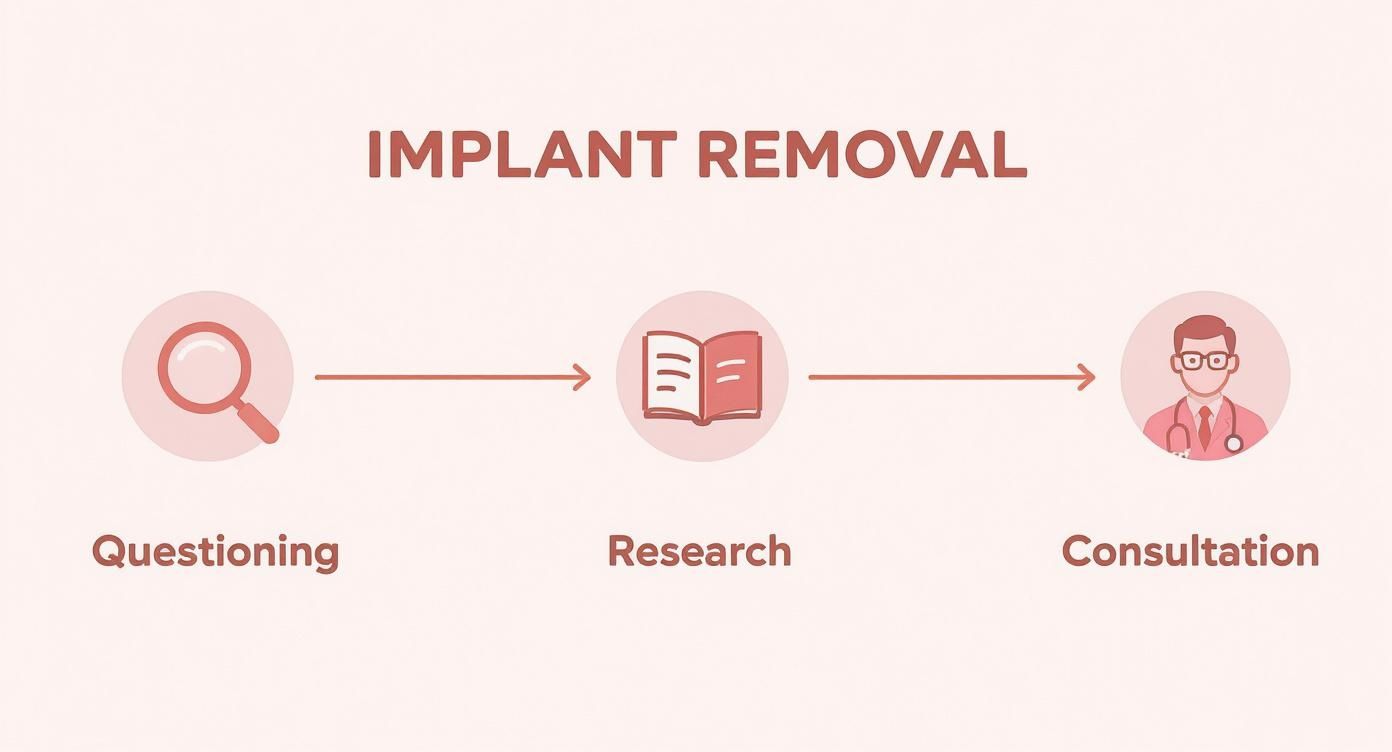
This process ensures you feel confident and fully informed, which is the cornerstone of any positive surgical experience.
As you head into your second, third, and fourth weeks of recovery, you’ll start to feel more and more like yourself again. The initial swelling and bruising will fade, and you'll notice your energy slowly coming back. The key here is not to jump the gun and do too much, too soon.
You can begin reintroducing light daily activities. Most patients are cleared to drive around the two-week mark, once they've stopped taking prescription pain medication and feel they can move comfortably and react quickly. Still, you’ll need to avoid any strenuous exercise, heavy lifting (a gallon of milk is too much!), or any activity that puts a strain on your chest muscles.
A Note on Healing: Remember, everyone heals at their own pace. Your personal timeline depends on your overall health, the specifics of your surgery (like whether you had a capsulectomy), and how closely you stick to your post-op care plan.
Speaking of care, your incisions are a top priority during this time. Keeping them clean and dry is crucial for preventing infection and ensuring they heal into the faintest scars possible. We'll give you detailed instructions, and you can learn more about how to care for surgical incisions in our guide. Following these steps is your best bet for a beautiful long-term result.
Making the decision to remove your breast implants is a significant first step. The next is deciding what comes after. This is a very personal choice, and it really hinges on what you want your body to look and feel like once the implants are gone.
Some women simply want the implants out, and that's it. They're ready to embrace their natural silhouette. Others, however, want to address the changes that having implants created over the years, like stretched skin or a loss of upper breast fullness.
Think of it like this: removing an implant is like taking a large painting off a wall. Sometimes, the wall behind it looks perfectly fine. Other times, you might see a faded outline or nail holes that you want to patch and repaint to make the space feel complete again. There’s no right or wrong answer—only what's right for you.
You're not alone in considering this. In 2021, an estimated 219,000 women in the U.S. had their breast implants removed. What's interesting is that about one-third of them chose not to replace their implants, a clear signal that many are seeking a return to a more natural contour. You can read more about these trends in recent articles exploring why more women are removing their breast implants.
So, what are your options? Let's walk through the three main pathways we can explore together.

The most direct route is a simple explantation. This procedure involves removing the breast implants and, in most cases, the scar tissue capsule that your body formed around them (this part is called a capsulectomy). The sole focus here is removing the implants and letting your body return to its natural state.
This is often a great choice for patients who:
After an explantation alone, your final result depends entirely on how much natural breast tissue you have and how well your skin retracts.
A mastopexy, more commonly known as a breast lift, is frequently performed at the same time as an explant. Over the years, the weight and volume of an implant can stretch the skin. When the implant is removed, that skin can remain loose, causing the breasts to sag (a condition called ptosis).
A mastopexy is designed to solve exactly that problem. During the procedure, I would:
This combination is ideal for women worried about drooping. It allows us to create a perkier, firmer breast shape using your own tissue, without needing an implant to provide that lifted look. We have a detailed guide that explains how a breast lift without implants achieves such beautiful, natural results.
Analogy: Think of a breast lift like having a favorite sweater expertly tailored after it has stretched out over time. We aren't adding any new material (volume); we're just removing the loose fabric and tightening the seams to restore its original, flattering shape.
What if you want to restore some of that lost volume but don't want new implants? That's where fat grafting (or fat transfer) comes in. This is a wonderful technique that uses your own body fat to subtly enhance your breast size and shape.
It's a two-step process:
Fat grafting gives you the dual benefit of slimming one part of your body while naturally enhancing another. It's fantastic for creating a soft, natural fullness and filling in any hollows or indentations that might be left after the implants come out. For a total rejuvenation, some patients even choose to combine all three: an explant, a lift, and fat grafting.
To help visualize these choices, here is a simple breakdown of the different surgical pathways available after you decide to remove your breast implants. Each approach is tailored to different aesthetic goals and patient needs.
Ultimately, the best path forward is a collaborative decision between you and your surgeon. During your consultation, we'll discuss your goals in detail to determine which procedure—or combination of procedures—will give you the results that make you feel confident and comfortable in your own skin.
The journey after breast implant removal doesn't end when you leave the recovery room. In many ways, that's just the beginning of a much longer healing process as your body rediscovers its natural state. Patience is your best friend during this time, because your final, settled results won't truly emerge for several months.
Think of it as an extended adjustment period. Your body needs time to recalibrate without the implants. Swelling will continue to go down, your breast tissue will soften and reshape, and your scars will start to fade.
It's so important to understand this timeline to keep your expectations realistic. What your breasts look like at six weeks is just a preview, not the final picture. The real beauty of the result unfolds over the next six, nine, and even twelve months.
One of the first things every patient asks is, "What will my breasts actually look like?" There's no single answer, because the final contour is completely unique to your body and depends on a few key factors.
At first, your breasts might look a bit flat or "deflated"—that's completely normal. Over the next few months, you'll watch them relax, settle, and take on a softer, more natural contour that is all your own. It's a gradual but rewarding process.
Taking good care of your incisions is crucial for making scars as faint as possible. They’ll start out looking red or pink, but over the course of a year, they typically fade into thin, pale lines. We'll give you a detailed scar care plan, which usually involves things like silicone sheets or gels to help them heal beautifully.
While we take every precaution to ensure a smooth recovery, it's smart to be aware of potential issues. Two things we watch for are capsular contracture and seromas.
When we remove implants, we often perform a capsulectomy, which means removing the capsule of scar tissue that forms around every implant. This is done to prevent or treat capsular contracture, a condition where the capsule hardens, causing pain or distortion. A seroma is simply a pocket of fluid that can sometimes develop after surgery. Most of the time it goes away on its own, but if it's large or uncomfortable, we may need to drain it.
The reasons for removing implants are complex and deeply personal. As implants age, the chances of medical issues do increase. In fact, one major study found that 43.5% of implants removed after more than 10 years were taken out for clear medical reasons like rupture or capsular contracture. You can read the full research on reasons for breast explantation to learn more.
The best approach is to stay in close contact with us. Keeping an open line of communication ensures that if any issues pop up, we can address them right away. Your long-term health and happiness with your results are our absolute top priorities.
True satisfaction with any cosmetic procedure starts with having a clear, realistic picture of your new body. The journey after breast implant removal is all about embracing a natural, new you, and understanding this process is the first step toward appreciating your results with patience and confidence.
Right after surgery, what you see in the mirror isn't the final product. It's a work in progress. Think of it like a brand-new memory foam pillow; it needs a little time to expand and settle into its intended shape. Your breast tissue, which was held in place and compressed by the implants, needs that same time to relax, unfurl, and find its new normal.
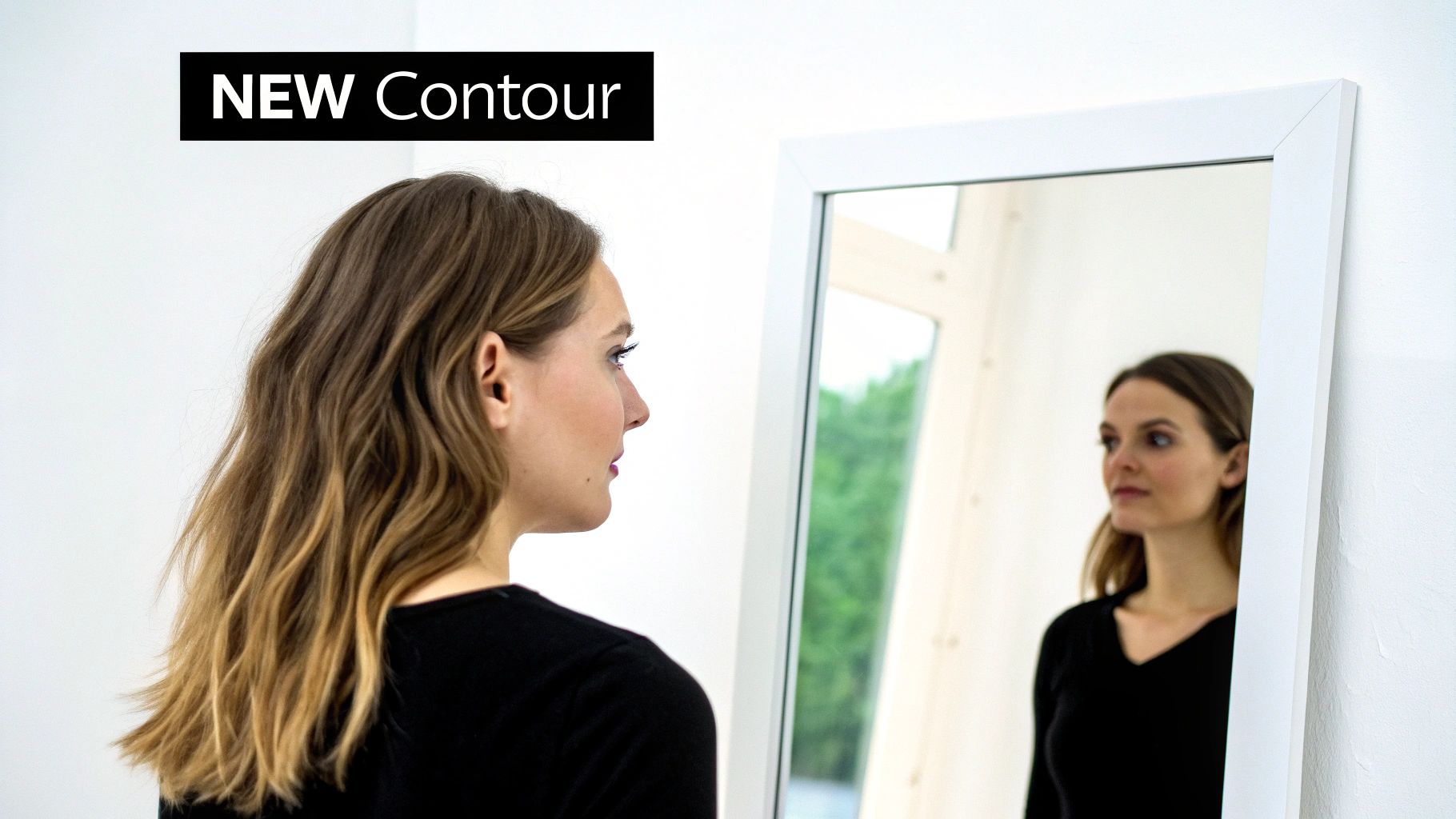
Many women are surprised by a feeling of flatness or an "empty" look, especially in the upper part of the breast. This is a completely normal and temporary part of the process. Your final contour will emerge gradually over the next three to six months as the last bit of swelling disappears and your tissues settle completely.
Every woman's body is different, so it stands to reason that every result will be unique. There's simply no one-size-fits-all outcome. Instead, your new silhouette is a reflection of your individual anatomy.
Several key factors play a big role in how your breasts will look and feel long-term:
Knowing how these elements come together helps paint a realistic picture of your surgical outcome. Our goal is to create a natural silhouette that feels balanced and harmonious with the rest of your body.
In the world of breast augmentation, patients talk about the "fluffing" period, where new implants soften and settle into place. After explantation, you go through a kind of "reverse fluffing." That initial sense of emptiness slowly gives way to a more natural, settled contour as your body heals.
This transition doesn't happen overnight. Your breast tissue, which was held in a specific position by the implant, will gradually relax and redistribute itself. This slow settling process is what helps create a softer, more teardrop-like shape that is uniquely yours.
"A patient’s happiness with their body is the most important part of what we do. Our goal is to restore confidence and comfort, whether that means removing implants, reshaping natural tissue, or combining techniques to help you feel like yourself again."
This journey is about so much more than just looks. Many women tell us they feel a profound sense of physical comfort and emotional freedom after removing their implants. They often describe feeling lighter, more at ease during exercise, and simply more connected to their own bodies.
Your final look is also heavily shaped by the surgical plan you and your surgeon decided on together. If you chose to have other procedures done at the same time as your explant, your results will naturally be different from someone who had a straightforward implant removal.
Ultimately, setting the right expectations means understanding that your body will go through a period of healing and settling. By focusing on your newfound comfort and embracing the gradual evolution of your shape, you can approach your recovery with positivity and look forward to a result that feels authentically you.
Finding the right surgeon is arguably the most important step you'll take when deciding to have your breast implants removed. Think of the consultation not just as an appointment, but as a genuine conversation—a chance for you to be heard, to ask tough questions, and to co-create a plan that feels right for you. This meeting truly sets the stage for everything that follows.
The single most critical decision you'll make is choosing a board-certified plastic surgeon who has deep, hands-on experience with explant procedures. It’s one thing to simply remove an implant; it’s another thing entirely to have the artistic skill and technical expertise to manage the capsule and reshape your natural breast tissue for a beautiful result. That’s where a specialist’s experience really shines.
A great consultation is a two-way street. It’s your time to interview the surgeon and get a feel for their approach, and it's our time to listen and understand what you're hoping to achieve.
To get the most out of our meeting, be ready to talk through your full medical history, the details of your original augmentation (if you have them), and any symptoms or concerns that are leading you to this decision. For a complete rundown, our guide explains what happens during a plastic surgery consultation in more detail.
Before you come in, spend some time thinking about what you really want. Are you looking to go back to your natural look and size? Or are you worried about what happens next—like sagging or a loss of volume? The clearer you are on your goals, the better we can design a surgical plan that gets you there.
"A patient’s happiness with their body is the most important part of what we do. Our goal is to restore confidence and comfort, whether that means removing implants, reshaping natural tissue, or combining techniques to help you feel like yourself again."
Come prepared with questions. Don't be shy—this is your body and your health. Here are a few to get you started:
You should walk out of a consultation feeling informed, respected, and confident in the path forward. At Cape Cod Plastic Surgery, Dr. Fater is committed to providing that exact experience. Schedule your one-on-one consultation today to explore your options with an expert who will put you first.
When you decide to move forward with breast implant removal, it's natural for a whole new set of questions to pop up. Let's walk through some of the most common things patients ask, so you can feel confident and clear about the road ahead.
This is probably the number one question on every woman's mind. The short answer is that all of your natural breast tissue will still be there after the implants come out. Your final volume really just depends on how much of your own tissue you started with.
If you’re hoping to keep some of the fullness you had with implants, fat grafting can be a fantastic solution. We can take your own body's fat from another area—like your stomach or thighs—and use it to subtly enhance your breast volume and shape. It’s a completely natural way to get a soft, beautiful result without putting in new implants.
The appearance of your scars will hinge on the incisions from your original breast augmentation and whether you also have a breast lift. In most cases, we can use the same incision in the crease under the breast (the inframammary fold), which does a great job of hiding the scar once it’s healed.
Scars have their own healing timeline, and it can take up to a year for them to fully mature. At first, they'll look pink or even red, but they almost always fade into thin, pale lines over time. We'll send you home with a detailed scar care plan using things like silicone gels or sheets to help them heal as beautifully as possible.
Your final result is a team effort between your surgeon and your body. How well your skin bounces back, the size of your old implants, and how closely you follow aftercare instructions all play a huge role in your new shape.
Getting back to your workout routine needs to be a slow and steady process. I can't stress this enough—pushing it too soon can cause problems and undo all the careful work we did in surgery.
Here’s a rough timeline that works for most of my patients:
Remember, this is just a guide. You must get the all-clear from your surgeon before jumping back into any strenuous activity. Everyone heals at their own pace, and your personal timeline will be based entirely on how your recovery is progressing.
This is a tricky one. Insurance coverage for explant surgery varies a lot from one provider to the next. The key is whether the procedure is considered medically necessary.
Insurance is much more likely to cover the surgery in specific situations, such as:
If the surgery is for purely cosmetic reasons—for example, you just don't like the size or shape of your breasts anymore—it's very unlikely to be covered. Our office team is experienced in this area and can help you work with your insurance company to figure out exactly what your plan covers.
Your explant journey is deeply personal, and having a surgeon you trust makes all the difference. Here at Cape Cod Plastic Surgery, Dr. Fater is committed to creating a plan that respects your health and helps you achieve your goals. Schedule your personalized consultation today and let's take the next step together.
October 7, 2026
A Practical Guide to Healing After Breast Surgery
October 6, 2026
Your Safety Guide: What to Look for When Choosing a Plastic Surgeon
October 5, 2026
Why Our On-Site Accredited Facility Matters for Your Safety
Cape Cod Plastic Surgery offers expert cosmetic and reconstructive procedures in a safe, accredited setting. Led by Dr. Marc Fater, we combine advanced techniques with personalized care to help you look and feel your best.
Monday: 9:00 AM – 5:00 PM
Tuesday: 9:00 AM – 5:00 PM
Wednesday: 9:00 AM – 5:00 PM
Thursday: 9:00 AM – 5:00 PM
Friday: 9:00 AM – 5:00 PM