

October 7, 2026
What to Expect During Your Breast Surgery Recovery
A Practical Guide to Healing After Breast Surgery
Apr 14, 2026

Brow lifts restore a refreshed, alert look by correcting drooping brows, deep forehead lines, and the "tired" appearance that comes with natural aging. At our clinic we offer a full spectrum of options, from surgical procedures—such as endoscopic, coronal, temporal, and pre‑trichial lifts that reposition tissue, remove excess skin, and provide lasting results lasting five to ten years—to minimally invasive alternatives like Botox or other neuromodulators, hyaluronic‑acid fillers, ultrasound‑based skin tightening, and thread lifts that give a subtle, temporary lift with little to no downtime. During your personalized consultation we will review your medical history, assess brow position, skin elasticity, and hairline, and discuss your aesthetic goals and lifestyle preferences. You’ll learn the expected recovery timelines, risks, costs, and how each technique can be combined with other facial rejuvenation procedures for a harmonious result. Our board‑certified surgeons will tailor a plan that balances safety, durability, and the natural appearance you desire.
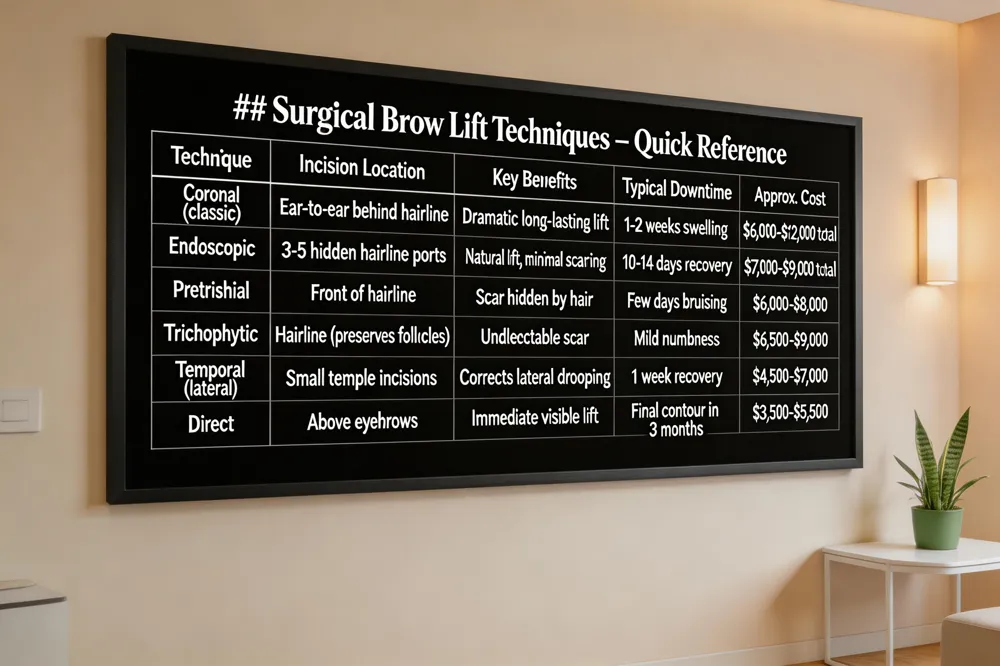 A coronal (classic) brow lift uses a single ear‑to‑ear incision behind the hairline to access the forehead. The surgeon lifts skin, muscle and fascia, elevating the brows and smoothing deep lines. This approach yields the most dramatic, long‑lasting lift, ideal for pronounced ptosis or heavy forehead skin, but requires a few weeks of swelling, bruising and a scar that matures over time.
Endoscopic lift lift minimally invasive. Small hidden incisions behind the hairline allow a camera and specialized instruments to reposition brow tissue. The result is a natural‑looking elevation with minimal scarring and a faster recovery—most patients resume normal activities within 10‑14 days. Temporary numbness or hair loss at the incision sites may occur, but complications are rare.
Pretrichial brow lift places a discreet incision just in front of the hairline. Hair grows through the scar, making it virtually invisible. By releasing deep brow attachments and removing a modest amount of excess skin, this technique restores a youthful brow position while preserving the hairline—a good choice for patients with a high forehead or heavy upper eyelids.
Trichophytic brow lift makes an incision at the hairline that preserves follicles, leaving an almost undetectable scar. It lifts the brow without lowering the hairline, suitable for high‑forehead or receding‑hairline patients. Recovery involves a few days of bruising, a compressive head wrap and mild numbness that resolves within weeks.
Temporal (lateral) lift targets the outer brow portion with small temple incisions. It corrects early lateral drooping, softens crow’s feet and avoids a full‑forehead scar. Most patients return to daily activities within a week.
Direct brow lift involves an incision just above the eyebrows to remove excess skin and elevate the brow 2‑5 mm. The scar is hidden in the natural brow line, and results are evident within weeks, with final contour maturing by three months.
All procedures are performed under local anesthesia with sedation or general anesthesia, depending on the technique and patient preference, ensuring safety and personalized care.
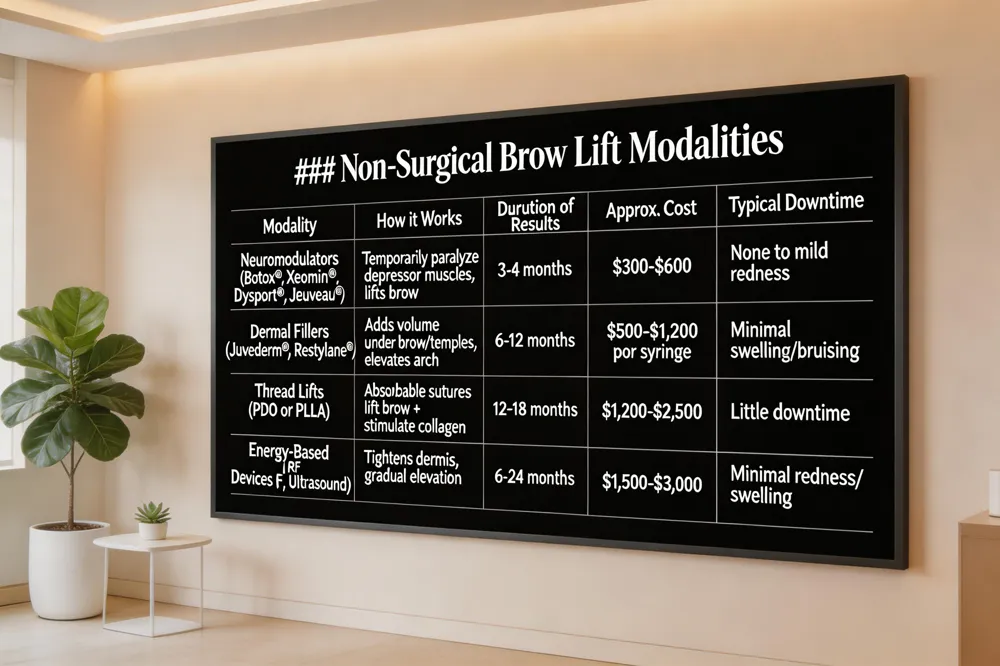 Non‑surgical brow lifts use minimally invasive techniques—no incisions, no anesthesia—to raise and smooth the forehead and eyebrows. The most common approach is neuromodulator injections (Botox®, Xeomin®, Dysport®, Jeuveau®) which temporarily paralyze the depressor muscles, allowing the frontalis to lift the brow naturally. Results appear within days and last 3‑4 months, with a typical cost of $300‑$600 per session.
Dermal fillers (hyaluronic‑acid products such as Juvederm® or Restylane®) add volume under the brow tail and temples, subtly elevating the arch and smoothing fine lines. Effects last 6‑12 months and cost $500‑$1,200 per syringe.
Thread lifts employ absorbable barbed sutures (PDO or PLLA) placed under the skin to mechanically raise the brow while stimulating collagen. Immediate lift is visible, lasting up to 12‑18 months, and the procedure takes 45‑60 minutes with minimal downtime.
Energy‑based devices—radio‑frequency, micro‑focused ultrasound (Ultherapy®), and micro‑current—tighten deep dermal layers, promoting gradual brow elevation and skin firmness. Results develop over 2‑3 months and can endure 6‑24 months, with session costs ranging $1,500‑$3,000.
Non surgical brow lift – A combination of neuromodulators, fillers, thread lifts, and energy‑based treatments can address mild‑to‑moderate ptosis without surgery.
Best non‑surgical brow lift – Neuromodulator injections (most often Botox are the most widely performed and consistently effective; they smooth horizontal lines and provide a subtle lift with virtually no downtime.
Non surgical brow lift thread – PDO thread lifts deliver immediate uplift, stimulate collagen, and typically last up to a year, with a quick outpatient recovery.
Non surgical brow lift for hooded eyes – Botox or thread lifts can modestly raise the brow line, reducing visual hooding; for more severe cases, surgical options may be recommended after evaluation.
Best non surgical brow lift – Neuromodulators combined with targeted fillers or ultrasound‑based tightening give a natural, lasting result tailored to each patient’s anatomy.
Non surgical brow lift near me – Cape Cod Plastic Surgery in Hyannis, MA, offers personalized, board‑certified care with these techniques in an accredited facility. Contact us to schedule a virtual or in‑person consultation.
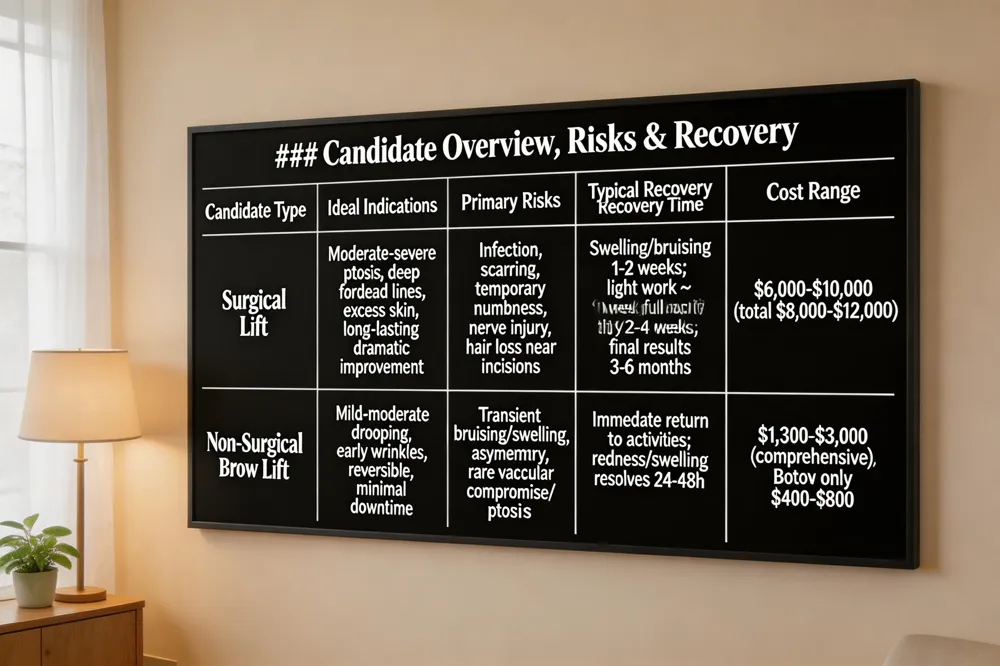 Ideal candidates for a surgical brow lift are healthy, non‑smoking adults with moderate‑to‑severe brow ptosis, deep forehead lines, or excess skin who want a long‑lasting, dramatic improvement. Non‑surgical candidates typically have mild‑to‑moderate drooping, early wrinkles, or prefer a reversible option with minimal downtime.
Potential complications differ by approach. Surgical lifts (endoscopic, coronal, temporal, or direct) carry risks of infection, scarring, temporary numbness, nerve injury and hair loss near incisions, and rare hematoma. Endoscopic lifts reduce visible scarring and nerve‑injury risk but still require careful protection of the supra‑orbital and temporal nerves. Non‑surgical lifts (Botox, Xeomin, dermal fillers, thread lifts, ultrasound or RF devices) are generally safe, with transient bruising, swelling, or asymmetry; rare adverse events include vascular compromise with fillers or ptosis with neuromodulators.
Typical downtime after surgery is 1‑2 weeks of swelling and bruising, with most patients returning to desk work within a week and full activity by 2‑4 weeks; final results mature over 3‑6 months. Non‑surgical treatments involve little to no downtime—patients resume normal activities immediately, experiencing only mild redness or swelling that resolves within 24‑48 hours.
Brow lift procedure: Performed by Dr. Marc Fater, the surgery uses intravenous sedation or general anesthesia, small hairline incisions (endoscopic) or a coronal scalp incision, tissue repositioning, and absorbable sutures or clips. Costs: Surgical lifts range $6,000‑$10,000 (total $8,000‑$12,000); endoscopic lifts average $5,000‑$6,000 surgeon fees, $7,000‑$9,000 total. Non‑surgical lifts start around $1,300, with comprehensive plans $1,500‑$3,000; Botox‑only sessions $400‑$800 per treatment. Reddit users frequently discuss Botox and thread lifts as popular, cost‑effective options.
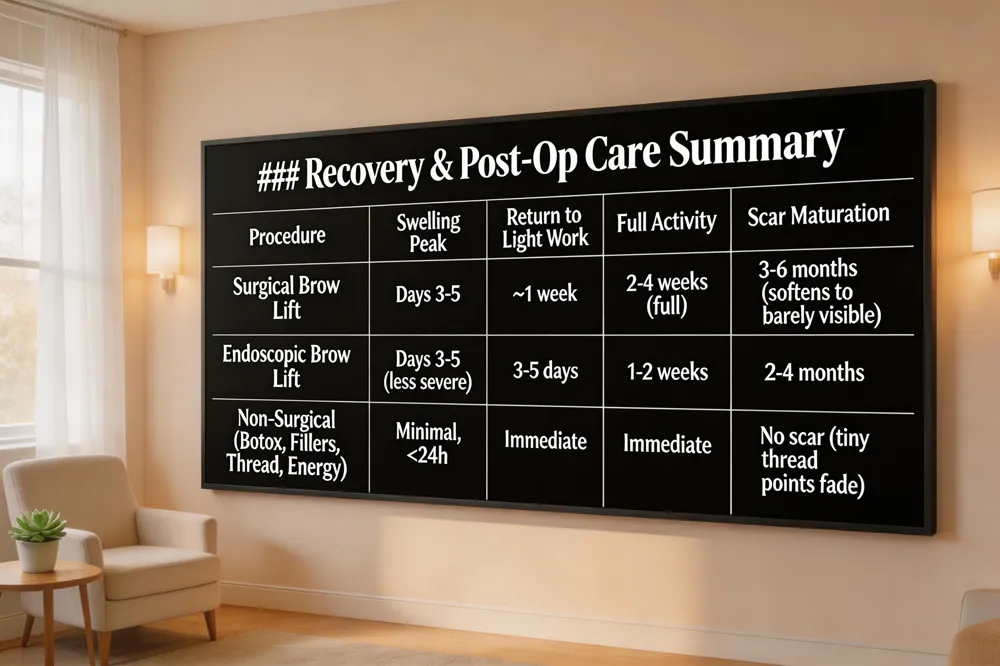 Recovery after a surgical brow lift usually shows swelling and bruising that peak within the first 3‑5 days and gradually fade over 1‑2 weeks; most patients resume light work after about a week and full activities by two weeks, while scar maturation can take 3‑6 months to soften into barely visible lines. Activity restrictions include avoiding strenuous exercise, heavy lifting, and direct sun exposure for the first 2‑4 weeks; gentle head elevation and cold compresses help reduce swelling. Healing speed is influenced by skin quality, age, smoking status, and adherence to post‑op instructions.
What is the difference between surgical and non‑surgical brow lift? A surgical brow lift uses small incisions hidden behind the hairline to reposition tissue, offering dramatic, long‑lasting results that can last years but requires weeks of downtime. A non‑surgical lift relies on Botox, fillers, or energy‑based devices, providing a subtle, temporary lift (3‑12 months) with virtually no downtime.
Brow lift near me – Cape Cod Plastic Surgery in Hyannis, MA, led by board‑certified Dr. Marc Fater, offers personalized endoscopic and other brow lift options in an accredited outpatient center.
Endoscopic brow lift before and after – Before‑and‑after photos show noticeable brow elevation, smoother forehead lines, and a refreshed, natural appearance that can last up to a decade.
Non‑surgical brow lift before and after – Injectable Botox, fillers or and ultrasonic tightening liftuate brows, smooth skin, and improve symmetry within days, with results lasting 6‑12 months.
Brow lift before and after – Our gallery displays real patient transformations highlighting elevated brows, reduced frown lines, and a youthful look while preserving natural facial harmony.
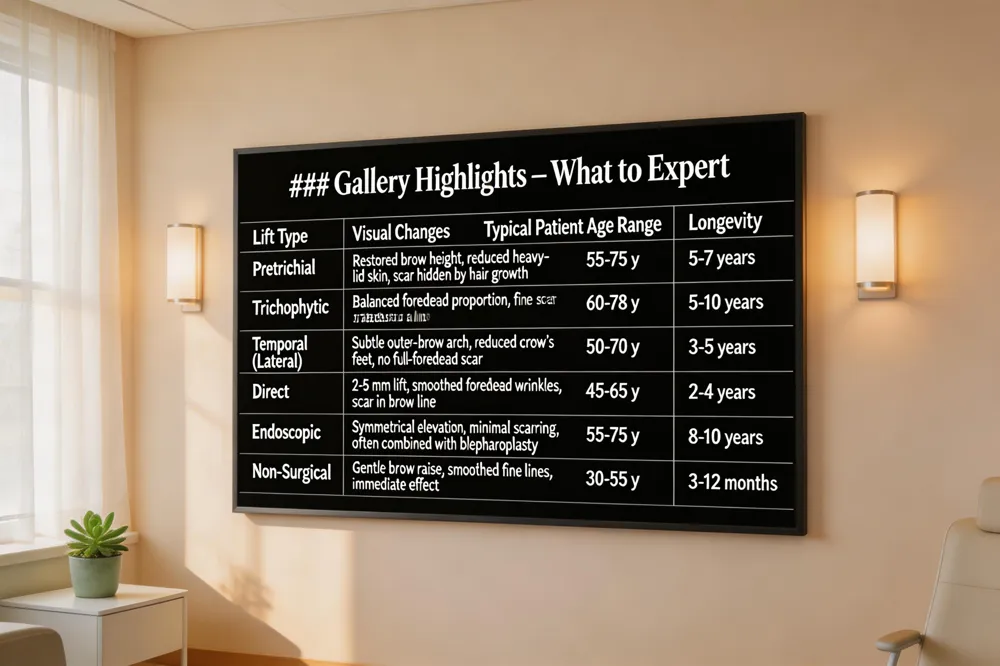 Our before‑and‑after gallery lets patients see the visual impact of each brow‑lift technique, the typical age range of candidates, and how to read the results over time.
Key visual changes from different lift types
Patient age ranges and goals Our patients typically range from their early 50s to mid‑70s, seeking relief from heavy brows, visual‑field obstruction, or deep forehead lines. Younger adults with mild ptosis may prefer non‑surgical options for a temporary lift.
How to interpret results Initial changes are visible within a few weeks; swelling subsides by 10‑14 days, and final contour stabilizes around six months. Scar maturation follows a predictable timeline—hairline incisions become hidden, while direct‑brow incisions soften to fine lines. Longevity varies: surgical lifts can last 5‑10 years, whereas non‑surgical lifts require repeat treatments every 3‑12 months.
Explore the full gallery on the Cape Cod Plastic Surgery website to see these transformations and schedule a personalized consultation with Dr. Marc Fater.

Matching technique to anatomy and goals
A successful brow lift starts with a thorough assessment of facial anatomy, hairline position, skin elasticity, and the degree of ptosis. For patients with deep forehead lines, significant brow sagging, or a high hairline, surgical options such as an endoscopic or trichophytic lift provide lasting, dramatic elevation. Those with mild drooping, early fine lines, or a desire for minimal downtime benefit from non‑surgical modalities that target muscle relaxation and volume restoration.
Newest advances and trends
The most recent surgical advance is the endoscopic brow lift, a minimally invasive procedure that uses three to five tiny incisions hidden behind the hairline and a high‑definition camera. This technique permits precise release of the zone of adhesion, the conjoint tendon, and the arcus marginalis, allowing the surgeon to reposition the brow tissue with bone‑anchored sutures or absorbable pegs. Results are subtle, natural‑looking, and accompanied by reduced scarring, faster recovery, and a high satisfaction rate exceeding 98 % in recent surveys. In the non‑surgical arena, neuromodulators (Botox®, Xeomin®) remain the gold standard for a temporary lift, while combined filler, Ultherapy, and thread‑lift protocols extend durability to 6–12 months.
Personalized consultation process
During a virtual or in‑person consultation, our board‑certified team evaluates your specific concerns, reviews photographic documentation, and discusses functional versus aesthetic goals. We explain the trade‑offs of each technique—longevity, downtime, cost, and potential risks—so you can make an informed decision. Tailored treatment plans may combine an endoscopic lift with Botox or fillers to fine‑tune the brow contour, ensuring a safe, customized outcome that restores confidence and a refreshed appearance.
Both surgical and non‑surgical brow lifts can rejuvenate the upper face, but they differ in durability, downtime, and cost. Surgical lifts—whether endoscopic, coronal, temporal, or trichophytic—offer a permanent structural change that can last 5‑10 years, making them ideal for deep forehead lines, significant ptosis, or excess skin. Non‑surgical options such as Botox, dermal fillers, thread lifts, ultrasound or radio‑frequency tightening provide a temporary lift (3‑12 months) with minimal downtime and lower upfront expense, suiting patients with mild sagging or those preferring a reversible approach.
Choosing a board‑certified plastic surgeon ensures mastery of anatomy, access to accredited facilities, and adherence to safety protocols—critical for minimizing complications like nerve injury, scarring, or anesthesia reactions.
If you’re ready to explore the best solution for your goals, schedule a virtual or in‑person consultation. During this personalized visit we’ll assess brow anatomy, discuss expectations, and outline a tailored treatment plan—including financing, recovery timelines, and post‑procedure care—to help you achieve a confident, refreshed appearance.
October 7, 2026
A Practical Guide to Healing After Breast Surgery
October 6, 2026
Your Safety Guide: What to Look for When Choosing a Plastic Surgeon
October 5, 2026
Why Our On-Site Accredited Facility Matters for Your Safety
Cape Cod Plastic Surgery offers expert cosmetic and reconstructive procedures in a safe, accredited setting. Led by Dr. Marc Fater, we combine advanced techniques with personalized care to help you look and feel your best.
Monday: 9:00 AM – 5:00 PM
Tuesday: 9:00 AM – 5:00 PM
Wednesday: 9:00 AM – 5:00 PM
Thursday: 9:00 AM – 5:00 PM
Friday: 9:00 AM – 5:00 PM