

October 7, 2026
What to Expect During Your Breast Surgery Recovery
A Practical Guide to Healing After Breast Surgery
May 29, 2026
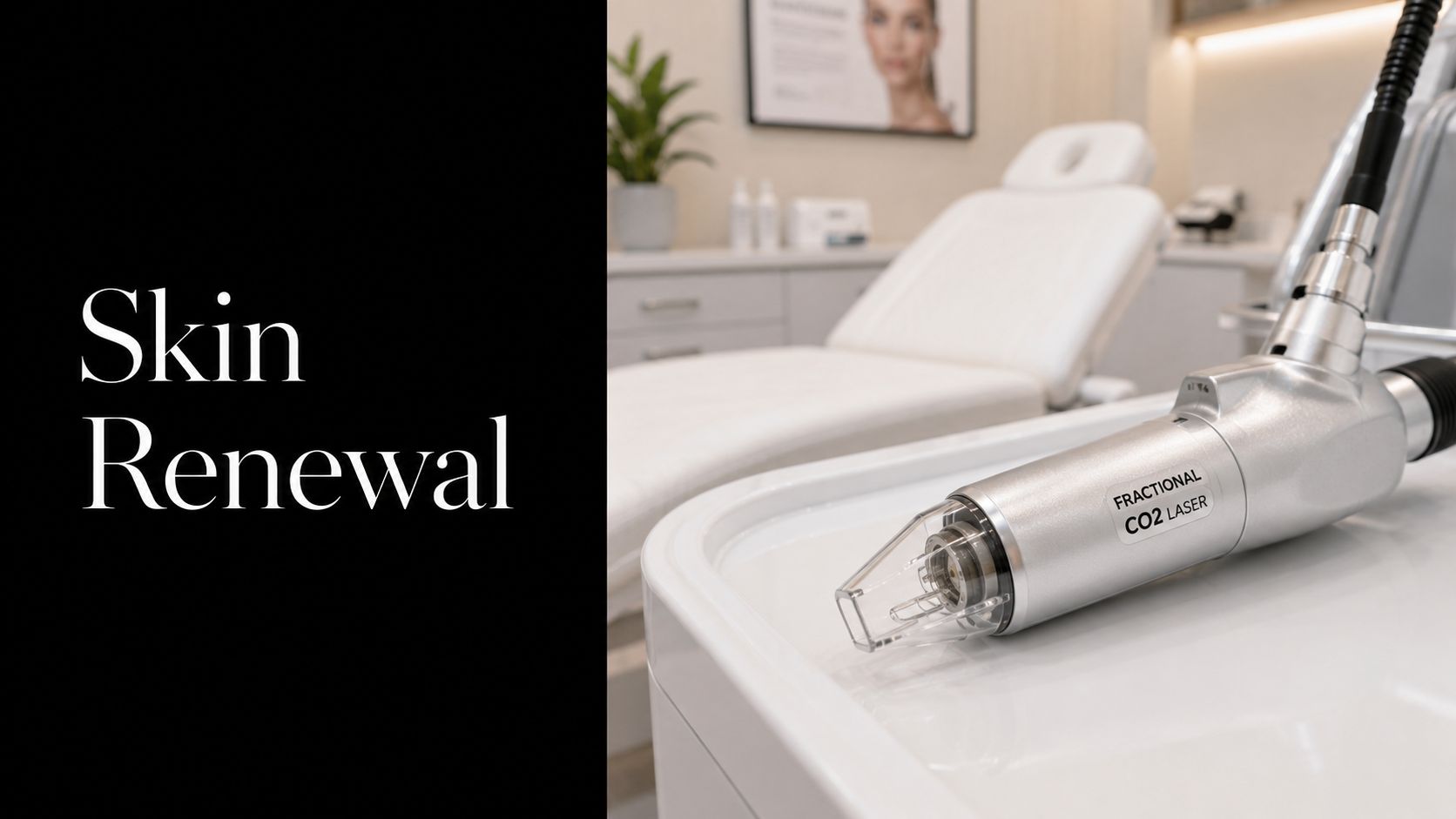
You're probably reading this because your skin doesn't look the way it used to. Maybe the issue is acne scarring that still catches the light. Maybe it's etched lines around the mouth, uneven texture, or sun damage that makeup doesn't fully hide. Many individuals reach this point after trying lighter treatments first and realizing they want something with more visible impact.
That's where fractional CO2 laser resurfacing enters the conversation. It's a powerful treatment, but it's also one that demands honest planning. The right patient can see meaningful improvement. The wrong expectations can turn a good treatment into a frustrating experience.
What most generic guides miss is the patient journey. The procedure is only one part of it. Consultation, preparation, healing, social downtime, and the slow return on collagen remodeling matter just as much as the treatment itself. If you're considering a fractional CO2 laser, you should understand the whole arc before you commit.
A fractional CO2 laser is an ablative resurfacing treatment that works by creating tiny, controlled columns of injury in the skin. The easiest way to picture it is lawn aeration. Instead of removing the entire surface, the device treats thousands of microscopic zones while leaving surrounding tissue intact. That untreated skin acts like a repair network and helps healing move faster and more predictably.
The underlying CO2 laser has a long history. It was first invented in 1964 by Kumar Patel at Bell Labs, and the dermatologic wavelength most patients hear about is 10,600 nm, which is strongly absorbed by water in skin tissue. That's part of why this technology became so useful for resurfacing. Modern fractional systems, introduced in the 2000s, refined the older fully ablative approach by splitting the beam into micro-columns so treatment could be more controlled and downtime more manageable while still delivering substantial resurfacing power, as described in this overview of the carbon-dioxide laser.
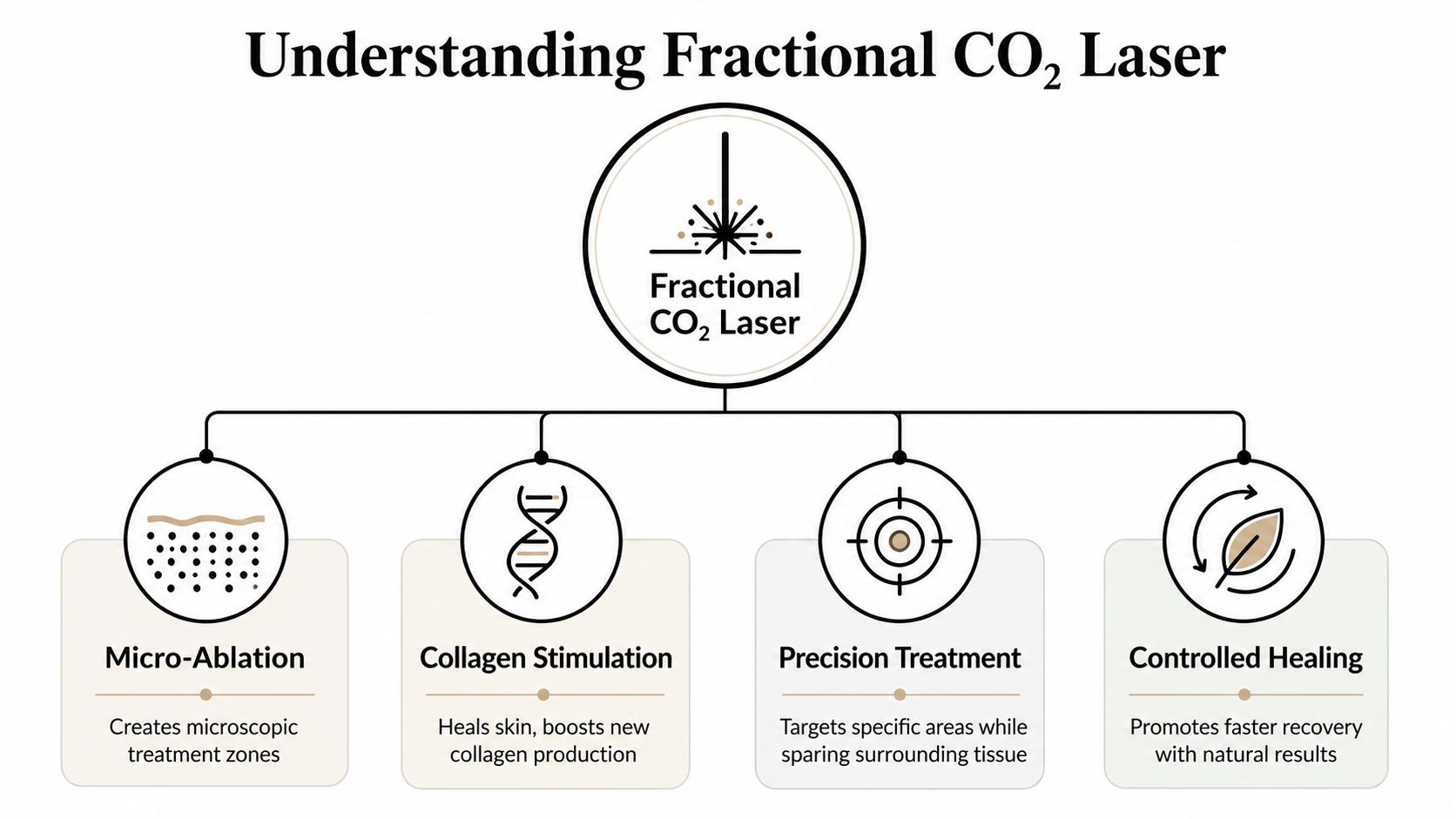
At the surface, the laser vaporizes damaged skin cells in very small treatment zones. Below the surface, heat reaches into the dermis and starts a wound-healing response. That response matters because resurfacing isn't just about peeling away damaged skin. It's also about prompting the skin to rebuild itself with better organization.
In practical terms, that means two things happen at once:
Older fully ablative CO2 resurfacing could produce strong results, but it treated the entire surface. Fractional delivery changed the trade-off. By treating only a fraction of the skin at a time, physicians could still target wrinkles, sun damage, and scarring while reducing downtime compared with earlier fully ablative methods. If you want a broader overview of resurfacing options, this guide on laser skin resurfacing and skin texture improvement is a useful companion read.
Practical rule: Fractional doesn't mean weak. It means the treatment is distributed in a way that preserves surrounding skin so healing is more manageable.
That distinction is why this treatment has remained relevant. It isn't a facial. It isn't a mild polish. It's a controlled skin injury designed to replace damaged texture with smoother, healthier tissue over time.
Fractional CO2 works best when the problem is rooted in texture, surface damage, or structural change in the skin. If your concern is purely volume loss or skin laxity from deeper facial aging, this laser may help the surface look better, but it won't replace a lifting procedure or injectable treatment when those are the primary concern.
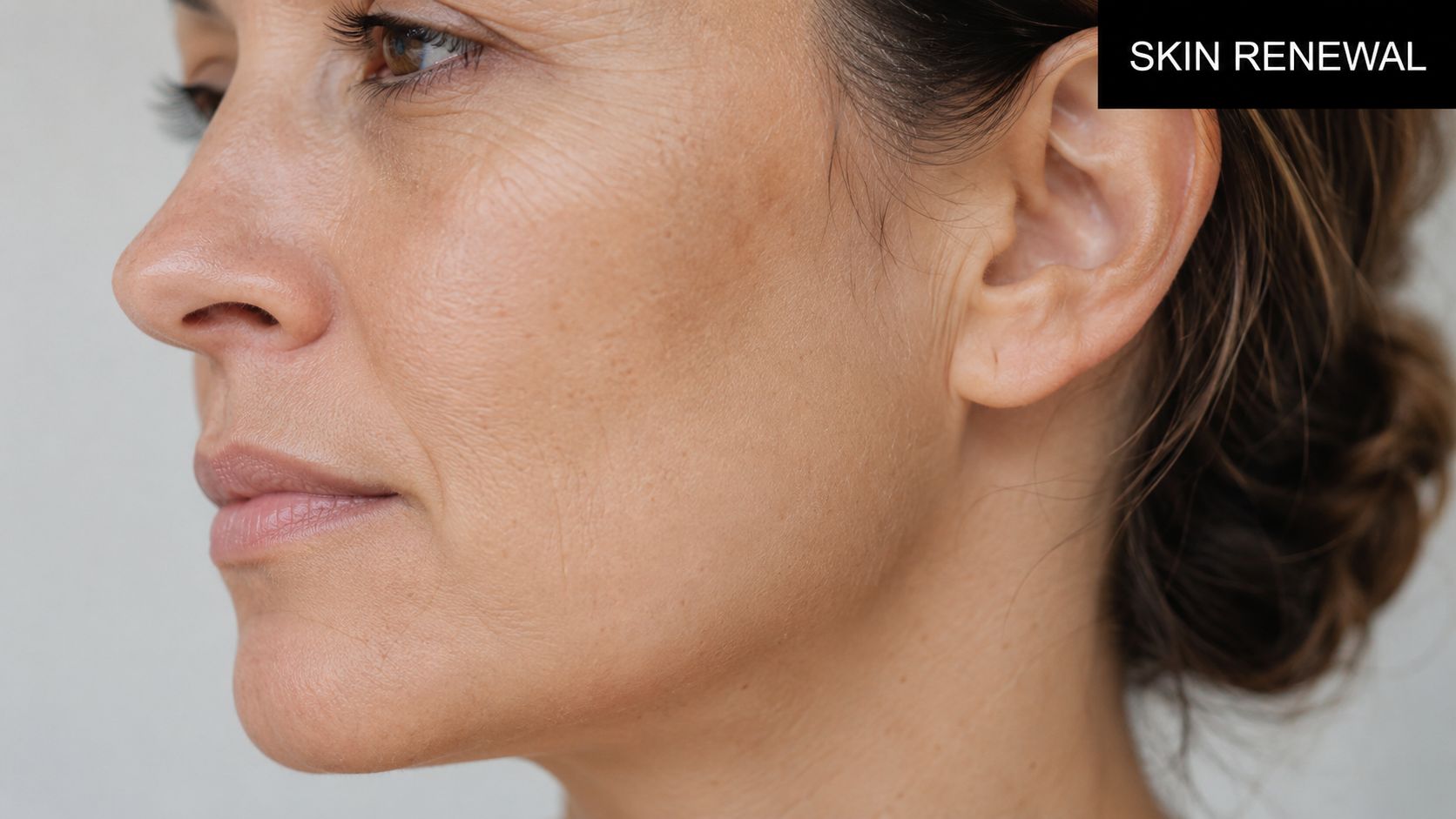
This is one of the most common reasons patients ask about the treatment. Fine lines that come from chronic sun exposure and repetitive facial movement often sit in skin that has become thinner, rougher, and less organized over time. A fractional CO2 laser improves that by resurfacing the outer layer and encouraging deeper remodeling.
The best results usually come in areas where the issue is texture-based rather than purely loose skin. Around the mouth, on the cheeks, and in the lower eyelid area, that distinction matters a lot.
Fractional CO2 often stands out, particularly for atrophic acne scars. Especially rolling and boxcar-type depressions, respond because the laser can soften the scar edges and stimulate rebuilding beneath them. In a clinical study published in JAMA Dermatology, three fractional CO2 laser treatments improved the appearance of atrophic acne scars by over 50% in the majority of patients, showing why it remains such an important tool for textural correction in carefully selected patients, as reported in JAMA Dermatology.
If acne scarring is your main concern, it also helps to understand where laser fits among other options. This overview of acne scar treatments gives useful context.
Sun-damaged skin often looks coarse before it looks old. Patients notice mottled tone, roughness, and a weathered appearance. Because fractional CO2 removes columns of damaged surface tissue, the skin can heal back with a more even texture and fresher appearance.
That said, this is an area where expectations need to stay grounded. Pigment concerns can be complex. Some discoloration responds well. Some requires a blended plan with skincare and sun management. The laser is strong, but it isn't a shortcut around diagnosis.
Good resurfacing doesn't just make skin smoother. It makes light reflect more evenly off the skin, which is why patients often describe their skin as looking healthier even before they can name exactly what changed.
Some patients don't have one dramatic problem. They have a collection of smaller ones: crepey texture, enlarged pores, early lines, and general loss of crispness. Fractional CO2 can be a strong fit in that setting because it addresses the skin as a fabric, not just as a spot-treatment tool.
That's why I often describe it as a treatment for quality. It won't reposition tissue. It won't add volume. But it can significantly improve the way the skin itself looks and behaves.
Not everyone who wants resurfacing should have a fractional CO2 laser. That's not a sales problem. It's a judgment problem, and good judgment is what keeps a powerful treatment safe and worthwhile.
The ideal candidate usually has visible textural concerns, accepts real downtime, and understands that improvement takes time. The less suitable candidate often wants dramatic change without recovery, or has skin and healing factors that make the risk profile less favorable.
Patients tend to do well when several factors line up:
Some patients need a modified plan. Others should postpone treatment or choose another modality. A careful consultation usually focuses on questions like these:
| Consideration | Why it matters |
|---|---|
| Active acne or irritation | Treating inflamed skin can complicate healing and make results less predictable |
| Rosacea, eczema, or very reactive skin | Barrier disruption can trigger a prolonged inflammatory response |
| History of abnormal scarring | If your body tends to scar poorly, resurfacing needs much stricter risk assessment |
| Recent isotretinoin use | Healing decisions should be individualized and conservative |
| Significant sun exposure habits | Freshly treated skin and ultraviolet exposure are a poor combination |
Ablative fractional CO2 is effective because it creates controlled thermal injury. The trade-off is that stronger treatment settings usually mean more visible recovery. Published resurfacing guidance reflects that balance. Clinical protocols commonly use 1 to 2 passes with facial settings around 100 to 125 mJ and density levels of about 2 to 4, with higher energy increasing ablation depth and remodeling potential while higher density increases coverage, thermal injury, and recovery time, as outlined in this clinical resurfacing review.
That sentence matters because it captures the heart of treatment planning. More isn't always better. Sometimes it's just more.
Potential side effects and complications include redness, swelling, oozing, prolonged pinkness, infection, and pigment change. Hyperpigmentation and hypopigmentation are especially important to discuss in anyone with a history of pigment sensitivity or a skin tone that may react unpredictably.
The safest laser plan is the one matched to your skin, your history, and your tolerance for downtime. Aggressive settings on the wrong patient don't create better medicine.
A good consultation should make you feel informed, not sold. If the conversation skips risks, healing demands, or the possibility that another treatment may fit better, that's a warning sign.
You come in wanting smoother skin, a more even surface, and a fresher look. The first question is not which laser setting to use. The first question is whether fractional CO2 is the right tool for your skin, your goals, and your calendar.
With Dr. Marc Fater, the consultation is built around that decision. Two patients may both ask for resurfacing and still need very different plans. Acne scars, sun damage, fine lines, enlarged pores, and laxity do not respond in the same way. In some cases, the better sequence is to treat volume loss or deeper folds first, then resurface the skin. That kind of planning is what keeps expectations realistic.
Dr. Fater examines the skin in detail and explains three things clearly. What the laser is likely to improve, what it may improve only modestly, and what it will not correct. That distinction matters. Fractional CO2 can improve texture and stimulate remodeling, but it does not replace surgery for significant skin excess, and it does not solve every cause of an aged appearance.
He also reviews the details that affect safety and recovery. That includes your medical history, medications, prior procedures, history of cold sores, tendency toward post-inflammatory pigmentation, daily sun exposure, and current skincare products. If a patient is using retinoids, acids, or other irritating topicals, those often need to be adjusted before treatment.
Timing matters too. If you have a wedding, reunion, business event, or travel coming up, that has to be part of the plan. Good laser treatment is not just about the day of the procedure. It is about choosing a date that gives your skin time to heal without forcing you to hide that process.
Before treatment, patients also get practical instructions for home preparation. Have gentle cleanser, bland moisturizer, sun protection, and any prescribed aftercare ready in advance. If your skin is already irritated, the goal is to calm it first, not push through it. In some cases, I explain this the same way I explain incision healing. Healthy skin recovers better than inflamed skin. If you are already dealing with irritation, it helps to first repair damaged skin barrier rather than add another stressor.
Fractional CO2 resurfacing is usually done in the office. The exact setup depends on the area treated and how aggressive the plan is. Some patients need only topical numbing and cooling measures. Others benefit from additional comfort support based on treatment depth and coverage.
During treatment, the sensation is usually described as heat with a rapid snapping feeling across the skin. Patients tolerate it much better when they know that sensation is expected and temporary. The procedure itself is controlled and deliberate. Settings are chosen to match the treatment goal, not to make the session more dramatic.
Once the laser is finished, the skin looks red and feels hot. Swelling can build over the next several hours, especially around the eyes if the face is treated. That response is normal, but it can be intense if you were expecting a light lunchtime procedure. This is why a careful consultation matters. Patients do best when the early appearance matches what they were told to expect.
The first phase at home is straightforward but important. Keep the skin clean, keep it moist, protect it from friction, and stay out of the sun. Do not scrub. Do not pick. Do not try to speed peeling with exfoliants or active products. The surface needs time to restore itself evenly.
Dr. Fater's team gives patients a clear aftercare plan so they know what to use, when to use it, and what changes deserve a phone call. That guidance is one of the biggest differences between a generic laser treatment and a well-managed resurfacing experience. Good outcomes depend on both the procedure and the healing plan that follows.
If device options come up during planning, one platform used in practice settings is Tetra CoolPeel CO2 laser treatment. It uses fractional CO2 technology for concerns such as sun damage and textural aging. Whether that approach makes sense depends on how much correction you want and how much downtime you can reasonably accept.
A smooth treatment day starts before you arrive. Clear your schedule, set up your aftercare at home, and plan for a quiet recovery period. That preparation lowers stress and makes the first few days much easier.
A common recovery scenario goes like this. A patient feels prepared for the procedure, then calls the office on day three because the skin looks darker, rougher, and more swollen than expected. In many cases, nothing is wrong. That is the normal midpoint of healing after fractional CO2 resurfacing.
Recovery runs on two timelines. The surface heals first. The deeper remodeling that improves wrinkles, scars, and texture continues long after the peeling stops. Patients who understand that sequence usually judge their result more fairly and have less anxiety during the first couple of weeks.
For a simple visual overview, this timeline helps frame the process:
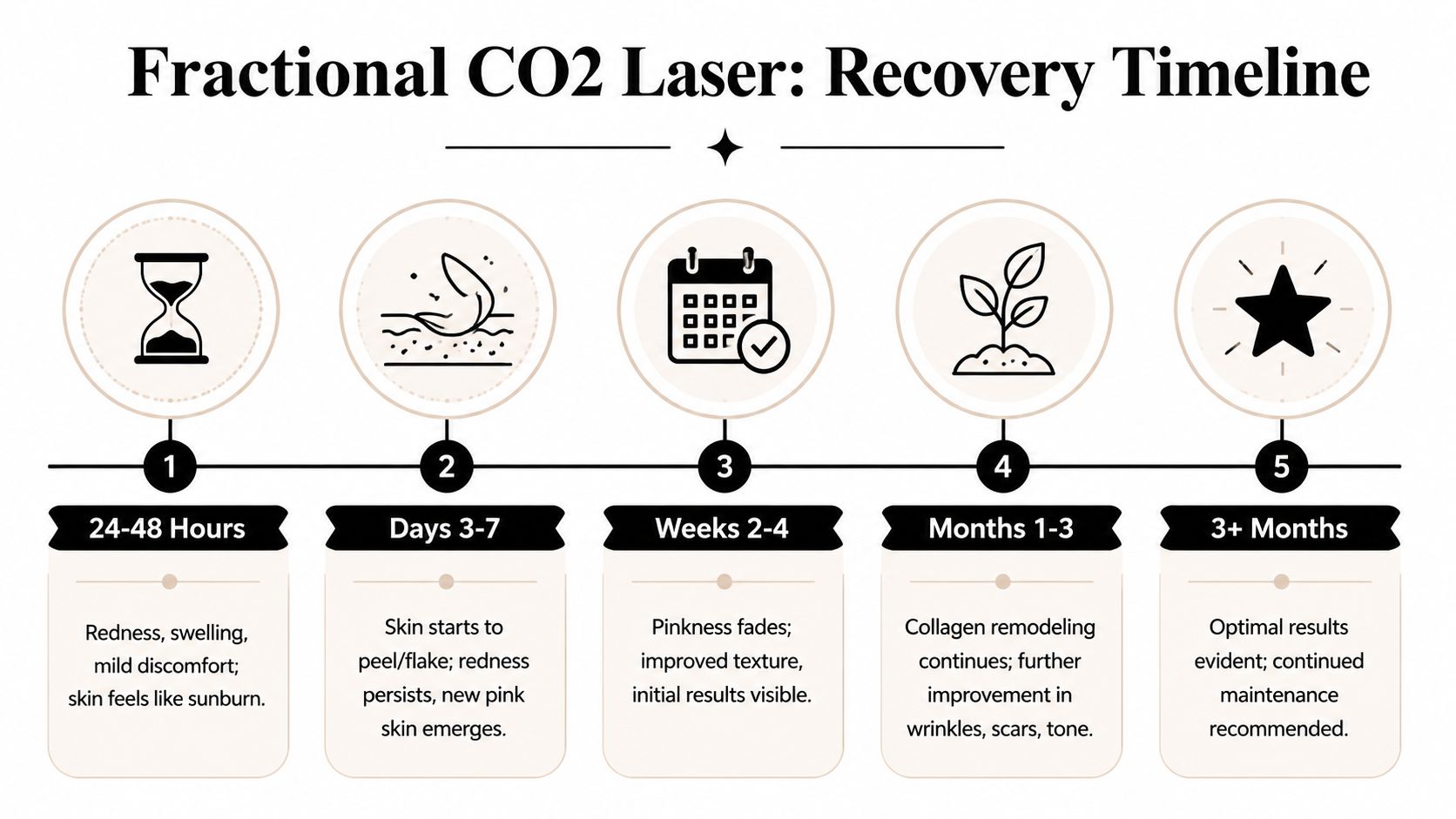
The first few days are the most dramatic. Skin often feels hot, tight, and swollen, then shifts into a bronzed, rough phase before it sheds. Patients are often surprised that the skin can look worse before it looks better. That reaction is understandable, but it is part of the expected reset.
A practical timeline looks like this:
Social recovery usually takes longer than patients hope. Many can be out in public after the first week, but residual pinkness often remains, especially in lighter skin tones or after a stronger treatment setting. In my practice, the key question is not whether the skin has finished peeling. It is whether the skin looks calm enough that the patient feels comfortable being seen.
A better way to judge progress is this: first the skin closes, then it settles, then it improves.
For some patients, reviewing a visual explanation helps set expectations before treatment:
Once peeling ends, the skin is still immature. It may flush easily, sting with active products, or feel dry even when it looks smoother. This is why I advise patients to treat the skin like fresh new fabric. Too much friction, heat, sun, or aggressive skincare can irritate it and prolong redness.
If your barrier feels compromised during this stage, general guidance on how to repair damaged skin barrier can help you understand why bland moisturization, reduced irritation, and patience are so important after resurfacing.
This is also the stage when patients start comparing their result to lighter treatments. If you are weighing downtime against improvement, this guide to microneedling vs laser treatment gives useful context.
Early improvement comes from removing damaged surface skin. The longer-term result comes from collagen remodeling underneath. That deeper change is slower and more meaningful, especially for acne scarring, etched lines, and crepey texture.
Here is the practical distinction:
| Phase | What you notice |
|---|---|
| Social recovery | Peeling has ended, redness is lower, makeup may sit better, and you look more like yourself |
| Structural recovery | Texture continues to refine, scars soften, fine lines improve, and skin quality matures over time |
Realistic expectations matter here. Some patients see a satisfying improvement after one treatment. Others need more than one session, or they may benefit from combining resurfacing with surgery, fillers, or scar-specific treatment depending on the starting point. Dr. Fater reviews that plan before treatment, but the result still has to be judged on the right timeline. Early pink skin is healing skin. Final skin takes longer.
Fractional CO2 is not the right answer for every patient. It sits on the stronger end of the resurfacing spectrum, which means it can do more, but it also asks more of the patient in return. A lighter treatment may be more sensible if your concern is mild, your schedule won't allow downtime, or your skin is less tolerant of aggressive resurfacing.
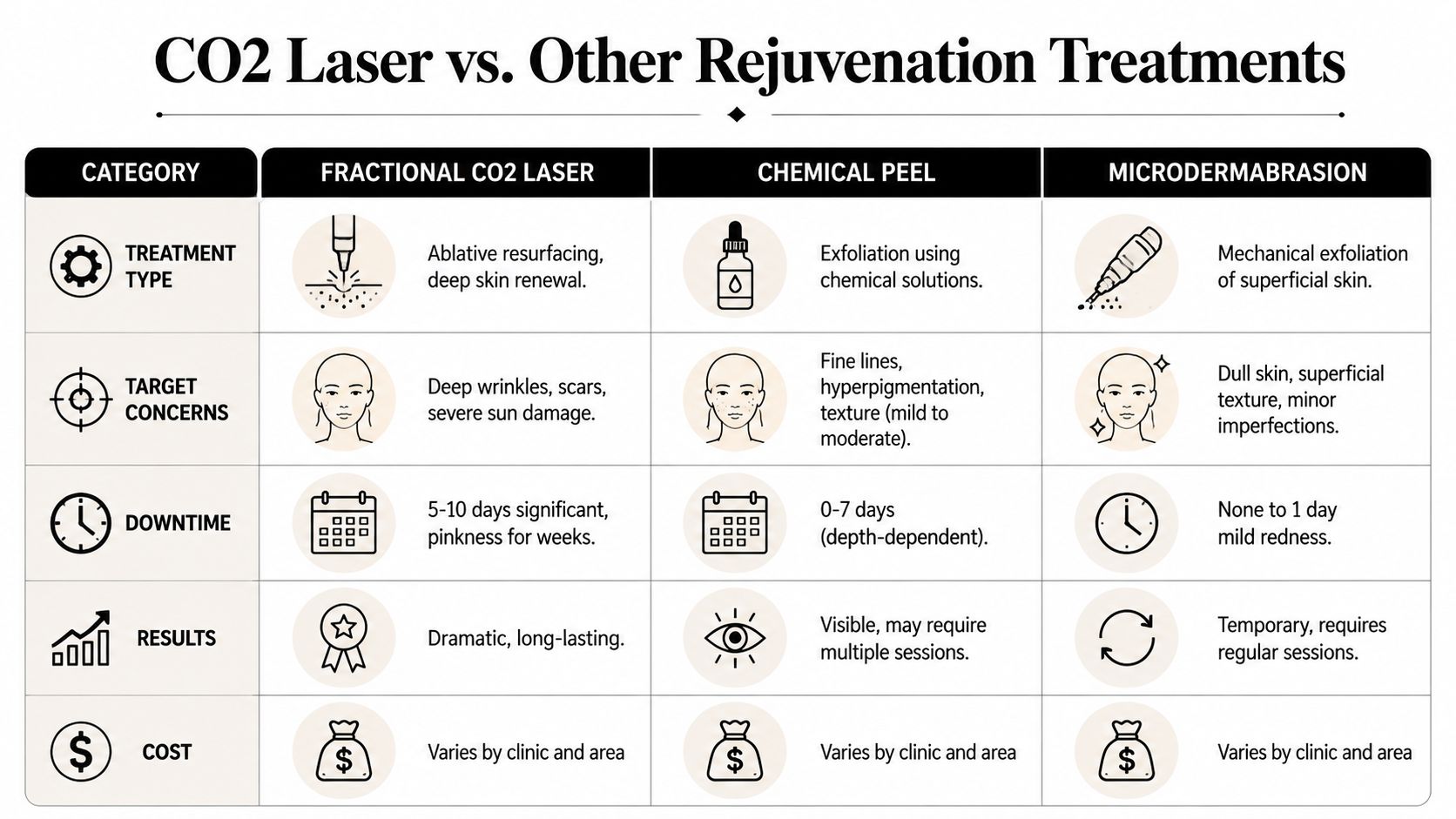
A patient deciding among options usually needs more than brand names. They need a plain-language comparison.
Skin Resurfacing Treatment Comparison
| Treatment | Mechanism | Best For | Downtime | Sessions Needed |
|---|---|---|---|---|
| Fractional CO2 laser | Ablative micro-columns with thermal remodeling | Acne scars, deeper wrinkles, sun-damaged texture | Meaningful downtime with visible healing | Often fewer sessions than lighter treatments, depending on goals |
| Chemical peel | Controlled chemical exfoliation at varying depths | Tone irregularity, superficial texture, mild photoaging | Varies widely by peel depth | May require a series |
| Microdermabrasion | Mechanical superficial exfoliation | Dullness and very mild roughness | Minimal | Requires ongoing repetition |
| Non-ablative fractional laser | Heats skin without ablating the surface in the same way | Mild to moderate texture and pigment concerns | Usually less downtime than CO2 | Often a series |
| Microneedling | Mechanical injury to stimulate repair | Mild texture change, maintenance, selected scar patterns | Usually shorter recovery | Often repeated treatments |
If you're weighing laser against another collagen-stimulating option, this comparison of microneedling versus laser treatment can help sort out where each fits.
Fractional CO2 tends to outperform lighter treatments for deeper textural correction. That's why it remains an important choice for etched wrinkles and acne scarring. It also tends to require more planning and more aftercare than treatments marketed as lunchtime procedures.
It does worse in one obvious category: convenience. If a patient wants no redness, no peeling, and no social interruption, this isn't the procedure to start with.
Strong resurfacing works because it asks the skin to do real repair. You can't demand a meaningful wound-healing response and also expect the skin to behave as if nothing happened.
The cost of a fractional CO2 laser treatment varies based on the area treated, the complexity of the concern, whether one session or a series is likely, and how intensive the treatment plan is. Full-face resurfacing is different from treating a small scarred area. Dense acne scarring often requires a different strategy than mild sun damage.
Patients also ask about add-ons and maintenance. Those discussions should be individualized rather than packaged into a one-size-fits-all quote.
For scar-related care after the skin has healed enough for your surgeon to approve additional support, some patients also ask about adjuncts such as silicon scar removal patches. They aren't a substitute for resurfacing, but they can be part of broader scar management in selected situations.
Does it hurt?
Most patients find it tolerable with proper numbing and preparation, but it's not a spa treatment. You should expect heat, sensitivity, and several days where your skin feels actively treated.
How many sessions will I need for acne scars?
That depends on scar type, depth, and how much improvement you want. Some patients do well with a limited series. Others need a staged plan and should know that one treatment may improve scars without fully correcting them.
Can I do this in the summer?
Sometimes, but only if you can be disciplined about sun avoidance. Freshly resurfaced skin and strong sun exposure are a poor combination.
When should I judge the outcome?
Not when the peeling stops. Judge early healing separately from long-term remodeling.
Why does provider choice matter so much here? Because fractional CO2 is technique-dependent. The device matters, but judgment matters more. Settings, pass pattern, treatment density, patient selection, and aftercare planning all affect outcome and safety.
Dr. Marc Fater brings over 30 years of experience as a board-certified plastic surgeon, and patients are treated in an on-site AAAASF-accredited surgical suite. That combination matters because resurfacing is not just about getting through the procedure. It's about having a physician who knows when to proceed, when to modify, and when to say a different treatment is the better choice.
If you're considering fractional CO2 laser resurfacing and want a thoughtful, individualized plan, Cape Cod Plastic Surgery offers consultations focused on candidacy, recovery, and realistic results so you can decide with clarity.
October 7, 2026
A Practical Guide to Healing After Breast Surgery

October 6, 2026
Your Safety Guide: What to Look for When Choosing a Plastic Surgeon
October 5, 2026
Why Our On-Site Accredited Facility Matters for Your Safety

Cape Cod Plastic Surgery offers expert cosmetic and reconstructive procedures in a safe, accredited setting. Led by Dr. Marc Fater, we combine advanced techniques with personalized care to help you look and feel your best.
Monday: 9:00 AM – 5:00 PM
Tuesday: 9:00 AM – 5:00 PM
Wednesday: 9:00 AM – 5:00 PM
Thursday: 9:00 AM – 5:00 PM
Friday: 9:00 AM – 5:00 PM