

October 7, 2026
What to Expect During Your Breast Surgery Recovery
A Practical Guide to Healing After Breast Surgery
Sep 5, 2026

You're looking in the mirror, wondering whether fuller lips would make you look refreshed or make it obvious that you've had work done. That uncertainty is reasonable. Lip filler is a small procedure performed in a highly mobile, highly visible part of the face, so the product, placement, injector, and follow-up plan all affect what you see and feel.
A useful starting point is that lip augmentation isn't an experimental corner of cosmetic medicine. International plastic surgery data cited in a 2024 review recorded 3.7 million hyaluronic acid filler procedures in 2018, making HA filler the second most frequently performed aesthetic procedure worldwide after botulinum toxin (2024 review of HA filler history and practice). The important question isn't whether dermal fillers lips can create volume. It's how a clinician chooses the gel and places it so your lips remain expressive, balanced, and medically monitored.
A first-time patient often describes the goal in simple terms: “I want my lips to look a little fuller, but I don't want them to look inflated.” Dermal fillers for lips are injectable gels placed beneath the vermilion border, within the lip body, or in carefully selected areas around the mouth. Depending on placement, they can add volume, sharpen the border, improve asymmetry, or restore deflation associated with aging.
Hyaluronic acid, usually called HA, leads because it combines a soft tissue feel with a practical safety advantage. HA is a gel that interacts with water and can be broken down with hyaluronidase if a clinician needs to reduce or remove it. That reversibility doesn't make complications impossible, but it gives the treatment a safety valve that permanent materials don't offer.

A 2021 meta-analysis found that 91% of treated subjects had increased lip fullness at 2 months, while 71% were still responders at 3 months. The same analysis concluded that HA injections remained effective through at least 6 months, and nearly half of successfully treated patients still showed significantly increased lip volume at 12 months (2021 meta-analysis of HA lip augmentation). These findings don't promise that every patient will have the same result. They establish a useful clinical benchmark: improvement is common early, and some visible enhancement can persist for a year.
Older permanent approaches, including silicone, create a different risk profile because removal can be difficult and tissue reactions may be hard to correct. Calcium hydroxylapatite, or CaHA, is a biostimulator with structural properties, but it generally isn't the first-line choice for the delicate, constantly moving lip body. Product selection should match the tissue, not just the desire for more volume.
If you're curious about how a smaller HA molecule is used in skincare rather than injectable augmentation, this overview of sodium hyaluronate for sensitive skin provides useful background. For the injection itself, how lip filler works offers another patient-focused explanation.
The next distinction is essential. HA fillers aren't interchangeable blobs of gel. Their internal structure affects whether they feel soft, hold a border, spread through tissue, or resist movement.
The word rheology describes how a material flows, stretches, resists pressure, and recovers its shape. For lip filler, rheology is the bridge between a laboratory measurement and the result you notice while speaking, smiling, or pressing your lips together.
Start with three practical properties.
G′, or storage modulus, describes how strongly a gel resists deformation. Think of a firm gummy candy compared with soft pudding. A product with higher resistance can provide more structure and projection, which may help define a border or support a depleted area. Too much firmness in the wrong layer, however, can make movement feel less natural or create visible irregularity.
Cohesivity describes how well the gel stays together rather than separating as it experiences pressure and motion. Picture a cohesive jelly that moves as one piece compared with a loose mixture that spreads easily. In the lips, cohesive behavior can help the product integrate into a mobile area and maintain a deliberate shape.
Elasticity refers to the gel's ability to deform and return toward its previous shape. A lip needs this spring-like quality because it changes shape constantly during speech, smiling, eating, and kissing. A good result isn't merely full at rest. It should remain comfortable and proportionate in motion.
Particle size, HA concentration, crosslinking, and the manufacturing process all influence these properties. In everyday language, crosslinking helps determine whether the gel behaves more like loose syrup, soft jelly, or a firmer gel. The clinician also has to consider where the product will sit. The vermilion border may benefit from definition and support, while the lip body usually needs a softer, more flexible behavior.
A 2025 study comparing three lip-indicated HA fillers, Belotero Intense, Kysse, and Volift, found meaningful rheological differences. Volift had the highest resistance to deformation, reflected by a higher complex modulus, while Kysse showed greater cohesivity (2025 study of lip filler rheology). Those measurements don't automatically make one product “best.” They help explain why two injections with the same stated purpose can look and feel different.
A useful consultation question: “Which property matters most for the area you're treating, softness, border support, integration, or projection?”
Brand names can simplify a conversation, but they shouldn't replace a tissue-based treatment plan. Restylane Kysse, Juvéderm Volbella, Juvéderm Ultra, Restylane Silk, and Belotero Balance are often discussed for lip enhancement, yet each product can behave differently depending on its formulation, injection plane, amount used, and the patient's anatomy.
The table below is a practical orientation, not a prescription. Product approvals vary by country and indication, and clinicians may use some products off-label when they believe the formulation suits a specific area.
| Brand | Best For | Key Rheology | Typical Duration |
|---|---|---|---|
| Restylane Kysse | Flexible volume and natural movement | Cohesive, adaptable gel behavior | Varies by patient, product, placement, and metabolism |
| Juvéderm Volbella | Soft definition and subtle fullness | Soft, flexible integration | Varies by patient, product, placement, and metabolism |
| Juvéderm Ultra | More noticeable volume or projection | Generally firmer, more lifting behavior | Varies by patient, product, placement, and metabolism |
| Restylane Silk | Fine definition and a delicate tissue feel | Soft, smooth, lower-profile behavior | Varies by patient, product, placement, and metabolism |
| Belotero Balance | Subtle correction and border or perioral refinement | Flexible, tissue-integrating behavior | Varies by patient, product, placement, and metabolism |
A patient seeking a hydrated, understated look may need a different gel from someone seeking stronger structural support. The same brand can also produce different outcomes when the injector changes depth or distributes the product between the border and body of the lip.
Packaging and social media trends can make one product seem universally desirable. They aren't reliable substitutes for an examination. A clinician should assess lip thickness, asymmetry, the relationship between the upper and lower lip, existing filler, skin quality, and how your lips move.
For a more detailed discussion of two commonly compared options, see Restylane Kysse vs. Juvéderm. Price can vary by product and practice, but provider skill, product authenticity, emergency preparedness, and follow-up access matter more than choosing the most recognizable label.
A well-run appointment should feel orderly rather than rushed. The first visit is a planning session, not merely a few injections followed by a mirror check.
The clinician reviews your medical history, allergies, medications, previous filler, and history of cold sores. Pregnancy, active infection, bleeding concerns, and medicines that affect clotting all need to be discussed openly. Reference photographs can help explain your preferences, but your plan should be adapted to your anatomy.
The written plan should identify the intended product, treatment areas, expected amount, total cost, and follow-up process. Ask what happens if you dislike the result or develop a complication. Those answers are part of informed consent.
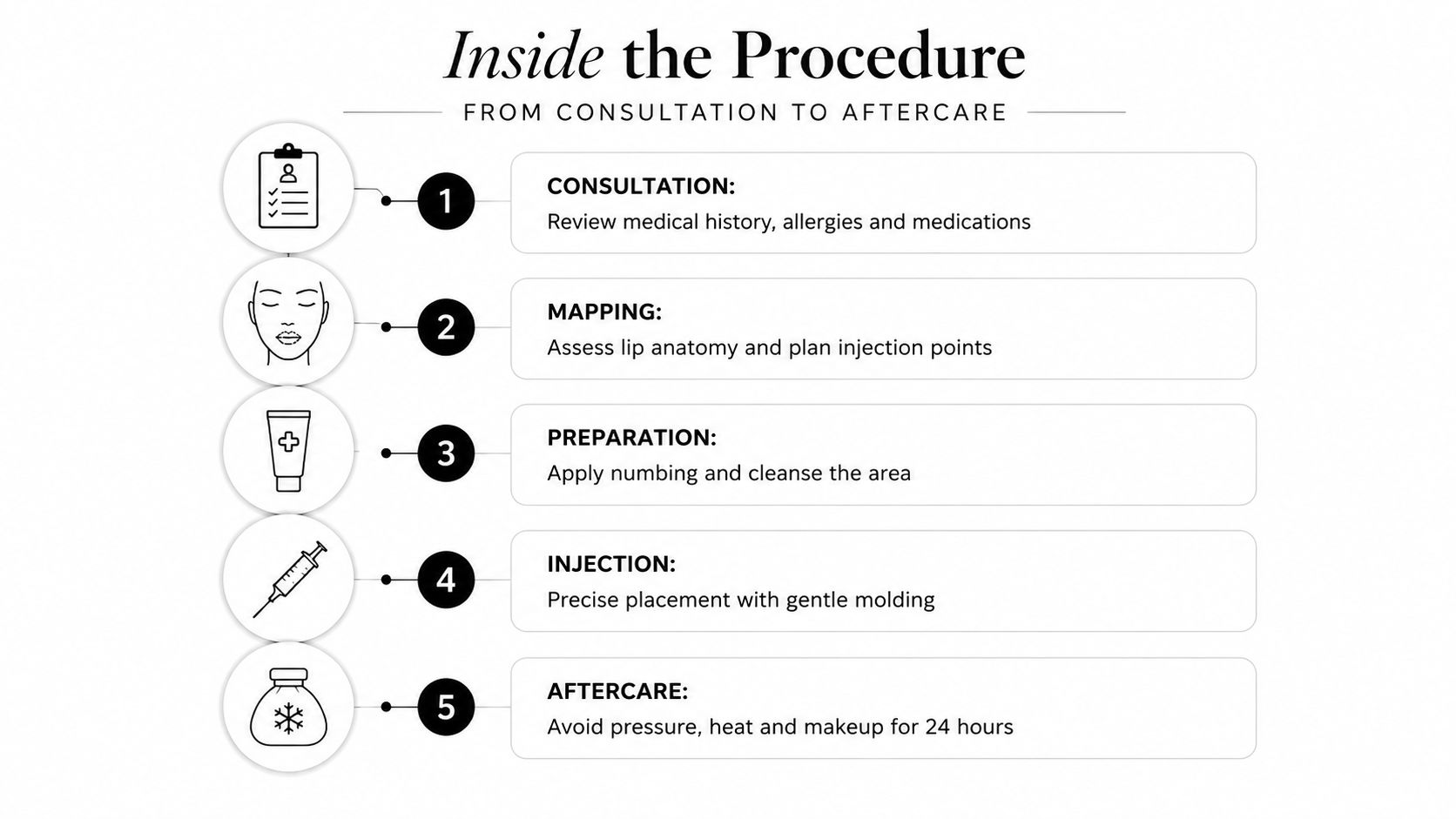
Numbing and cleansing: The provider may use topical anesthetic or a local nerve block. Numbing commonly takes 10 to 20 minutes, depending on the method and the patient.
Mapping: The lips are examined and marked. The injector decides whether a needle, cannula, or both are appropriate for particular areas.
Placement: Product may be layered between the vermilion border and the lip body. The injector places small amounts, checks symmetry, and may gently mold the gel.
Feedback: You can describe pressure, discomfort, or the shape you're seeing. A careful injector uses that feedback without allowing a patient to judge the final result while swelling is developing.
Aftercare: Cold compresses can ease discomfort. Avoid pressure and follow the clinic's instructions about straws, kissing, exercise, alcohol, heat, and makeup during the early recovery period. Many providers recommend limiting strenuous activity and pressure for 24 to 48 hours.
The lips often need a settling period before anyone decides whether more product is appropriate. A touch-up is generally considered after the initial swelling has resolved, commonly around the two-week review point.
For a visual explanation of the injection process, watch this patient education video:
A first-time patient may see fuller lips in the mirror and wonder whether the result is already final. Two timelines are unfolding. Recovery covers swelling, bruising, tenderness, and firmness as they settle. Longevity covers how long the added fullness remains visible. Early swelling can make the lips look larger or less even than the eventual result, while a short recovery does not mean the gel has vanished.
Visible duration depends on more than the product label. HA gel can remain in tissue while the mirror shows less volume because swelling has resolved, the gel has integrated, or lip movement has redistributed the effect. Formulation, placement, metabolism, daily movement, and previous filler all influence what remains noticeable. A clinical overview of how long lip filler lasts can help set expectations, but an individual assessment still matters.
| Timeframe | Filler Duration | Recovery Milestone |
|---|---|---|
| Treatment day | The gel is present immediately | Redness, tenderness, and swelling may begin |
| Early recovery | Fullness may look greater than intended | Swelling and sensitivity can make the lips look uneven |
| Settling period | The underlying enhancement remains | Bruising and firmness gradually improve |
| Follow-up | The clinician assesses whether enhancement is balanced | A refinement decision is made only after the tissue settles |
| Longer term | HA gradually loses visible effect | Maintenance is planned according to your response |
Swelling may distort the outline, and bruising can become more visible after the appointment. Firm areas may reflect the early tissue response. Pain that worsens, discoloration, or a change that does not improve calls for clinical review rather than casual reassurance.
HA's reversibility offers a practical safety option. If the shape needs correction, a trained clinician may use hyaluronidase to break down HA. Dissolving filler remains a medical procedure, so the decision should follow an examination and a clear discussion of the concern. A settled mirror result, not the first swollen reflection, should guide maintenance or correction.
Most early side effects are familiar: bruising, swelling, tenderness, temporary firmness, and asymmetry. Some lumps reflect swelling or product settling, while others may need assessment if they remain, enlarge, or become painful. A patient shouldn't assume every irregularity is harmless just because it appeared after an injection.
The less discussed issue is that risk doesn't end when the first recovery period ends. A 2024 review of 30 lip-filler adverse drug reaction cases reported a mean onset of granulomatous foreign body reactions at 57.9 months, with a median onset of 24 months (2024 review of delayed lip-filler reactions). The review also noted that no study in its case set reported these adverse reactions to regulatory authorities. Delayed inflammation may occur long after a patient has forgotten the product name or changed clinics, which is why treatment records matter.
Vascular occlusion is uncommon but serious. Needles may carry greater risk than cannulas in some contexts, but neither instrument removes the need for anatomical knowledge and an emergency plan. A provider should know how to recognize and manage vascular complications, and you should know exactly whom to call outside regular appointment hours.
Complete disclosure matters. Tell the injector about prior filler, autoimmune or inflammatory conditions, cold sores, dental procedures, vaccines, medications, allergies, and any previous reaction. A clinician can only plan around risks that you disclose.
The injector's judgment usually matters more than a product's marketing language. Lip filler requires an understanding of facial anatomy, vascular pathways, tissue layers, gel behavior, asymmetry, and the limits of correction. A practitioner who knows when to stop can be as important as one who knows where to inject.
Start by identifying who will perform the treatment and what professional oversight exists. A board-certified dermatologist or plastic surgeon may personally inject or supervise a trained medical injector. An aesthetic nurse or physician extender can also have substantial experience, but you should ask specifically about lip training and emergency management. A medical spa deserves the same scrutiny as any other setting, especially when ownership, supervision, and credentials aren't clear.
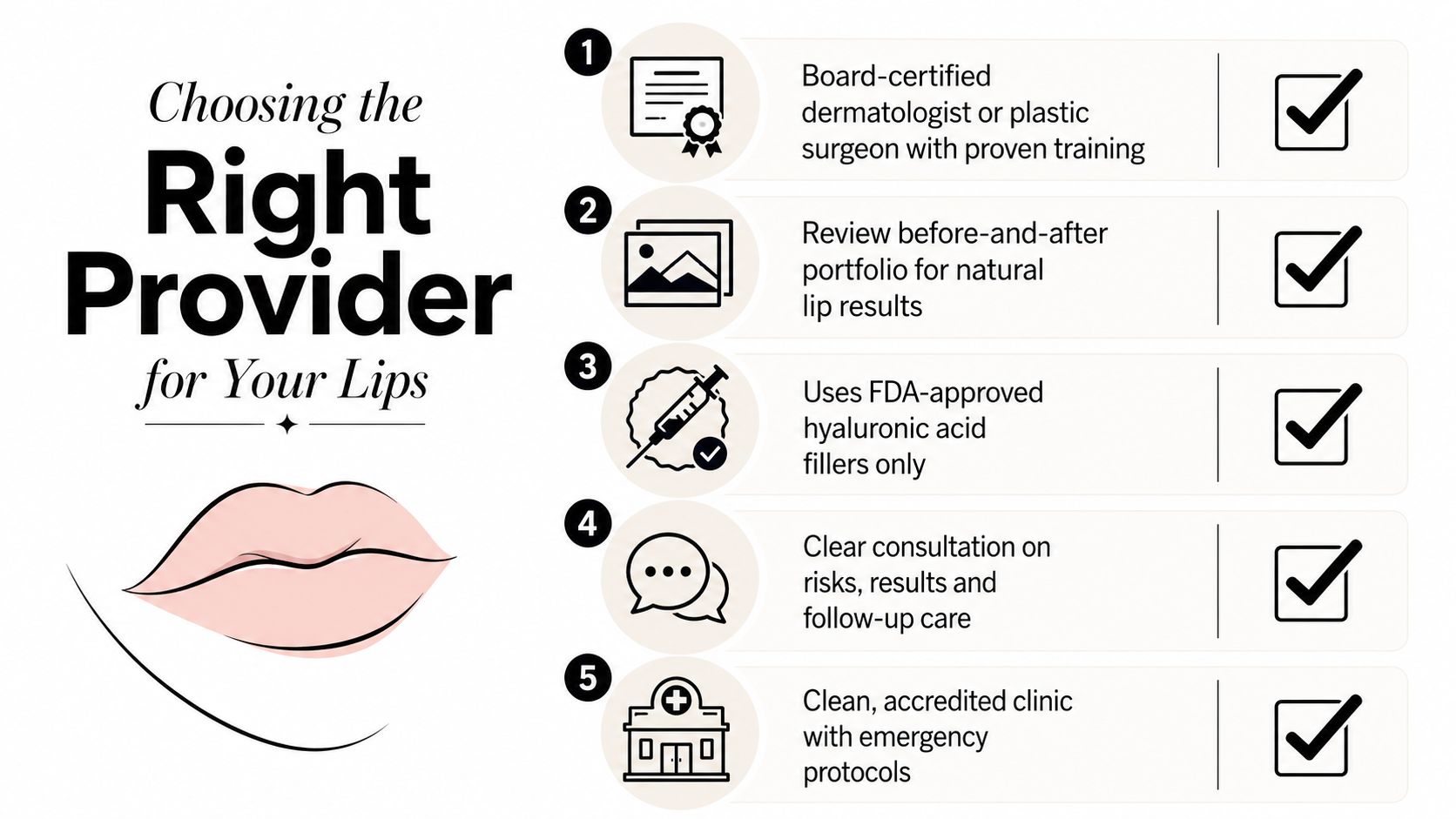
Be cautious if a clinic skips an in-person consultation, refuses to identify the product, shows no authentic before-and-after work, or uses unusually low pricing to create urgency. A clean facility and emergency supplies are important, but they don't replace judgment and communication.
Schedule two consultations before committing. Comparing explanations often reveals whether a provider is listening to your goals or selling a standard package.
Lip filler works best as a monitored process rather than a series of disconnected appointments. Your injector should track photographs, product names, placement, reactions, and how long the result lasted. Without that history, each visit becomes a guess, especially if you move between clinics or switch products repeatedly.
A first treatment may be deliberately conservative. After the tissue settles, some patients choose a small refinement, while others decide the original result is enough. Later maintenance should follow your observed pattern, not a calendar forced by a promotion. HA turnover differs between patients, and the lips' constant motion makes individual response particularly important.
Define the shape before chasing volume. Decide whether your priority is border definition, central fullness, symmetry, hydration, or age-related restoration. A reference photo can start the discussion, but the plan should respect your own proportions.
Keep a treatment record. Write down the date, product, areas treated, reaction, and the point at which you felt the result had faded. This information helps the next clinician avoid stacking unnecessary product.
Set a stopping rule. More filler can gradually change the lip envelope and may accumulate visually when treatments are repeated before earlier product has fully diminished. If the shape becomes heavy, firm, or less mobile, reassessment may be more appropriate than another injection.
Plan for follow-up access. Choose a provider who can review delayed concerns, not only perform the initial treatment. Long-term care includes knowing when to observe, when to adjust, and when to dissolve or investigate.
Bring reference photos and your treatment history to a consultation, then ask the provider to explain the proposed product, placement, risks, aftercare, and revision plan. Cape Cod Plastic Surgery offers lip dermal filler treatments for augmentation and lip-border definition, with planning that suits individual aesthetic goals.
If you're considering dermal fillers lips, visit Cape Cod Plastic Surgery to learn about consultation-based lip augmentation and border definition. Bring your questions, reference photos, and any prior filler records so the team can discuss an appropriately conservative plan, product choice, aftercare, and follow-up.
October 7, 2026
A Practical Guide to Healing After Breast Surgery

October 6, 2026
Your Safety Guide: What to Look for When Choosing a Plastic Surgeon

October 5, 2026
Why Our On-Site Accredited Facility Matters for Your Safety

Cape Cod Plastic Surgery offers expert cosmetic and reconstructive procedures in a safe, accredited setting. Led by Dr. Marc Fater, we combine advanced techniques with personalized care to help you look and feel your best.
Monday: 9:00 AM – 5:00 PM
Tuesday: 9:00 AM – 5:00 PM
Wednesday: 9:00 AM – 5:00 PM
Thursday: 9:00 AM – 5:00 PM
Friday: 9:00 AM – 5:00 PM