

September 9, 2026
How to Care for Surgical Incisions Properly
Expert Guide to Proper Surgical Incision Care
Aug 3, 2026

You may be staring at your waist in the mirror, tugging at a dress seam, or comparing surgical options late at night and wondering whether your ribcage is what's keeping you from the silhouette you want. That's usually when floating rib removal shows up in the search results, and it can sound both promising and unsettling at the same time.
The procedure is highly specialized. It isn't a routine body contouring step, and it isn't something to pursue casually. For the right patient, though, it can be part of a serious conversation about waist narrowing, body proportion, or, in some cases, anatomic correction after trauma or congenital differences.

A patient usually doesn't arrive asking for rib surgery first. She often comes in after learning that liposuction can refine soft tissue, but can't change the skeleton underneath. At that point, floating rib removal enters the discussion because the lowest ribs can influence how narrow the waist can look from the front and the side.
The people who explore this surgery tend to fall into two broad groups. Some want cosmetic waist contouring and a more dramatic hourglass outline, while others are dealing with structural asymmetry, old injury, or another anatomic issue that makes the lower rib area part of a reconstructive plan. It's a niche operation, which means experience matters more than marketing.
Practical rule: if a procedure changes bone, not just skin or fat, you should treat it as permanent and surgeon-dependent.
A good consultation should cover what gets removed, what stays in place, and what the visible effect is likely to be. The goal is not “smaller at any cost.” The goal is a result that fits your frame, your goals, and your tolerance for risk.
Patients also need to understand that this surgery is not mainstream. The clinical literature is smaller than many expect, and that alone should make you cautious enough to ask detailed questions before moving forward.

The 11th and 12th ribs are called floating ribs because they do not attach to the sternum in front. They sit at the lower edge of the rib cage, anchored at the back and open in the front, so they can shape the side profile more than many patients realize.
That anatomic position matters for contour. If the lower ribs flare outward, the waist can appear wider even when the soft tissue is already slim. For some patients, floating rib removal is discussed because it changes the bony outline itself, not just the tissue that lies over it.
The operation is usually performed through a small posterior flank incision, often described as about 2 inches, or 3 to 5 cm, placed over the costal margin or rib 11. Surgeons use subperiosteal dissection and careful pleural protection to lower the risk of lung injury and postoperative pain operative description of aesthetic floating-rib excision.
Protection of the intercostal neurovascular bundle and the periosteum is also part of standard technique, because those structures help limit bleeding, nerve irritation, and avoidable pain technical review of rib-removal surgery. In practical terms, the surgeon is working around the rib like a carpenter stripping paint from a narrow beam, careful not to damage the supports that sit just beneath the surface.
The amount removed depends on the rib level. Technical reviews describe partial resection lengths of roughly 3-4 cm for rib 12, 10-12 cm for rib 11, and more than 10 cm for rib 10 technical review of rib-removal surgery.
Some approaches also remove the rib tip cartilage to reduce the chance of a palpable postoperative lump operative description of aesthetic floating-rib excision. Other surgeons close the soft tissues without a drainage tube. The details matter because rib surgery is not one simple cut, it is a sequence of level selection, careful dissection, and protection of nearby anatomy.
As the field has evolved, many patients now ask about rib-remodeling alternatives before committing to full removal. That comparison makes sense, because the tradeoffs are different. Full excision is more permanent and more invasive, while remodeling approaches aim to change contour with less bone loss, which may appeal to patients who want a smaller change in structure with less trauma.
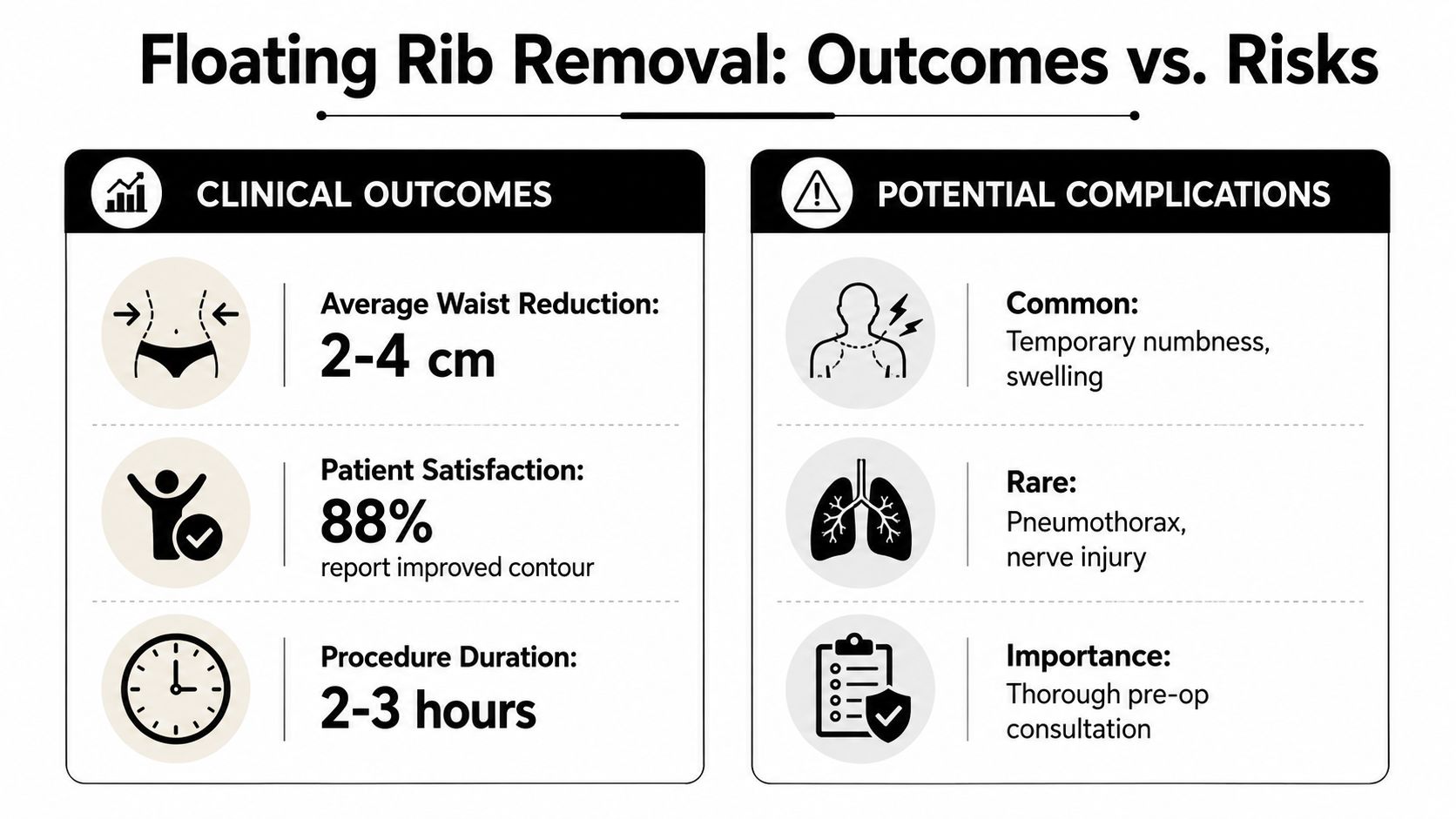
A patient considering floating rib removal usually wants two answers first. How much contour change is realistic, and what can go wrong. The published evidence is still limited, but it gives enough detail to set expectations without sugarcoating the procedure. A 2023 systematic review identified 23 studies published between 2000 and 2022, with 847 patients who underwent floating rib resection for aesthetic purposes. Across those studies, the average waist circumference reduction was 4-8 cm, patient satisfaction ranged from 78% to 92%, and the reported complication rate was 12-18%.
The same review reported pneumothorax at 8% and chronic pain at 6%. Those are not minor footnotes. They are the complications patients should understand before focusing on contour changes, because they affect safety, not just comfort. A procedure that changes the shape of the rib cage is still surgery on a structure close to the pleura and the nerves.
A separate clinical cohort described 104 women who underwent 11th and 12th rib removal over 8 years. The average age was 29.39 years, with a range from 18 to 63 years, and the waist-to-hip ratio decreased from 0.78 to 0.72, which the authors described as a 7.7% reduction. That same cohort reported two pneumothoraces as the only intraoperative complications, while a small prospective series of 5 patients reported no surgical complications and similar waist-to-hip ratio improvement. As noted earlier, the same source can answer more than one question, but the numbers still need to be read in context, because small series can look reassuring without fully capturing risk.
Practical rule: if a clinic only talks about contouring and never talks about pneumothorax, chronic pain, or respiratory testing, keep asking questions.
The 2023 review also found a mean 12-15% reduction in FVC and FEV1 at 3 months, with partial recovery by 12 months. Breathing changes are usually temporary, but they should still be discussed in plain language before any consent form is signed. A rib is not a cosmetic overlay, it is part of the chest wall, so even a carefully planned resection can affect mechanics for a period of time.
The same review found maintained waist reduction in 92% of patients at 2-5 years. That matters for anyone weighing permanence against trauma, because it suggests the contour change can last. For patients comparing full rib removal with options like rib-remodeling, the tradeoff becomes clearer, permanent structural change can produce durable shape improvement, but the healing burden and complication profile are part of the decision from the start. If you want to compare procedures side by side, see this overview of body contouring procedures.
A patient sitting in consult may expect a binary choice, remove the ribs or leave them alone. That view is too narrow. Current clinical writing describes rib-remodeling approaches that alter the angle of the floating ribs instead of excising them completely, which shifts the discussion toward a rib-sparing option rib-remodeling overview.
| Factor | Full Rib Removal | Rib Remodeling |
|---|---|---|
| Permanence | Removes bone tissue entirely | Changes rib angle instead of removing the whole structure |
| Trauma | More direct bone excision | Less destructive by design |
| Recovery feel | More invasive healing burden | Often framed as a gentler structural approach |
| Pain and risk | Higher concern for pleura, nerve, and chronic pain issues | Intended to reduce destructive impact |
| Contour goal | Direct waist narrowing | Waist shaping through altered rib position |
A 2024 study described better rib angulation and a smaller waist diameter at 6 months when a complementary rib-conversion technique was added to the base procedure. That matters because the choice is no longer only “remove or do not remove.” It is also about how much structural change a patient wants, and how much tissue disruption that result requires.
The difference is easier to understand if you compare it to changing the frame of a garment versus cutting pieces out of it. Full rib removal is more final, which is part of its appeal for some patients. Rib remodeling keeps more of the rib structure in place, so it may suit people who want visible contour change without the same degree of bone loss.
For a broader look at waist-shaping procedures that may be discussed alongside rib work, this overview of the 10 best body contouring procedures can help place the options side by side.
If you are choosing between these approaches, ask one direct question, do I want the most permanent skeletal change, or the least destructive method that still changes the waistline?
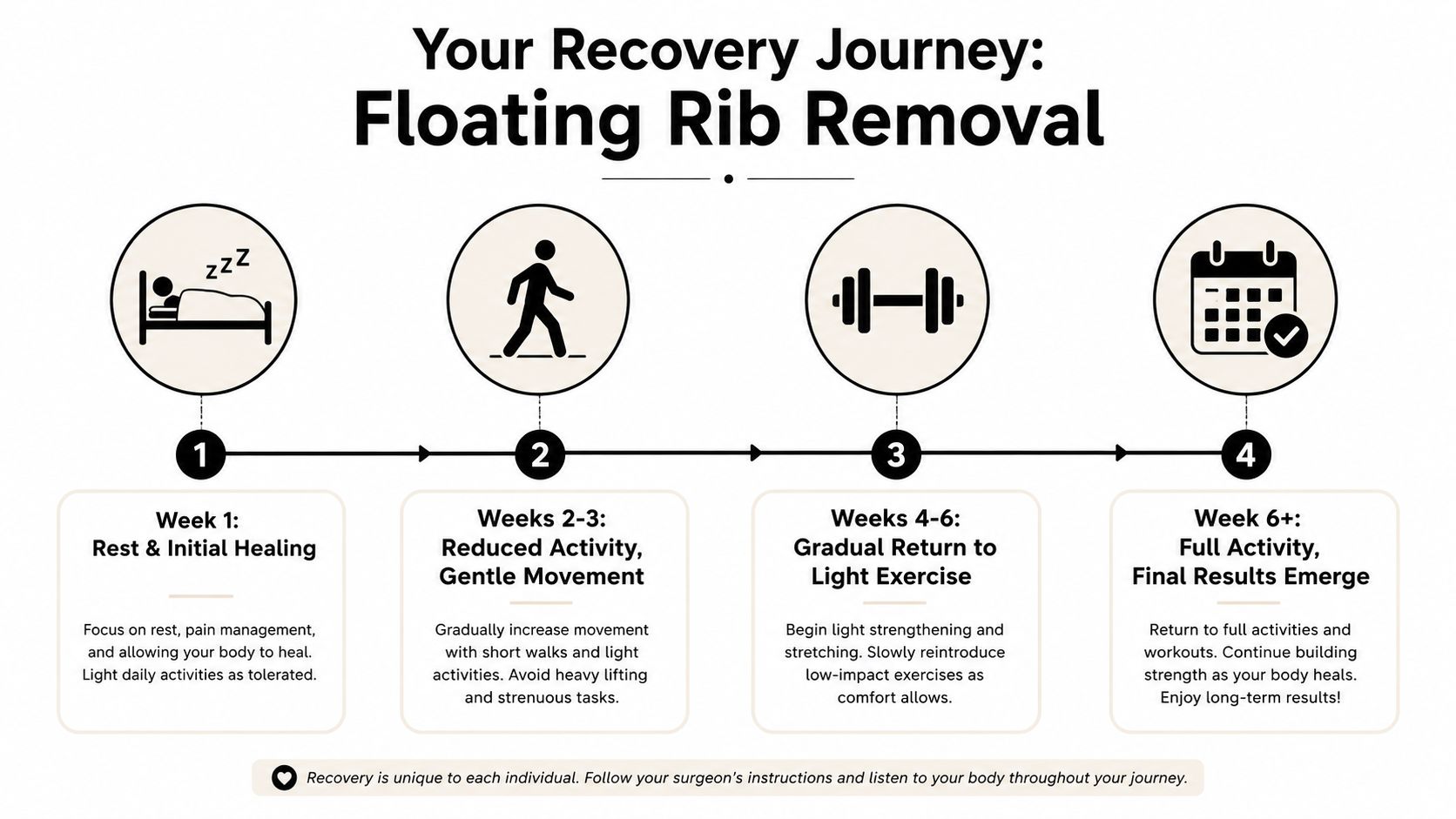
Recovery starts before you leave the operating room. After floating rib removal, patients usually need a plan for rest, help at home, and a clear idea of when normal movement can safely return.
The first few days are about protecting the incision, keeping discomfort under control, and breathing steadily even if every deep breath feels guarded. Many patients tense their chest and shoulders during this phase, so calm movement and good pain control matter more than trying to push through. Your surgeon's instructions should spell out wound care, walking limits, and when to come back for a check.
As the second and third weeks pass, movement usually becomes easier, but that does not mean full activity is appropriate. Light walking is often better tolerated than twisting, lifting, or sudden reaches, because the tissues are still settling and the chest wall is still healing.
Later recovery is gradual, not dramatic. Clothing may fit differently before the deeper healing has finished, and the area can keep changing after the skin looks closed.
If breathing feels unusually limited, or pain is getting worse instead of easing, contact the surgical team promptly.
Breathing recovery deserves the same attention as the incision. As noted earlier, temporary drops in lung function can improve over time, so breathing exercises and follow-up are part of the safety plan, not an extra afterthought. For a broader look at how surgeons frame recovery planning after plastic surgery, this guide to recovery after plastic surgery is a useful companion before you schedule anything.
A consultation for rib surgery should leave you with a clearer map of your anatomy, not a stronger sales pitch. You want a board-certified plastic surgeon who understands body contouring and chest wall anatomy, because rib procedures leave less room for guesswork than soft-tissue-only surgery.
Ask who performs the surgery, where it is done, and how often the surgeon works on body contouring cases that involve bone. Ask what happens if the pleura is injured, how the intercostal bundle is protected, and what backup plan is in place if the anatomy is unusual.
You should also ask to see before-and-after photos that match your body type. A surgeon with sound judgment should be able to explain why one rib level was chosen, why another was not, and what result is realistic for your frame. That kind of answer shows the plan was built around your anatomy, not a template.
A practice should also be clear about its surgical setting. Cape Cod Plastic Surgery, for example, describes an on-site AAAASF-accredited surgical suite and body contouring services, which is the sort of facility detail patients should look for when comparing options.
Practical rule: if the consultation feels rushed, vague, or sales-driven, keep looking.
You can also compare how the practice explains safety and preparation in this discussion of choosing a board-certified plastic surgeon. The point is not finding someone who says yes quickly, it is finding someone who can explain why a particular plan fits your anatomy, your goals, and the tradeoff between permanence, trauma, and complication risk.
The best consults feel specific. They do not promise a universal hourglass shape. They map your body and your goals onto a surgical plan that makes clinical sense, and they should also help you understand why rib-remodeling alternatives may fit some patients better than full rib removal when the goal is contour change with less disruption to the chest wall.
Does floating rib removal affect future pregnancies? Pregnancy changes the abdominal wall and ribcage mechanics regardless of surgery, so this is a question for your surgeon and, when needed, your obstetrician. The concern is less about the uterus itself and more about how your chest wall and core recover over time.
How does it compare with corset training or non-surgical waist shaping? Non-surgical methods can change how the waist looks, but they don't alter the skeleton. That's the basic dividing line between temporary compression and permanent structural change.
What if I'm unhappy with my result? This is one of the reasons choosing the right surgeon matters so much. Bone surgery is harder to “undo” than soft-tissue contouring, so the pre-op discussion has to be clear about scope, limitations, and asymmetry risk.
Is rib removal still the standard, or are less destructive rib-sparing options becoming preferred? That's the right question to ask now. Rib-remodeling alternatives are drawing more attention because many patients want contour change with less trauma, so the decision is increasingly about matching the method to the goal, not assuming removal is the only path.
If you're seriously considering waist contouring, schedule a consultation with a surgeon who can explain both rib removal and rib-remodeling options in plain language. Cape Cod Plastic Surgery offers body contouring consultations, and you can learn more by visiting Cape Cod Plastic Surgery.
September 9, 2026
Expert Guide to Proper Surgical Incision Care

Master dermal fillers aftercare with do's and don'ts, swelling tips, activity limits and warning signs to protect your results and heal smoothly.

September 8, 2026
Ensuring Safety: Why Your Surgeon's Credentials Matter Most

Cape Cod Plastic Surgery offers expert cosmetic and reconstructive procedures in a safe, accredited setting. Led by Dr. Marc Fater, we combine advanced techniques with personalized care to help you look and feel your best.
Monday: 9:00 AM – 5:00 PM
Tuesday: 9:00 AM – 5:00 PM
Wednesday: 9:00 AM – 5:00 PM
Thursday: 9:00 AM – 5:00 PM
Friday: 9:00 AM – 5:00 PM