

October 7, 2026
What to Expect During Your Breast Surgery Recovery
A Practical Guide to Healing After Breast Surgery
Apr 29, 2026

You may be reading this while dealing with the same routine that sends many people looking for a longer-term option. Shaving again because stubble came back faster than expected. Scheduling waxing around work or travel. Managing razor burn, ingrown hairs, or irritation in areas that never seem to stay smooth for long.
Laser hair removal appeals to people for a simple reason. It offers a way to reduce hair growth over time rather than repeatedly removing the hair above the skin. But it isn't a casual beauty service in the way it's often marketed. It is a medical light-based treatment that depends on skin tone, hair color, timing, equipment choice, and careful technique.
That matters if you're trying to understand how does laser hair removal work, whether you're a good candidate, and what kind of results are realistic. The difference between a safe, well-planned treatment course and a disappointing one often comes down to diagnosis, device selection, and oversight.
A clinical setting changes the conversation. Instead of promising perfection, a physician-led practice should explain what the laser can target, what it can't, why multiple sessions are needed, and how safety protocols protect your skin throughout the process.
Most temporary hair removal methods ask you to repeat the same cycle forever. Shave, grow back, shave again. Wax, wait, regrow, repeat. For some people, that cycle is mostly inconvenient. For others, it also means bumps, irritation, and a steady sense that the results never last long enough to feel worth the effort.
Laser hair removal takes a different approach. Instead of removing visible hair at the surface, it aims to damage the follicle's ability to keep producing strong new hair. That is why the treatment is described as long-term hair reduction rather than a quick fix.
In a clinical practice, that distinction matters. A responsible provider doesn't treat laser hair removal as a one-size-fits-all appointment. They evaluate your skin tone, your hair color and texture, the body area involved, your history of sun exposure, and whether the device being used is appropriate for your skin.
Laser hair removal is most successful when the treatment plan matches the biology of the hair and the characteristics of the skin.
That's also why physician oversight matters. In a board-certified plastic surgery environment with an AAAASF-accredited facility, the standard isn't just comfort. It's safety, candidacy screening, and device selection based on risk as much as outcome.
Patients often come in asking one of two questions. Will this work for me, and is it safe? Those are the right questions. The science is strong, but the answer depends on your individual features and on who is performing the treatment.
A good consultation should leave you with a clear understanding of five things:
A patient often arrives assuming the laser "zaps the hair away" on contact. The biology is more specific than that. Laser hair removal works by sending a controlled beam of light into the skin, where pigment in the hair absorbs that energy and converts it to heat. The goal is to injure the follicle enough to slow or stop future growth while protecting the surrounding skin.
The medical term for this process is selective photothermolysis. The name sounds dense, but the idea is simple. "Selective" means the device is designed to focus on a target. "Photo" refers to light. "Thermolysis" refers to heat-related destruction. In other words, the treatment uses light to create heat in a chosen structure. Here, that structure is the pigmented hair unit.
A useful comparison is dark fabric in the sun. Dark material absorbs more energy than light material and warms faster. Hair rich in melanin behaves in a similar way. The laser is chosen so that the pigment in the hair absorbs far more energy than the nearby skin should absorb under the right settings. That difference is one reason results are usually best when there is good contrast between skin tone and hair color.
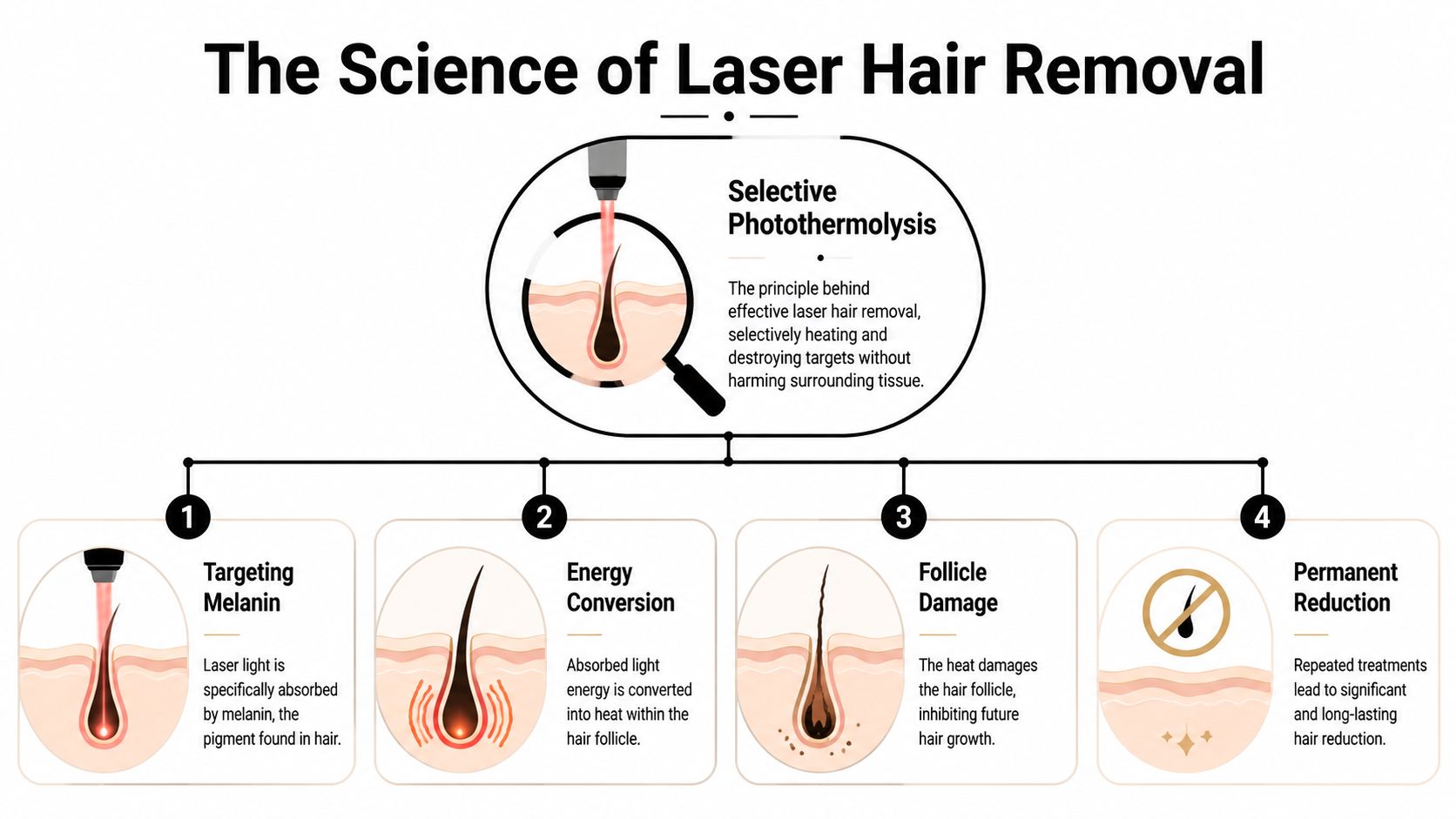
The treatment is directed at the hair follicle below the skin, not the visible hair above the surface. The shaft helps guide energy downward, but the clinical target is the growth center at the base of the follicle. Once enough heat reaches that structure, the follicle's ability to produce a thick, healthy hair is reduced.
That precision is why medical oversight matters. Laser settings are not chosen by guesswork. In a board-certified plastic surgery practice and an AAAASF-accredited facility, the provider's job is to balance two goals at the same time. Deliver enough energy to affect the follicle. Protect the epidermis from excess heat. That is a very different standard from treating laser hair removal like a routine spa service.
Patients sometimes wonder why skin can be treated safely if the laser is looking for pigment. The answer is timing, wavelength, cooling, and parameter selection. Hair follicles contain concentrated pigment in a deeper structure. The skin also contains melanin, especially in darker skin tones, so the device must be matched carefully to the patient. That is why experienced physician oversight and access to multiple laser treatment options in a plastic surgery setting matter.
Hair grows in cycles, not all at once. Each follicle moves through growth, transition, and resting phases. The phase that responds best to treatment is anagen, the active growth phase, because the hair is still closely connected to the follicle.
That connection matters because it allows heat to travel where it needs to go.
Follicles in other phases may contain less of a target or may not transmit energy as effectively to the structures that control regrowth. So during any one appointment, some hairs are in an ideal treatment window and others are not. This is the biological reason a single session cannot treat every follicle permanently.
Laser hair removal works more like catching successive waves than flipping a switch. One session affects the follicles that are ready on that day. Later sessions target a different group as new hairs enter anagen.
This is why regrowth after an early session does not mean the treatment failed. It usually means untreated follicles have cycled into view, or previously treated follicles are shedding on a different timetable. Patients often notice that hair returns more sparsely, more slowly, or with a finer texture before they see a larger overall reduction.
A few treatment patterns are common:
A careful clinician will usually describe laser hair removal as long-term hair reduction, not a guarantee that every follicle is gone forever. That wording is deliberate. Follicles can recover partially, dormant follicles can become active later, and hormones can influence future growth patterns.
Clear expectations improve satisfaction and safety. Patients do best when they understand that the science is strong, but results depend on hair color, skin tone, hormone patterns, body area, and the quality of the treatment plan. In a physician-led setting, that discussion is part of the treatment itself, because choosing realistic goals is just as important as choosing the right laser.
The phrase "laser hair removal" makes it sound as if every machine works the same way. It doesn't. Different devices use different wavelengths, and those wavelengths interact with skin and hair differently. Choosing the right device is a safety decision first and an efficacy decision second.
A clinical evaluation matters more than marketing language. A provider should look at your Fitzpatrick skin type, your natural hair color, the thickness of the hair, and the area being treated before deciding which platform is appropriate.
Shorter and longer wavelengths don't behave identically in the skin. Some are more strongly absorbed by pigment closer to the surface. Others penetrate in a way that allows treatment of darker skin more safely because less energy is taken up by epidermal melanin.
For patients with darker skin tones, the key concern is avoiding excess heating in the epidermis while still reaching the follicle.
The Nd:YAG clinical benchmark video reference identifies the 1064 nm Nd:YAG laser as the benchmark for treating Fitzpatrick IV-VI skin safely. Because that longer wavelength is less absorbed by melanin in the epidermis, it can target the follicle more safely, with 60% to 80% reduction after 3 to 6 sessions when paired with dynamic cooling.
| Laser Type | Wavelength | Best For Skin Types (Fitzpatrick) | Best For Hair Color |
|---|---|---|---|
| Alexandrite | Longer light-based wavelength used in professional hair reduction systems | Lighter skin tones | Dark hair |
| Diode | Longer light-based wavelength used for follicle targeting | A range of skin tones depending on platform and settings | Dark hair |
| Nd:YAG | 1064 nm | IV-VI | Dark hair |
The table is simplified on purpose. Real treatment planning is more nuanced than matching a name to a category. Cooling systems, pulse settings, spot size, and operator judgment all matter. But the broad takeaway is clear. There is no single ideal laser for everyone.
A patient with fair skin and coarse dark underarm hair presents one type of treatment scenario. A patient with deeper skin tone and dense hair along the bikini line presents another. A patient with blonde facial hair presents a third, and that third situation may not be suitable for laser at all.
That is why many physician-led practices build treatment plans around diagnostic questions such as:
The safest treatment isn't the one with the strongest marketing. It's the one that fits your skin and hair profile.
Patients who want to compare available options can review laser treatment offerings at Cape Cod Plastic Surgery, then discuss with their clinician which platform is appropriate for their skin type rather than assuming one device suits every case.
A med-spa advertisement may emphasize convenience. A clinical practice should emphasize selection and supervision. If your skin is prone to pigment change, if you've had recent sun exposure, or if your hair characteristics make treatment less predictable, the decision-making becomes more important than the device name alone.
That is especially relevant for darker skin tones, hormonally influenced facial hair, and patients who have had disappointing prior treatment elsewhere. In those cases, a careful reassessment often reveals that the issue wasn't laser hair removal itself. It was the wrong candidate, the wrong settings, the wrong timing, or inadequate oversight.
You arrive for treatment with the area shaved, a little unsure what the laser will feel like and how long you will be in the room. That uncertainty is normal. A well-run visit replaces guesswork with a clear sequence: check the skin, confirm the plan, protect the eyes, treat the area methodically, then review aftercare before you leave.

Preparation starts at home. Patients are usually asked to avoid tanning and to shave the treatment area shortly before the visit. That advice can seem backward at first. If hair is the target, why remove what you can see?
The answer is simple. The laser is meant to deliver heat down to the follicle, where the growth center sits. Hair left above the skin acts like a wick above a candle. It can singe on the surface, create extra odor, and make treatment less comfortable without helping the laser reach the follicle more effectively.
Your visit should also include a skin check and a review of recent changes. New medications, a fresh tan, active irritation, open cuts, or a recent waxing appointment can all affect whether treatment should proceed that day. In a physician-directed plastic surgery practice, that screening is part of the treatment itself, not paperwork done on the side. In an AAAASF-accredited setting, the expectation is careful documentation, clear safety standards, and a low threshold to postpone if conditions are not right.
Sometimes the safest and smartest decision is to wait.
Once you are in the room, the skin is cleansed and the team confirms the exact area to be treated. Eye protection is placed before any laser pulse is delivered. The clinician then sets the device for your skin and hair profile and places the handpiece against the skin in a controlled pattern, covering the area section by section rather than waving quickly across it.
Patients often describe the feeling as a brief snap, followed by warmth. A rubber-band comparison is common, although some body areas feel sharper than others. The upper lip can be more sensitive than the lower legs. Coarse hair can feel more intense than sparse fine hair. Built-in cooling helps protect the surface of the skin while making treatment more tolerable.
Sessions are often shorter than patients expect for small areas, while larger areas naturally take longer because the clinician has more skin to cover carefully. The pace should feel deliberate. Good treatment is not just about delivering energy. It also includes watching the skin's immediate response, staying within treatment borders, and adjusting technique if comfort or safety calls for it.
A careful session is measured twice. Once by what the laser does to the hair, and once by how well the skin is protected while that happens.
Laser hair removal is often presented as routine, but it still works by creating controlled heat in and around the follicle. That requires judgment. A retail-style setting may focus on speed and convenience. A surgical practice with physician oversight focuses on selection, supervision, and response if the skin does not behave as expected.
That difference matters most when the case is less straightforward. Patients with pigment-prone skin, a history of irritation, recent sun exposure, or prior disappointing treatment benefit from medical oversight because the plan may need to change in real time. An accredited facility also means the practice has formal systems for safety, equipment standards, and escalation if a concern arises. For patients, that often means fewer assumptions and a more cautious approach.
The skin may look pink or feel warm for a short time after the session, similar to mild sun exposure. Small bumps around follicles can appear as well. That reaction is often expected because the follicle has absorbed heat. Cooling, gentle skincare, and avoiding extra irritation usually help the area settle.
The main aftercare instructions are straightforward. Protect the area from sun, skip harsh exfoliation, avoid picking or scrubbing, and treat the skin gently for the next several days. If you are unsure when shaving is appropriate again, this guide on when to shave after laser hair removal explains what is usually safe and what to avoid.
One detail causes confusion later. Treated hairs may seem to be growing back soon after the appointment. In many cases, those hairs are loosening and shedding from the follicle, much like stubble working its way out. That process can take time, so the first week or two after treatment is not the right moment to judge the final effect of that session.
A visual overview can make the process easier to picture:
The laser operator does more than press a button. The clinician is watching for a treatment endpoint that suggests the follicle has responded without pushing the skin beyond a safe limit. Skin color, perifollicular swelling, patient feedback, and the way the area looks from one pass to the next all guide those decisions.
That real-time judgment is a major reason physician oversight improves safety. A skilled medical team knows when to continue, when to lower settings, when to cool more aggressively, and when to stop and reassess. For a prospective patient, that should be reassuring. The goal is not to make every session as intense as possible. The goal is to produce steady hair reduction while protecting the skin at every step.
The most satisfied laser hair removal patients usually aren't the ones who expected perfection. They're the ones who understood from the beginning what the treatment is designed to do.
The most important phrase is permanent hair reduction. That language is more accurate than "permanent hair removal," and it sets expectations in a way that supports long-term satisfaction.
The Louisiana Dermatology explanation of permanent hair reduction states that laser hair removal provides permanent hair reduction, not total removal. It also notes that most patients need 4 to 10 initial sessions, followed by maintenance treatments once or twice a year to manage new growth.
Hair reduction tends to happen gradually. You don't finish one treatment and wake up with a completely hair-free area forever. Instead, many patients notice that regrowth becomes slower, patchier, finer, and easier to manage as the series progresses.
That pattern is worth emphasizing because it changes how you judge progress. Improvement may show up first as less shaving, fewer ingrown hairs, or softer regrowth before it shows up as dramatic sparseness.

Patients often ask why touch-ups are needed if some follicles were already damaged. The reason is biological, not promotional. Some follicles can recover partially. Others may have been dormant at the time of earlier sessions. Hormonal shifts can also activate new growth patterns over time.
That doesn't mean the treatment failed. It means the body remains active. Maintenance visits are often the way patients preserve a result that already required careful timing and repeated treatment to establish.
A useful way to think about it is this:
Honesty about maintenance usually increases confidence. Patients tend to feel more comfortable when they're told what the treatment can do and what it can't promise.
Spacing matters. Too frequent, and you may not be catching enough new follicles in the right stage. Too delayed, and the process becomes less efficient. The ideal interval varies by body area and growth pattern, which is why individualized planning matters.
If you're trying to understand the scheduling logic, this article on how long between laser hair removal treatments gives a practical explanation of why timing is built into the treatment strategy.
Overpromising is bad medicine. If a provider suggests you'll never need to think about hair growth again, that claim should make you cautious. Good laser care is still appealing without exaggeration. Reduced density, less frequent shaving, finer regrowth, and easier maintenance are meaningful outcomes.
For many patients, that is exactly the value. The goal isn't usually an abstract promise of total permanence. It's having less hair, less irritation, less time spent removing it, and a more predictable long-term routine.
Not everyone is an ideal candidate for laser hair removal, and saying that clearly is part of safe care. The treatment depends on contrast. The laser is looking for pigment in the hair while trying to spare the surrounding skin. The easier that visual and thermal distinction is, the more straightforward treatment becomes.
The Mayo Clinic overview of laser hair removal explains that the treatment works best on dark hair and light skin because the laser targets pigment. It also notes that laser hair removal is largely ineffective for red, white, blonde, or gray hair, which don't contain the type or amount of melanin needed for the laser to work well.
Historically, the easiest patients to treat were those with dark coarse hair and lighter skin. That remains a very favorable combination. But that doesn't mean only one demographic can be treated.
Modern laser protocols have expanded options for a broader range of skin tones. The key is matching the wavelength and settings correctly, then using cooling and conservative judgment where appropriate. Darker skin can often be treated safely in experienced hands. Very light hair remains the more stubborn limitation because the target pigment isn't there in sufficient quantity.
Some consultations end with a recommendation to proceed. Others should end with a candid conversation about limited benefit or alternative approaches.
That is especially true if you have:
A careful provider should also examine whether the area being treated has hormonally influenced growth. Facial hair in particular can behave differently than body hair, and that changes how results should be discussed.
Most side effects are temporary and manageable when treatment is properly selected and properly performed. But safety in laser medicine doesn't come from confidence alone. It comes from evaluation, test spots when appropriate, calibrated settings, cooling, and follow-up.
If a provider dismisses your skin type, your hair color, or your prior treatment history as unimportant, that's a warning sign.
In a board-certified plastic surgery practice, the consultation should feel specific. Your skin should be examined. Your candidacy should be discussed plainly. If the likely outcome is modest, you should hear that before treatment begins. If the risk profile is higher, that should also be discussed upfront.
That kind of honesty protects patients. It also tends to produce better experiences because the treatment plan starts from reality rather than wishful thinking.
Most patients don't describe laser hair removal as intolerable, but they also don't describe it as feeling like nothing. The sensation is usually brief and repetitive, often compared to a fast snap of heat on the skin. Some areas are easier than others. Dense hair can also feel more intense because there is more pigment absorbing energy.
Cooling makes a real difference. So does conservative technique and selecting the right settings for your skin rather than pushing intensity for its own sake.
Cost varies by treatment area, hair density, the number of sessions you need, and the technology being used. Instead of asking only what one session costs, ask what a complete course is likely to involve and whether maintenance may be part of the plan.
That gives you a more accurate sense of investment and helps you compare providers more fairly.
Laser hair removal can be used on many common treatment areas, including the face, underarms, arms, legs, bikini area, chest, and back. Suitability depends less on the body area itself and more on the type of hair in that location, the sensitivity of the skin, and whether the area can be treated safely with the device selected.
Because the procedure is more clinical than it appears. The questions that determine a good outcome are medical questions. Is your skin tone a safe match for this wavelength? Is your hair color likely to respond? Has recent sun exposure changed your risk? Are the settings appropriate for this area and this patient?
A board-certified plastic surgery practice approaches those questions with a higher level of oversight. An AAAASF-accredited facility also reflects a structured commitment to patient safety, protocols, and professional standards. For patients, that often means better screening, more thoughtful planning, and more confidence that the treatment is being performed in the right environment.
If you're considering laser hair removal and want a medically grounded assessment of whether it fits your skin, hair, and goals, schedule a consultation with Cape Cod Plastic Surgery. A personalized evaluation can clarify candidacy, treatment options, and what kind of result is realistic for you.
October 7, 2026
A Practical Guide to Healing After Breast Surgery

October 6, 2026
Your Safety Guide: What to Look for When Choosing a Plastic Surgeon

October 5, 2026
Why Our On-Site Accredited Facility Matters for Your Safety

Cape Cod Plastic Surgery offers expert cosmetic and reconstructive procedures in a safe, accredited setting. Led by Dr. Marc Fater, we combine advanced techniques with personalized care to help you look and feel your best.
Monday: 9:00 AM – 5:00 PM
Tuesday: 9:00 AM – 5:00 PM
Wednesday: 9:00 AM – 5:00 PM
Thursday: 9:00 AM – 5:00 PM
Friday: 9:00 AM – 5:00 PM