

October 7, 2026
What to Expect During Your Breast Surgery Recovery
A Practical Guide to Healing After Breast Surgery
Apr 21, 2026
You’re probably asking the same question almost every filler patient asks before booking. “Will this look good, and how long will it last?”
That hesitation makes sense. Filler isn’t just a treatment. It’s a decision about your face, your time, and your money. Individuals often want something subtle and refreshed, not something obvious. They also want an honest answer, not the usual vague promise that it “depends.”
Filler longevity is more nuanced than the standard quick answer suggests. Many patients still hear that filler lasts 6 to 12 months, then disappears. But modern imaging has changed how experienced providers think about longevity. In many cases, filler remains in the tissue much longer than people realize. That changes how maintenance should be approached. It also explains why some people stay looking natural for years, while others slowly drift into an overfilled look without meaning to.
If you’ve also been reading about broader top aesthetic trends, you’ve probably noticed a bigger shift in aesthetics. Patients want evidence, personalization, and treatments that age well over time. Filler fits into that shift, but only when you understand what it can do, what it can’t do, and how long it really stays with you.
A patient in her 40s comes in wanting softer smile lines and a little lift through the cheeks. She isn’t looking for a dramatic change. She wants to look rested, polished, and like herself. Then she asks the question that usually matters most. “If I do this, how often will I have to keep doing it?”
That question sits underneath almost every filler consultation. People aren’t only asking about chemistry. They’re trying to understand value. They want to know whether filler is a short-lived fix or part of a smart long-term plan.
The answer starts with this. How long does filler last depends on what filler is used, where it’s placed, how your body handles it, and how carefully it’s maintained. But there’s another layer that patients rarely hear. The visible effect and the physical presence of filler aren’t always the same thing.
That distinction matters. You might look like you need a refresh before the previous filler has fully gone away. That’s why the best filler plans aren’t built around “waiting until it disappears.” They’re built around preserving balance.
Practical rule: Think of filler like maintaining the shape of a haircut, not rebuilding from scratch every time.
When patients understand that idea early, they make better decisions. They’re less likely to chase volume and more likely to focus on proportion, support, and timing. That’s what leads to elegant results.
Filler longevity starts with a simple question. What is the product designed to do once it is placed under the skin?
Some fillers add soft volume right away. Some provide firmer support. Others prompt your own collagen to rebuild support over time. If two products behave differently from day one, they will not fade on the same schedule or age in the same way on your face.
For a broader primer on products, placement, and safety, this overview of dermal fillers explained is a helpful companion.
Hyaluronic acid fillers, often called HA fillers, are the products many patients know best. Juvéderm and Restylane are common examples. HA works like a soft gel cushion that also attracts water, which is why it can create smooth, flexible volume.
That property makes HA useful in many areas. Lips usually need softness and movement. Cheeks often need more lift. Under-eyes need careful product choice and placement because the skin is thin and every detail shows. Manufacturers create HA fillers in different thicknesses and firmness levels so the injector can match the product to the job.
Another reason HA is widely used is control. It can be placed with precision, refined gradually, and in many cases dissolved if adjustment is needed.
Some fillers do more than occupy space. They act as a framework or trigger a collagen response, which changes both how they look and how long their effect develops.
Calcium hydroxylapatite, or CaHA, works like a scaffold under the skin. It gives immediate structure and also supports collagen formation around the treated area. Many patients know this category as Radiesse.
Poly-L-lactic acid, or PLLA, works more gradually. It is used to stimulate collagen production over time rather than creating all of its visible effect at the moment of injection. Sculptra is the best-known example.
Polymethylmethacrylate, or PMMA, is more structural still. Bellafill is the common brand in this category. PMMA contains microspheres that remain in place while your body forms collagen around them, so it is chosen selectively and with a longer-term plan in mind. The American Society of Plastic Surgeons overview of dermal fillers notes that some fillers are temporary, some can last several years, and some are considered permanent.
Patients often hear one simple number and assume every filler should behave the same way. Real treatment planning is more like choosing building materials for different parts of a house. You would not use the same material for a window cushion, a support beam, and a foundation. Fillers work the same way.
Here is the practical breakdown:
| Filler Type | Common Brands | How It Works | General Longevity Pattern | Best For |
|---|---|---|---|---|
| Hyaluronic acid | Juvéderm, Restylane | Adds gel volume and attracts water | Often refreshed sooner, especially in high-movement areas | Lips, cheeks, folds, contouring |
| Calcium hydroxylapatite | Radiesse | Adds structure and supports collagen response | Often selected when longer support is needed | Cheeks, jawline, deeper support |
| Poly-L-lactic acid | Sculptra | Stimulates collagen gradually | Builds over time and can support longer-term correction | Diffuse volume loss, broader facial support |
| PMMA | Bellafill | Creates a lasting framework with collagen support | Chosen for very long-term correction in select cases | Acne scars, select structural areas |
The best filler is the one that matches the tissue, the movement of the area, and the result you want to keep.
This also helps explain a common point of confusion. A patient may feel that her lips faded quickly, while her cheek treatment still seems present much later. That does not mean one treatment failed. It usually means the products, placement depth, and movement of those areas were different.
Once you understand the building blocks, the maintenance approach makes more sense. The goal is not to keep starting over from zero. The goal is to choose the right material first, then refresh with restraint so your face stays balanced over time.
A simple answer is still commonly heard. Filler lasts 6 to 12 months, maybe 18 months, then it’s gone. That answer is easy to repeat, but it doesn’t fully match what modern imaging shows.
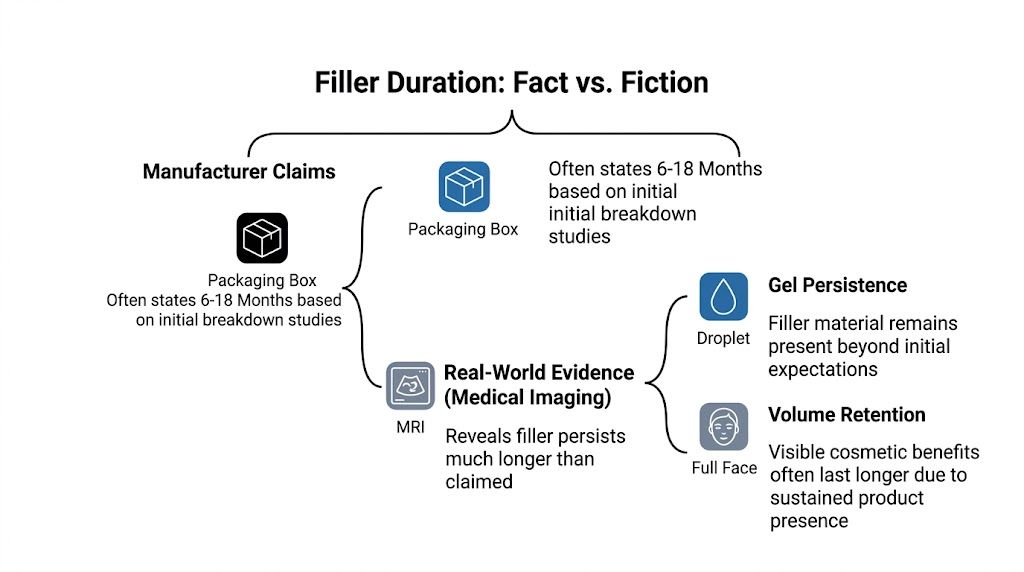
When researchers started looking at filler with MRI and 3D imaging, they found something patients and many providers didn’t expect. Hyaluronic acid often remains present well beyond the commonly quoted timeline.
According to Dermatology Affiliates’ review of imaging data, a 2024 meta-analysis found that 50 to 86% of hyaluronic acid volume persists at 24 months. The same review notes that an NIH MRI study found evidence of HA filler in the mid-face lasting from 2 to 15 years, with all patients showing HA presence even after 2 years without injections.
That doesn’t mean every patient looks exactly the same for years. It means something more important. Visible softening of results is not the same as complete disappearance of product.
Here’s a quick visual explanation from a patient education video.
A patient may come back at the one-year mark and say, “I think all my filler is gone.” Sometimes what they’re really noticing is that the initial crispness has softened. The face may have changed around the filler. Swelling has long since resolved. Light hits differently. Natural aging continues.
But if filler is still physically present, adding more isn’t the same as replacing what disappeared. It’s layering onto what remains.
That’s why an experienced injector thinks in terms of maintenance, not automatic refill. In some cases, a patient may need only a small adjustment. In others, the better choice may be to treat a different area that supports the original result.
A good example of this treatment-planning mindset appears in discussions of longer-lasting structural fillers like how long Radiesse can last, where support and collagen response influence the timeline differently than a simple “fill and fade” model.
Patients rarely ask for an overfilled result. More often, it happens one conservative appointment at a time. Each visit seems reasonable. Each syringe seems modest. But if prior filler is still there, the total can gradually accumulate.
Key takeaway: “Touch-up” should mean reassess first, then add only what serves the face.
This is one of the biggest shifts in modern filler education. The question isn’t only how long does filler last. The better question is whether your current plan respects the fact that filler may still be there.
A patient may sit beside a friend at dinner, compare photos from the same month, and wonder why one filler result still looks crisp while the other has already softened. That difference is common. It does not mean one treatment worked and the other failed.
Your result is shaped by four moving parts working together: the filler itself, the area treated, your body’s habits and biology, and the injector’s technique. A useful comparison is baking. You can use the same flour, but if you change the oven, pan, and temperature, the final result changes too.

Each filler is built for a job. Some are softer so they can move naturally in expressive areas. Others are firmer so they can hold lift and structure in places like the cheeks.
As noted earlier, longer-lasting structural fillers such as Juvederm Voluma are often used in the mid-face, while softer products placed around the mouth can wear differently in high-mobility areas. The label gives a general starting point. Your face decides how that starting point plays out.
That is one reason a cheek filler should not be judged by the same timeline as a lip filler. If you are curious about why lips behave differently, our guide on how lip filler works in a high-motion area explains the mechanics in plain language.
Faces are always in motion, but not every area moves the same way.
Lips, the corners of the mouth, and smile lines fold, stretch, press, and purse all day. Cheeks and deeper support points in the mid-face usually experience less constant compression. Filler in a quiet area often keeps its shape and visible definition longer. Filler in a busy area may soften sooner, even when some product is still present.
A cushion on a sofa seat wears faster than the same cushion placed in a guest room. The material matters, but daily use matters too.
Package inserts describe averages. Real people do not live on averages.
Your body has its own rate of circulation, tissue turnover, inflammation, enzyme activity, and movement. Some patients process hyaluronic acid filler faster. Others hold it longer than expected. Fitness level, facial expressiveness, skin thickness, and even the way you sleep can all play a part in how results change over time.
This is why two well-done treatments can age differently and still both be normal.
Injection technique affects more than the first two weeks. It influences how filler sits in the tissue, how smoothly it blends, and whether the result continues to look natural as months pass.
Depth matters. Placement pattern matters. Respect for anatomy matters. A carefully placed amount can support the face in a way that looks quiet and balanced. Poor placement can create puffiness, uneven contour, or a result that seems to fade quickly because it never sat in the right place to begin with.
This also connects to the larger idea in this article. MRI and 3D imaging studies have shown that filler can remain present longer than many patients expect. So the primary question is often not, “Has it vanished?” A better question is, “What is still there, and what does this face need now?”
Here is the simpler version:
Good filler planning is custom tailoring for the face, not a standard refill schedule.
That is often reassuring for patients. If your friend loved her result for longer than you did, that comparison may say more about anatomy, movement, and treatment design than about whether your filler “lasted.” The best plan is individualized, conservative, and based on reassessment instead of assumption.
First-time filler patients often assume the first treatment will set the standard forever. If it fades sooner than expected, they worry the product “didn’t work.” That’s not usually the right interpretation.
For many people, the first filler session behaves a little differently from later maintenance sessions. A useful way to think about it is priming a canvas. The first treatment lays down the initial support. Later appointments refine and preserve it.
According to DermaCare San Diego’s review of first-time filler longevity, HA fillers typically endure 4 to 9 months the first time, compared with 9 to 12 months in subsequent treatments. The same review explains that this happens because the body hasn’t yet developed optimal tissue integration, and initial hyaluronidase activity can be higher.
That’s an important concept for new patients. It means a shorter first cycle doesn’t automatically mean the filler failed.
Your first appointment usually does more than add visible volume. It helps your provider learn how your face responds. It also gives you a chance to see how much change feels right for you.
Some patients come in worried they’ll look “done” right away. In reality, the safest and most natural path is often conservative treatment followed by reassessment. That’s especially true for expressive areas like the lips. If you’re curious about that process specifically, this guide on how lip filler works gives a useful patient-friendly overview.
Try not to judge filler only by whether the first appointment gave the longest possible duration. A more useful question is whether it created a good foundation.
If your first filler treatment fades earlier than you hoped, that’s often part of the learning curve, not a sign you’re a bad candidate.
When patients understand that, they usually feel less anxious and make steadier choices going forward.
Once filler is in place, the goal isn’t to micromanage it. The goal is to support healthy skin and avoid the cycle of waiting too long, then trying to rebuild all at once.
Most patients get the best long-term results when they combine good daily habits with a thoughtful maintenance schedule. That approach usually looks more natural than chasing dramatic corrections.
You can’t force filler to last forever, but you can create better conditions for your skin and results.
These habits don’t replace product choice or good technique. They support them.
The old model was simple. Wait until you feel like everything is gone, then start over. The problem is that this often leads to uneven changes. You lose support, then try to regain it in one bigger step.
A maintenance approach is usually smoother. The provider reassesses what remains, what has softened, and whether the issue is true volume loss or a shift in balance. Then they use the smallest amount needed to keep the result coherent.
That strategy often helps patients avoid sudden swings. It also reduces the temptation to overcorrect a face that already contains residual filler from prior sessions.
Not every change means you need more filler right away. Sometimes you need evaluation, not more product.
Watch for these clues:
Small, well-timed adjustments usually age better than large catch-up appointments.
That’s the practical answer behind “maximizing filler life.” It’s less about squeezing every last day out of a syringe and more about maintaining proportion with restraint.
The most useful takeaway from all of this is simple. Filler does not behave like a timer that reaches zero and resets. It changes gradually, often remains longer than patients expect, and needs a plan that respects both science and facial balance.
That’s why experience matters. A skilled provider doesn’t just know how to inject. They know when not to add more, when to shift strategy, and how to keep long-term results looking natural.

Dr. Marc Fater brings more than 30 years of experience to aesthetic and reconstructive care, and Cape Cod Plastic Surgery offers patients the reassurance of treatment in a practice led by a board-certified plastic surgeon. The practice also features an on-site, AAAASF-accredited surgical suite, reflecting a strong commitment to safety and high standards of care.
For patients considering filler, that kind of expertise matters most at the points where judgment matters. Product selection. Placement. Timing. Maintenance. Those decisions shape whether your result stays elegant or slowly becomes too much.
A personalized consultation is the best place to answer the question, “How long does filler last for me?” because the right answer depends on your face, not on a generic timeline.
Some fillers can. Hyaluronic acid fillers can often be dissolved with hyaluronidase. That’s one reason many patients and injectors appreciate HA products, especially in areas where precision matters. Not every filler type works this way, so it’s important to know what product was used.
Most patients expect mild swelling, tenderness, or bruising. The exact recovery experience depends on the area treated, the amount placed, and your own healing response. Lips usually swell more than cheeks. A social event the same day usually isn’t ideal.
Don’t rely only on the feeling that the filler is “gone.” A better sign is that the treated area looks less balanced, less supported, or less in line with your goal. A good provider can tell whether you need more product, a different placement strategy, or more time.
Not necessarily. The best filler is the one that suits the area, the level of support needed, and your comfort with maintenance. In some parts of the face, flexibility and reversibility matter more than maximum duration.
Yes, if the treatment plan is conservative and regularly reassessed. Natural long-term results usually come from restraint, not repeated full correction.
If you’re considering filler and want a plan built around facial balance, safety, and long-term results, schedule a consultation with Cape Cod Plastic Surgery. Dr. Marc Fater and his team can help you understand your options, choose the right approach for your goals, and create a maintenance plan that keeps your results refined and natural.
October 7, 2026
A Practical Guide to Healing After Breast Surgery

October 6, 2026
Your Safety Guide: What to Look for When Choosing a Plastic Surgeon

October 5, 2026
Why Our On-Site Accredited Facility Matters for Your Safety

Cape Cod Plastic Surgery offers expert cosmetic and reconstructive procedures in a safe, accredited setting. Led by Dr. Marc Fater, we combine advanced techniques with personalized care to help you look and feel your best.
Monday: 9:00 AM – 5:00 PM
Tuesday: 9:00 AM – 5:00 PM
Wednesday: 9:00 AM – 5:00 PM
Thursday: 9:00 AM – 5:00 PM
Friday: 9:00 AM – 5:00 PM