

September 9, 2026
How to Care for Surgical Incisions Properly
Expert Guide to Proper Surgical Incision Care
Dec 28, 2025
For most people, the sweet spot for scheduling Botox is every 3 to 4 months. This timing is the key to maintaining consistently smooth, refreshed skin. By staying on a regular schedule, you treat the wrinkles before they have a chance to fully reappear.
While the 3- to 4-month mark is a great rule of thumb, it helps to know what’s actually happening under your skin from the moment you leave our office. Botox doesn’t work instantly; it's a gradual process. The product takes a little time to settle in, and your body naturally breaks it down over several months. This predictable cycle is why a consistent treatment plan is so effective.
Botox works by temporarily relaxing the specific facial muscles that cause dynamic wrinkles—those lines from squinting, smiling, or frowning. When we block the nerve signals telling those muscles to contract, the overlying skin smooths out. We have a detailed guide that goes deeper into how long you can expect Botox to last based on this process.
Your results will unfold over a few weeks. Right after the injection, the product begins binding to the nerve receptors. You'll start to notice a change within a few days, but the full, beautiful result typically reveals itself around the two-week mark.
Here's a simple breakdown of what that timeline looks like:
This table outlines the progression of Botox effects from the day of injection to when a follow-up is typically needed.
Following this timeline helps ensure your results never completely fade between visits.
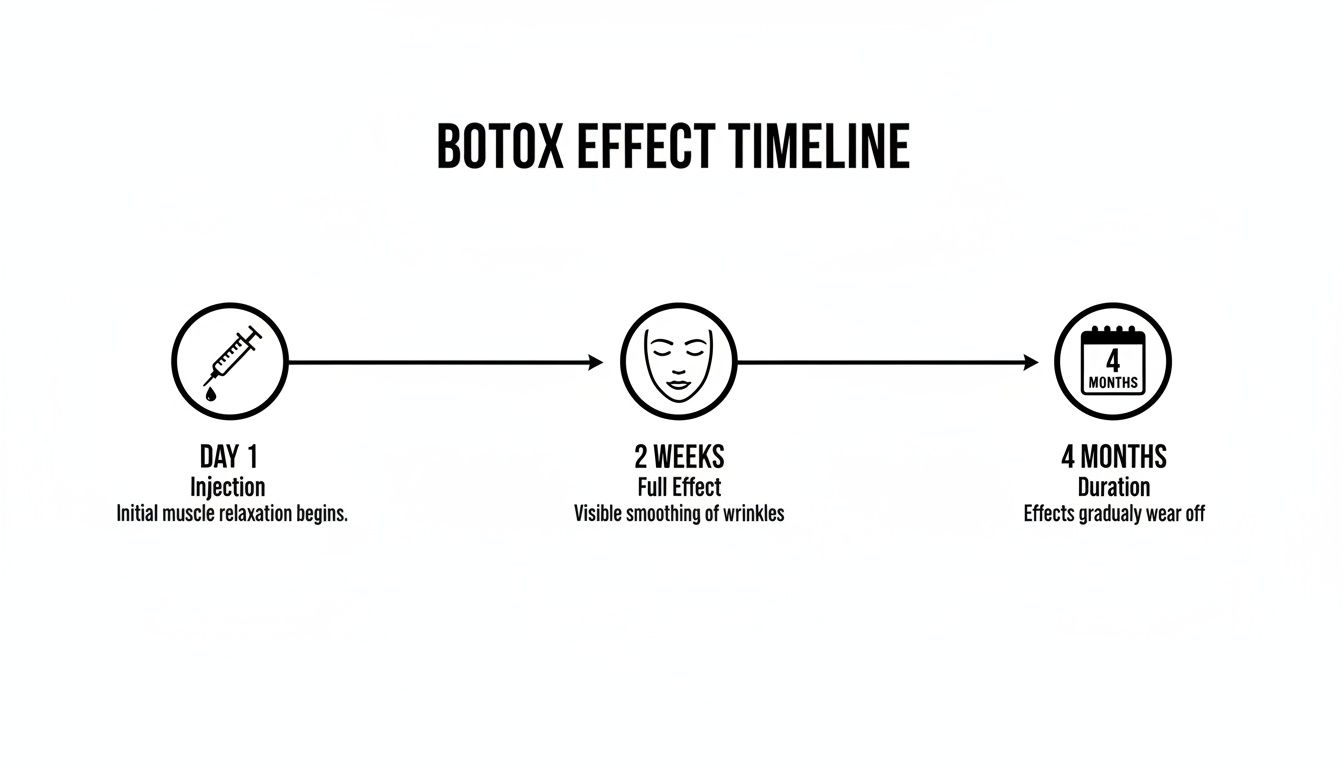
As you can see, you enjoy the peak results for a solid couple of months. Then, as your body naturally metabolizes the product, muscle activity slowly starts to come back. That gradual return of movement is perfectly normal and lets you know it’s time to schedule your next visit.
Key Takeaway: The goal of a maintenance schedule is to treat the area before the muscles regain their full strength. This approach not only maintains your results but can also help "re-educate" the muscles over time, potentially leading to longer-lasting effects in the future.
Understanding this cycle is the first step toward creating a treatment plan that's perfectly suited to you. Once you have this baseline in mind, we can start looking at the personal factors that might adjust your unique schedule.
To really get why you need Botox treatments every few months, it helps to understand what’s happening beneath the skin. A common misconception is that Botox is a filler that pushes out wrinkles from below. It's actually something entirely different—a highly purified protein called a neuromodulator.
Think of the nerves in your face as tiny messengers delivering constant instructions to your facial muscles, telling them to contract. Every time you frown, squint at the sun, or laugh, a signal zips from a nerve ending to a muscle. After years of these repeated movements, the skin on top starts to crease, forming what we call dynamic wrinkles.

When we inject Botox in tiny, strategic amounts, it acts like a temporary roadblock for those signals. It intercepts the message right where the nerve tries to communicate with the muscle.
The command to contract never gets delivered, so the muscle simply doesn’t squeeze. It stays relaxed. When the muscle isn't constantly bunching up the skin above it, that skin gets a chance to smooth out, causing those expression lines to soften dramatically or even fade away completely.
What’s brilliant about this process is how precise it is. Botox only affects the specific, tiny muscles it’s placed into. All the surrounding muscles continue to function as usual, which is how a skilled injector can smooth your crow's feet without changing your smile or get rid of forehead lines without giving you a "frozen" look. It’s all about artistry and anatomy.
This temporary nerve block is also the key to why you can’t just get Botox once and be done. Our bodies are incredibly resourceful. Over time, they recognize the block and begin to build new pathways for the nerve signals to get through.
Think of it like a detour around road construction. The main route is closed, but eventually, the body builds a new side road to get traffic moving again. This process typically takes about 3 to 4 months.
Once those new connections are made, the muscle starts getting the "contract" signal again, and you'll slowly notice those lines starting to reappear. It’s not an overnight change; it's a very gradual return of movement as your body metabolizes the product.
This natural, predictable cycle is what makes a regular maintenance schedule so effective. By booking your next appointment just as the effects begin to fade, you keep the muscles in that relaxed state without interruption. This not only keeps your skin smooth but can also help prevent those lines from becoming deeper over time.
If the standard 3- to 4-month schedule is the baseline, think of your personal biology and lifestyle as the variables that dial that timeline in. A one-size-fits-all approach simply doesn't work for Botox, because no two bodies are the same. Everything from how fast you burn through energy to the natural strength of your facial expressions plays a part in determining how long your results will last.
This is exactly why a detailed, in-person consultation is so crucial. It’s our chance to look beyond the averages and create a treatment schedule that’s designed specifically for you and your goals.
Your body’s metabolism—the engine that processes everything from your lunch to medications—is a huge factor in your Botox timeline. Just like some people get a jolt from a single cup of coffee while others need three, people with faster metabolisms tend to break down the neuromodulator more quickly.
This is often the case for serious athletes or anyone who lives a very active lifestyle. Regular, intense exercise naturally revs up your metabolism, which can sometimes mean your Botox results fade a bit sooner. You don't need to hang up your running shoes, but you might find yourself ready for a touch-up closer to the 3-month mark.
The inherent strength of your facial muscles is another key piece of the puzzle. Someone with a very expressive, strong forehead muscle will need a different approach than someone with finer, more delicate muscles around their eyes.
Here's an easy way to think about it:
Imagine your facial muscles are like rubber bands. A thick, powerful rubber band snaps back with a lot more force and requires more effort to keep it smooth. In contrast, smaller, delicate muscles are like thin rubber bands—they don’t need as much work to stay relaxed.
This is why we never use a cookie-cutter dose. The amount of Botox that works beautifully for your friend's crow's feet might not be enough for your stronger frown muscles. We always take the time to assess your unique expressions and muscle patterns to get your results just right. It's this kind of personalized care that has made these treatments so popular; in 2022 alone, there were over 9 million procedures globally, a jump of 26.1% from the year before. You can read more about these global Botox treatment statistics to see just how mainstream it has become.
How long you've been getting Botox and your age also influence your maintenance schedule.
The age you start can also shape your long-term plan. Many of our younger patients use Botox as a preventative measure to stop deep, static lines from ever forming. We cover this topic in more detail in our guide on what age is best to start Botox.
At the end of the day, all these factors come together to create your personal treatment rhythm. By looking at your metabolism, muscle anatomy, and treatment history, we can build a schedule that keeps you looking refreshed and feeling great—without ever looking "overdone."
Of course. Here is the rewritten section with a more natural, human-expert tone.
While everyone’s body is a little different, your daily habits can make a real difference in how long your Botox results stick around. Think of it like this: your treatment is an investment in feeling your best, and a little smart aftercare is how you protect that investment. You have more control than you think over the longevity of your refreshed look.
The work starts right after you leave our office. Following a few simple rules right after your appointment is probably the most critical step to ensure the product settles in perfectly and does its job.
What you do in the first 24 hours really matters. The goal is to keep the product exactly where we placed it, so it can work on the intended muscles without wandering off.
Here’s a quick checklist for right after your treatment:
A Pro Tip: For about an hour after your appointment, try gently making the expressions you were treated for—like frowning, raising your brows, or squinting. Some evidence suggests this helps the muscle take up the product more effectively.
Beyond the first day, your everyday choices play a surprisingly large role in maintaining your results and overall skin health.
Sun protection is, without a doubt, the most important thing you can do. UV rays are the number one enemy of healthy collagen, and less collagen means more wrinkles. Protecting your skin is your best line of defense.
What you eat and drink also matters. A diet packed with antioxidant-rich foods (think berries, nuts, and leafy greens) helps your skin fight back against environmental damage. Staying well-hydrated keeps your skin looking plump and healthy, which beautifully complements the smoothing effects of your Botox.
Combine this with a solid skincare routine—especially products with ingredients like retinol and vitamin C—and you’ve created the perfect environment for your results to look better and last longer.

Keeping up with a regular Botox schedule is about more than just maintaining a smooth forehead from one season to the next. Think of it as a proactive strategy for your skin's future—turning your treatments into a long-term investment in aging gracefully.
The secret sauce here is something we call muscle re-education. Your facial muscles aren't all that different from the other muscles in your body. If you stop working them out, they gradually weaken. Botox essentially puts those overactive, wrinkle-causing muscles on a temporary vacation.
By consistently keeping these muscles relaxed, they slowly begin to "forget" their old habits of making harsh, repetitive movements. It’s a bit like training a puppy not to jump on guests; with enough gentle, consistent reinforcement, the impulse just isn't as strong anymore.
This muscle retraining doesn't happen overnight; it builds on itself. With each appointment, those muscles remain in a relaxed state for longer, which stops the skin on top from creasing and etching lines deeper.
Over time, this has a really noticeable effect. You'll likely find that even as the Botox starts wearing off around the three or four-month mark, those muscles don't just snap back to their old, aggressive ways. Your frown lines stay a bit softer, and your forehead doesn't furrow with the same intensity.
The real goal of a long-term Botox plan is this gentle weakening of the muscle. It’s not about looking “frozen,” but about softening the involuntary movements that carve lines into our faces over the years.
This long-term benefit can actually change how often you need to come in for touch-ups down the road. It's very common for patients who stick to a consistent schedule for the first year or two to find they can eventually push their appointments further apart.
So, what could this look like for you?
When you start looking at Botox as a preventative tool instead of just a reactive fix, you're actively taking control of how your skin ages. A consistent schedule doesn't just smooth out today's wrinkles—it helps stop tomorrow's from ever taking hold.
Getting those incredible, natural-looking results isn't about chasing a one-size-fits-all timeline. It’s about partnering with a true expert who understands the art and science behind the treatment. At Cape Cod Plastic Surgery, every plan we create is built on the foundation of Dr. Marc Fater’s 30+ years of board-certified experience, making your safety and satisfaction our absolute top priorities.
We don't do "standard" here. Instead, we craft a Botox schedule that is uniquely yours. During your consultation, we'll take the time to really look at your facial anatomy, understand your unique muscle patterns, and listen to what you want to achieve. This in-depth approach is how we deliver that refreshed, confident look you’re after—without ever looking unnatural or "done."
Your goals are the heart of our practice. We believe the best results come from a collaborative relationship, where you feel heard, understood, and completely comfortable with every step of your treatment. It's this deep commitment to patient care that truly sets our practice apart.
By focusing on your individual needs, we can design a maintenance schedule that not only delivers beautiful results but also fits seamlessly into your life.
To make managing your appointments even easier, you can explore online scheduling solutions that help you stay on track with your long-term aesthetic goals.
Ready to see what a truly personalized approach can do for you? We invite you to schedule a consultation with Dr. Fater and our team to begin your journey.
Once you start thinking about a regular Botox routine, a few key questions usually pop up. Patients often ask me about the risk of looking unnatural, what happens if they miss an appointment, or if their body might just get used to the treatments over time. Let's clear up these common concerns so you can feel completely comfortable and confident with your plan.
One of the biggest worries I hear is about looking "overdone" or "frozen." It's really important to understand that this look isn't caused by how often you get treated, but by improper dosage or placement. A skilled injector knows how to soften wrinkles while keeping your natural expressions intact.
In fact, sticking to a consistent 4-month schedule with the correct dose is the best way to maintain a naturally relaxed and refreshed appearance, as it prevents those deep, harsh lines from ever fully coming back.
Life gets busy, and sometimes you might go well beyond the recommended window—maybe six months or even longer. The good news? No harm done. Your muscles will simply regain their full pre-treatment strength, and those dynamic wrinkles will gradually reappear just as they were before.
The only real downside is that you lose the muscle-retraining benefits that come with a consistent schedule. You're essentially starting over from square one at your next appointment, rather than building on previous results.
It's incredibly rare for someone to develop a true resistance to Botox. What usually happens is that patients get so used to their smooth, wrinkle-free results that they become much more aware of the very first signs of muscle movement returning.
Many people who have been getting Botox for years find the opposite happens. Their muscles become conditioned to stay relaxed, which can sometimes allow them to stretch the time between appointments even longer. The specific product used also plays a big role in how long results last; for a deeper dive, check out our article comparing Daxxify vs. Botox.
Ultimately, the best, most lasting results always come from a schedule that’s perfectly tailored to you.
Ready to discover a Botox plan designed just for you? The experts at Cape Cod Plastic Surgery are here to help you achieve your aesthetic goals with precision and care. Schedule your personalized consultation with us today!
September 9, 2026
Expert Guide to Proper Surgical Incision Care
Master dermal fillers aftercare with do's and don'ts, swelling tips, activity limits and warning signs to protect your results and heal smoothly.

September 8, 2026
Ensuring Safety: Why Your Surgeon's Credentials Matter Most

Cape Cod Plastic Surgery offers expert cosmetic and reconstructive procedures in a safe, accredited setting. Led by Dr. Marc Fater, we combine advanced techniques with personalized care to help you look and feel your best.
Monday: 9:00 AM – 5:00 PM
Tuesday: 9:00 AM – 5:00 PM
Wednesday: 9:00 AM – 5:00 PM
Thursday: 9:00 AM – 5:00 PM
Friday: 9:00 AM – 5:00 PM