

October 7, 2026
What to Expect During Your Breast Surgery Recovery
A Practical Guide to Healing After Breast Surgery
Apr 20, 2026

You notice it in a photo first. Not your face, but the angle beneath your chin. Then you catch it again on a video call, in bright bathroom lighting, or while looking down at your phone. The jawline looks softer. The skin under the chin seems heavier or looser. Maybe there are vertical bands that weren’t there before.
That’s usually when people start searching for how to get rid of turkey neck.
The good news is that this concern is common, and it’s treatable. The more important point is that “turkey neck” is not one single problem. Some people mainly have loose skin. Others have fat under the chin. Others have muscle banding in the platysma, the thin muscle sheet that shapes the neck. Many have a combination of all three. If you don’t identify the underlying cause, it’s easy to spend time and money on treatments that won’t give you the result you want.
A thoughtful neck evaluation should answer a simple question first: what exactly is creating the aged appearance in your neck? Once that’s clear, the right treatment path becomes much easier to choose.
Most patients don’t walk in saying, “My platysma is separating” or “I’ve developed submental fullness.” They say their neck looks older than the rest of their face. That’s a useful observation, because the neck often shows aging early and in a very visible way.
Three anatomical changes usually drive the look people describe as turkey neck.
The first is skin laxity. Over time, skin loses structure and elasticity. It doesn’t snap back the way it once did, so it begins to drape rather than contour. That can create a crepey texture, a hanging fold under the chin, or a blurred jawline. If you want a deeper explanation of why this texture develops, Cape Cod Plastic Surgery has a helpful overview of what causes crepey skin.
The second is submental fat, often called a double chin. This can appear even in patients who are otherwise fit. Diet and exercise help overall body composition, but they don’t reliably target a specific pocket of fat beneath the chin. When that fullness sits in front of the neck structures, the profile loses definition.
The third is platysma change. The platysma is the broad, thin muscle that runs through the neck. With aging, its edges can become more visible as vertical bands, or the muscle can loosen and contribute to sagging. In some patients, these bands are the main issue. In others, they’re only one piece of a larger structural problem.
Practical rule: If your concern is mostly texture, fat reduction alone won’t fix it. If your concern is mostly fullness, creams won’t remove it. If your concern is muscle banding, surface skincare won’t change the underlying anatomy.
Posture can also affect what you see in the mirror. It doesn’t create true excess skin, but it can make the neck and jawline look less defined in daily life and in photos. If you spend long hours looking down at screens, it’s worth learning about correct forward head posture (or 'tech neck') because positioning can exaggerate an already aging neck.
That distinction matters. Some people need subtle support. Some need fat reduction. Some need a structural repair. The neck only looks youthful when skin, fat, and muscle are in balance.
People usually try home remedies before they call a plastic surgeon. That makes sense. Creams are easy to buy, neck masks promise lifting, and social media is full of exercises that claim to tighten the jawline. The problem is that most of these approaches overpromise and underdeliver.

Good skincare still matters. It helps maintain skin quality, supports texture, and may make the neck look healthier and smoother. Daily sunscreen is essential. Retinoids can also be useful for surface-level improvement, though the neck can be more sensitive than the face. If you’re considering that route, this breakdown of the clinical truth about using Tretinoin on your neck gives a realistic look at irritation and application issues.
A well-formulated neck cream may improve hydration and appearance. It may soften dryness and improve the look of mild crepiness. What it won’t do is remove excess fat, repair platysma laxity, or tighten significantly loose skin.
“Neck yoga” and jawline exercises are popular because they feel active and motivating. But they don’t remove redundant skin, and they don’t dissolve fat under the chin. In some patients, repeatedly contracting the platysma can make vertical banding more noticeable.
That doesn’t mean movement is useless. Gentle mobility, posture correction, and general fitness support overall appearance. They’re just not reliable solutions for an aging neck that already has structural change.
The neck is not a body area where effort alone reliably overcomes anatomy.
The most common mistake is stacking weak treatments and expecting a surgical result. Patients buy a cream, then a home device, then another product marketed for “lifting,” and months later they’re frustrated because the neck still looks the same.
Here’s a practical way to think about home care:
For readers trying to understand whether fullness or laxity is the bigger issue, Cape Cod Plastic Surgery also has a useful discussion on how to make my neck thinner.
If your concern is mild and early, home care can be part of a prevention plan. If you already see hanging skin, a soft jawline, or visible bands, the answer usually lies in office-based treatment or surgery, not in another jar.
A common consultation starts the same way. Someone is comfortable with their face, but in photos or on video calls the area under the chin looks heavier, the skin looks less crisp, or vertical neck bands seem to stand out more than they used to. In that setting, non-surgical treatment can make sense, but only if the problem is defined correctly.
Non-surgical neck rejuvenation works best for three patterns: a small to moderate pocket of submental fat, early skin laxity, or mild platysmal banding. It works less well when the neck already has hanging skin, deep structural laxity, or a poorly defined jawline caused by multiple layers aging at once. That distinction matters because it determines whether an office-based plan is likely to be worthwhile or whether it will become a series of treatments with limited return.
Kybella is a targeted treatment for submental fullness. The FDA approved deoxycholic acid for this use in 2015, and Cleveland Clinic notes that it can help selected patients reduce fat beneath the chin over a series of treatments (Cleveland Clinic review of turkey neck treatment).
In practice, the right candidate has pinchable fullness under the chin, decent skin elasticity, and realistic expectations about the pace of change. Kybella does not remove loose skin. It also does not tighten separated platysma muscle edges. Patients who benefit most are usually those who say, “I dislike the fullness here,” not those whose main complaint is hanging skin.
Recovery is the trade-off. Swelling can be substantial for several days, tenderness is common, and the improvement appears gradually rather than all at once. For some patients, that slower course is acceptable because they want to avoid surgery. Others decide the downtime-to-improvement ratio is not ideal for their goals.
Botox can soften visible platysma bands when those cords are created mainly by muscle activity rather than excess skin. I use it selectively. It is most helpful in thinner patients with mild banding that becomes more obvious during speaking, smiling, or neck tension.
The limitation is straightforward. Botox reduces muscular pull. It does not remove redundancy in the skin, and it does not restore a sharply defined neck angle if the problem is deeper or more advanced.
Results are temporary, so this option works best for maintenance, early intervention, or for patients who want a modest change before considering a procedure with more recovery.
Energy-based treatments improve skin quality more than they change neck structure. Radiofrequency microneedling and related devices are usually best for crepey texture, early looseness, and mild skin aging. They can be a good fit for the patient who sees the first signs of neck aging and wants to address them before laxity becomes more pronounced.
These treatments require patience. Improvement builds over time, and the endpoint is refinement, not major contour change. In my view, they are often oversold when a patient needs skin removal or muscle tightening.
If you are comparing office-based options before scheduling, Cape Cod Plastic Surgery has a helpful overview of non-surgical and minimally invasive approaches to neck skin tightening.
A good non-surgical plan matches the treatment to the layer that is aging.
| Concern | Non-surgical option | What it can realistically do |
|---|---|---|
| Fat under the chin | Kybella | Reduce a defined pocket of submental fat |
| Mild platysma bands | Botox | Relax visible vertical banding |
| Early laxity and texture | RF microneedling or similar tightening treatment | Improve collagen support and skin quality |
Combination treatment can work well in selected patients because each tool addresses a different issue. Fullness, banding, and surface skin quality are separate problems. They should be evaluated separately before any money is spent.
That is also the decision point many patients need before a consultation with Dr. Fater. If your concern is mostly fat, an injectable approach may be reasonable. If your concern is mostly texture and early crepiness, energy-based treatment may help. If the neck has visible skin excess at rest, strong vertical bands, or loss of jawline definition from the side, non-surgical treatment is less likely to deliver the change you probably want.
Patients deserve a clear answer here. Non-surgical treatment does not reliably correct a true turkey neck once excess skin and deeper laxity are established.
It can improve. It rarely resets.
That does not make these treatments poor choices. It makes patient selection more important than the treatment itself. The most productive next step is a focused consultation at Cape Cod Plastic Surgery, where Dr. Fater can examine the skin, fat, and platysma directly and tell you whether a non-surgical plan is likely to be enough, or whether surgery will give you a better result for the time, cost, and recovery involved.
A patient usually reaches this point after trying to make non-surgical treatment fit a problem that has become structural. The mirror shows loose skin at rest, a soft jawline from the side, or vertical bands that stay visible even when the neck is relaxed. In that situation, surgery is often the option that can produce a real change rather than a modest improvement.
A neck lift works because it allows the surgeon to treat the specific layer causing the problem. That may mean removing extra skin, reducing fat under the chin, tightening the platysma, or combining all three. The goal is not only to make the neck tighter. The goal is to restore a cleaner angle between the jaw and neck in a way that still looks natural for the patient’s age, anatomy, and skin quality.

Extra neck skin does not respond well to injectables, devices, or exercise once it has started to hang. Cervicoplasty addresses that directly by removing redundant skin and redraping the remaining skin more cleanly.
This step matters most for patients who describe folds, creases, or a draped appearance below the chin. If the problem is visible skin excess, leaving that skin in place usually means accepting a limited result.
Some patients have a heavy neck because fat is blunting the contour. Others have loose skin with very little fat. Treating both patients the same way leads to disappointment.
Liposuction or direct fat contouring can sharpen the transition from chin to neck when fullness is part of the picture. In practice, this is one of the key trade-offs I discuss with patients. If the neck looks full because of deep structure, weak chin projection, or muscle laxity, removing fat alone can make the result look incomplete or even exaggerate laxity. Good planning matters more than choosing the most aggressive treatment.
The platysma is often the deciding factor in a true turkey neck. When this muscle separates or loosens, the neck can look banded, wide, or poorly defined even if the skin itself is not the only issue. Platysmaplasty repairs that layer and helps rebuild the internal support of the neck.
Patients do not always expect this. Many come in asking for skin tightening, but their main problem sits deeper. If the platysma is left untreated in the right candidate, the neckline may still look aged after healing.
A better result usually comes from matching the operation to the anatomy, not from using a single standard recipe for everyone.
Modern neck rejuvenation is a planning exercise as much as an operation. The surgeon has to assess where the fullness sits, how strong the jawline is, whether bands are dynamic or fixed, how much skin recoil is left, and whether the chin supports the neck aesthetically. The American Society of Plastic Surgeons discusses advanced platysmaplasty approaches that focus on restoring neck contour by addressing the deeper support structures, not just pulling skin tighter (American Society of Plastic Surgeons discussion of advanced platysmaplasty).
That distinction matters during consultation. A patient with a recessed chin may need a different conversation than a patient with isolated skin laxity. Men often require different incision planning and contour goals than women. Patients who want a sharp, dramatic neckline must also accept the trade-offs that can come with a more involved repair.
At Cape Cod Plastic Surgery, that evaluation is what makes the consultation with Dr. Fater so useful. The best surgical plan depends on what is creating your neck aging, not on the label you attach to it before you come in.
Recovery is manageable, but it should be approached candidly. Most patients deal with swelling, tightness, bruising, temporary numbness, and a period where the neck looks improved but not finished. Social downtime is often the bigger issue. You may feel physically functional before you feel ready for photographs, work events, or dinners out.
The first week usually requires the most patience. Head elevation, activity restriction, and careful follow-up make a difference. Final refinement takes longer than many patients expect, especially in the lower face and neck where swelling can linger.
That is the trade-off with surgery. It asks for more recovery, higher upfront cost, and more planning. In return, it offers the strongest correction for established skin excess and platysma laxity.
Surgery is often the better fit when the neck shows clear structural aging, such as:
For patients considering Cape Cod Plastic Surgery, this is the practical checkpoint before consultation. Look at your neck in repose, from the side, and in normal room lighting. Note whether the problem is loose skin, fullness, banding, or a combination. Bring old photos if you have them. Come prepared to discuss what level of improvement would feel worthwhile to you, how much downtime you can accept, and whether you want the most durable correction or the least invasive option.
Those details help Dr. Fater determine whether a neck lift alone is appropriate, whether the platysma needs repair, or whether another plan would make more sense for your goals.
Once you understand the anatomy, the decision becomes less emotional and more practical. The main question isn’t “surgery or no surgery?” It’s what problem are you trying to solve, and how much correction do you want?
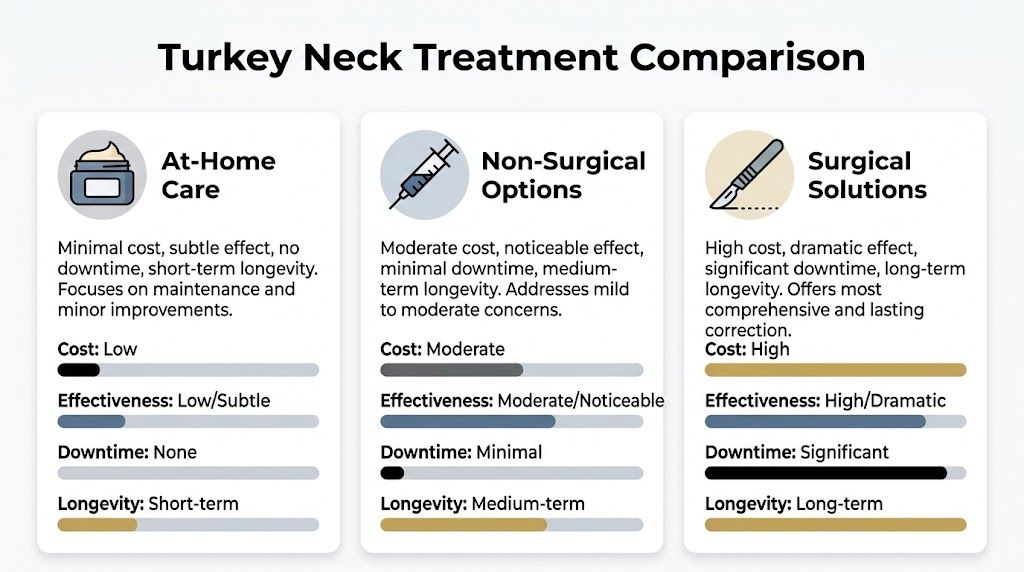
| Category | Best for | Effect | Downtime | Longevity | Cost expectation |
|---|---|---|---|---|---|
| At-home care | Early maintenance, texture support, prevention | Subtle | Low | Short-term maintenance | Lower |
| Non-surgical treatment | Mild to moderate fat, early laxity, mild banding | Noticeable but limited | Minimal to modest | Medium-term | Moderate |
| Surgical treatment | Moderate to severe laxity, structural aging, excess skin and muscle issues | Most comprehensive | Significant | Long-term | Higher |
At-home care belongs in almost every neck plan, but mostly as maintenance. It supports skin quality. It helps preserve results. It can improve the look of dry or mildly crepey skin. It does not replace treatment once the issue is structural.
This path makes sense if your neck still looks firm overall and your concern is mostly prevention.
Non-surgical treatment is often the right choice when the neck still has decent underlying support. You may have a small pocket of fat beneath the chin, early texture change, or visible bands that bother you in certain lighting or angles.
This path makes sense if you want improvement with less downtime and you’re comfortable with a result that may be meaningful but not completely altering.
If you want a refreshed neck, non-surgical care may be enough. If you want a redefined neck, surgery is often the more honest answer.
Surgery makes sense when your neck looks aged because the tissue has descended. That means extra skin, loosened muscle, and a heavier contour that can’t be smoothed by surface treatments. This is also the better path when you want a result that lasts rather than a series of maintenance procedures.
This path makes sense if you want the strongest correction and accept a more involved recovery.
If you’re trying to self-sort before meeting with a surgeon, use this checklist:
A lot of disappointment comes from picking a lower-downtime treatment for a higher-severity problem. The better strategy is to match the intervention to the anatomy.
A consultation should do more than give you a price or a menu of options. It should clarify the anatomy, narrow the treatment choices, and show you what’s realistic for your face, neck, age, and goals.
Dr. Marc Fater brings over 30 years of experience in facial rejuvenation and performs surgery in an on-site AAAASF-accredited surgical suite, which matters when safety and surgical planning are part of the conversation. For a patient considering neck rejuvenation, that consultation is where vague frustration turns into a precise plan.
A strong neck consultation usually starts with your concern in plain language. Common expressions include, “My neck looks older than I feel,” or “I don’t like my profile anymore.” That’s enough to begin.
From there, the surgeon evaluates the neck in a structured way, including:
That kind of assessment matters because different findings point to different treatments. A patient who thinks they need a neck lift may be a better candidate for limited treatment. Another who wants injections may need surgery to get the result they have in mind.
Bring questions. The best consultations are conversations, not lectures.
The right consultation should leave you with fewer fantasies and more clarity. That’s a good thing.
A little preparation improves the conversation.
A consultation is not a commitment. It’s the point where the options become personal instead of theoretical.
Every neck lift leaves scars. The question is where they are placed, how they heal, and whether the trade-off makes sense for the improvement you want.
In a well-planned neck lift, incisions are usually tucked around the ears, sometimes with a small incision under the chin if the platysma muscle or deeper neck fat needs to be addressed directly. Good scar placement matters, but so does choosing the right operation. If loose skin, banding, and fat are all contributing to the problem, a limited procedure with smaller scars can leave you disappointed because the neck still looks heavy or lax.
Scar quality also depends on your skin type, healing history, sun exposure, and how closely you follow aftercare instructions. During a consultation with Dr. Fater, ask where your incisions would likely sit, how they tend to mature, and what parts of your neck can improve versus what may remain unchanged.
Neck lift recovery is usually described as tightness, soreness, and swelling more than sharp pain. That distinction matters because patients often fear the wrong part of recovery.
The first several days are the most restrictive. Sleeping position, activity limits, and incision care usually affect comfort as much as the procedure itself. Some patients feel ready to be seen socially fairly quickly, while others need more time for swelling and bruising to settle. Recovery is not just about pain control. It is also about when your neck looks natural enough that you feel comfortable being out in public.
Yes, and in many cases that gives a more balanced result.
A neck can look younger after surgery, but if the jawline is heavy, the lower face has descended, or the chin is underprojected, the improvement may feel incomplete. That is why some patients consider a neck lift along with facial rejuvenation or contouring procedures. Combination treatment can improve harmony, but it also affects cost, operative time, and recovery. The right plan depends on what is aging in your face and neck together, not on a package approach.
Age is a weak screening tool. Anatomy, skin quality, medical history, and expectations are far more useful.
A younger patient may have a full or poorly defined neck because of inherited anatomy. An older patient may be in excellent health and a very good candidate for surgery. What matters is whether the treatment matches the actual problem. A consultation should answer that clearly. If the neck issue is mild, surgery may be more than you need. If the issue is advanced, non-surgical treatment may cost money without giving a meaningful change.
That is common, especially for patients still deciding how much change they want and how much downtime they can accept.
A careful consultation should help you compare waiting, trying a non-surgical option, or proceeding with surgery now. Sometimes a temporary treatment is reasonable. Sometimes it delays the result you already know you want. The goal is not to push you toward an operation. The goal is to leave you with a clear decision path based on your neck anatomy, budget, recovery tolerance, and standard for improvement.
If you want that kind of guidance, schedule a consultation with Cape Cod Plastic Surgery. Dr. Marc Fater can examine whether your concern is driven mainly by skin laxity, excess fat, platysmal banding, or a combination, and help you choose the option that fits your goals, recovery window, and budget with realistic expectations.
October 7, 2026
A Practical Guide to Healing After Breast Surgery

October 6, 2026
Your Safety Guide: What to Look for When Choosing a Plastic Surgeon

October 5, 2026
Why Our On-Site Accredited Facility Matters for Your Safety

Cape Cod Plastic Surgery offers expert cosmetic and reconstructive procedures in a safe, accredited setting. Led by Dr. Marc Fater, we combine advanced techniques with personalized care to help you look and feel your best.
Monday: 9:00 AM – 5:00 PM
Tuesday: 9:00 AM – 5:00 PM
Wednesday: 9:00 AM – 5:00 PM
Thursday: 9:00 AM – 5:00 PM
Friday: 9:00 AM – 5:00 PM