

October 7, 2026
What to Expect During Your Breast Surgery Recovery
A Practical Guide to Healing After Breast Surgery
Jun 4, 2026
A liquid facelift usually costs $2,000 to $12,000 in the U.S. The range is so wide because this isn't one standard procedure. It's a customized combination of injectables, and the final price changes with the products used, how many areas are treated, and how much correction you want.
If you're reading this, you're probably in a familiar spot. You want to look fresher, less tired, and more lifted, but you don't want surgery, scars, or a long recovery. You also don't want to walk into a consultation blind and hear a number that makes no sense.
That's the right instinct.
When patients ask me about liquid facelift cost, I tell them to stop looking for a single price and start asking a better question. What result am I buying, and what level of safety and expertise comes with it? On Cape Cod, that matters just as much as it does in Boston, New York, or Miami. A bargain quote that leaves you overfilled, uneven, or under-corrected is expensive. A thoughtful treatment plan that fits your face and your goals is where the value is.
You come in expecting a simple number. Instead, you hear a range that feels too wide to trust. That reaction is reasonable. A liquid facelift is priced that way because you are not buying one standardized treatment. You are buying a plan built around your anatomy, your aging pattern, and the result you want to see in the mirror.
A better way to judge cost is to ask what the quote is designed to accomplish. A lower price may cover a small refresh. A higher price may include enough product and physician time to restore cheek support, soften folds, improve jawline definition, and reduce the tired look that develops around the mouth and eyes. Those are very different outcomes.

The final cost rises or falls with the amount of correction needed. Early volume loss in the cheeks is one problem. Lower-face heaviness, deeper nasolabial folds, chin imbalance, and etched lines are another. Treating all of that well takes more product, more judgment, and more time.
On Cape Cod, many patients want to look rested and refined, not inflated. That usually requires restraint and precise placement, especially in a face that does not need more volume everywhere. The value is not in finding the cheapest syringe. The value is in using the right product in the right plane, and in knowing when injectables will give you a strong result and when surgery would be the smarter investment.
That distinction matters.
An experienced plastic surgeon should be able to explain where your money is going and what improvement each part of the plan is expected to deliver. At Cape Cod Plastic Surgery, treatment is performed by Dr. Fater in an AAAASF-accredited facility. That affects price, and it should. Expertise and a properly accredited setting reduce avoidable risk and improve the odds that your result looks natural the first time.
If you want a local benchmark before your visit, review the Cape Cod Plastic Surgery pricing page for injectable treatment ranges. Use it to frame the conversation. Then judge the quote by outcome, safety, and who is doing the injecting.
The phrase liquid facelift sounds like a single item on a menu. It isn't. It's closer to a bespoke suit than an off-the-rack jacket. You're not paying for “filler” in the abstract. You're paying for a physician-designed combination of products, placement, and judgment.
A practice guide on how a liquid facelift is structured notes that it's typically priced as a bundled injectables procedure, not a fixed standalone service. The main cost drivers are the type of filler, the number of syringes or injection units, the number of facial zones treated, and the provider's experience level. That same guidance places the national range at $2,000 to $12,000, with some market guides citing totals closer to $3,000.
That quote usually includes more than product in a syringe. It includes facial analysis, treatment design, injection technique, and product selection. A skilled injector doesn't just fill lines. They decide where support is missing and where adding volume would be a mistake.
For example, a face with flattened cheeks and early descent often benefits from lift and support placed higher and more laterally. A face with heaviness in the lower third may need a different approach entirely. The treatment plan is the procedure.
If you want a better sense of what falls under this category, review what a liquid facelift involves. It helps patients understand why two quotes can sound very different even when both are technically describing the same service.
A useful consultation quote should make these points clear:
If a quote is vague, the treatment plan probably is too.
A patient on Cape Cod may hear one office quote and then see a lower national number online. That gap does not mean one of them is wrong. It usually means the quotes are measuring different things.
A useful breakdown ties dollars to outcomes. In a liquid facelift, the biggest line items are usually dermal fillers and neuromodulators. Fillers create structure and support. Neuromodulators reduce the muscle activity that deepens lines or pulls tissue downward.
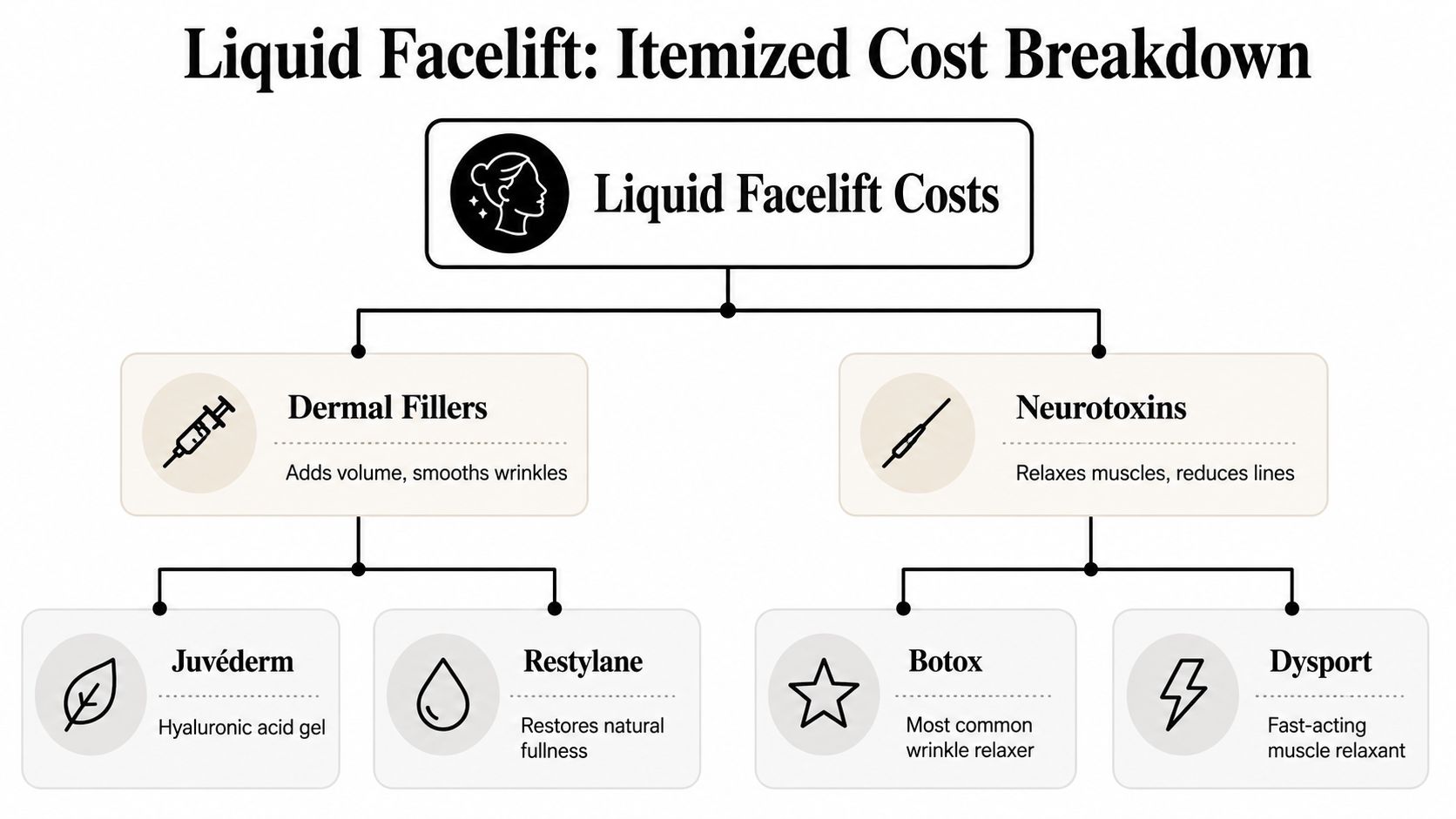
Fillers are often the primary cost driver because they create the shape change patients notice. Cheek support, temple refill, jawline definition, and softening around the mouth usually come from filler placement, not from toxin.
One pricing guide reports filler pricing often starts around $650 per syringe, and many liquid facelift plans use 2 to 4 syringes, according to Glowday's liquid non-surgical facelift guide. That range is useful as a baseline, not a shopping target. A patient with early volume loss may need modest support. A patient with flatter cheeks, temple hollowing, and lower-face descent may need a broader plan to get a balanced result.
What matters is where the product goes and why. One syringe placed strategically by an experienced injector can do more than extra product placed poorly.
| Cost component | How it's commonly priced | What affects the total |
|---|---|---|
| Dermal fillers | Per syringe | Area treated, degree of volume loss, product choice |
| Neuromodulators | Per unit or bundled with treatment | Muscle strength, number of areas treated |
| Overall liquid facelift quote | Bundled plan | Treatment design, injector expertise, safety setting |
Neuromodulators such as Botox are usually the smaller line item, but they still matter. They soften movement lines and can improve the pull of certain muscles in the brow, neck, or lower face.
Patients often misread value. A lower quote that relies mostly on toxin may look attractive at first, but it will not replace missing midface support or rebuild contour. If your goal is lift, shape, and facial balance, filler usually carries more of the result.
Practical rule: Ask which part of your quote is paying for structure, and which part is paying for muscle relaxation.
The day-one price is only part of the financial picture. Maintenance schedule matters just as much.
As noted earlier in the article, fillers often last longer than neuromodulators. That means a plan with more structural filler may cost more upfront but hold value over a longer interval. A plan weighted toward toxin may start lower and require more frequent upkeep.
Patients who focus only on entry price usually miss that distinction.
Use the itemized breakdown to decide whether the plan makes sense for your face and your goals.
That is how discerning patients should read a liquid facelift quote in Cape Cod or anywhere else. Price matters. Outcome, safety, and judgment matter more.
Two patients can both ask for a liquid facelift and leave with very different treatment plans. That's normal. Cost shifts because the procedure is a moving target shaped by anatomy, goals, and product mix.
One pricing review notes that liquid facelifts often combine dermal fillers and neuromodulators, and may use multiple filler families such as hyaluronic acid products, Sculptra, Radiesse, Restylane, and Juvederm. That product mix is a major reason one quote may be $2,000 while another is $8,000 or more, according to this liquid facelift pricing analysis.
This is the factor patients underestimate most.
An experienced, board-certified plastic surgeon doesn't charge for product alone. You're also paying for assessment, restraint, complication management, and aesthetic judgment. Those are not extras. They are the reason a treatment looks elegant instead of puffy, distorted, or obviously injected.
If a lower quote comes from someone with less advanced training, you need to ask what exactly is being discounted. Sometimes it's overhead. Sometimes it's skill. Those are not equivalent.
Different products behave differently. Some are better for soft contouring. Some are better for structure. Some are chosen for collagen stimulation. A plan using several product types will often cost more because it is solving several problems at once.
Here's how to approach it:
Cape Cod doesn't price exactly like Manhattan or Los Angeles, and it shouldn't. But geography alone isn't the full story. The more important question is whether your quote matches the complexity of your face.
A patient in Hyannis may receive a different quote than someone in a major metro area, but the decision still comes down to value. The right plan for a subtle, natural result may cost more than a discount treatment that uses the wrong products in the wrong places.
Cheap injectables can become expensive when you need them dissolved, corrected, or redone.
Patients often assume age predicts price. It doesn't. Anatomy matters more.
A younger patient with significant volume loss can need more product than an older patient with good structure and minimal deflation. Likewise, someone seeking a mild refresh won't need the same investment as someone trying to camouflage more advanced laxity with injectables.
You sit down for a consultation expecting injectables to be the cheaper, easier answer. Then you learn your real concern is loose skin along the jawline and neck. That is the moment cost and value separate.
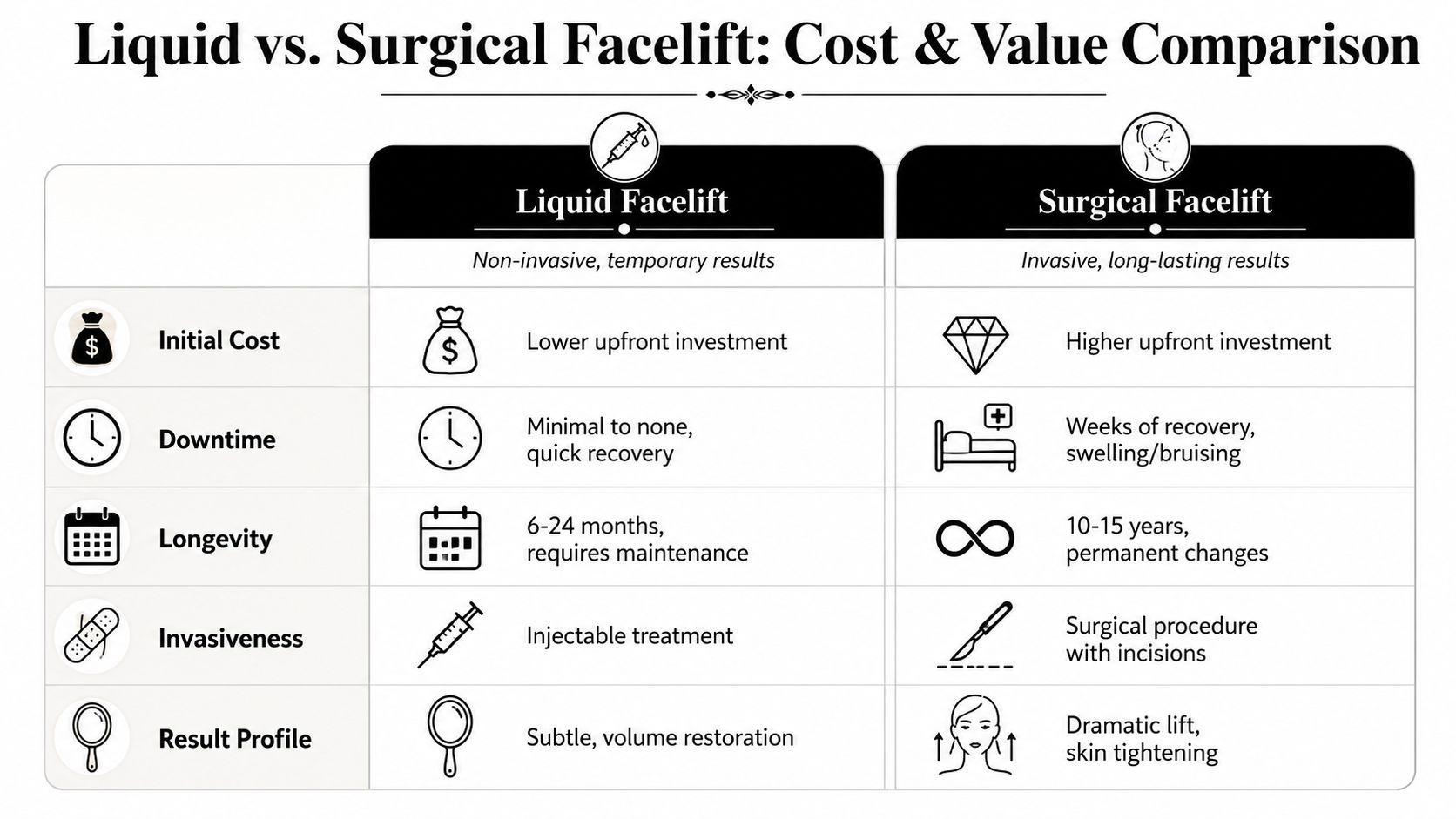
A liquid facelift usually starts with a lower upfront investment than surgery. That matters, but it is not the deciding factor. The right question is simpler. Which option solves the problem you have?
A liquid facelift creates value when the goal is selective correction. Volume loss in the cheeks, early hollowing, mild contour changes, and a tired look often respond well to fillers and wrinkle relaxers. You get improvement without an operating room, without surgical recovery, and with the ability to adjust treatment over time.
That flexibility has limits. Injectables do not lift descended tissue, remove excess skin, or tighten a neck. If those are your main concerns, repeated filler sessions can become the more expensive path because you keep paying for camouflage instead of correction.
Later in the decision process, it helps to hear a surgeon explain the difference visually:
Choose a liquid facelift if you want refinement, not major repositioning.
It is a strong fit for patients who still have decent skin tone and facial support but want to restore shape, soften lines, and look less drawn or tired. In that setting, the money goes toward visible improvement with little interruption to daily life. For many Cape Cod patients with early aging changes, that is a smart use of budget.
Provider skill matters here. A precise injector can use product strategically and avoid the puffed, overfilled look that wastes money and creates problems. At Cape Cod Plastic Surgery, treatment planning under Dr. Fater is tied to anatomy, restraint, and safety. That is where value lives.
Surgery is the better investment when laxity is driving the problem.
If the cheeks have dropped, jowls are prominent, or the neck has loose skin, a facelift addresses the structure itself. Yes, the upfront number is higher. The result is also more aligned with the anatomy. In an AAAASF-accredited facility, you are paying for surgical correction, anesthesia planning, sterility, monitoring, and a level of safety that discount pricing does not match.
That is why chasing a bargain can backfire. Cheap filler placed to compensate for sagging often leads to more product, more appointments, and a result that still looks off.
| Question | Liquid facelift | Surgical facelift |
|---|---|---|
| Best for | Early aging, volume loss, mild sagging | More advanced laxity and tissue descent |
| Upfront investment | Lower starting cost | Higher initial procedure cost |
| Recovery | Minimal to limited downtime | Longer recovery |
| Maintenance | Ongoing touch-ups | Longer-lasting structural correction |
| Aesthetic profile | Subtle refresh | More dramatic repositioning and tightening |
The least expensive plan is the one that matches your anatomy the first time.
My recommendation is direct. Use injectables when they can realistically get you to your goal. Choose surgery when they cannot. If you are weighing timing and payment options for either path, review the Cape Cod Plastic Surgery financing overview and, if needed, brush up on steps to better credit for families before your consultation.
A liquid facelift is a cosmetic procedure, so health insurance typically doesn't cover it. That's the first thing to understand. If your goal is facial rejuvenation rather than reconstruction or medically necessary treatment, you should expect to pay out of pocket.
That doesn't mean you need to make a rushed financial decision. It means you need a plan.
Many aesthetic practices offer third-party financing, and patients commonly look at options such as CareCredit when they want to spread payments out over time. If you're weighing timing, monthly budgets, and approval odds, it also helps to understand the basics of personal credit. A practical primer on steps to better credit for families can make that process easier to manage.
If financing helps you choose the right treatment safely, that's reasonable. If financing pushes you into more treatment than you need, step back.
A consultation should do one thing well. It should tell you whether a liquid facelift is the right procedure for your face, and if it is, whether the plan is worth the cost.
Most patients walk in prepared to ask, “How much?” Ask that, of course. Then ask better questions.

If someone is injecting your face, credentials matter. A lot.
Dr. Marc Fater brings more than 30 years of experience, is board-certified in plastic surgery, and operates in an AAAASF-accredited surgical suite. Those facts matter because judgment and safety are inseparable from aesthetic outcomes. Even for non-surgical treatment, you want a physician who understands facial anatomy thoroughly and knows when not to push injectables past their proper role.
Ask these directly:
Patients sometimes feel awkward asking those questions. Don't. A serious practice expects them.
A strong consultation shouldn't sound like shopping for products. It should sound like a facial assessment.
You want the surgeon to explain what's causing the tired or aged look. Is it cheek volume loss? Descent? Hollowing? Skin laxity? Overactive muscles? A quote has meaning only after that diagnosis is clear.
Ask:
That last question is where trust is built. If a provider promises surgery-like correction with syringes alone, be careful.
The best consultations produce a quote you can understand line by line. You should know which products are recommended, which areas are being treated, and whether your plan is conservative, staged, or extensive.
Good questions include:
Notice the language there. “On my face” matters. Product longevity and visual effect vary from one patient to another.
A trustworthy injector doesn't sell you a trendy name. They explain why a specific product fits your anatomy.
A higher quote is justified when it buys one or more of these:
That's the standard discerning patients should use.
If you're considering treatment on the Cape, the consultation should leave you with clarity. You should know whether you're a good candidate, what your result is likely to look like, what maintenance will involve, and whether injectables are the right investment for you.
If you want a personalized assessment of your liquid facelift options, schedule a consultation with Cape Cod Plastic Surgery. A careful evaluation can tell you whether injectables will give you the result you want, what your treatment plan should include, and whether the cost reflects real value rather than just a number on a quote.
October 7, 2026
A Practical Guide to Healing After Breast Surgery

October 6, 2026
Your Safety Guide: What to Look for When Choosing a Plastic Surgeon

October 5, 2026
Why Our On-Site Accredited Facility Matters for Your Safety

Cape Cod Plastic Surgery offers expert cosmetic and reconstructive procedures in a safe, accredited setting. Led by Dr. Marc Fater, we combine advanced techniques with personalized care to help you look and feel your best.
Monday: 9:00 AM – 5:00 PM
Tuesday: 9:00 AM – 5:00 PM
Wednesday: 9:00 AM – 5:00 PM
Thursday: 9:00 AM – 5:00 PM
Friday: 9:00 AM – 5:00 PM