

October 7, 2026
What to Expect During Your Breast Surgery Recovery
A Practical Guide to Healing After Breast Surgery
Apr 15, 2026
You may be dealing with this right now. You pull on a pair of boots and they stop halfway up. You wear wide-leg pants because fitted silhouettes make your lower legs feel more noticeable. You train consistently, your body changes elsewhere, and your calves look exactly the same.
That frustration is common, and it doesn’t mean you’re doing anything wrong.
As a plastic surgeon, I see a pattern. Many people searching for how to shrink calves assume the answer is more cardio, more stretching, or more discipline. Sometimes that helps. Often it doesn’t. Calf size can come from very different causes, and the right solution depends on which one you have.
For some people, the issue is a layer of fat. For others, it’s a strong gastrocnemius muscle that stays prominent even at a low body weight. For many, genetics play a larger role than fitness culture admits.
The good news is that there isn’t just one path. There’s a spectrum. It starts with understanding your anatomy, then moves through realistic lifestyle changes, office-based treatments, and, in selected cases, surgery. The most important step is matching the treatment to the reason your calves look the way they do.
A typical patient doesn’t come in saying, “I want calf reduction” on the first line. They usually say something more personal.
They’ll tell me they avoid ankle boots because the shaft feels tight. Or that dresses and shorts never look balanced to them. Or that they’ve lost weight, built strength, and still feel their calves dominate their silhouette.
That matters, because body concerns are rarely just about a measurement. They affect how you get dressed, how you pose in photos, and how comfortable you feel in your own skin.
The calf is one of the most stubborn areas of the body. It works all day, every day, every time you walk, climb stairs, or stand on your toes. Because it’s already highly conditioned, it may not respond the way people expect.
Someone can stop doing calf raises and still have muscular calves. Someone can slim down overall and still keep fullness in the lower leg. That doesn’t mean change is impossible. It means the calf doesn’t follow the same rules as the waistline or upper arms.
Bulky calves aren’t always a fitness problem. Many times, they’re an anatomy problem.
I encourage patients to stop asking one broad question, “How do I make my calves smaller?”, and ask three narrower ones:
Those answers shape everything that follows.
Some people do best with exercise changes and patience. Some are much better candidates for Botox to reduce muscular prominence. Others need surgery because non-surgical approaches won’t create a meaningful difference.
Most disappointments come from a mismatch between anatomy and treatment.
If your calves are muscle-dominant, fat-loss advice won’t do much. If your calves are fat-dominant, muscle-weakening treatments won’t solve the problem. If the lower leg looks broad because of bone structure or ankle shape, even excellent treatment has limits.
That’s why good calf contouring starts with diagnosis, not a trendy fix.
A good calf reduction plan starts with one question: what is creating the size?
Patients often use the same phrase, "big calves," for very different anatomy. In practice, I may be seeing prominent muscle, a layer of subcutaneous fat, fluid retention, inherited lower-leg shape, or a combination of all four. Treatment only works well when that distinction is clear.
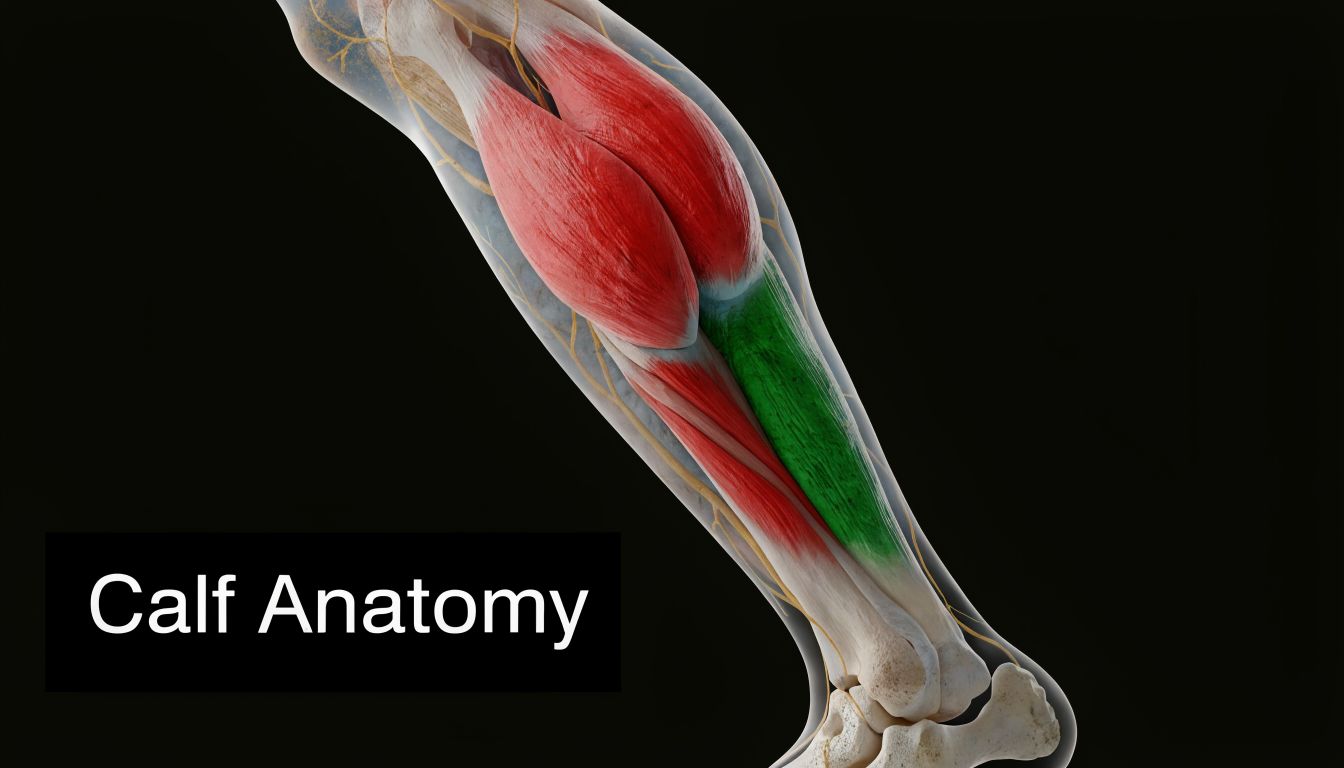
The visible calf contour comes mainly from two muscles: the gastrocnemius and the soleus. The gastrocnemius creates most of the rounded upper-calf shape. The soleus sits deeper and can add thickness lower in the leg.
Muscle-dominant calves usually feel firm, stay prominent even at a lower body weight, and become more pronounced when you point your toes or rise onto the balls of your feet. I see this pattern in runners, dancers, people who climb stairs frequently, and patients who inherited stronger calf development.
That last point matters. Some people are working against anatomy, not effort.
Other calves look larger because of subcutaneous fat, the soft layer beneath the skin. These calves usually feel less dense, look less sharply defined, and may change with overall weight gain or weight loss.
This is one reason exercise advice online often misses the mark. A patient with a fat-dominant calf needs a different plan than a patient whose bulk comes from muscle. Botox will not remove fat. Liposuction will not shrink a strong gastrocnemius. Mixed cases often need a staged approach.
| Pattern | What it often feels like | What usually helps most |
|---|---|---|
| Mostly muscle | Firm, rounded, prominent when flexing | Botox or selected muscle-focused procedures |
| Mostly fat | Softer, pinchable fullness | Weight loss if appropriate, sometimes liposuction |
| Mixed | Some softness plus strong contour | Combination planning |
Genetics affect calf shape more than many fitness articles admit. Muscle insertion points, natural muscle bulk, tendon length, and overall leg proportions are largely inherited. Two people can follow the same training plan and end up with very different lower legs.
This is the gap between gym advice and medical reality. Exercise can improve tone, conditioning, and body composition, but it cannot change where your muscles attach or how your lower leg is built. For some patients, that is why months of stretching, walking, and avoiding calf raises produce little visible change.
Calf shape is often discussed as a cosmetic issue, but lower-leg anatomy can influence comfort and movement too. Tight or overactive calves may alter ankle mobility and put extra stress higher up the chain.
A helpful plain-language overview of the connection between calves and knee pain can clarify why lower-leg tension sometimes shows up at the knee.
Before choosing any treatment, look at your calves in a relaxed standing position and again while flexing.
In consultation, I sort through these patterns first. That step prevents a common mistake: using a treatment that works well for one type of calf on a completely different one.
If you want to start conservatively, that’s reasonable. Non-surgical changes are the right first step for many people, especially when calf fullness is related to fat, fluid retention, or training habits that keep the muscles overdeveloped.
The key is choosing methods that support a leaner contour without accidentally making the calves work harder.
If the calf has a fat component, overall fat loss can help. Spot reduction doesn’t work in any reliable way, so endless calf-specific moves usually create fatigue, not shrinkage.
A structured nutrition plan matters more. If you need a simple primer on understanding what a calorie deficit is, that’s a good starting point before you redesign your routine.
That said, not every large calf becomes small with weight loss. This approach helps most when the problem is softness, not prominent muscle bellies.
For patients asking how to shrink calves without procedures, I usually steer them toward activity that supports fat loss and mobility without constantly loading the gastrocnemius.
What you’re trying to avoid is repeated explosive push-off.
People often make the problem worse by choosing routines that repeatedly train the exact area they want smaller.
Consider reducing or modifying:
Those are excellent training tools for performance. They’re usually poor tools for aesthetic calf reduction.
If your workouts burn your calves every session, don’t expect your calves to become less noticeable.
Stretching won’t melt away muscle or remove fat. It can, however, improve the way the calf sits and feels.
Tight calves can look more bunched and prominent. Daily stretching may soften that impression by improving length and reducing chronic tension.
A simple routine often includes:
Hold stretches gently and consistently. Aggressive stretching doesn’t produce faster aesthetic change, and it may irritate the tendon or fascia.
A guided demonstration can help if you’re unsure how these positions should look in practice.
Some people aren’t dealing with true excess size alone. They’re dealing with temporary fullness layered on top of their natural anatomy.
These habits can help:
Here’s the honest version.
Lifestyle changes can improve calf shape if the issue is body fat, swelling, posture, training style, or baseline tightness. They can also prevent further hypertrophy if your workouts have been calf-dominant.
But they usually have limited power against genetically strong, muscular calves.
That’s why many people feel stuck. They follow excellent fitness advice, but they’re using the wrong category of solution.
Try conservative management first if your calf feels soft, changes with weight, or worsens with specific training. Reassess after a sustained period of consistent habits.
Move beyond lifestyle alone if:
A common scenario in my office is the patient who is lean, exercises consistently, and still feels that the lower leg looks too strong or too wide in proportion to the rest of the body. In that setting, exercise advice often stops helping because the issue is not extra fat or poor conditioning. It is calf muscle bulk.
Botox can help in that middle ground between gym-based strategies and surgery.
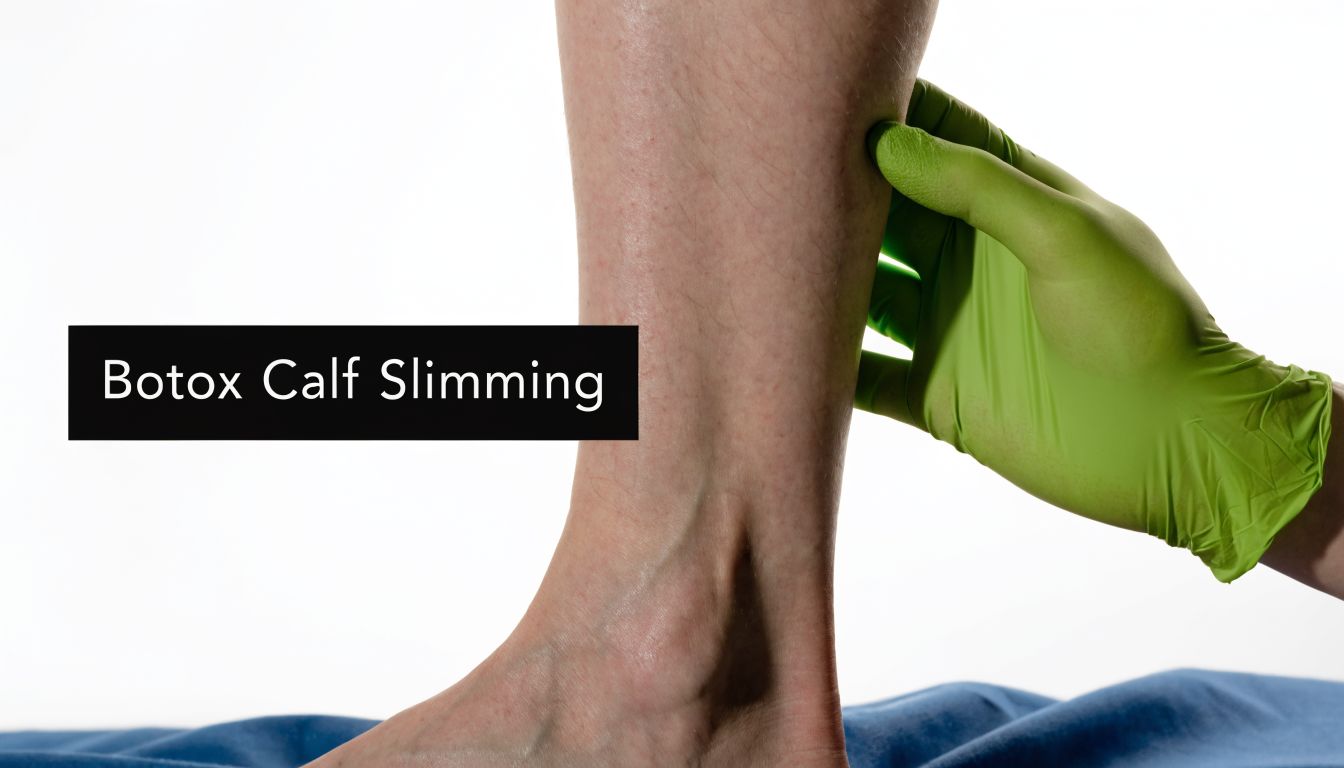
Botox reduces the strength of targeted muscle contraction. When it is placed into the gastrocnemius with the right pattern and dose, the muscle works less forcefully. Over time, that lower workload can reduce some of the visible fullness.
The goal is contour refinement. The goal is not to make the leg look hollow or interfere with normal walking.
This option tends to work best for patients with muscle-dominant calves. Typical signs include a firm calf, visible bulging when standing on tiptoe or flexing, and very little pinchable fat over the area. If the lower leg looks large because of fat, fluid retention, or broader bone structure, Botox will not address the main cause.
Treatment is done in the office. I examine the calf both at rest and with contraction, map the fuller portions of the muscle, and place injections across selected points. Good technique matters because calf contouring is not the same as treating a forehead or crow's feet. The dose, placement, and symmetry all affect the result.
Downtime is light for most patients. Mild soreness or bruising can happen. The visible change is gradual, which is important to understand before treatment. Patients do not leave the office with an instantly smaller calf.
Results develop over weeks, not days. The slimming effect is temporary, and maintenance treatments are usually needed if you want to keep the reduction. For patients comparing areas of the body or trying to understand timing more generally, this article on how long Botox lasts gives useful context.
The trade-off is straightforward. Botox can soften a muscular calf without surgery, but it does not create a permanent change. If treatment stops, muscle activity can return and some bulk may come back. That makes Botox a reasonable choice for patients who want a lower-commitment option, a preview of muscle reduction, or a modest contour change before considering surgery.
Botox is more appealing when the calf is driven by muscle and the patient accepts a subtle, progressive result.
It is less appealing in these situations:
| Situation | Why it may not be ideal |
|---|---|
| The calf is mostly fatty | Muscle weakening will not remove the volume causing the shape |
| You want a one-time permanent result | Repeat treatment is usually needed |
| You rely on maximal calf strength for sport or work | Temporary weakness may be a poor trade-off |
| Your calf width is caused by several factors | Botox treats muscle only, not the full anatomy |
I see Botox as a selective tool, not a blanket answer. For the right patient, it can improve calf contour with little downtime and no incisions. For the wrong patient, it leads to disappointment because the anatomy was never going to respond enough.
That distinction matters. People often hear "calf reduction" and assume every option works on every type of fullness. It does not. The best plan starts by identifying whether the calf is driven mainly by muscle, fat, swelling, or inherited structure, then choosing the least invasive treatment that can realistically meet the goal.
When non-surgical measures won’t produce enough change, surgery becomes the most direct way to reshape the calf. The important distinction is simple. Fat requires fat removal. Muscle requires muscle-focused surgery.
Those are different procedures for different anatomies.
Calf liposuction is best for patients with a meaningful layer of localized fat in the lower leg. The goal is to smooth and refine contour, not to create an unnaturally hollow look.
This can be an excellent option when the calf feels soft, the fullness is pinchable, and the problem is volume in the fatty layer rather than a sharply bulging gastrocnemius.
Surgeons may use tumescent technique, power-assisted methods, or ultrasound-assisted tools such as VASER depending on the tissue characteristics and treatment plan. The exact technique matters less to the patient than the judgment behind it. Lower legs require restraint, symmetry, and respect for skin quality.
For readers comparing body contouring procedures more broadly, the practice’s liposuction page gives helpful background on the procedure category.
This category is reserved for the muscle-dominant calf.
If the gastrocnemius is the main source of width and projection, and the patient wants a permanent reduction beyond what Botox can offer, a surgeon may consider procedures that reduce muscle bulk more definitively. Depending on the case, this may involve selective muscle resection or nerve-based approaches intended to reduce hypertrophy.
These operations demand caution. The calf isn’t just cosmetic tissue. It’s part of walking, balance, push-off strength, and lower-leg symmetry. That means patient selection is strict, expectations must be realistic, and surgical planning must prioritize function.
This is not an area for aggressive shortcuts.
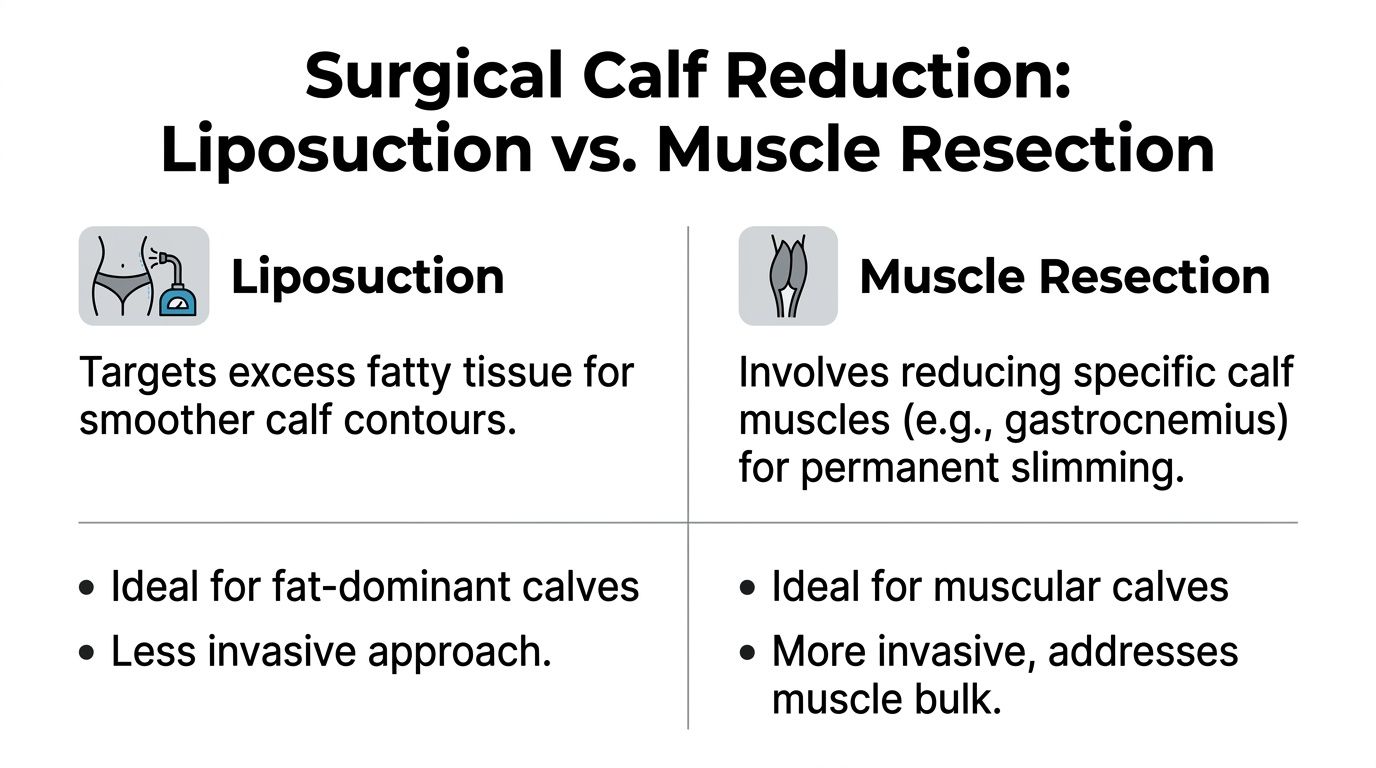
| Method | Best for | Main advantage | Main limitation |
|---|---|---|---|
| Lifestyle change | Mild fat, swelling, training-related bulk | Non-invasive | Limited effect on inherited muscle shape |
| Botox | Muscle-dominant calves | Office-based, no surgery | Temporary, needs maintenance |
| Liposuction | Fat-dominant calves | Direct fat removal | Won’t shrink a large muscle |
| Muscle resection | Severe muscle hypertrophy | Most definitive muscle reduction | Most invasive option |
Recovery depends on the procedure.
With liposuction, patients usually deal with swelling, compression garments, temporary bruising, and a gradual reveal of contour over time. The legs can look uneven or more swollen before they look better, which is normal early in healing.
With muscle-focused surgery, recovery tends to be more involved. Walking restrictions, a slower return to exercise, and closer monitoring are often necessary because the procedure affects functional tissue more directly.
The more permanent the change, the more carefully the procedure must be selected.
That’s especially true in calf contouring because overcorrection can look unnatural and may affect movement. A beautiful result in this area is usually conservative, balanced, and proportionate to the rest of the leg.
The best calf surgery doesn’t make the lower leg look “done.” It makes the leg look more harmonious.
Surgery usually enters the conversation when one or more of these are true:
Sometimes the right decision is no surgery.
If the concern is mild, if swelling hasn’t been evaluated, if the ankle structure is the underlying issue, or if expectations are unrealistic, surgery can disappoint even when technically successful. Good surgical judgment includes telling a patient when the available procedure won’t create the outcome they imagine.
That honesty protects both function and satisfaction.
The first step is usually the hardest emotionally. Most patients spend a long time thinking about calf contouring before they ever schedule a consultation.
Once they do, the process becomes much more concrete.
At the first visit, the focus is on anatomy, goals, and whether the complaint is really coming from fat, muscle, or a mix of both. That sounds simple, but it’s the decision point that determines whether a treatment makes sense at all.
Some patients arrive convinced they need surgery and are better served by a non-surgical approach. Others have spent years trying exercise plans that could never have changed their inherited muscle shape in a meaningful way.
The consultation should slow the process down enough to make the right call.
After the exam, the treatment plan gets more specific.
That may mean saying yes to a procedure. It may also mean saying not yet, or not this one. The right plan should match your anatomy, your tolerance for downtime, and how much change you want.
A well-run practice also makes it easy to know who you’ll be working with throughout the process. Patients often find reassurance in meeting the clinical team ahead of time, and the Cape Cod Plastic Surgery team page offers that introduction.
Preparation varies by procedure, but the principles are consistent. You need clear instructions, a realistic recovery plan, and an understanding of what the first days will feel like.
That includes practical details such as transportation, compression if needed, activity restrictions, and the difference between expected post-procedure soreness and a problem that deserves a call.
A strong surgical experience is never just about the operating room. It’s also about how well the patient is prepared before they arrive.
On the day of treatment, patients do best when there are no surprises. They know what’s being done, why it’s being done, and what the immediate recovery will involve.
For office treatments like Botox, that’s usually simple. For surgery, the experience should feel organized, calm, and safety-focused from start to finish.
The early recovery period can be emotionally noisy. Swelling, asymmetry, stiffness, and second-guessing are common. That doesn’t mean something went wrong. It means healing is a process, especially in the lower leg where tissues can hold swelling longer than patients expect.
The final result doesn’t come from the procedure alone. It comes from the procedure plus follow-up.
That means monitoring healing, adjusting activity, answering questions early, and watching for contour concerns while there’s still time to manage them appropriately. Good outcomes often depend on small course corrections and clear communication.
Patients usually feel much less intimidated once they understand that calf contouring isn’t one dramatic leap. It’s a sequence of thoughtful decisions made with guidance at each step.
Yes, in selected patients. That usually makes sense when the calf has both a fatty layer and a prominent muscle component. The details matter, because each treatment addresses a different tissue and has a different recovery pattern.
Any treatment that changes the calf should respect function first.
Lifestyle changes and liposuction generally don’t target muscle strength directly. Botox can temporarily reduce muscle power, which matters if you rely heavily on explosive lower-leg strength. Muscle-focused surgery requires the most careful planning because the calf contributes to gait, push-off, and balance.
The simplest clue is what the tissue feels like and how it behaves.
If the calf is mostly muscular and you want a non-surgical option, Botox may be worth considering. If the calf is mainly fat, liposuction is usually the more logical procedure. If the problem is severe muscular hypertrophy and you want a permanent answer, surgery may be the better discussion.
A physical exam is still the best way to sort that out.
Yes. That doesn’t mean exercise is bad. It means training has to match your aesthetic goal.
Repeated stair work, heavy resistance, sprinting, and calf-isolation exercises can maintain or increase muscular prominence in people who are predisposed to build in that area.
No, and that’s important.
In calf contouring, subtle improvement often looks better than aggressive reduction. The lower leg needs to stay proportional to the thigh, knee, and ankle. A refined contour usually looks more natural than an attempt to erase all muscle definition.
That’s one of the most common reasons people seek treatment. Genetic anatomy can limit what fitness alone can achieve. It doesn’t mean you’re out of options. It means you need an anatomy-matched plan rather than generic advice.
No. There’s only a best method for your calf anatomy.
That answer depends on whether the issue is fat, muscle, mixed tissue, or overall leg structure. The safest and most satisfying outcomes come from choosing the least invasive treatment that can realistically produce the result you want.
If you’re ready for a personalized evaluation, Cape Cod Plastic Surgery offers expert guidance on calf contouring, body contouring, and non-surgical aesthetic options. A consultation can help you determine whether your calves are best treated with lifestyle changes, Botox, liposuction, or a more advanced surgical approach, so you can move forward with realistic expectations and a plan built around your anatomy.
October 7, 2026
A Practical Guide to Healing After Breast Surgery

October 6, 2026
Your Safety Guide: What to Look for When Choosing a Plastic Surgeon

October 5, 2026
Why Our On-Site Accredited Facility Matters for Your Safety

Cape Cod Plastic Surgery offers expert cosmetic and reconstructive procedures in a safe, accredited setting. Led by Dr. Marc Fater, we combine advanced techniques with personalized care to help you look and feel your best.
Monday: 9:00 AM – 5:00 PM
Tuesday: 9:00 AM – 5:00 PM
Wednesday: 9:00 AM – 5:00 PM
Thursday: 9:00 AM – 5:00 PM
Friday: 9:00 AM – 5:00 PM