

October 7, 2026
What to Expect During Your Breast Surgery Recovery
A Practical Guide to Healing After Breast Surgery
May 30, 2026
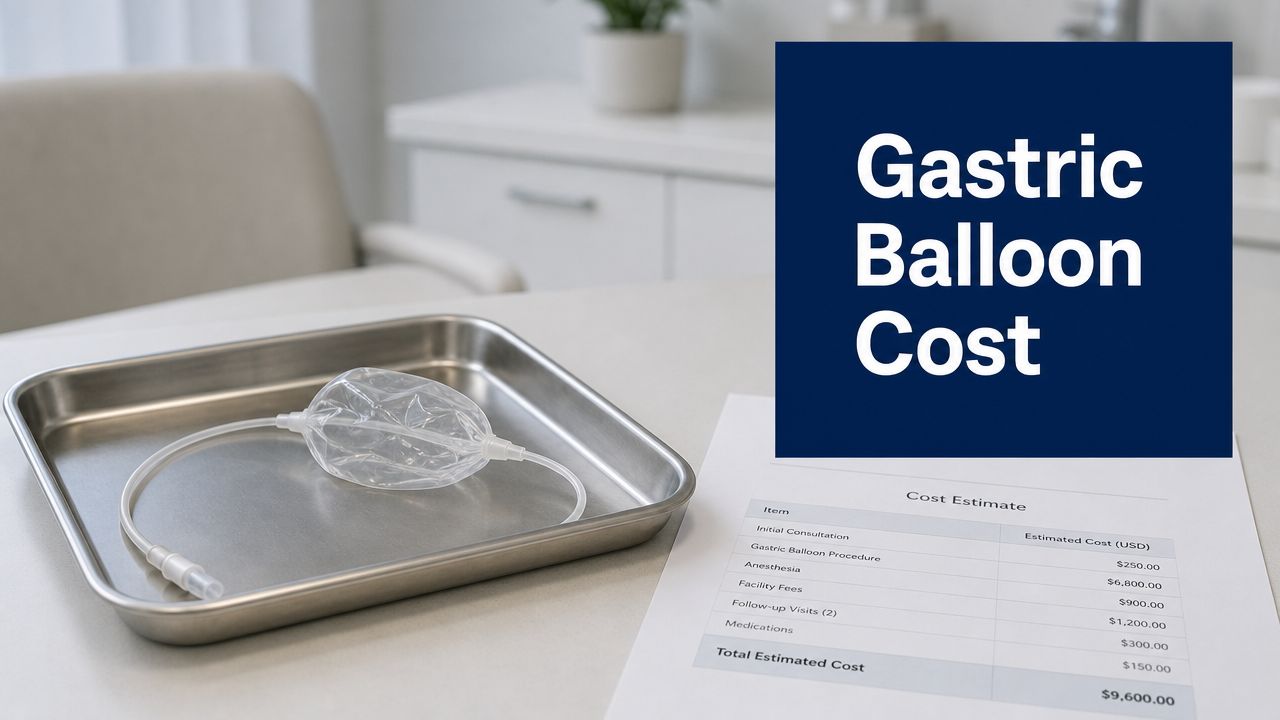
A gastric balloon program in the United States typically costs $6,000 to $9,000, and one recent estimate placed the average at $8,000. In most practices, that figure reflects a program, not just the balloon itself, which is why the smartest question isn't only “What does it cost?” but “What does that fee include?”
If you're researching weight loss options online, you've probably already seen how confusing pricing can be. One page gives a single number. Another mentions a lower promotional offer. A third talks about removal, follow-up, or anesthesia as if those are separate issues when, in real life, they're part of the same decision.
That confusion matters. A gastric balloon isn't a handbag or a gym membership. It's a medical treatment that affects your stomach, appetite, comfort, and daily routine for months. The price should be judged the same way you would judge any other medical care: by safety, physician oversight, facility quality, and the strength of the support system wrapped around the procedure.
Many patients start in the same place. They want a straight answer on gastric balloon cost, but what they need is a way to compare value.

The lowest advertised number can look attractive, especially when you're already spending money on nutrition programs, fitness plans, and previous attempts that didn't stick. But a bargain price can hide important omissions. If the quote doesn't clearly address physician evaluation, placement, removal, and structured follow-up, you're not comparing equal offers.
A premium gastric balloon program should be evaluated as a total care package. That means looking at more than the device.
Patients often focus on the insertion day, but that isn't the whole treatment. The weeks after placement are when coaching, symptom management, dietary adjustments, and accountability make the difference between a rough experience and a manageable one.
A low sticker price can become the expensive choice if it leaves you paying separately for the parts of care that actually help you succeed.
If you're also thinking ahead to how your body may change after meaningful weight loss, it's worth understanding what options exist for body contouring after weight loss. Some patients also benefit from a broader wellness strategy that includes resistance training and nutrition aimed at simultaneous fat loss and muscle gain, because preserving strength changes how weight loss looks and feels.
A patient may call asking for the lowest gastric balloon price in town. The better question is what that price includes. In practice, the balloon is one part of a supervised treatment plan, and the quality of that plan has a direct effect on comfort, safety, and follow-through.
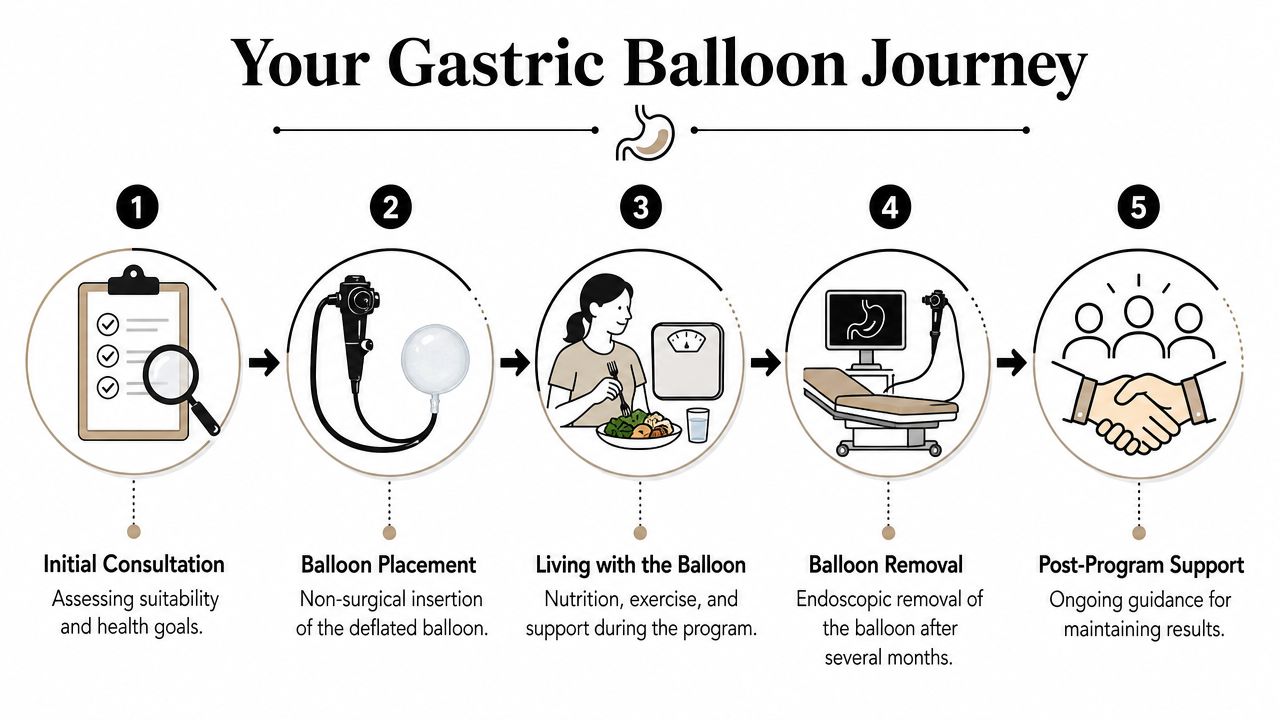
The process starts with screening, not scheduling. A proper consultation reviews weight history, eating patterns, reflux, prior abdominal procedures, medications, and whether the patient is likely to tolerate the adjustment period well. That first visit also clarifies goals. A balloon can be a useful tool for the right patient, but it is not the right tool for everyone.
Placement comes next. Some systems require endoscopy. Others are swallowed in capsule form. Those differences affect anesthesia needs, recovery, and price. They also affect the kind of monitoring a practice should provide. Patients comparing quotes often benefit from reading broader plastic surgery and procedure cost statistics by treatment type, because medical pricing usually reflects more than the device or the day of treatment.
Once the balloon is in place, the main work begins. Early nausea, cramping, reflux, and food intolerance are common enough that patients should expect a plan for symptom management before placement day arrives. In a high-end program, that support is built in.
The balloon stays in for a limited period, and the program usually includes placement, follow-up visits, removal, and post-removal guidance. During that time, patients need more than general advice to eat less. They need specific direction on hydration, meal size, food texture, pacing, protein intake, and how to respond when appetite changes from week to week.
A well-run program often includes:
The balloon is temporary by design. The habits built during the program are what make the investment worthwhile.
The gap between a bargain quote and a premium quote often reflects the total cost of care. One office may be charging for device placement alone. Another may include physician evaluation, symptom management, nutrition visits, removal, and structured follow-up.
That difference matters. A lower upfront fee can become the more expensive choice if complications, extra visits, or removal costs are billed later, or if the program leaves you without the support that helps you succeed. In a premium practice, the goal is not to sell a balloon. The goal is to deliver a safer, better-managed treatment experience with a responsible finish.
A patient may call three offices in the same week and hear three very different numbers for a gastric balloon. The price gap is real, but the more important question is what each quote includes from start to finish.
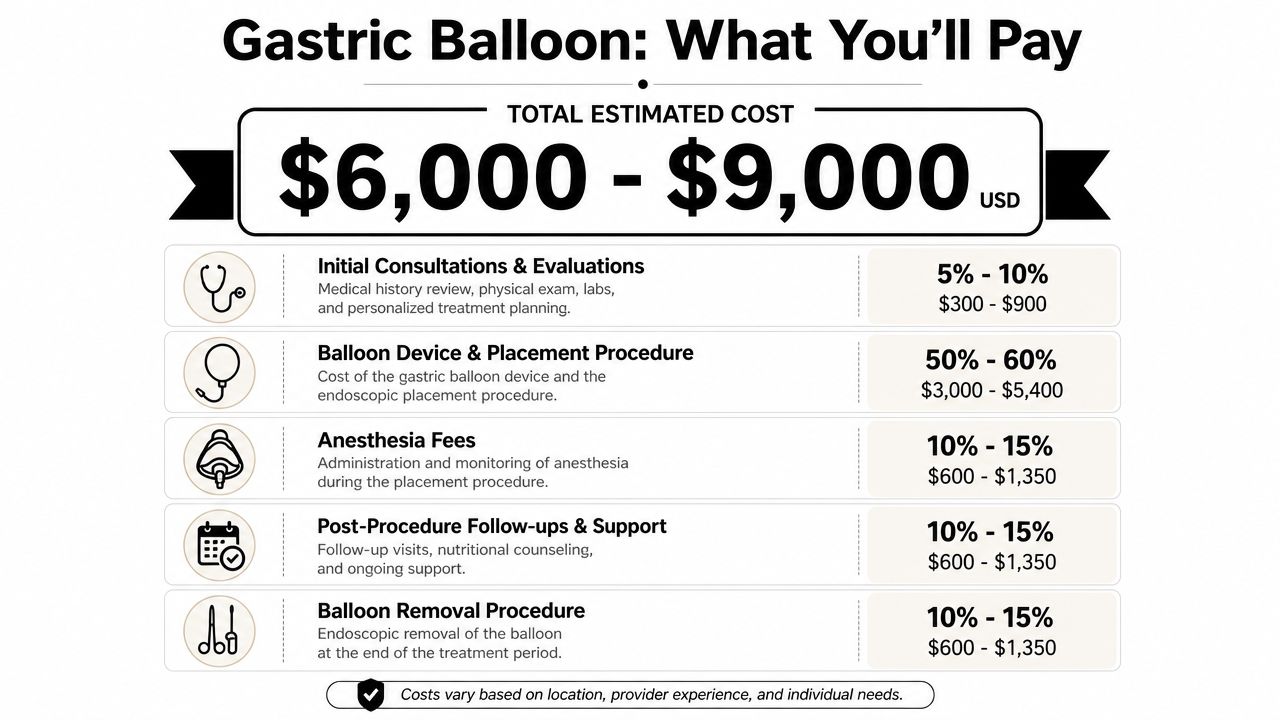
In the United States, gastric balloon pricing commonly falls in the mid-thousands. One national pricing overview from Spatz Medical places many programs in the $6,000 to $9,000 range and notes that balloon treatment is generally priced well below bariatric surgery in the same comparison (national gastric balloon and bariatric pricing overview).
That headline range is useful. It is not enough.
At a premium practice, the fee usually reflects the full episode of care, not just the moment the device is placed. Patients are paying for physician judgment, appropriate monitoring, access to help if symptoms become difficult, and a planned removal process that does not feel like an afterthought.
A clear quote should spell out each major part of treatment so you can compare programs fairly.
That bundled price often includes:
The video below gives a useful visual overview of the procedure itself.
Patients sometimes focus on the device because it is the most visible part of the treatment. In practice, the cost comes from everything surrounding it. Placement method, facility standards, sedation, physician time, follow-up, and removal all affect the final number.
I tell patients to be careful with quotes that sound dramatically lower than the local norm. A bargain price may exclude removal, shift facility charges to a separate bill, or offer very limited follow-up after placement. Those omissions matter, especially in the first days and weeks when nausea, reflux, cramping, or hydration problems may need prompt attention.
Practical rule: Ask for the total amount you will pay from evaluation through removal, assuming the normal course of treatment.
A good quote is specific. It tells you who is performing the procedure, where it is being done, what support is available after placement, and whether removal is already included.
Patients comparing elective procedures often run into the same issue across specialties. This overview of average procedure pricing and how bundled medical costs are structured shows why expertise, facility quality, and follow-up care often justify a higher fee.
The right question is not, “What is the cheapest balloon?” It is, “What am I getting for this price, and how safely is it being delivered?” In a high-end setting, that difference is where value lives.
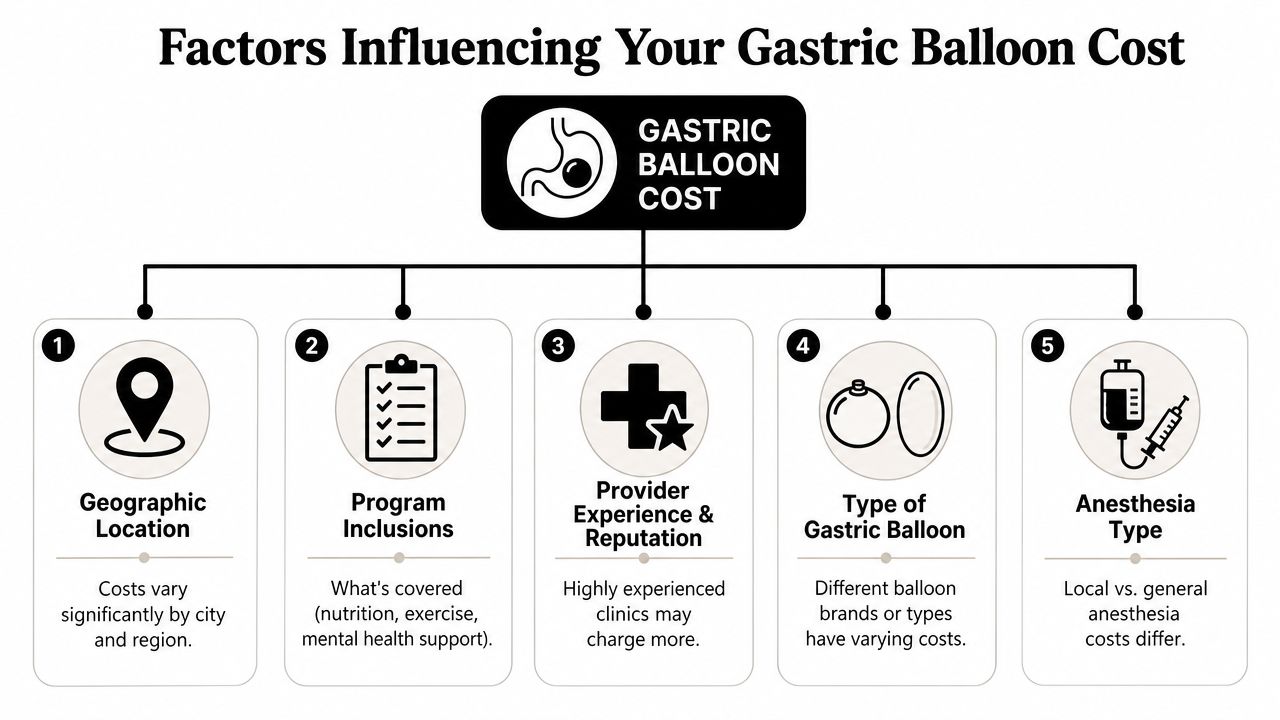
Two gastric balloon quotes can both be legitimate and still be far apart. The reason is that the treatment isn't identical from one practice to the next.
Technical design has a direct effect on gastric balloon cost. Swallowable, office-based systems such as Allurion have been offered at around $4,000 in a monitored program, while conventional endoscopically placed balloons are more commonly quoted at $6,000 to $9,000 because they involve endoscopy, sedation, and facility time, as described in this review of Allurion and conventional balloon pricing.
That difference isn't mysterious. If a system avoids endoscopy and anesthesia, direct procedural costs usually fall. But the lower price doesn't automatically mean it's the better fit for every patient. Device profile, monitoring structure, and candidate selection still matter.
Some price drivers are obvious. Others are easy to miss until you've already committed.
| Cost factor | Why it matters |
|---|---|
| Provider expertise | Experienced physicians may charge more for evaluation, placement judgment, and complication management |
| Facility quality | Accredited procedural settings generally add cost, but they also add layers of safety and oversight |
| Program inclusions | Nutrition visits, symptom support, and removal planning may be built in or billed separately |
| Anesthesia approach | Sedation needs can change the total fee |
| Geography | Regional market differences affect staffing, facility, and overhead costs |
A high-end facility doesn't just charge for decor. It charges for systems. Experienced staff, careful screening, procedural readiness, and responsive follow-up all cost money to provide well.
If a practice can't tell you exactly who manages your symptoms, how removal is arranged, and what support you receive between those two dates, the low price should not reassure you.
In my view, the safest way to compare programs is to separate cheap from complete. Cheap means the headline number is low. Complete means the treatment has been thoughtfully built around the patient experience from start to finish. When you're dealing with a device placed in the stomach, complete is the better investment.
A gastric balloon sits in a middle lane. It isn't as casual as trying to lose weight on your own, and it isn't as invasive or permanent as bariatric surgery.
That middle position is exactly why cost comparisons need context. A headline fee can make a balloon look inexpensive or expensive depending on what you compare it to.
| Procedure | Average Cost (Self-Pay) | Type | Permanence | Recovery Time |
|---|---|---|---|---|
| Gastric balloon | $6,000 to $9,000 | Non-surgical or endoscopic weight loss intervention | Temporary | Shorter than surgery in typical practice |
| Swallowable balloon program | Around $4,000 in some monitored offers | Office-based balloon program | Temporary | Often simpler procedural experience |
| Gastric bypass | $15,000 to $35,000 or about $24,300 in one average comparison | Bariatric surgery | Permanent anatomical change | Longer surgical recovery |
The important comparison isn't just price. It's price relative to commitment.
A balloon may appeal to patients who want medical structure and a meaningful intervention without moving directly to permanent surgery. Surgery may be the better path for some patients, but it comes with a different level of procedural intensity, recovery, and long-term anatomical change.
One of the most useful patient questions is whether a gastric balloon is still cheaper once follow-up and removal are included. A pricing review aimed at patients noted that headline U.S. prices often land around $6,000 to $9,000, while some limited-time packages can be as low as $4,000. It also highlighted the need for a true total-cost comparison, especially in higher-cost regions such as the Northeast (discussion of total gastric balloon ownership cost and bundled pricing questions).
That's the right framework. A surgery quote usually reflects a larger and more permanent intervention. A balloon quote should reflect a complete temporary program. Comparing them only by upfront price misses what you're buying.
The balloon often makes sense for patients who want:
Medication-based options enter this same financial conversation, especially for patients considering long-term treatment rather than a device-based program. If you're weighing that route too, Weight Method's GLP-1 cost analysis is a useful complementary read because it frames cost as an ongoing care decision rather than a one-time purchase.
The best option depends on what you're optimizing for. Lower upfront cost. Less invasiveness. Reversibility. Stronger structure. Faster recovery. Different patients answer those priorities differently.
A common scenario is this: a patient is comfortable with the medical decision, then pauses when the financial discussion starts. That pause is reasonable. The right question is not only, "What does the balloon cost?" It is, "What am I paying for, and how predictable is the full cost of care?"
Insurance coverage for gastric balloon treatment is often limited, so many patients should plan for a self-pay process. At a premium practice, that usually means a bundled fee with clear inclusions. That structure matters because it reduces the risk of surprise charges for parts of treatment that should have been discussed upfront, such as placement, removal, follow-up visits, or medication support.
Self-pay is common, but self-pay should still be organized medical care, not a piecemeal purchase.
A low quote can look attractive until you learn what it leaves out. In my view, the better financial question is whether the quoted fee covers the full treatment episode in a safe setting, with appropriate physician oversight and follow-up. That is the difference between shopping for a number and evaluating value.
Ask for a written breakdown that clarifies:
These details affect your real cost far more than a headline price.
Patients usually pay for treatment in one or more of these ways:
Financing can make a well-structured program easier to fit into a household budget. It does not improve a weak program. If the quote is vague, if follow-up is thin, or if safety standards are unclear, monthly payments do not fix that problem.
If you are comparing private medical expenses more broadly, even outside gastric balloon treatment, the XO guide to UK private prescription fees is a helpful example of how private healthcare pricing becomes easier to manage when you separate fixed costs from variable ones.
Before you commit, ask three direct questions. What is the total amount due? What is the payment schedule? What costs could still be added later? Patients who want help evaluating monthly affordability can review this guide on how to finance cosmetic surgery, which outlines practical ways to compare lender terms and payment options.
National averages are useful for orientation. They aren't a substitute for an individual quote.
The right gastric balloon program depends on your medical history, your goals, the type of device being considered, and the level of support you want around the process. Some patients need a straightforward, temporary intervention with clear guardrails. Others benefit from a more thorough approach that places extra emphasis on monitoring, comfort, privacy, and structured follow-up.
That is where a premium practice can offer better value than a rock-bottom price. You're not paying more to be in a nicer room. You're paying for physician judgment, careful candidacy review, a safe accredited setting, and a team that treats the entire experience as medical care rather than a transaction.
At Cape Cod Plastic Surgery, patients meet with Dr. Marc Fater, a board-certified plastic surgeon with over 30 years of experience, in a setting designed around personalized care, privacy, and safety. The practice's on-site AAAASF-accredited surgical suite adds another layer of reassurance for patients who want expert oversight and a high standard of procedural care.
For the patient considering gastric balloon treatment, that matters. The financial decision should be tied to confidence in the team, the clarity of the quote, and the quality of the support before, during, and after treatment.
A consultation gives you the one number that matters most: your own. It also helps answer the more important question, which is whether a gastric balloon is the right fit for your body, your timeline, and your goals.
If you're ready for a clear, personalized discussion of gastric balloon cost and whether this approach fits your needs, schedule a confidential consultation with Cape Cod Plastic Surgery. You'll get an honest evaluation, a precise quote, and guidance from an experienced team focused on safety, value, and long-term success.
October 7, 2026
A Practical Guide to Healing After Breast Surgery

October 6, 2026
Your Safety Guide: What to Look for When Choosing a Plastic Surgeon

October 5, 2026
Why Our On-Site Accredited Facility Matters for Your Safety

Cape Cod Plastic Surgery offers expert cosmetic and reconstructive procedures in a safe, accredited setting. Led by Dr. Marc Fater, we combine advanced techniques with personalized care to help you look and feel your best.
Monday: 9:00 AM – 5:00 PM
Tuesday: 9:00 AM – 5:00 PM
Wednesday: 9:00 AM – 5:00 PM
Thursday: 9:00 AM – 5:00 PM
Friday: 9:00 AM – 5:00 PM