

October 7, 2026
What to Expect During Your Breast Surgery Recovery
A Practical Guide to Healing After Breast Surgery
Feb 28, 2026
Is plastic surgery worth it? For a growing number of people, the answer is a resounding yes—but the real value is deeply personal. It's best to think of it not as a simple purchase, but as an investment in your confidence, your well-being, and ultimately, your quality of life.

Choosing to have plastic surgery is a major decision, and it goes so much deeper than just wanting to look different. The real question isn't about changing a feature; it's about aligning your physical self with how you feel on the inside. It's about feeling comfortable and confident in your own skin. This is where the true "worth" of plastic surgery really lies.
The interest in cosmetic procedures isn’t just a passing trend; it's a global phenomenon. Projections show the cosmetic surgery market growing from roughly $59 billion in 2025 to over $159 billion by 2031. That's an annual growth rate of more than 11%.
This isn't just about numbers. It represents millions of people making a conscious choice to invest in themselves. In 2024 alone, an estimated 38 million procedures were performed worldwide—a staggering 42.5% jump in just four years. Minimally invasive treatments like Botox and fillers are also on the rise, increasing by 7% between 2022 and 2023. This boom is a clear signal that for many, the benefits are well worth the investment.
Honestly, the most powerful benefits of plastic surgery often have little to do with the mirror and everything to do with what’s happening in your mind. A successful procedure can deliver a psychological boost that ripples through every part of your life.
Here's where people often see the real payoff:
A great parallel can be seen in other cosmetic procedures. For instance, many people ask, Is Hair Transplant Worth It?, and they weigh very similar factors of cost, confidence, and permanent results.
Ultimately, the right surgeon is your most important partner on this journey. They are the one who can help you have an honest conversation about the potential benefits and the realistic risks ahead.
When people ask me if plastic surgery is "worth it," my answer always comes back to one thing: making sure your personal goals line up with what can realistically be achieved. The most powerful benefits—that life-changing boost in confidence or feeling comfortable in your own skin again—are almost always a direct result of having clear, honest expectations right from the start. That’s where the real magic happens.
I often encourage patients to think of surgery as a thoughtful, long-term investment in themselves. It’s not a fleeting fix like a new outfit. It’s a foundational change that can bolster your self-image for years to come. This is about making a deliberate choice to address something that truly bothers you, which can lead to a profound and lasting satisfaction that a simple haircut just can't deliver.
Take, for instance, a mother who is done having children and feels her body doesn't match her energetic spirit. For her, a tummy tuck isn't just a procedure to remove loose skin; it’s a way to reclaim her pre-pregnancy confidence and feel like herself again. Or consider a professional who feels their tired-looking reflection doesn't match their inner drive. A facelift isn't about looking 20 years younger, but about looking rested, vibrant, and as sharp as they feel.
One of the most important conversations we have involves shifting the focus from "perfection" to "improvement." It's so easy to get caught up in the flawless images we see on social media, but that's an illusion. The mark of a great surgeon isn't making you look like a celebrity; it’s skillfully enhancing your own unique features to create the best possible version of you.
I’ve found that the happiest patients are always the ones who understand what surgery can—and can't—do. They aren't chasing an impossible ideal. They're looking for a natural-looking enhancement that helps their outer appearance finally match how they feel inside.
This mindset is truly the key to a successful outcome. It means you understand that scars are a part of the healing process, that recovery is a journey, and that your final result will be a beautiful refinement of what you already have.
Your body, your skin, and your goals are unlike anyone else's. That’s why a cookie-cutter surgical plan is never the answer. A truly personalized strategy, like the one we are committed to at Cape Cod Plastic Surgery, is the only way to bridge the gap between your hopes and what's surgically possible. This all begins with our very first conversation.
A good surgeon doesn't just look; they listen. They take the time to hear your story, understand what motivates you, and carefully assess your unique anatomy. It’s a collaborative process to ensure the plan is tailored to your life, not just to a procedure name. The numbers back this up—patient satisfaction in cosmetic surgery is incredibly high when expectations are managed well from the beginning.
Interestingly, while women still make up the majority of patients at 85.9% of all procedures, we're seeing a significant shift. Procedures for men are growing at a 15.8% compound annual rate and have shot up over 200% since 2019. In 2024 alone, men underwent over 1.6 million procedures, often to address specific insecurities with treatments like gynecomastia surgery or liposuction. You can dig into more of these plastic surgery statistics and see just how strong the demand is.
Ultimately, this whole journey starts with a simple conversation. When you choose a surgeon who makes understanding your vision their top priority, you’re setting yourself up to confidently answer, "Yes, it was absolutely worth it."
Deciding if plastic surgery is the right path for you means taking a clear-eyed look at the practical side of things. It's easy to get excited about the final outcome, but the journey itself involves real risks, a dedicated recovery period, and a significant financial investment. Thinking through these elements is every bit as important as picturing your results.
Let’s be honest: every surgery, no matter how routine, has some level of risk. Complications are rare, especially when you’re in the hands of a board-certified surgeon in an accredited facility, but they can happen. It’s crucial to go into this with your eyes wide open.
Potential risks you should be aware of include:
Knowing about these possibilities isn't meant to scare you—it's meant to empower you. A frank discussion with your surgeon about their safety protocols and specific complication rates is the foundation of a trusting relationship.
The cost of plastic surgery is, for most of us, a major consideration. It’s important to understand exactly what that price tag covers. It’s not just one number but a comprehensive package designed to ensure your safety and the quality of your result.
Your total investment is typically broken down into several parts:
For a more granular look at the numbers, you can find a detailed guide on plastic surgery cost statistics and average prices on our blog.
The financial piece is one side of the coin. On the other side are the profound benefits that patients experience, like a major boost in self-esteem and confidence in social situations.
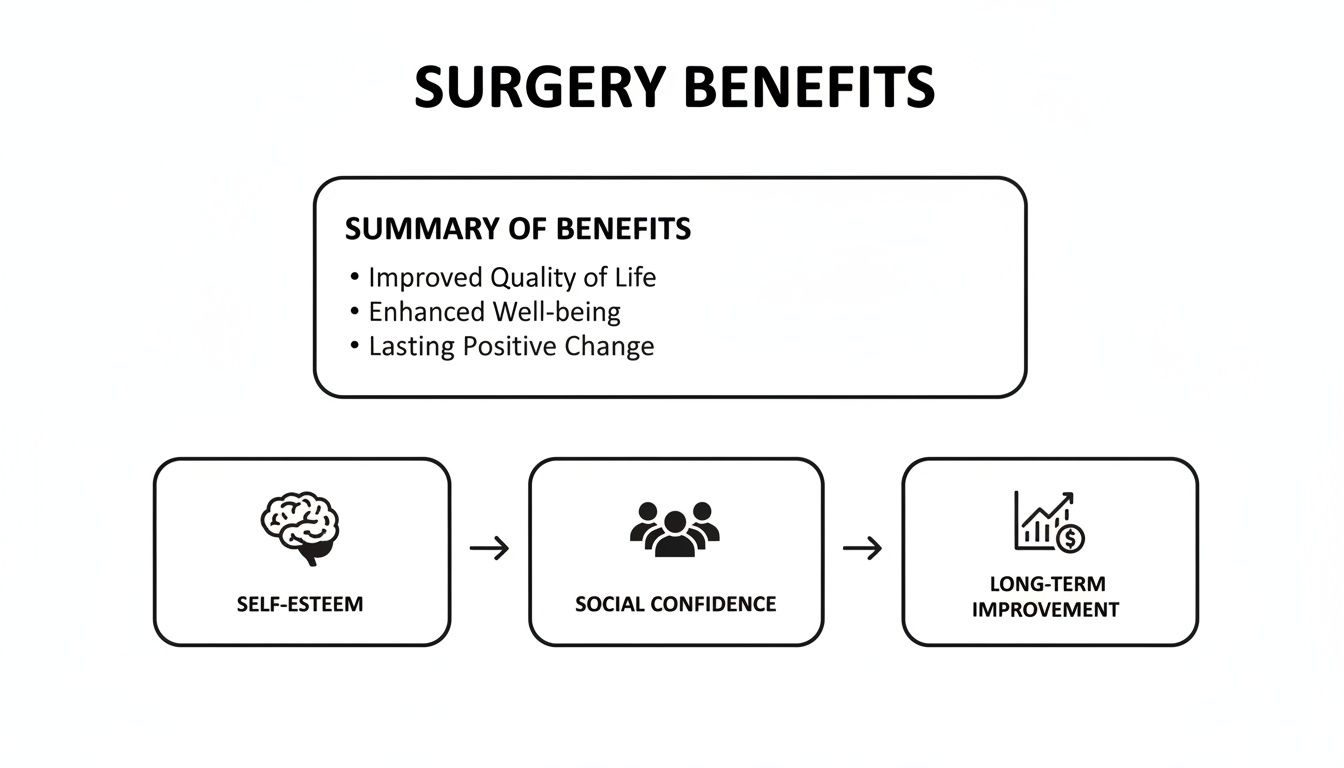
As you can see, the investment often pays dividends in long-term well-being that extend far beyond the physical change.
Recovering from plastic surgery isn't an overnight event—it's a process with distinct phases. Understanding this helps set realistic expectations for both the physical healing and the emotional journey that accompanies it. The first few days are often the toughest, with swelling, bruising, and discomfort. But this is temporary.
Think of it less like a "big reveal" when the bandages come off and more like a gradual unveiling of your final result. This process is unique for every person and every procedure, but the one constant is steady, day-by-day improvement. Patience is your best friend during this time.
Part of weighing whether surgery is "worth it" is comparing it to the non-surgical alternatives available today. Each approach has its own set of trade-offs when it comes to cost, downtime, and how long you can expect the results to last. For some, a non-surgical treatment can be a great way to "test drive" a change, while surgery offers a more powerful and permanent solution.
To help you visualize the differences, here is a quick comparison of some popular options.
Ultimately, there's no single "best" choice. The right path depends entirely on your personal goals, your budget, and how much recovery time you can realistically fit into your life.
When you're asking, "Is plastic surgery worth it?" the answer truly comes down to the person holding the scalpel. The surgeon you choose is, without a doubt, the single most important decision you'll make in this entire journey. It's not just about finding someone who is qualified; it's about finding the right expert for you.
Think of it like hiring an architect to build your dream home. You wouldn’t just pick someone from a list. You'd pour over their past projects, verify their credentials, and make sure they completely understood your vision. The same careful process applies here—your safety and satisfaction depend on it.
Before you even glance at a before-and-after photo, there's one thing you absolutely must verify: board certification. But here's the critical part: not all certifications are the same. You need a surgeon certified by the American Board of Plastic Surgery (ABPS).
This isn't just a certificate on a wall; it's the culmination of a long and incredibly demanding path. An ABPS-certified surgeon has completed a minimum of six years of surgical training, with at least three of those years focused exclusively on plastic surgery. On top of that, they've passed rigorous written and oral exams covering every facet of the specialty.
Think of ABPS certification as the gold standard. It’s a guarantee that your surgeon has proven expertise in both cosmetic and reconstructive procedures, from head to toe. Anything less is a risk you shouldn't have to take.
This credential is the essential first step in ensuring your safety and the quality of your outcome. To really understand why this matters so much, you can learn more about the 7 key benefits of choosing a board-certified plastic surgeon.
Once you've confirmed a surgeon is board-certified, it’s time to become an art critic. Their before-and-after gallery is their portfolio, and it’s your best window into whether their aesthetic style matches your goals. Don’t just scroll through; really study the images.
Use this checklist to guide your review:
Patient reviews give you a peek behind the curtain, showing you what the entire experience is like—not just the final result. While the star rating is a starting point, the real gold is in the written comments.
As you read, look for patterns. Do patients consistently praise the surgeon's bedside manner and how they felt heard during the consultation? Do they mention how supportive the staff was during the recovery process? These comments paint a clear picture of the practice's culture.
It’s also telling to see how a practice handles negative feedback. A thoughtful, professional response to a less-than-perfect review shows a practice that values honesty and is always looking to improve.
Finally, where your surgery takes place is just as crucial as who performs it. A top-tier, board-certified surgeon will operate in an accredited surgical facility. This means the center meets hospital-grade safety standards.
Accreditation from an organization like the American Association for Accreditation of Ambulatory Surgery Facilities (AAAASF) ensures the facility has the proper equipment, anesthesia professionals, and emergency protocols in place.
Choosing a surgeon who operates in their own accredited suite means you are being cared for in an environment built around your well-being. It is the ultimate mark of a surgeon's commitment to safety and excellence.

The initial consultation is where the abstract idea of changing your body becomes a concrete, personalized plan. It’s arguably the most vital step in your entire journey, laying the foundation for your safety, satisfaction, and final results. This meeting is your chance to make absolutely sure that you and your surgeon are on the same page.
Think of it like meeting with an architect before building a house. You wouldn’t let them break ground without first approving a detailed blueprint. The consultation serves the exact same purpose—it's a collaborative session where you and the surgeon co-create that plan, ensuring every last detail aligns with what you envision.
A productive consultation is a genuine two-way conversation, not a high-pressure sales pitch. The surgeon's job is to listen carefully, understand your reasons for being there, and offer an expert, honest assessment of what's realistically possible. Feeling rushed is a major red flag; a great surgeon wants you to feel confident and informed, never hurried into a decision.
This critical meeting should always cover a few key things:
The whole point is to build a relationship based on trust. You should leave the consultation feeling heard, respected, and empowered with a clear understanding of the path ahead. For a deeper dive, check out our guide on the 10 things to expect during your first plastic surgery consultation.
To get the most out of this meeting, you have to show up prepared. Having a list of questions ready will help you cover all your bases and get the information you need to decide if this surgeon and this procedure are right for you. Don't be shy—your health and your results are on the line.
Consider starting with these:
The value of these procedures goes far beyond simple aesthetics. The need for both reconstructive and cosmetic plastic surgery is growing fast, with incident cases projected to jump from 930 million in 2022 to 1.35 billion by 2050. That 45.2% increase, detailed in this comprehensive public health overview, underscores the essential role plastic surgery plays in improving people's quality of life.
A successful consultation is the bedrock of a successful outcome. It's where you confirm that your surgeon’s expertise aligns with your aesthetic goals, ensuring that the answer to "is plastic surgery worth it?" is a confident yes.
We’ve covered a lot of ground—the potential benefits, the real risks, the costs, and how to find a surgeon you can trust. Now, it all comes down to you. The only person who can truly answer, “Is plastic surgery worth it?” is the one looking back at you in the mirror.
This isn't a decision to be rushed. It’s deeply personal and requires some quiet, honest reflection. In my experience, the happiest patients are always the ones who’ve thought it through from every angle and move forward with their eyes wide open. The best outcomes happen when your personal goals, your understanding of what's possible, and your surgeon’s skill all align.
To help you get some clarity, sit with these questions for a bit. There are no right or wrong answers, only what’s true for you.
An informed choice is always the right one. Whether that means moving forward with surgery, trying a non-surgical treatment, or simply waiting, the goal is to feel confident in your decision. That's what really matters.
Ultimately, this whole journey is about helping you feel more comfortable and confident in your own skin. The "worth" of any procedure isn't just about the physical change; it's measured by the boost in self-assurance and the quality of life you gain. It's about making a choice that fits your life.
If you’ve done the research and feel ready to explore your options, the next step is a simple conversation. A one-on-one, no-pressure consultation is the perfect setting to talk through your goals and get expert guidance.
Ready to see what’s possible? Schedule your confidential consultation at Cape Cod Plastic Surgery today, and let's discuss a plan that’s right for you.
It’s completely normal to have a long list of questions when you're thinking about plastic surgery. Getting real, honest answers is the most important step in feeling confident and prepared for your journey. Let's walk through some of the questions we hear most often from people just like you.
This is a big one, and the answer really depends on the procedure you're considering. A good way to think about it is that surgery can reset the clock, but it can’t stop it from ticking forward.
For instance, body contouring procedures like liposuction permanently remove fat cells—they don't grow back. But the key to making those results last is maintaining a stable weight. A surgical facelift can look fantastic for 7-10 years, while non-surgical options are more of a short-term refresh. Botox typically lasts 3-4 months, and dermal fillers can last anywhere from 6 months to 2 years.
Honestly, there's no magic number. The right time for surgery is less about your age and more about your personal circumstances. It’s when something has been bothering you for a while, you’re in good health, and you feel mentally and emotionally ready for a change.
We see patients in their 20s and 30s who are interested in procedures like rhinoplasty or breast augmentation. Later, in their 40s and 50s, people often start looking into procedures like facelifts or tummy tucks to address the natural signs of aging. It’s not about the year you were born; it’s about your personal readiness.
The best outcomes always happen when a patient is doing this for themselves—not for anyone else—and they have a realistic grasp of the entire process, from the first conversation to the final recovery.
Absolutely. Since cosmetic surgery is almost always an elective choice, it isn’t covered by health insurance. To help make these procedures accessible, most practices have great financing options available.
Many clinics, ourselves included, work with trusted medical financing companies like CareCredit. These work a lot like a credit card but are used only for healthcare costs. They allow you to break down the total cost into manageable monthly payments. Our patient care team can walk you through the simple application process right here in our office.
At Cape Cod Plastic Surgery, we truly believe that an informed patient is an empowered one. If you have more questions or you’re ready to talk about your goals, we’d love to sit down with you for a private, no-pressure consultation. Learn more and book your appointment with Dr. Fater today.
October 7, 2026
A Practical Guide to Healing After Breast Surgery

October 6, 2026
Your Safety Guide: What to Look for When Choosing a Plastic Surgeon

October 5, 2026
Why Our On-Site Accredited Facility Matters for Your Safety
Cape Cod Plastic Surgery offers expert cosmetic and reconstructive procedures in a safe, accredited setting. Led by Dr. Marc Fater, we combine advanced techniques with personalized care to help you look and feel your best.
Monday: 9:00 AM – 5:00 PM
Tuesday: 9:00 AM – 5:00 PM
Wednesday: 9:00 AM – 5:00 PM
Thursday: 9:00 AM – 5:00 PM
Friday: 9:00 AM – 5:00 PM