

October 7, 2026
What to Expect During Your Breast Surgery Recovery
A Practical Guide to Healing After Breast Surgery
Aug 23, 2026

“Lunchtime procedure” is convenient marketing, not a complete description of jawline contouring with fillers. The injection itself may be brief, but the result depends on anatomical assessment, product selection, precise placement, and your willingness to plan around swelling, tenderness, bruising, and temporary irregularity. A non-surgical treatment still deserves surgical-level attention to anatomy and risk.
The evidence has also moved beyond social-media before-and-after photographs. Prospective studies have evaluated jawline filler with standardized aesthetic scales, measured contour changes, and follow-up extending across many months. That doesn't mean every patient will get the same result. It means the treatment can be approached as a defined medical procedure rather than a casual cosmetic tweak.
Jawline filler is often presented as a quick way to sharpen the lower face before returning to work. The procedure may fit into a busy schedule, but your face may not look meeting-ready afterward. Injection-site swelling, tenderness, bruising, and small contour changes are part of the normal recovery experience, not signs that the treatment has failed.
A 2021 prospective clinical study enrolled 30 subjects receiving hyaluronic acid filler for the jawline and chin. At 20 days, 29 of 30 patients, or 96.7%, rated their appearance as “much improved” or “very much improved”. The study used a grid-based injection approach, which is important because it reflects a move toward reproducible placement and measurable outcomes rather than relying only on artistic judgment. The full clinical study is available through the National Library of Medicine.
A defined jawline depends on more than placing product along the visible border of the mandible. A clinician has to evaluate chin projection, the mandibular angle, prejowl hollowing, soft-tissue thickness, skin elasticity, and whether under-chin fullness is blurring the transition between face and neck.
That assessment determines whether filler alone makes sense. A patient with mild volume loss and reasonable skin quality may respond well to structural support. Someone with substantial skin laxity, prominent submental fullness, or skeletal deficiency may need a different plan, because adding filler cannot remove excess skin or reliably replace a missing surgical correction.
Practical rule: If a provider promises a sharp result without discussing anatomy, recovery, product choice, and alternatives, the consultation is incomplete.
The early clinical data are encouraging, but they're still limited. The 2021 study was a small prospective cohort, so its results should inform expectations, not guarantee them. A thoughtful practitioner uses evidence as a baseline and then adjusts the plan to the individual face.
Not all fillers behave alike. The most important distinction for jawline treatment isn't just the brand name. It's how the product responds to pressure, movement, and the tissue plane where it's placed.
The technical term is rheology, which describes how a filler flows and resists deformation. One commonly discussed property is the elastic modulus, often expressed as G′ or G*. A higher value generally indicates a product with greater resistance to deformation, which can make it more useful for deeper structural support. Softer products may integrate more naturally when the aim is subtle subcutaneous refinement.
A useful analogy is construction. A firm filler placed near bone functions more like concrete supporting a structure. A softer filler placed closer to the surface behaves more like plaster used to smooth and finish an existing form. Using a stiff product superficially can produce an unnatural edge, while using a product with too little structural capacity at depth may fail to create the desired projection.
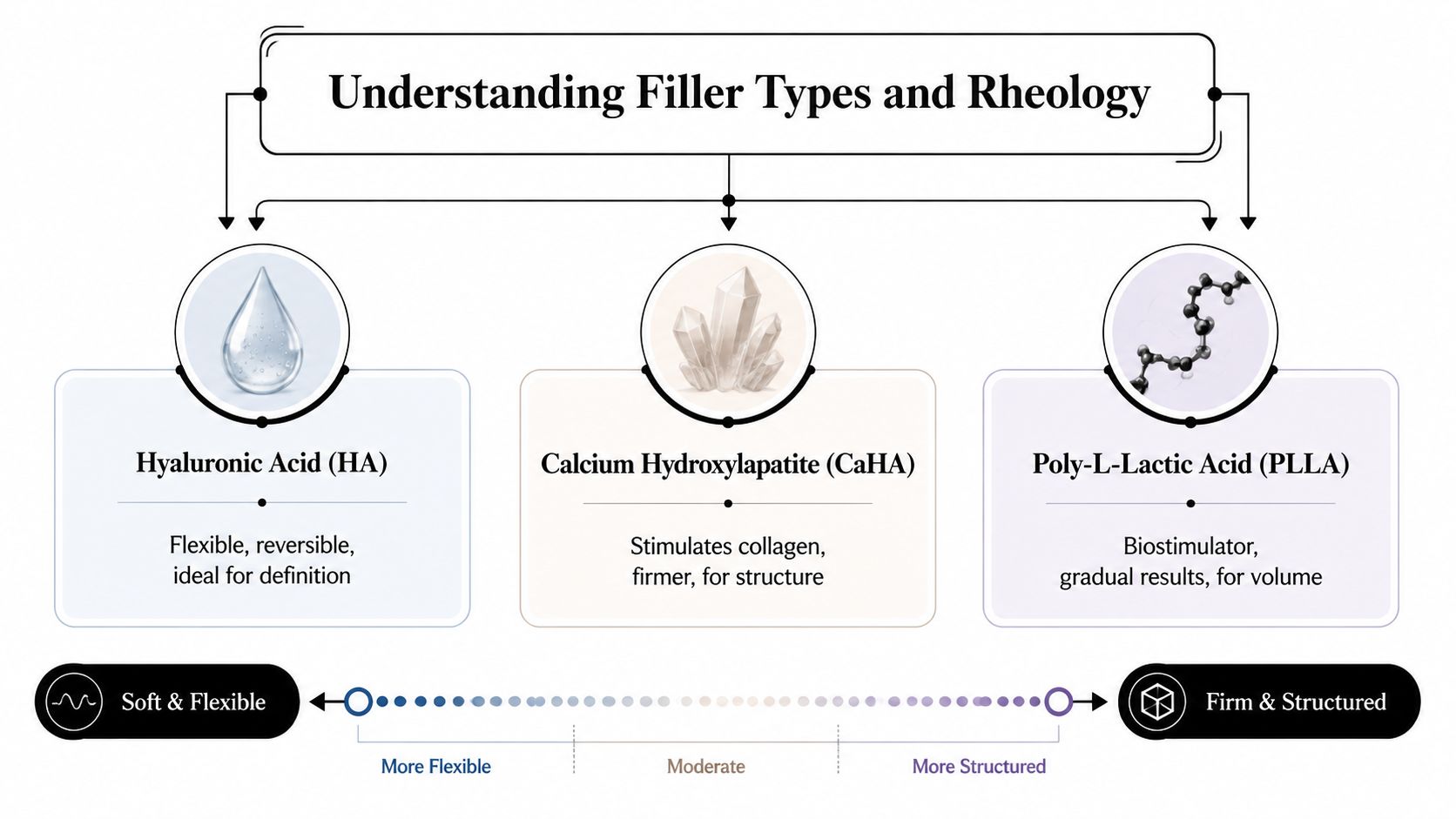
Expert reviews recommend high G′ or high G* fillers for periosteal support and lower G′ products for subcutaneous refinement. A published lower-face reshaping protocol used a filler with G′ above 400 Pa for over-periosteum boluses and a product in the G′ 200 to 300 Pa range for subcutaneous injections. The lower-face reshaping protocol explains the relationship between rheology and placement.
Hyaluronic acid, or HA, is often attractive when flexibility and reversibility matter. It can provide immediate structure and can be adjusted by an experienced clinician if the result requires correction. For readers comparing skincare with injectable treatment, the difference between hyaluronic acid serums is important. A topical serum and an injectable HA filler are different products used in different tissue environments, and a serum won't recreate the structural effect of an injection.
Calcium hydroxylapatite, or CaHA, is firmer and can provide a more substantial structural feel, while also supporting collagen-related tissue response. Poly-L-lactic acid, or PLLA, is a biostimulatory product that works gradually rather than delivering the same immediate contouring effect associated with a traditional HA filler.
Product selection should account for your anatomy, desired degree of definition, skin thickness, previous filler, and whether reversibility is a priority. A useful overview of dermal filler types, results, and safety can help you prepare, but the final choice belongs in an examination room, not a shopping cart.
A well-planned appointment begins before the syringe appears. During consultation, the clinician examines your face at rest and in motion, studies the profile, and identifies whether the main concern is a weak chin, a soft mandibular angle, prejowl hollowing, or diffuse lower-face fullness.
The treatment map usually centers on two structural vectors, the mandibular angle and the prejowl sulcus. Consensus guidance emphasizes restoring continuity along the jawline shadow while avoiding direct injection into jowl fat. It also recommends small boluses and careful control of the injection plane. The consensus guidance on jawline filler anatomy and technique is available here.
After the skin is cleansed, the provider may use topical anesthetic or local anesthetic depending on the plan and product. Photographs and markings help preserve symmetry while the patient is seated or positioned for assessment.
The injection technique may involve a 22 to 25G cannula or a 27G needle, with product placed in the subcutaneous or subdermal plane according to the treatment objective. Consensus recommendations describe approximately 2 mL per side, delivered in small 0.1 mL boluses, but that's a reference protocol, not a prescription for every face. The required amount depends on anatomy and the amount of correction being attempted.
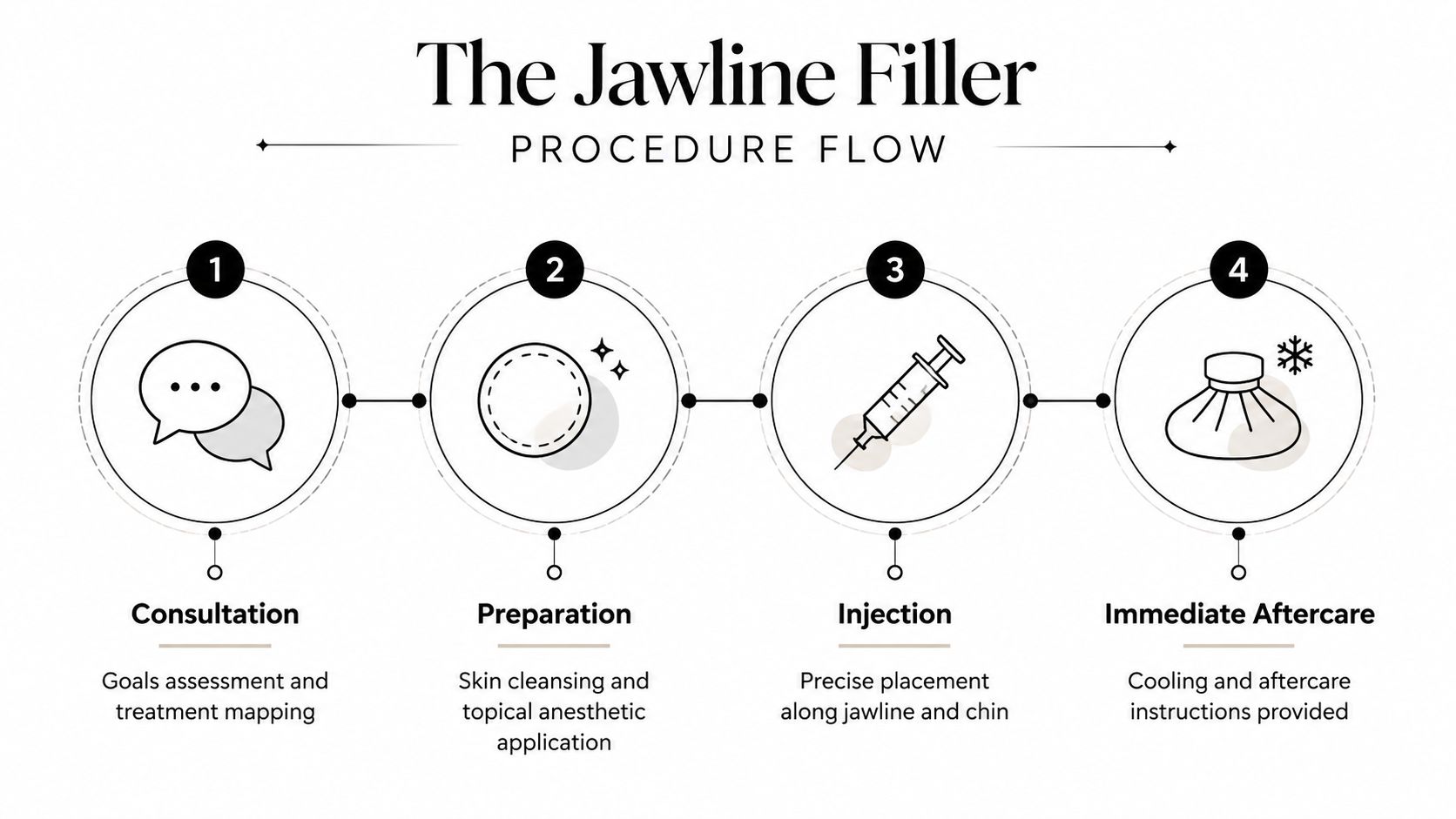
The provider should build definition incrementally, reassessing the contour rather than placing a large volume without pauses. This approach helps preserve facial balance and reduces the chance of creating a heavy, overprojected lower face.
The facial and external carotid vessels and the parotid gland are among the structures that require respect. Safer technique depends on anatomical knowledge, appropriate tissue-plane control, and avoiding deeper structures rather than treating the jawline as an empty space.
After injection, the clinician checks symmetry, contour continuity, and the transition from chin to mandibular angle. Immediate appearance can be misleading because swelling may exaggerate fullness. The final judgment should wait until the tissue settles.
The strongest reason to consider filler is its ability to create visible structural change without an incision. The strongest reason to remain cautious is that the result is still temporary, technique-dependent, and influenced by the anatomy that filler cannot change.
A 2024 prospective study reported that 39 of 42 evaluable participants, or 92.9%, achieved at least a 1-point improvement on the Allergan Loss of Jawline Definition Scale. Mean improvement was -1.8 points four weeks after the final treatment. In the same line of research, responder rates at Month 6 were 69.0% in the treatment group versus 38.0% in controls, and benefits were reported to persist up to 12 months. The 2024 prospective jawline filler research is indexed by PubMed.
“Lasting” doesn't mean the jawline looks identical throughout the entire period. Early swelling can temporarily make the contour appear more pronounced. As that resolves, the shape may look softer and more natural. Over subsequent months, the body gradually metabolizes the filler, and the visible effect diminishes at a pace that varies by product, placement, metabolism, facial movement, and treatment plan.
A patient may also perceive improvement after the filler itself has softened because the original contour has been restored and the face feels more balanced. That subjective benefit is different from claiming permanent correction.
Combination treatment is becoming more relevant when jawline definition and under-chin fullness occur together. A 2024 study combining cryolipolysis with HA filler reported a mean cervicomental-angle improvement of -9.34 degrees with the combined approach, compared with -4.94 degrees after cryolipolysis alone. That finding supports staged planning when excess fullness contributes to a blurred jawline, rather than assuming filler should solve every lower-face concern.
For broader context on durability, review how long filler lasts, then ask your provider what longevity is realistic for the specific product and anatomy being considered.
Jawline filler is usually workable around a patient's schedule, but it is not appearance-neutral immediately afterward. Visible swelling, tenderness, bruising, and temporary irregularity are common parts of the early recovery.
A recent systematic review found swelling in 81% of studies or patients, lumps or bumps in 83%, pain after injection in 79%, and tenderness in 76%. The systematic review detailing these common reactions is available through PubMed. Those findings should influence scheduling. You may return to work quickly, yet the jawline may remain visibly swollen or uneven while the tissues settle.
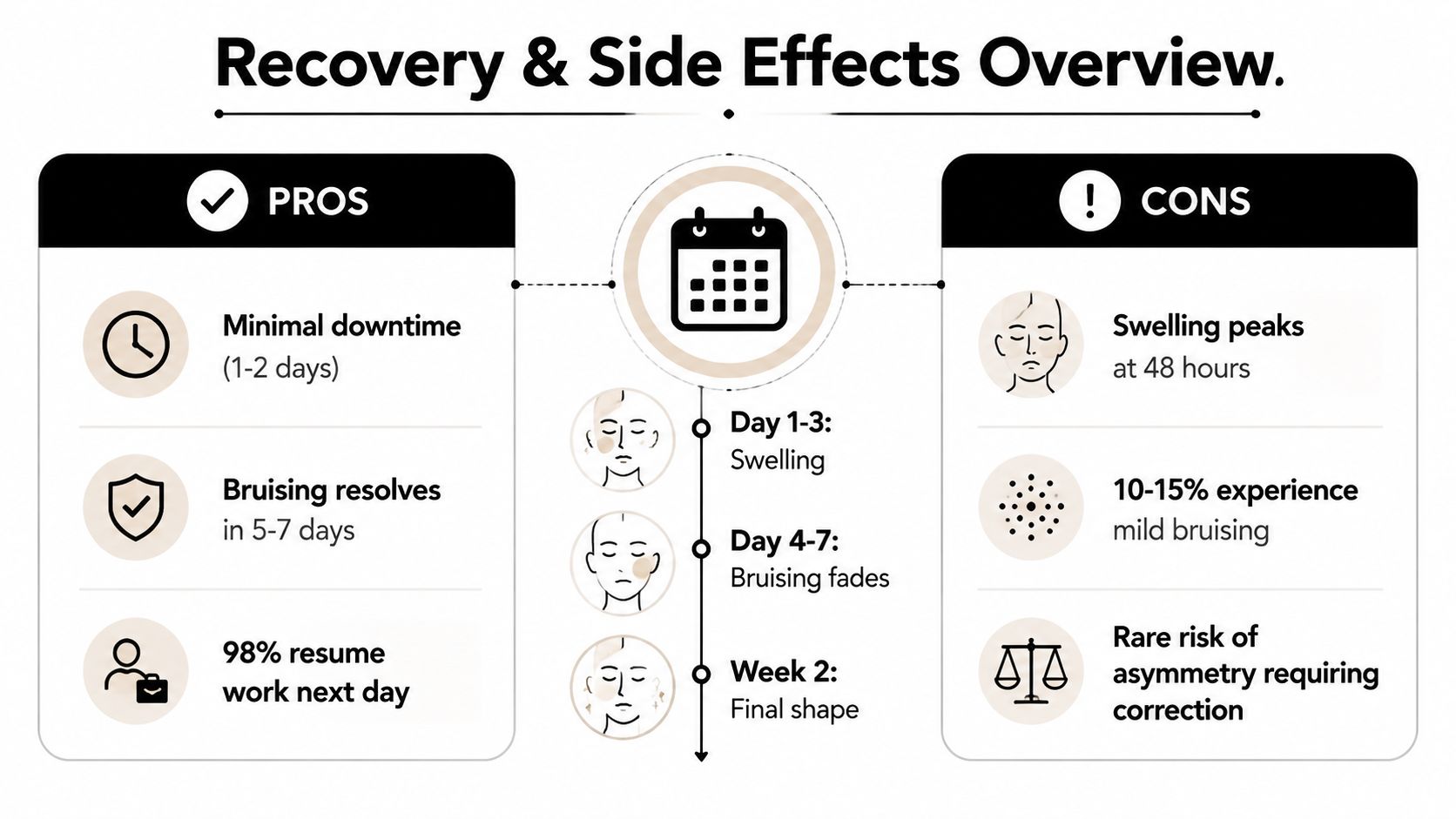
Pressure, firmness, tenderness, and asymmetry from uneven swelling are expected possibilities. Small lumps may result from product placement, edema, or the filler integrating into the surrounding tissue. Do not massage or manipulate the area unless your injector specifically directs you to do so. Unnecessary pressure can irritate healing tissue or shift a carefully placed product.
Plan for recovery before booking:
Serious complications are uncommon, but filler is injected near important vessels, so warning signs require prompt attention. In a 2021 clinical study, no infection, paresthesia, asymmetry, hematoma, necrosis, or skin discoloration was reported. The cohort was small, however, and those findings do not eliminate risk.
Contact your provider promptly for worsening pain, unusual skin color change, increasing warmth, spreading redness, marked one-sided swelling, or any visual symptom. Your injector should provide a direct emergency contact pathway before treatment. Do not rely on online searches if a symptom feels abnormal.
Recovery is part of the treatment plan. If your schedule cannot accommodate several days of uncertain appearance, postponing treatment may be wiser than forcing it into a narrow window.
Fillers and surgery solve different problems. Filler adds or restores volume and can refine a contour. Surgery can alter the underlying framework, remove excess tissue, tighten lax skin, or deliver a more durable structural change.
| Criteria | Dermal Fillers | Surgical Options |
|---|---|---|
| Invasiveness | Injectable, non-surgical treatment with tissue-plane and vascular considerations | Incisions, anesthesia, and operative recovery |
| Main strength | Adjustable contour enhancement and support | More substantial correction of skeletal deficiency, skin laxity, or excess tissue |
| Reversibility | HA filler offers more flexibility for adjustment than non-HA products | Surgical changes generally require another procedure to revise |
| Recovery | Often less disruptive, but swelling, bruising, tenderness, and irregularity still occur | More involved recovery, with restrictions determined by the operation |
| Longevity | Temporary, with persistence varying by product and patient | Generally more durable, although aging continues |
| Best fit | Mild to moderate definition concerns, subtle refinement, or patients avoiding surgery | Significant laxity, major skeletal deficiency, or a preference for lasting structural change |
Filler is a reasonable discussion for someone with a relatively stable weight, adequate skin quality, and a desire for refinement rather than transformation. It can support the chin, sharpen the mandibular angle, and smooth a discontinuity along the prejowl area.
It isn't a substitute for treating every cause of a soft jawline. If submental fullness dominates the profile, reducing that fullness may matter more than adding volume. If loose skin creates heavy jowls, filler may camouflage the problem only briefly and may create an overfilled appearance when used aggressively.
A chin or jaw implant can provide a different type of projection than injectable filler. A neck lift or related surgical approach may address skin and soft tissue that filler cannot tighten. The decision should be based on anatomy, desired permanence, tolerance for recovery, and willingness to accept operative risks.
Cost also deserves a long-term discussion. Filler may have a lower initial commitment, but repeated maintenance can accumulate. Surgery may require more recovery and a larger upfront commitment, but its durability changes the financial comparison. A consultation should address both the immediate plan and what ongoing treatment may look like.
The provider matters more than the syringe. Choose someone who understands facial anatomy, regularly treats the chin and jawline, can explain tissue planes clearly, and is comfortable recommending against filler when the anatomy points elsewhere.
Look for before-and-after photographs showing patients with similar facial structure, not just identical lighting and camera angles. Ask whether photographs are standardized, whether the patient is shown in profile and three-quarter views, and whether the result was achieved with filler alone or a combination plan.
Bring photographs showing the type of profile you prefer, but treat them as communication tools, not guarantees. Facial proportions, bone structure, skin quality, and soft-tissue distribution determine what can be reproduced safely.
Review your medications and supplements with the provider, particularly anything that may affect bruising or bleeding. Don't stop prescribed medication without advice from the clinician who manages it. Tell the injector about previous filler, adverse reactions, active skin problems, relevant medical conditions, and upcoming commitments.
You can also review guidance on preparing for a plastic surgery consultation. Even though filler isn't surgery, the same principle applies: arrive ready to discuss goals, risks, alternatives, and recovery rather than asking only how quickly the appointment can be completed.
At Cape Cod Plastic Surgery, dermal filler treatments can include precise placement along the chin and jawline to improve definition, with product selection based on the patient's facial structure and goals. Schedule a consultation to discuss whether jawline contouring with fillers fits your anatomy, and visit Cape Cod Plastic Surgery to learn more about available facial enhancement options.
October 7, 2026
A Practical Guide to Healing After Breast Surgery

October 6, 2026
Your Safety Guide: What to Look for When Choosing a Plastic Surgeon

October 5, 2026
Why Our On-Site Accredited Facility Matters for Your Safety

Cape Cod Plastic Surgery offers expert cosmetic and reconstructive procedures in a safe, accredited setting. Led by Dr. Marc Fater, we combine advanced techniques with personalized care to help you look and feel your best.
Monday: 9:00 AM – 5:00 PM
Tuesday: 9:00 AM – 5:00 PM
Wednesday: 9:00 AM – 5:00 PM
Thursday: 9:00 AM – 5:00 PM
Friday: 9:00 AM – 5:00 PM