

October 7, 2026
What to Expect During Your Breast Surgery Recovery
A Practical Guide to Healing After Breast Surgery
Mar 4, 2026
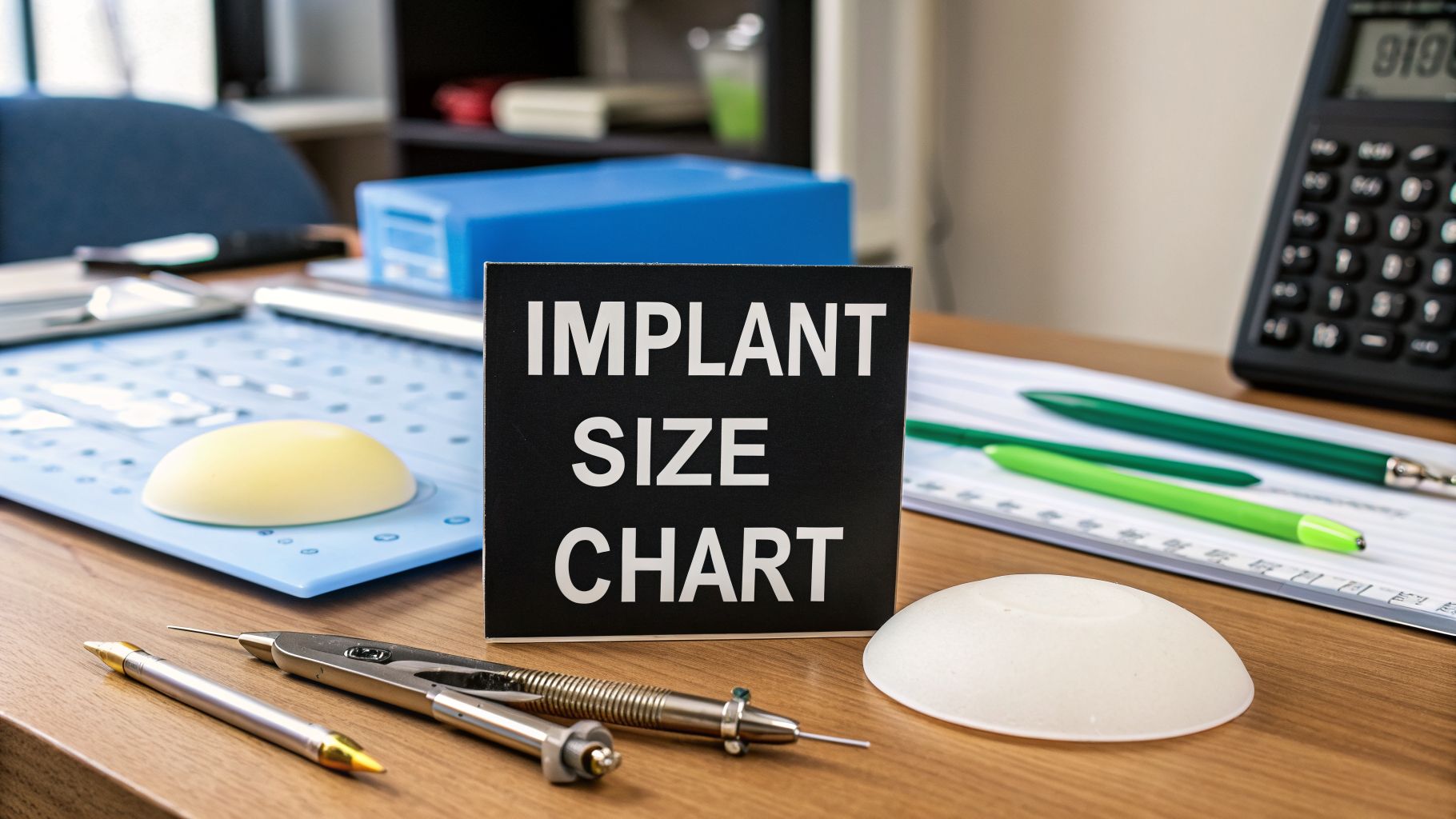
A detailed Mentor implant sizes chart is one of the most important tools we use to begin a conversation about breast augmentation. It’s essentially a catalog that connects an implant’s volume, measured in cubic centimeters (CCs), to its actual physical dimensions—things like its width and how far it projects from the chest. This chart helps translate abstract numbers into a tangible understanding of shape and proportion.

While the full Mentor implant sizes chart can feel overwhelming with its hundreds of options, a quick reference guide is a great way to get oriented. The table below is a simplified snapshot, designed to give you an at-a-glance look at how common implant volumes correspond with different profiles and their resulting dimensions.
Think of this as a "cheat sheet" to help you start visualizing the possibilities before we dive into the specifics during your consultation.
Before you look at the numbers, it helps to know what they mean and, more importantly, how they work together. Each measurement plays a critical role in shaping the final outcome.
Looking at these dimensions together shows you that size is about so much more than just a CC number. The following table provides a high-level summary to help you see these relationships in action.
This table provides a general overview of how implant volume (CCs) corresponds to available profiles and the typical ranges for base diameter and projection.
Remember, this is a starting point. The perfect implant for you is a unique combination of these metrics, all selected to harmonize with your specific anatomy and aesthetic goals.
A professional Mentor implant sizes chart can look pretty intimidating at first glance—it's a lot more than just a simple list of sizes. Think of it as a blueprint that you and your surgeon will use to map out your final look. To really get the most out of your consultation, you need to understand the three core measurements that define every implant: volume, base diameter, and projection.
Getting a handle on these numbers is what turns a potentially confusing conversation into a productive planning session. It empowers you to describe exactly what you're hoping for and helps ensure you and Dr. Fater are on the same page from the start.
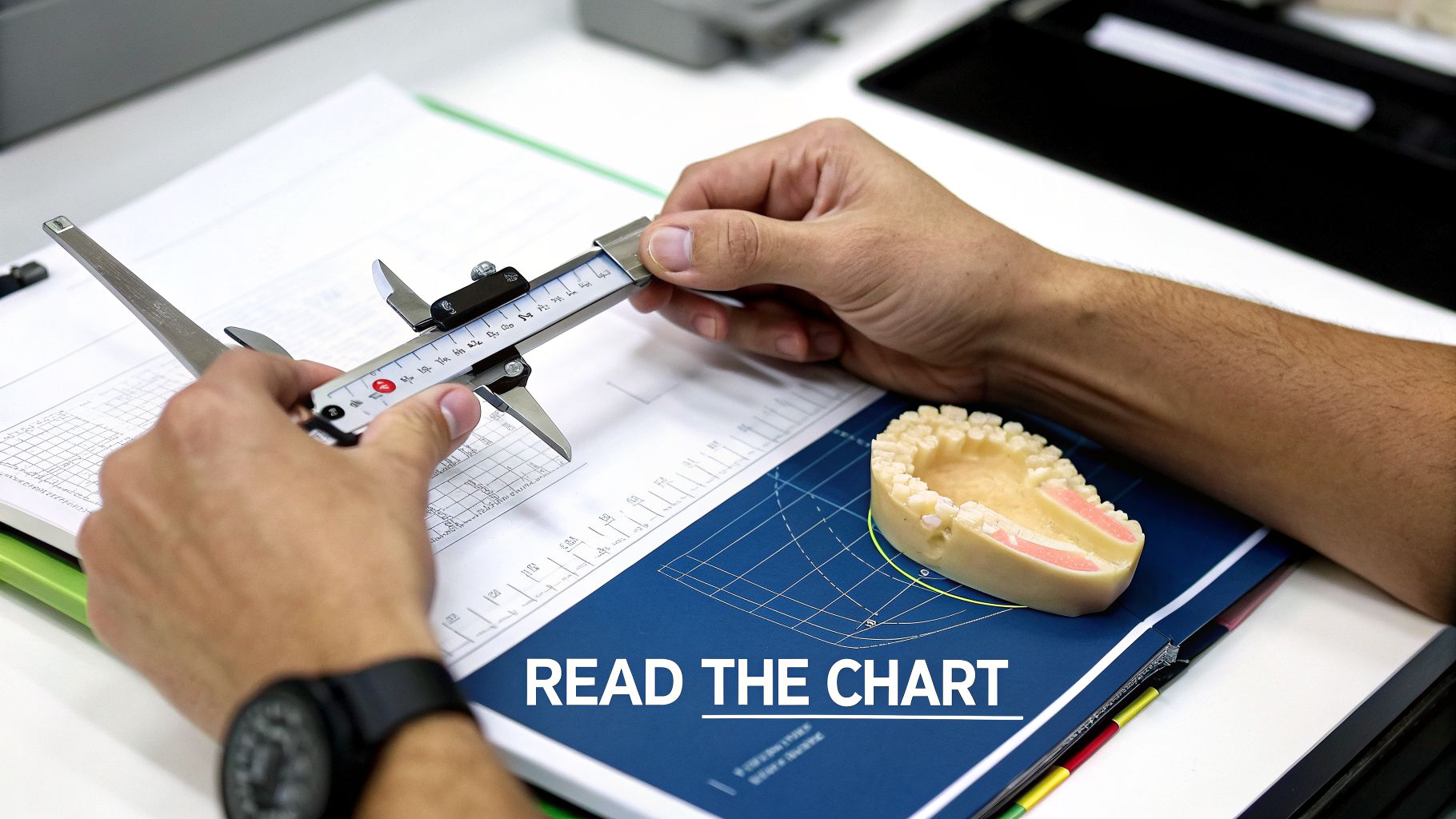
Every single Mentor implant is described by three key dimensions that all work together. A common mistake patients make is focusing only on one of these, like volume, which can lead to results that don't quite match their goals.
Volume (CCs): This is the total amount of MemoryGel™ the implant holds, measured in cubic centimeters. While it's the main indicator of overall size, it's not the whole story. Two implants can have the exact same volume but completely different shapes.
Base Diameter (cm): This is the width of the implant where it rests against the chest. Frankly, this is the most important number of the three. For a natural-looking result, the implant's base diameter needs to align with the width of your own breast tissue.
Projection (cm): This is how far the implant "projects" forward from your chest wall. It's the dimension that creates fullness and defines your profile. A higher projection gives you a more prominent, rounder curve.
A good way to think about it is like buying tires for your car. The volume is like the total amount of rubber, but the diameter has to fit the wheel, and the tire's width (its projection) has to fit in the wheel well without rubbing. All three measurements have to be right for a perfect fit.
Let’s look at a real-world scenario to see how these numbers play out. Imagine a patient is trying to decide between two different 350cc Mentor implants.
Example A: A 350cc Moderate Plus Profile implant might have a base diameter of 12.5 cm and a projection of 4.1 cm. This combination creates a wider, more gently sloped look.
Example B: In contrast, a 350cc High Profile implant could have a narrower base of 11.5 cm but a greater projection of 4.7 cm. This one would deliver more forward fullness on a smaller "footprint."
Even though both implants are 350cc, the final breast shape they create will be completely different. This is precisely why the Mentor implant sizes chart is such an indispensable tool. It allows Dr. Fater to first select an implant with a base diameter that fits your frame perfectly, then fine-tune the projection to achieve the specific aesthetic you desire—whether it's a subtle, natural enhancement or a more dramatic curve.
While the number of CCs (cubic centimeters) tends to grab all the headlines, your implant’s profile is just as crucial in defining your final look. The profile is simply a measure of how far the implant projects forward from your chest.
Think of it this way: two implants can have the exact same volume, but one can be wide and flat like a pancake, while the other is narrow and projects forward like a cone. They hold the same amount of gel, but the shape they create is worlds apart. Understanding this difference is key to translating the numbers on a Mentor implant sizes chart into your real-world aesthetic goals.
Mentor’s MemoryGel™ and MemoryGel® Xtra implants come in four distinct profile options. Each one offers a different balance between the implant's base width and its forward projection, allowing for a truly customized fit.
Moderate Profile: This is our widest, flattest option. It has the most gradual slope and is a great choice for patients with a broader chest who are looking for a subtle, natural-looking volume increase that blends seamlessly with their frame.
Moderate Plus Profile: Easily one of the most popular choices, the Moderate Plus is the perfect "in-between." It offers a bit more projection than the Moderate profile but on a slightly narrower base, creating a beautiful balance of fullness without being overly dramatic.
High Profile: With a noticeably narrower base and more forward projection, the High Profile creates a rounder, more prominent breast shape. This is often the go-to for women with a petite or narrow frame who want significant volume and "upper pole" fullness without the implant feeling too wide.
Ultra High Profile: As the name suggests, this profile provides the maximum possible projection on the narrowest base. It’s designed for patients who want the most dramatic, projected result with a lot of cleavage and a very round, full appearance.
The main takeaway here is that for the same volume—let's say 400cc—an Ultra High Profile implant will look much more projected and feel narrower on the chest than a Moderate Profile implant, which will be wider and sit flatter.
The profile you and your surgeon select has a direct and powerful impact on your final silhouette. For instance, putting a High Profile implant on someone with a very broad chest can sometimes create a "stuck-on" appearance because it doesn't adequately fill out their natural breast width.
On the flip side, using a low-profile implant on a very petite woman might not provide enough forward "oomph" to achieve the look she was hoping for, even if the CC volume is right. A patient with a naturally wide breast base is often a fantastic candidate for a Moderate Plus implant, which fills out her frame perfectly while adding a pleasing projection. Someone else with an athletic, narrow torso might opt for an Ultra High Profile to get that classic curvy look without the implant's edges spilling into her armpit area.
This is exactly why the detailed measurements in a Mentor implant sizes chart are so critical. By looking at the base diameter, projection, and volume together, Dr. Fater can pinpoint the implant that not only matches your desired size but also perfectly fits your unique body. In the sections that follow, you’ll find the complete data tables that show you these precise differences side-by-side.
Alright, let's get into the specifics. This is where we look at the exact numbers that surgeons use to plan a breast augmentation. The following tables lay out the official specifications for the Mentor implant sizes chart, turning abstract terms like "profile" and "volume" into concrete measurements.
Think of this as your cheat sheet. By organizing the data by implant profile, you can easily compare different options. For instance, you can see precisely how a 400cc Moderate Plus implant differs in its base width and forward projection from a 400cc High Profile implant. Having a grasp of these details helps you and your surgeon have a much more focused conversation about achieving your aesthetic goals.
The Moderate Plus profile is a true classic in our practice, and for good reason. It offers a beautiful balance, providing noticeable volume without looking unnatural. This profile is often a perfect fit for patients with an average or slightly wider chest who want a significant but still proportionate enhancement.
As you'll see in the data, when the implant volume (cc) increases, both the base diameter and the projection grow in a balanced way. Mentor has been refining these dimensions since its founding in 1969, and its MemoryGel™ implants are a trusted choice here at Cape Cod Plastic Surgery. The range is impressive; a tiny 125 cc Smooth Round Moderate Plus implant measures 8.9 cm across with a 2.8 cm projection, while the largest 800 cc version expands to 17.2 cm wide with a 4.6 cm projection. To see every single option, you can look through the full Mentor implant catalogue sizer.
Here’s a quick look at some of the most commonly selected sizes within this versatile profile.
These specifications give us the precise building blocks to customize your results based on your unique anatomy.
The MemoryGel® Xtra line is a different beast altogether. Mentor engineered these implants to feel a bit firmer and provide more upper-pole fullness. When you pair that "Xtra" technology with a High Profile, the result is an implant designed for maximum forward projection on a relatively narrow base.
This creates a very round, prominent breast shape. It's an excellent choice for patients who:
So, what exactly does "Xtra" mean? It means the implant shell is filled more completely with the cohesive gel. This is what gives it that enhanced firmness and a noticeable boost in projection compared to a standard MemoryGel™ implant of the exact same size and profile.
The table below shows some popular Xtra High Profile sizes. Notice how much projection you get relative to the diameter—that's the signature of this implant style.
Of course, looking at numbers on a screen is just the first step. To get a better sense of how these measurements translate to real-world results and different body types, be sure to read through our complete breast implant size guide.
One of the first questions patients often ask is, "How many CCs will get me to a D cup?" It's a totally understandable question, but the truth is, there’s no magic number. A 350cc implant might look like a C cup on one person and a D cup on another. It's just not that simple.
Your final cup size is a combination of the implant's volume and your own unique anatomy—your existing breast tissue, the dimensions of your chest, and even your skin's elasticity. Think of it this way: pouring a cup of water into a tall, thin flute glass creates a very different result than pouring that same cup of water into a short, wide tumbler. Your body is the unique "glass" that gives the implant its final shape and size.
Focusing only on CCs means you're missing the bigger picture, which is finding a size and shape that looks beautiful and harmonious on your body. This is where a surgeon's experience really comes into play.
Here are the key factors we evaluate to predict your outcome:
This is why we rely on detailed specifications, not just a single volume number.

The three core measurements—volume, diameter, and projection—all work together. Understanding how they're connected is why a full Mentor implant sizes chart is an indispensable tool for surgical planning.
While having a goal cup size is a great place to start the conversation, our mission at Cape Cod Plastic Surgery is to create a beautiful shape and proportion that truly fits your body. During your consultation, we'll spend less time talking about a letter on a bra tag and more time focused on the silhouette you want to see in the mirror.
The most successful and satisfying outcomes happen when patients shift their goal from hitting a specific letter to achieving a specific look. We prioritize proportion, shape, and a natural fit over an arbitrary cup size.
This philosophy is precisely why the in-office fitting process is so critical. Using implant sizers, we can help you physically see and feel how different dimensions will look and feel on your frame. It’s a hands-on, collaborative process that moves the conversation beyond the limits of CCs and cup sizes, making sure your final result is something you'll absolutely love.
Familiarizing yourself with a Mentor implant sizes chart is a great first step, but it's only half the story. The numbers and measurements on a page can't tell you how an implant will actually look and feel on your body. This is where the consultation and personalized fitting come in—it’s where the technical data meets the art of aesthetic surgery.
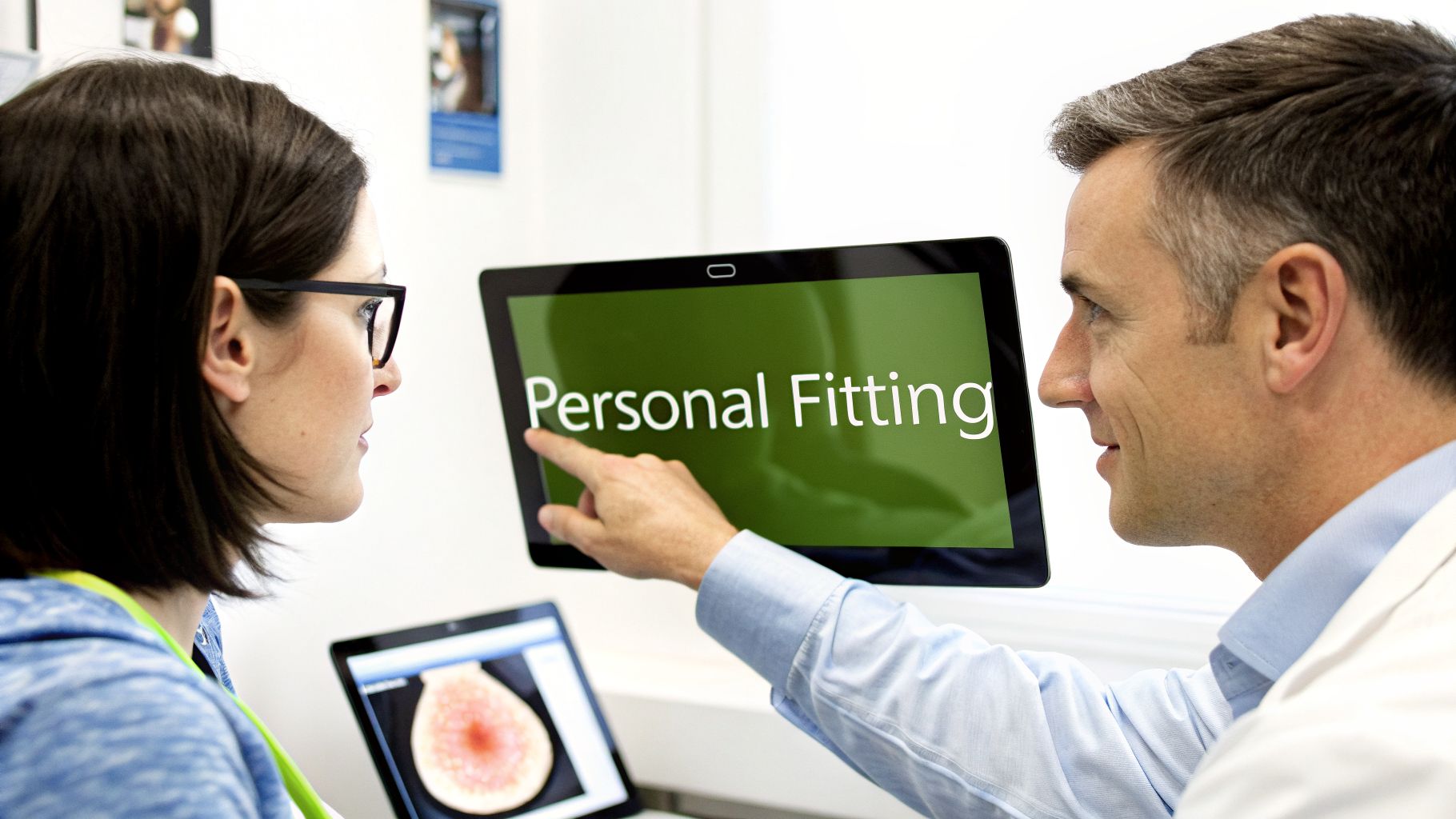
During your fitting, abstract numbers become a real, tangible preview of your final results. It's a collaborative experience designed to ensure you feel completely confident in your decisions.
Dr. Fater’s fitting process is meticulous, combining time-tested techniques with modern technology to help you clearly visualize the outcome. He leaves no stone unturned to make sure every choice is right for you.
Here’s a look at what you can expect during your appointment:
Think of the fitting as a true partnership. Dr. Fater brings his expertise to the table, advising on what is surgically sound and what will be aesthetically balanced for your unique anatomy. His recommendations are always grounded in proven safety standards.
The ultimate goal is to find the perfect intersection between your aesthetic vision and an implant that your body can support beautifully for years to come.
This detailed, data-driven approach is key to achieving the natural shapes and feel that our patients love. In fact, Mentor implants have an impressive 97% satisfaction rate among patients, largely thanks to the precision offered by this fitting process. The vast range of sizes, from 100 cc up to 800 cc, gives a skilled surgeon the tools to achieve incredibly customized outcomes. For those interested in the clinical details, you can explore the technical specifications for Mentor implants.
This entire experience, guided by the skill of Dr. Marc Fater, is designed to demystify the process. It empowers you to move forward with your final decision, feeling nothing but excitement and confidence.
Exploring the Mentor implant sizes chart is a fantastic starting point. You've dug into the numbers—the CCs, diameters, and projections—which gives you a solid foundation for what's possible. But at the end of the day, charts and data can only take you so far.
The next step is personal. It's about translating those numbers into a result that feels right for your body and fits the vision you have for yourself. This is where a one-on-one conversation with an experienced surgeon becomes invaluable.
At Cape Cod Plastic Surgery, you’ll have your consultation with Dr. Marc Fater, a board-certified plastic surgeon with over 30 years of dedicated experience. His expertise isn't just in the technical aspects of surgery; it's in listening to patients and helping them navigate the fitting process to find the perfect match for their goals.
Our office is conveniently located right in Hyannis, Massachusetts, and we're ready to help you take that next step with confidence.
A direct consultation is the only way to translate the data from an implant chart into a result you will love. It bridges the gap between numbers on a page and a final look that is harmonious with your frame.
For those curious about the technology behind modern practice management, many clinics use systems to make booking easier. You can learn more about this by reading a guide on medical appointment scheduling software.
Ready to see how the numbers on the chart could look on you? Please contact us to schedule your appointment and start your personalized journey today.
Even after looking over a detailed Mentor implant sizes chart, it’s completely normal to have more questions. We get it. Let’s dive into some of the most common ones we hear from our patients, clearing up the practical details so you can feel confident heading into your consultation.
These are the kinds of questions that pop up once you start picturing how the numbers and profiles will actually translate to your body.
We see a lot of patients choosing implants in the 300cc to 500cc range, but honestly, the whole idea of a "popular" size is a bit of a trap. When it comes to breast augmentation, the best size is simply the one that fits your body's proportions perfectly.
The single most important factor isn't a cc number that’s trending online; it's the implant's base diameter. Dr. Fater’s first priority is to match that width to your unique chest dimensions. This ensures your final result looks like it belongs to you—balanced and natural, not just a size someone else chose.
Your ideal profile really comes down to a combination of your body frame and the look you're hoping to achieve. This is where we balance the implant's width with how much it projects forward.
This is something you can't decide from a chart alone. During your fitting, Dr. Fater will have you try on sizers to physically show you how each profile looks and feels on your body, taking all the guesswork out of the decision.
The main health consideration isn't the implant's cc volume itself, but whether the implant is inappropriately large for your frame. An implant that's too wide or heavy for your body's tissues to support can raise the risk of long-term problems.
Some potential complications from a poorly-sized implant include "bottoming out" (where the implant sags below the breast fold), visible rippling, or just chronic strain on your skin and tissue. This is exactly why getting a professional assessment is non-negotiable for a safe, beautiful outcome.
Dr. Fater will only ever recommend implant sizes that your body can safely support for the long haul. The goal is a result that not only looks incredible but also prioritizes your health and comfort for years to come.
Ready to move from charts to choices? The expert team at Cape Cod Plastic Surgery is here to guide you through a personalized fitting. Schedule your consultation with Dr. Fater today to find your perfect fit.
October 7, 2026
A Practical Guide to Healing After Breast Surgery

October 6, 2026
Your Safety Guide: What to Look for When Choosing a Plastic Surgeon
October 5, 2026
Why Our On-Site Accredited Facility Matters for Your Safety

Cape Cod Plastic Surgery offers expert cosmetic and reconstructive procedures in a safe, accredited setting. Led by Dr. Marc Fater, we combine advanced techniques with personalized care to help you look and feel your best.
Monday: 9:00 AM – 5:00 PM
Tuesday: 9:00 AM – 5:00 PM
Wednesday: 9:00 AM – 5:00 PM
Thursday: 9:00 AM – 5:00 PM
Friday: 9:00 AM – 5:00 PM