

September 9, 2026
How to Care for Surgical Incisions Properly
Expert Guide to Proper Surgical Incision Care
Aug 7, 2026

Many ask for filler as if all fillers do the same job. They don't. Poly-L-lactic acid filler is not built for instant plumping, and that's exactly why it earns a place in aesthetic medicine, especially for patients who want restoration that looks like their own tissue rather than a visible, immediately filled effect.
The market data reflects that this is no fringe product anymore. The global poly-L-lactic acid filler market was valued at USD 207.3 million in 2025 and is projected to reach USD 404.3 million by 2033, with a 8.9% CAGR from 2026 to 2033, and North America held 39.34% of the regional share in 2025, while the face accounted for 43.5% of applications and cosmetic surgery centers/dermatology clinics made up 55.1% of end use (Grand View Research report). That growth makes sense once you understand what PLLA does, because it works with your biology instead of trying to replace it.
If you expect the same kind of result you would get from a hyaluronic acid gel, poly-L-lactic acid filler will feel different from the first conversation. Traditional fillers are made to create visible volume right away. PLLA is built to encourage your skin to rebuild support gradually, which means the treatment is planned around a slower biological response rather than an immediate fill.
That difference matters because a filler's role is not only to add fullness. With PLLA, the goal is to trigger collagen production over time, so the face regains structure in a way that often blends more naturally with movement and the aging process. It is a biostimulator that works through a different mechanism, and that is part of why the category has become established in aesthetic medicine rather than remaining a specialty-only option.
Many patients read delay as a drawback. For PLLA, the pace is the point. It suits people who can commit to a process that unfolds over months, not minutes, and that patience often determines whether the result feels satisfying or disappointing.
A simple rule helps here. If you want instant contouring for a specific line or fold, another filler type may be the better fit. If you want gradual, broader restoration, PLLA belongs in the discussion.
A useful starting point is this overview of dermal fillers, their types, results, and safety, because it places PLLA alongside other injectable options without confusing products that do very different jobs.
The main mindset shift is straightforward, patience is a feature of PLLA, not a flaw. Once you judge it by that standard, it becomes much easier to decide whether it matches your goals, your timeline, and your tolerance for a multi-session treatment path.
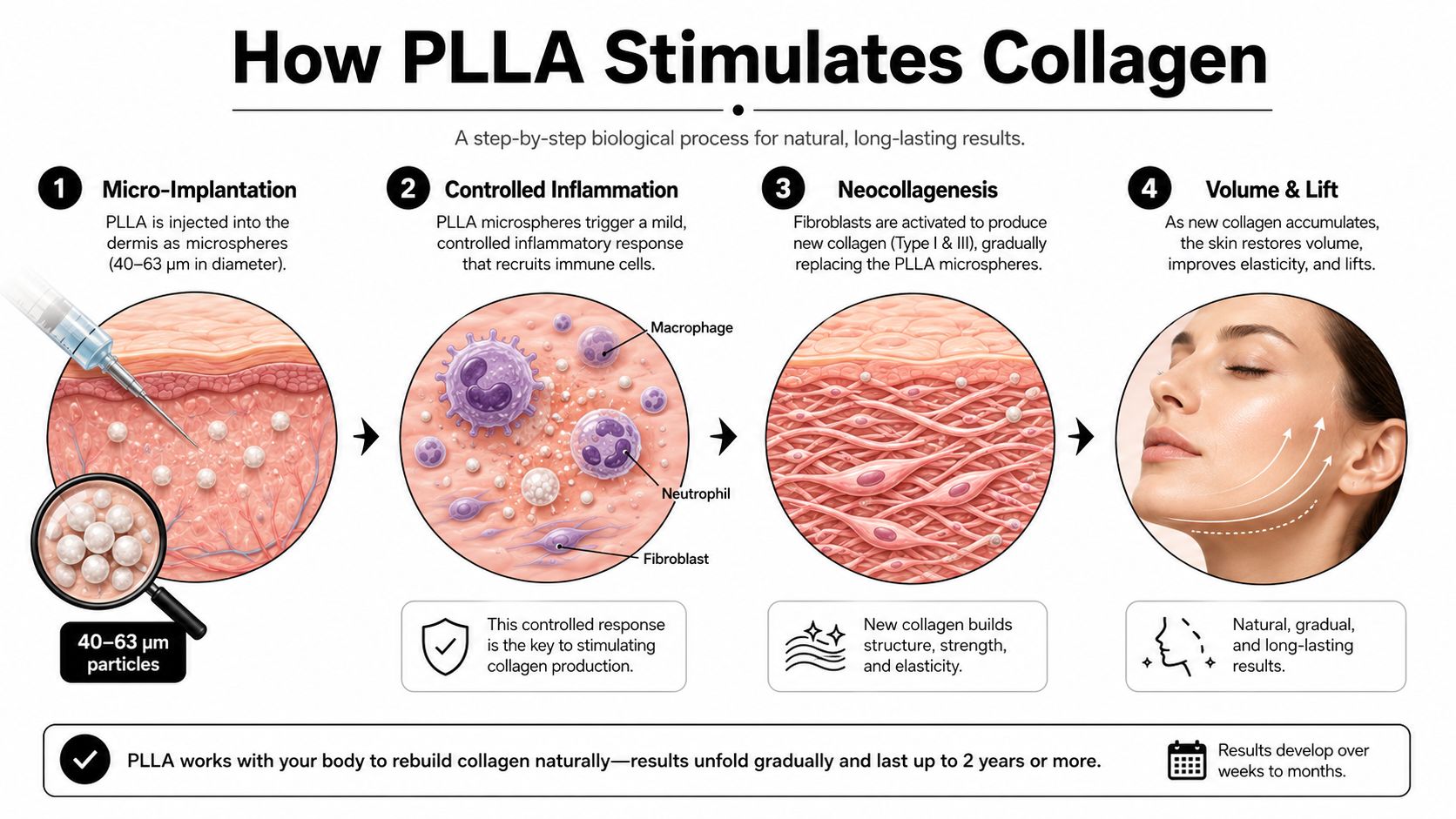
PLLA works because the body reads it as a signal, not as simple filler volume. The injectable material is made of microparticles that are typically about 40 to 63 μm in diameter, a size selected to reduce phagocytosis by dermal macrophages and allow the particles to pass through fine needles such as 26G (American Society for Aesthetic Plastic Surgery review). That sounds technical, but the design directly affects safety, injectability, and how the product disperses under the skin.
After placement, the particles gradually hydrolyze into lactic acid. The local response encourages fibroblasts to make new collagen, which is why PLLA behaves more like a slow-release scaffold than a gel that occupies space. Published reviews describe PLLA as biodegradable and biocompatible, and note that it is ultimately metabolized through the same pathway as lactic acid into carbon dioxide and water.
That is easier to understand if you compare it with a support frame under a new structure. A hyaluronic acid filler adds immediate volume in the spot where it is placed. PLLA works over time by giving the skin a framework that the body gradually integrates, so the visible change develops more slowly but can look more blended with facial movement.
The biologic response depends on careful preparation and placement. Reconstitution, injection depth, and massage all influence how evenly the particles spread, and that affects the risk of clustering or palpable nodules. That is why the same product can look excellent in one set of hands and disappointing in another.
A practical place to start is this guide to the best facial fillers, because it helps place PLLA in context with other injectable choices without mixing products that work in very different ways.
The easiest way to think about PLLA is as a construction project under the skin. If the material is distributed well, the body can build evenly around it. If it is not, the result can be uneven and frustrating.
That gradual biological response is also why PLLA often ages gracefully. The restoration is not trying to override your face, it is trying to support it from within.
Choosing a filler without understanding its mechanism is how people end up mismatching treatment to goal. Poly-L-lactic acid filler, hyaluronic acid, and calcium hydroxylapatite can all improve facial aging, but they solve different problems. If you want fast shaping, you're usually looking at hyaluronic acid. If you want a middle ground, CaHA often fits. If you want a slower collagen-building approach, PLLA is the more logical choice.
The easiest way to sort them is by asking one question, what do you need most, speed, reversibility, or structural rebuilding? That question usually tells you more than brand names do.
| Feature | Poly-L-Lactic Acid (PLLA) | Hyaluronic Acid (HA) | Calcium Hydroxylapatite (CaHA) |
|---|---|---|---|
| Main mechanism | Collagen stimulation | Immediate gel volume | Volume plus some biostimulation |
| Onset of visible change | Gradual | Immediate | Immediate with gradual support |
| Best fit | Patients who want progressive restoration | Patients who want precise, fast correction | Patients who want a middle path |
| Reversibility | Not the same as dissolvable gel fillers | Dissolvable | Not dissolvable like HA |
| Maintenance style | Session-based journey | Touch-ups as needed | Intermediate maintenance approach |
PLLA is the least “instant” of the three, but that's also its advantage for the right patient. It's meant for people who can accept a slower path in exchange for a more collagen-driven result. HA remains better for corrections where precision matters, especially when a patient wants to see the effect in the chair before leaving.
CaHA sits in the middle. It offers a different balance of lift and stimulation, but it doesn't behave exactly like PLLA, and it shouldn't be grouped into the same mental bucket just because both can support collagen. If you're still deciding which filler family fits your goals, this guide to the best facial fillers is a useful starting point for sorting the options by use case rather than by trend.
The decision usually comes down to your tolerance for waiting. PLLA rewards patience, HA rewards immediacy, and CaHA often appeals to patients who want a compromise between the two.
A strong PLLA plan starts before the first injection. The consultation should review facial structure, skin quality, the pattern of volume loss, and whether your goals fit a treatment that works gradually. Because the material has to be prepared in advance, reconstitution is part of the treatment itself, not a behind-the-scenes detail, and it affects how smoothly the session proceeds.
The injection visit is usually straightforward, but the pacing matters. PLLA is commonly used as part of a multi-session treatment course, so patients should expect a staged process rather than a single appointment that leaves the final result behind immediately. A published PMC facial-rejuvenation study found that visible wrinkle improvement increased after treatment, which supports the broader point that change develops over time instead of appearing all at once.
The early recovery period is often manageable, yet it is rarely invisible. The same facial-rejuvenation study reported mild inflammation as the most common adverse event after treatment, with no severe events reported in that group, which helps explain why bruising, swelling, tenderness, and temporary inflammation belong in the normal pre-treatment conversation.
For patients, the aftercare step that gets overlooked most often is massage. Proper massage helps distribute the product more evenly and can reduce clustering, which matters because PLLA depends on uniform deposition to build smooth collagen support. If a patient skips this step, the chance of unevenness rises.
A simple way to understand the timeline is this: the first appointment places the material, the tissue then responds over the following weeks, and later sessions refine the result.
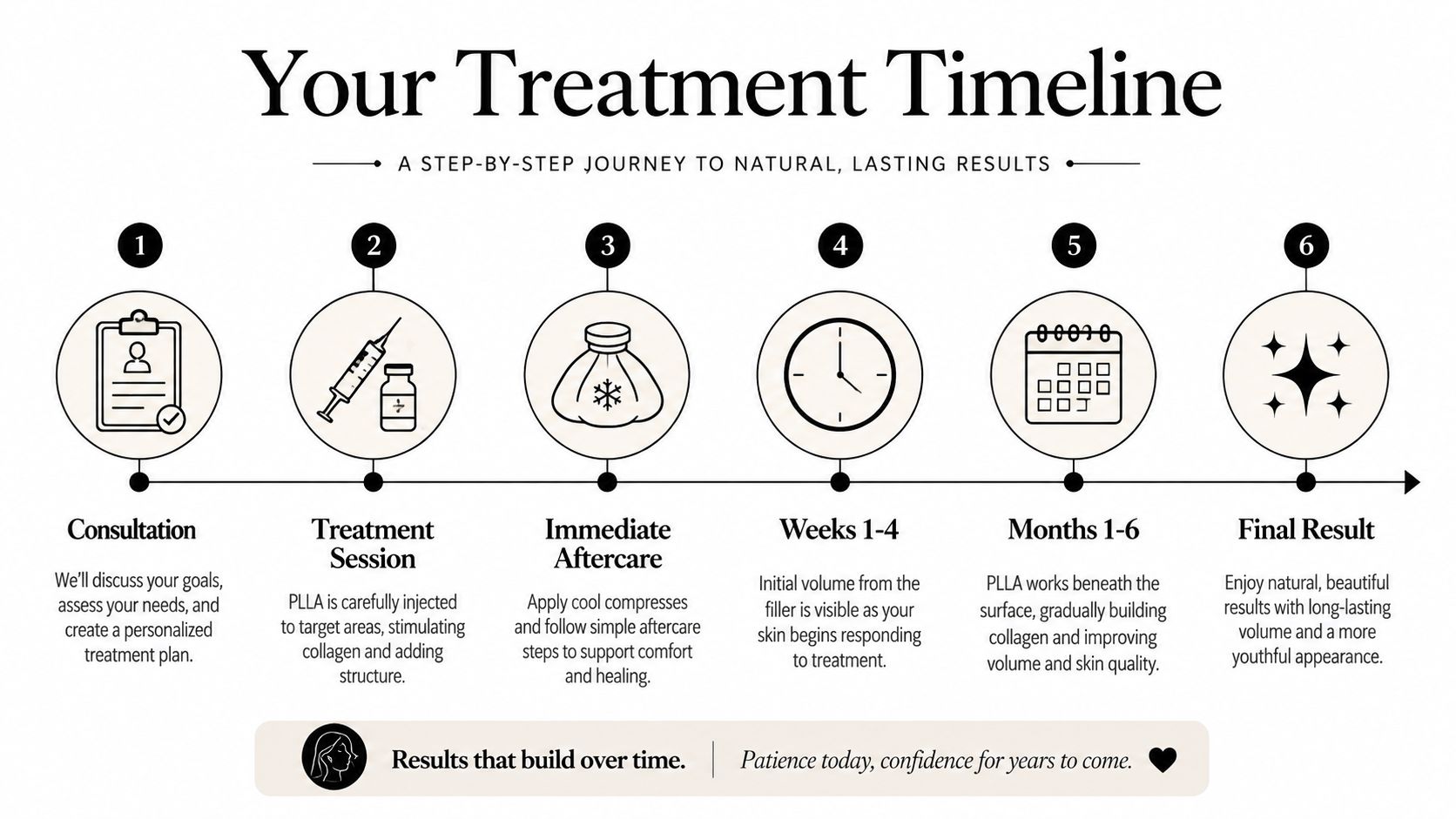
The mistake I see most often is asking PLLA to behave like a quick cosmetic tweak. It requires a staged collagen-building plan rather than a single visit.
The best PLLA candidate is not the person who wants the fastest result. It's the person who wants a gradual, natural-looking improvement and understands that treatment usually unfolds across multiple sessions. That expectation matters because satisfaction with PLLA depends less on chasing immediate volume and more on accepting a biologic process that takes time.
PLLA tends to make the most sense for patients with generalized facial volume loss, especially when they want support that doesn't look overfilled. It's also a strong option for people who value a soft, progressive change rather than a dramatic one-shot correction.
The caution list is just as important. StatPearls lists important contraindications including allergy to components and caution or contraindication in patients with a history or predisposition to keloids or hypertrophic scarring (NCBI Bookshelf). The American Society for Dermatologic Surgery also notes that PLLA is not recommended in people with oral herpes, uncontrolled diabetes, clotting problems, lupus or other connective-tissue disorders, pregnancy, or breastfeeding (NCBI Bookshelf).
Practical takeaway: if someone needs a one-time quick fix, PLLA is usually the wrong tool. Session frequency matters more than trying to load extra product into a single visit.
That point is often glossed over in consumer content. More product per session doesn't automatically create better results, and in PLLA, careful planning beats aggressive dosing almost every time. The material works best when the face has time to respond between sessions.
Patients deserve to know that evidence quality in some facial-rejuvenation literature is still limited, even though outcomes are often favorable (NCBI Bookshelf). That doesn't make the treatment unreliable. It does mean the best results come from thoughtful candidate selection, honest timelines, and a provider who doesn't oversell what the product can do.
If you're the type of patient who wants to compare options first, that's a good sign. PLLA should be chosen deliberately, not by default.

PLLA is often introduced as a facial filler, but that framing is too narrow. Recent reviews support benefit for the neck, knees, abdomen, hands, and upper arms, and they also discuss use for contouring, laxity, dimpling, cellulite, and scarring with minimal side effects in selected patients (NIH review). That broader use makes sense because collagen stimulation matters just as much on the body as it does on the face.
The practical issue is that body areas usually need a different treatment mindset. Skin on the neck or hands doesn't behave like cheek tissue, and cellulite or laxity problems are not solved by placing the same product in the same way. PLLA is attractive here because it's working on skin quality over time, not only on immediate volume.

The body often needs a slower, more diffuse strategy. On the face, a small shift in support can change how light hits a contour. On the body, the goal is often skin quality, firmness, and smoother texture rather than a dramatic shape change.
That's why PLLA can be useful in areas where hyaluronic acid fillers are less practical. It doesn't behave like a simple “add volume here” product. It's better suited to regions where tissue quality matters more than sharp contour.
For readers thinking beyond the face, this overview of body contouring procedures can help frame where injectable approaches fit among other options. It's especially helpful if you're trying to separate skin-quality treatments from true contour-changing operations.
The most realistic expectation is improvement in texture and support, not perfection. Patients who do best with body PLLA usually want visible but subtle refinement, and they're comfortable with the fact that treatment plans can vary by area. The neck is not the knee, and the abdomen is not the hand.
If you're considering PLLA for the body, the main question is whether your concern is volume, laxity, or surface quality. PLLA helps most when collagen loss is part of the problem.
PLLA is technique-sensitive, so the provider matters as much as the product. Reconstitution, injection depth, session planning, and massage instructions all affect outcome, which is why a board-certified plastic surgeon's oversight can make a real difference in a treatment this dependent on judgment.
At Cape Cod Plastic Surgery, Dr. Marc Fater brings more than 30 years of experience to patient evaluation and planning, and the practice operates with an AAAASF-accredited surgical suite that reflects a strong safety culture. That matters for patients who want a careful discussion of whether PLLA fits their anatomy, timeline, and tolerance for gradual change.
A patient who asks about PLLA often isn't asking only about filler. They're asking whether there's a reliable way to look rested without appearing obvious. The best consultations answer that by comparing goals, not just products, and by making sure the treatment choice fits the face in front of the clinician.
For practices that are also thinking about how they communicate this kind of service to patients, a resource on fractional paid media oversight for practices can be helpful in understanding how specialized services are presented clearly. Clear communication matters when the treatment itself requires patience and precision.
If you're considering poly-L-lactic acid filler and want a consultation that focuses on candidacy, timeline, and realistic results, Cape Cod Plastic Surgery can help you decide whether it's the right fit. Visit Cape Cod Plastic Surgery to learn more about filler treatments and schedule a visit with a team that treats PLLA as a planning conversation, not a quick sale.
September 9, 2026
Expert Guide to Proper Surgical Incision Care

Master dermal fillers aftercare with do's and don'ts, swelling tips, activity limits and warning signs to protect your results and heal smoothly.

September 8, 2026
Ensuring Safety: Why Your Surgeon's Credentials Matter Most

Cape Cod Plastic Surgery offers expert cosmetic and reconstructive procedures in a safe, accredited setting. Led by Dr. Marc Fater, we combine advanced techniques with personalized care to help you look and feel your best.
Monday: 9:00 AM – 5:00 PM
Tuesday: 9:00 AM – 5:00 PM
Wednesday: 9:00 AM – 5:00 PM
Thursday: 9:00 AM – 5:00 PM
Friday: 9:00 AM – 5:00 PM