

October 7, 2026
What to Expect During Your Breast Surgery Recovery
A Practical Guide to Healing After Breast Surgery
Jan 14, 2026

Technically, the legal age to get lip fillers is 18. However, the FDA’s official recommendation is to wait until you are at least 21. The right age, though, isn't just a number on a calendar. It's a combination of physical maturity, emotional readiness, and having clear personal goals for the treatment.
Deciding to get lip fillers is a significant step that goes far beyond meeting a minimum age requirement. Think of it as a personal aesthetic journey—one that demands careful thought about several key factors. At Cape Cod Plastic Surgery, Dr. Marc Fater’s patient-first philosophy means we always prioritize safety, ethics, and achieving beautifully natural results that complement your unique facial anatomy.
This guide will walk you through the crucial milestones—legal, medical, and developmental—to help you understand why patience is often the best approach. It’s all about making sure this decision is the right one for you, both for today and for the long run.
In the United States, you can legally consent to a cosmetic procedure like lip fillers at 18 years old. However, the FDA has only approved most popular dermal fillers for adults who are 21 and over. Here in Massachusetts, ethical practices like ours often have their own safeguards in place. For instance, at Cape Cod Plastic Surgery, Dr. Marc Fater may require parental consent for patients between the ages of 18 and 20 to ensure everyone is on the same page. You can learn more about age-related requirements at our partner medspa.
This timeline helps visualize the key age-related benchmarks for considering lip fillers.
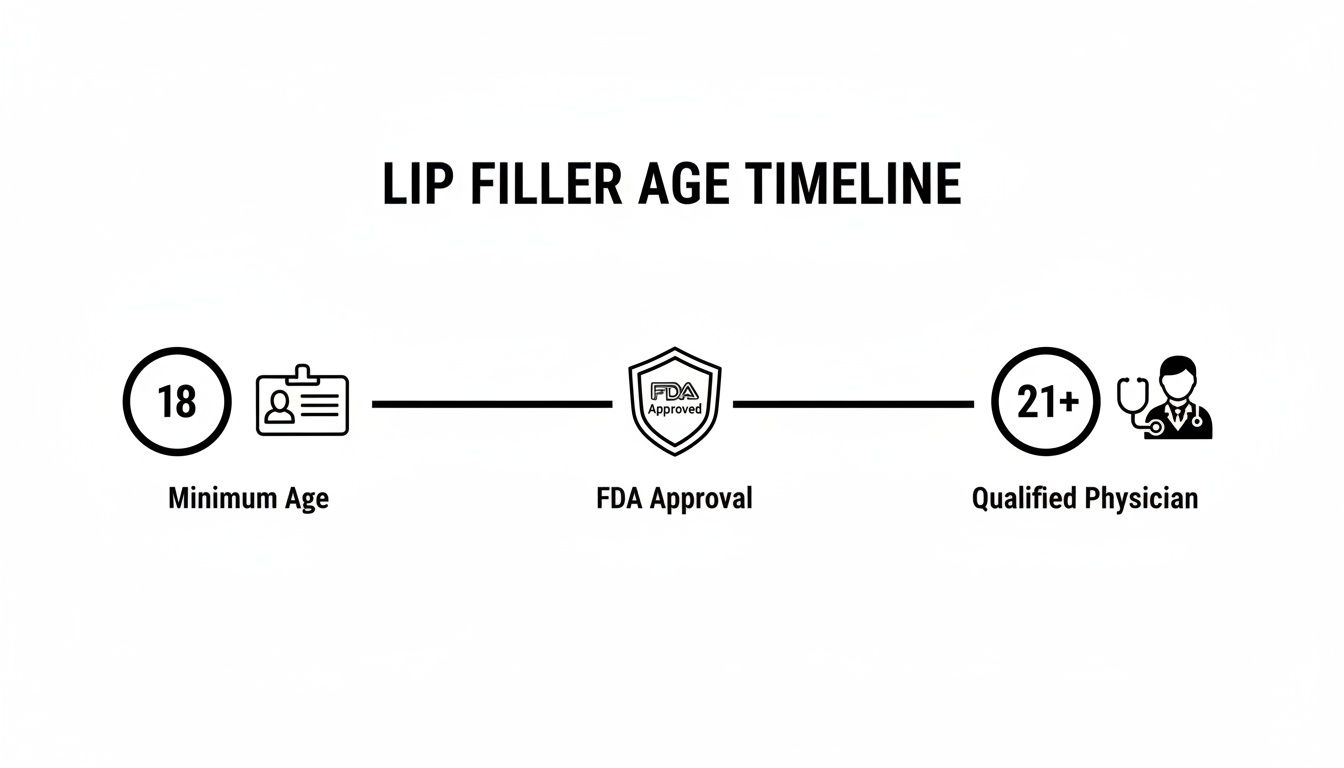
The infographic really drives the point home: while you can legally say "yes" at 18, the medical community and regulatory bodies like the FDA strongly suggest waiting until 21. Why? By then, your facial structure has largely finished developing, giving us a stable canvas to work with.
To make these distinctions clearer, here’s a quick summary of the key age milestones.
This table shows why the conversation is more nuanced than just one legal age. Each stage of young adulthood brings different considerations to the table.
True readiness for an aesthetic procedure is a blend of physical maturity and emotional clarity. It's our job to evaluate both, ensuring every treatment enhances a patient's well-being for years to come.
Ultimately, the best time to get fillers is when you are fully informed, confident in your choice, and have found a provider who puts your long-term health and happiness first. This careful approach is what turns a simple procedure into a positive and empowering experience.
Thinking about the right age for lip fillers goes way beyond just the legal requirements. It’s really about the biology of how your face grows and settles. Imagine your facial structure is like the foundation of a house—you wouldn't start hanging pictures and putting up expensive wallpaper until you're absolutely sure the foundation is solid and done shifting.
Your face, especially through your late teens and into your early twenties, is still a work in progress. The bones, the soft tissue, even the projection of your chin and cheeks are subtly changing. This whole process culminates in what we call facial skeletal maturity, which is just the medical term for when your features have finally reached their adult form.
Facial skeletal maturity isn't just a vague idea; it's a real, measurable milestone. For most of us, this doesn't fully happen until we're in our early twenties. Trying to add volume with fillers before your own features have finished their journey is like decorating a room before the drywall is even up. The final look just might not come together the way you'd hoped.
When fillers are introduced too early, you can get a result that looks great for a little while but starts to look unbalanced as your face continues to mature around it. For instance, lips that looked perfectly proportional on a 19-year-old could suddenly seem overfilled and out of place by the time they're 22, once their jawline and cheeks have fully settled. This is a huge reason why experienced practitioners urge a little patience.
"A patient-first approach means prioritizing long-term harmony over short-term trends. We aim to enhance your natural anatomy, not work against its developmental process, ensuring results that remain beautiful for years."
Here at Cape Cod Plastic Surgery, our whole philosophy is about working with your unique anatomy. Dr. Fater's expertise is built on creating enhancements that look both beautiful today and stand the test of time. That requires a genuine understanding of how facial structures change as we age.
Waiting until your face is fully developed is the best way to sidestep some common issues and get a much more predictable, beautiful result. The main worries with getting fillers too young really boil down to a few key things:
By waiting until you’re at least 21, you’re giving your face the time it needs to create that stable foundation we've been talking about. A little bit of patience now means we can create an enhancement that truly complements your natural beauty for the long haul. It saves you from the frustration of future corrections and delivers a result you can feel great about for years to come. This is a core part of the conversation when we discuss what age you can get lip fillers with our patients.
Figuring out the "right" age for lip fillers can feel a bit like a maze. You have state laws on one side and FDA recommendations on the other, and they don't always say the same thing.
Legally speaking, most states set the age for medical consent at 18 years old. This means that once you're 18, you can technically walk into a clinic and consent to a procedure like lip fillers yourself. But that’s only half the story.
The other, and frankly more important, piece of the puzzle comes from the U.S. Food and Drug Administration (FDA). The FDA’s job is to make sure medical products, including the dermal fillers we use, are safe and effective. Their guidelines aren't laws, but they're based on rigorous clinical trials that establish when a product is proven to be safe for a specific age group.
The FDA’s recommendations aren’t just arbitrary numbers; they’re grounded in solid science and patient safety. For most of the popular hyaluronic acid fillers on the market, the FDA has set an approved age of 21 or 22 years old.
Why so specific? It all comes down to when your face is truly finished developing. By age 21 or 22, your underlying facial bones have typically reached full maturity.

This is a huge deal. Injecting fillers before that foundation is fully set can lead to results that look good now but become unbalanced or disproportionate as your face continues to subtly change. In fact, safety trials show that complication rates can drop by as much as 25% in patients over 21 compared to younger individuals. It's a key reason why any practitioner worth their salt will follow FDA guidance, not just the bare minimum legal age.
At its core, the distinction is simple: state law addresses your legal right to consent, while FDA guidelines address the product's proven safety for your specific age group. An ethical practice prioritizes both.
Here at Cape Cod Plastic Surgery, we’re committed to the highest standards of patient care. Our policies are designed to meet—and often go beyond—the basic legal requirements. We follow the stricter FDA guidelines to make sure every procedure is not just legally sound, but also medically appropriate and safe for you.
Our commitment to your safety isn't just a promise; it's backed by our facility's accreditation from the American Association for Accreditation of Ambulatory Surgery Facilities (AAAASF). This isn't just a plaque on the wall. It’s a sign that we've voluntarily undergone intense, ongoing scrutiny to prove we meet the highest national standards for quality care and patient safety.
An accredited facility is held accountable for everything from the sterility of our on-site surgical suite to the credentials of our medical team. You can learn more about why accreditation and certification are crucial in plastic surgery in our detailed article on the topic. Choosing an accredited practice gives you peace of mind, knowing you’re in an environment that puts your long-term health and beautiful results above all else.
When a young adult comes in to talk about lip fillers, our consultation goes far beyond just discussing size or volume. Think of it as a genuine, educational conversation we have together. Our entire goal is to make sure you feel confident and fully informed before making any decision.
The first thing we'll do is just talk. I want to hear what you're hoping to achieve. Are you looking for a little bit of subtle plumpness, more definition around the edges of your lips, or maybe to even out a bit of natural asymmetry? This is also where we touch on your motivations—we want to be sure this is a choice you're making for yourself, not because of a passing social media trend.
Next, Dr. Fater will do a careful analysis of your facial anatomy. This isn't just about zeroing in on your lips; it's about looking at your entire face—how your lips relate to your nose, chin, and jawline. This holistic perspective is the key to creating results that look balanced and natural, and that will continue to complement your features as you mature.
We’ll also have a very honest chat about what fillers can and can't do. The aim isn't to make you look like you've had "work done." It's about enhancing what you already have in a way that feels completely authentic to you.
A responsible consultation isn't about selling a procedure; it's about building a partnership. We provide the medical expertise and aesthetic guidance, while you provide the personal goals and motivations. Together, we determine the best path forward.
The consultation is also the time for total transparency. We’ll walk through every single detail, from the specific type of filler we’d recommend for you to the potential risks and side effects. You'll leave knowing exactly what to expect for aftercare and during the healing process.
We take this thorough approach to remove any mystery from the experience. To get a better sense of how we handle these meetings, our guide on preparing for your initial plastic surgery consultation offers some great insights. At the end of the day, our commitment is to a responsible, personalized process that puts your safety and long-term happiness first.
When we talk about the right age for lip fillers, the conversation quickly moves beyond just a number. For anyone under 18, it becomes a crucial discussion about consent, maturity, and ethical medical practice. While the law might simply require a parent's signature, a truly responsible practice sees that as just the first step.
An experienced, board-certified surgeon like Dr. Fater is trained to see the bigger picture. We have to consider the incredible social pressures young people are navigating today. The decision to get a cosmetic treatment should always be about enhancing one's own confidence, not chasing a passing trend seen on social media.

This patient-first mindset is becoming the global standard. Most countries set the minimum age for lip fillers at 18+, and many are tightening regulations after seeing a spike in procedures among teens. In fact, an estimated 70% of board-certified surgeons now prefer to postpone purely cosmetic treatments for minors, even when they have parental consent. It’s all about prioritizing a patient's long-term happiness and well-being over a short-term request.
Legally, getting a signature on a consent form might be enough to proceed. The legalities around parental consent can be complex, and for context, you can look at examples like how to notarize a child travel consent form to understand the formal processes involved. But ethically, the bar is set much, much higher in a medical setting.
At Cape Cod Plastic Surgery, our ethical compass is what truly guides us. A patient’s psychological readiness and potential for long-term satisfaction will always be our top priorities. It's not about checking a box; it's about making sure every treatment is a positive and empowering experience.
This means we invest time in real conversations. We want to understand the why behind the request and set realistic expectations. Frankly, a patient's maturity and grasp of the procedure's implications matter far more than the date on their driver's license.
Of course, there are very specific and rare circumstances where fillers might be considered for a minor. These situations are almost always reconstructive, not purely cosmetic.
In these cases, the goal isn't just enhancement—it's restoration. Every situation is unique and requires a compassionate, nuanced evaluation. This is a collaborative decision made between the patient, their parents, and Dr. Fater, always with the young person's health and emotional well-being as the number one priority.
If you’re wondering “what age can you get lip fillers,” you might also be curious about what else is out there. Dermal fillers are a fantastic option, but they aren't the only way to enhance your smile, especially if you're not quite ready for an injectable treatment. The good news is, several effective alternatives can help you get a fuller, more defined lip look without a single needle.
A lot of people are surprised by the difference a high-quality lip-plumping gloss can make. These products often use ingredients like cinnamon oil or peppermint, which boost blood flow to the lips for a short time. This causes a bit of temporary swelling that really brings out their natural volume. It's a simple, safe way to test-drive a plumper look.
Beyond specialized products, don't underestimate the power of simple daily habits. Staying hydrated is foundational—drinking plenty of water keeps your lips naturally full and prevents them from looking thin or deflated. You can also gently exfoliate with a soft brush or a sugar scrub to slough off dead skin. This reveals a smoother surface that reflects light better, making your lips appear healthier and more prominent.
And of course, makeup is an incredibly powerful tool for creating the illusion of volume. Professional artists have a few tricks up their sleeves:
Your aesthetic journey is personal, and our goal is to be a trusted resource every step of the way. We provide expert guidance that serves your best interest, whether it involves a procedure with us or exploring non-invasive options first.
Many people also find beautiful results with cosmetic solutions that enhance lips in a more natural way. For instance, a complete guide to vegan lip stain can provide gorgeous color and subtle definition without injectables. These alternatives empower you to enhance your look on your own terms while you think about your long-term aesthetic goals.

It’s completely normal to have questions, even after you’ve done your research. Let's tackle some of the most common ones we hear from patients, giving you straightforward answers from our team's perspective.
Legally, yes. Once you turn 18, you're considered an adult who can consent to your own medical procedures in most states. However, there's a big difference between what's legal and what's recommended for the best, safest outcome.
Here at our practice, we follow the science. The FDA has approved most dermal fillers for individuals who are 21 and older, and we stand by that guidance. The first step is always a thorough consultation with Dr. Fater, where we can assess your unique facial anatomy and emotional readiness, which are far more important than just the number on your driver's license.
The biggest risk is getting an outcome that looks "off" or unnatural down the road. Your facial structure is still settling into its final form well into your late teens and early twenties. Placing filler on a facial "foundation" that's still under construction can lead to disproportionate results as your features mature around it.
There's also the emotional side to consider. A decision made based on a passing social media trend can easily lead to regret. Waiting until you're a bit older ensures the choice is truly your own and that the final look will complement your mature facial structure for years to come.
The goal of any aesthetic treatment should be long-term satisfaction. By respecting the natural timeline of facial development, we can create enhancements that look beautiful and appropriate as you gracefully mature.
This is probably one of the most persistent myths out there, and the answer is a firm no. Your lips will not sag or look stretched out after the filler is gone.
Hyaluronic acid fillers, like those in the Juvéderm family, are designed to be naturally and safely metabolized by your body over time. They don't cause permanent changes to your skin's elasticity. In fact, many patients find that the filler treatment has a bonus benefit—it can stimulate a little of your body's own collagen production, leaving your lips with slightly improved texture and hydration even after they've returned to their original size.
We go to great lengths to make this experience as comfortable as possible. Most of the advanced fillers we use, including the entire Juvéderm line, come with lidocaine (a local anesthetic) already mixed in. This starts working to numb the area from the inside out as soon as the injections begin.
Before we even start, we'll apply a high-strength topical numbing cream to the surface of your lips. You might feel a slight pinch or a bit of pressure, but Dr. Fater’s gentle, practiced hand makes the entire process quick and very tolerable. Most of our patients are pleasantly surprised at how easy it is. If you're curious about how long these beautiful results stick around, you can learn more in our guide to how long lip filler lasts.
October 7, 2026
A Practical Guide to Healing After Breast Surgery

October 6, 2026
Your Safety Guide: What to Look for When Choosing a Plastic Surgeon

October 5, 2026
Why Our On-Site Accredited Facility Matters for Your Safety

Cape Cod Plastic Surgery offers expert cosmetic and reconstructive procedures in a safe, accredited setting. Led by Dr. Marc Fater, we combine advanced techniques with personalized care to help you look and feel your best.
Monday: 9:00 AM – 5:00 PM
Tuesday: 9:00 AM – 5:00 PM
Wednesday: 9:00 AM – 5:00 PM
Thursday: 9:00 AM – 5:00 PM
Friday: 9:00 AM – 5:00 PM