

October 7, 2026
What to Expect During Your Breast Surgery Recovery
A Practical Guide to Healing After Breast Surgery
Feb 26, 2026

It’s completely understandable to feel a bit of panic when you see new spots pop up after a chemical peel. You just invested in clearer skin, so what gives? The truth is, a breakout after a chemical peel is not only common but often a really good sign that the treatment is working its magic.
This isn't a typical acne flare-up. It’s a process called "skin purging," which is your skin’s way of clearing out all the gunk that was hiding deep below the surface.
Let's be honest, seeing pimples after a professional treatment can feel defeating. But I want you to reframe how you see it. Think of your chemical peel as a deep, professional cleaning for your skin—like decluttering a messy closet.
The peel uses a specialized acid solution to speed up your skin's natural exfoliation process. This doesn't just sweep away the dead cells you can see; it reaches down into your pores and pushes everything else up and out. We're talking about trapped oil, dead skin, and all those tiny, invisible clogs (called micro-comedones) that were just waiting for their chance to become full-blown pimples.

Instead of those hidden clogs turning into pimples over the next several weeks or months, the peel brings them all to the surface at once. This intense, coordinated clear-out is what we call skin purging. Your skin is literally pushing out the bad stuff to make way for the good.
Knowing the difference between purging and a true breakout is key to staying sane during recovery. A real breakout involves new pimples forming, while purging is just the rapid-fire eviction of clogs that were already there.
Here’s how you can usually spot a purge:
A simple way to think about it: The peel didn't create the problem. It just exposed the underlying congestion that was already brewing and kicked it out for good. It's a sign of progress, not a step backward.
So, while it feels completely backward, those initial blemishes are often the opening act for the clear, glowing skin you came for. Trust the process. This phase is a temporary but necessary step on your journey to healthier, more radiant skin.
To really get why breakouts can happen after a chemical peel, it helps to think of your skin as more than just a surface. Imagine it’s a garden. Over time, things like old roots and small stones—or in your skin’s case, trapped oil, debris, and dead cells—get buried just under the topsoil.
A chemical peel is like tilling that garden. The active ingredients, whether it's glycolic or salicylic acid, don't just sit on top. They sink in and kick cellular turnover into high gear. This process shoves everything lurking in the lower layers of your skin up to the surface, and fast. All those impurities that were already brewing underneath are suddenly forced out all at once.
That sudden rush of blemishes isn't your skin creating new acne. It's actually just clearing out what was already there: pre-existing micro-comedones, which are the tiny, invisible seeds of future pimples. These are clogs that would have probably popped up as random zits over the next few weeks or months anyway. The peel just puts them all on an express train to the surface.
This process, known as skin purging, is a good sign. It means the treatment is working exactly as it should, cleaning your pores from the inside out. It's not a step backward—it's a necessary step forward to getting genuinely clear skin.
To really wrap your head around purging, it helps to know what causes clogged pores in the first place. A chemical peel essentially clears out the traffic jam of dead cells, giving all that hidden gunk a clear path to exit.
Knowing how to tell the difference between a purge and a regular breakout can save you a lot of stress. They might look similar, but their causes and timelines are completely different.
Once you understand the science, you can see the process for what it is. You're not having a flare-up; you're watching an accelerated deep-clean in action. This phase is temporary, and it's a fantastic sign that your skin is on its way to a healthier, renewed state. For a deeper dive into the treatment itself, take a look at our guide on what chemical peels do and who they are for.
Knowing what’s coming after your chemical peel can turn a potentially stressful week into a confident, well-managed recovery. The healing process isn't the same for everyone; it’s directly tied to the strength and depth of your treatment. A breakout after a chemical peel simply looks and feels different depending on whether you had a light, medium, or deep peel.
Think of it like a workout for your skin. A light, superficial peel is like a brisk walk—you get a great refresh with almost no downtime. A deep peel, on the other hand, is more like running a marathon. It’s a bigger commitment with a more intense recovery, but the results are truly remarkable. This timeline will be your map for the journey.
Immediately after you leave our office, your skin will probably feel tight and look a little flushed, a lot like a mild sunburn. This is completely normal. In this early stage, the goal is simple: be gentle and protect the fresh, vulnerable skin.
During days 1-3, your main job is to let your skin rest and prepare for what’s next. This is the period when the peel solution is doing its deep work, getting ready to push underlying congestion up and out. If any small blemishes appear now, it's the start of that "great purge" we talked about.
This visual gives a great overview of the whole process, from the day of treatment to the final, glowing result.
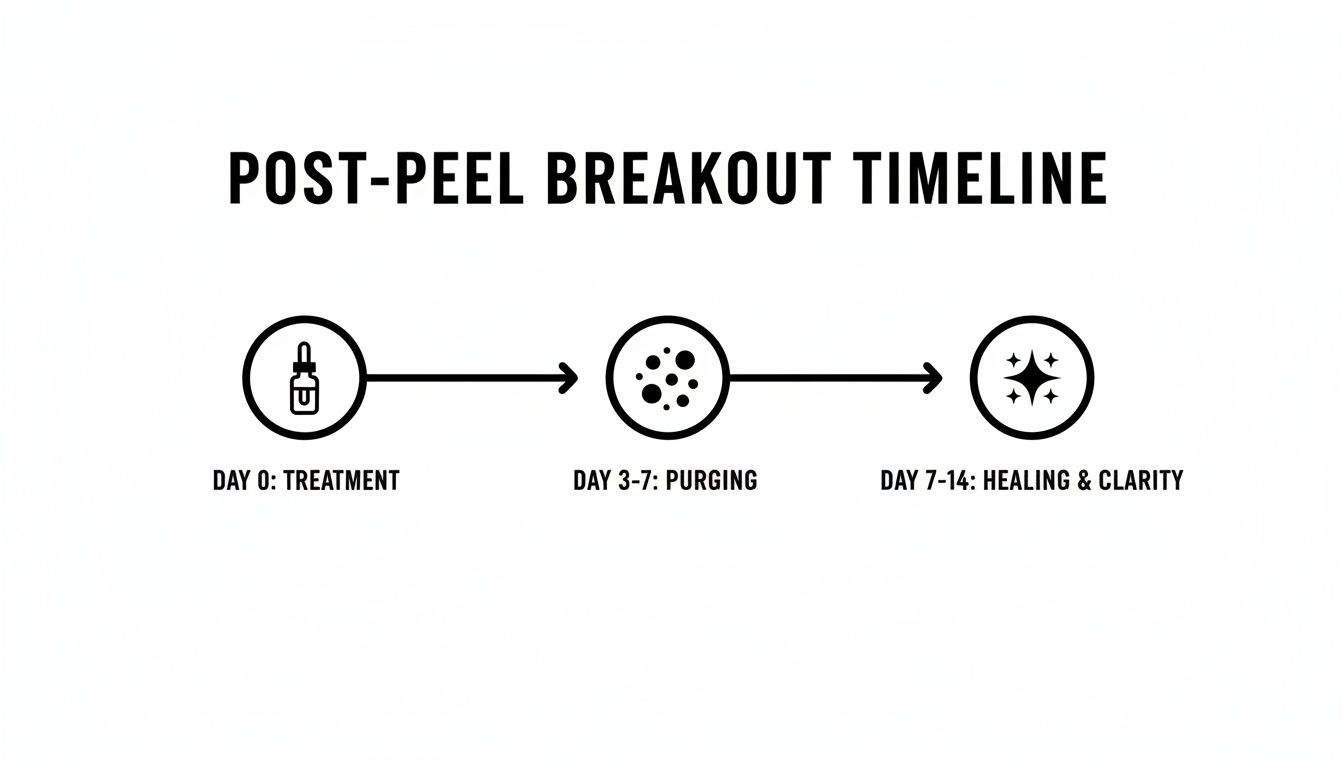
As you can see, the purging phase is a temporary, middle step on the path to clearer skin. It’s a sign that things are working exactly as they should.
This is the phase everyone asks about, and it usually kicks in between days 3-7. You'll see the most noticeable flaking and shedding of old skin during this time. Not surprisingly, this is also when a breakout after a chemical peel is most likely to show up. As those dead skin cells slough away, all the gunk that was trapped beneath them finally comes to the surface.
This is the peel doing its job. Think of it as a deep, effective spring cleaning for your pores. Whatever you do, resist the temptation to pick, scrub, or peel the flaky skin or any blemishes. This can cause serious irritation and even lead to scarring.
Now, how intense this gets really varies. For light, superficial peels, the breakout risk is low, with only 15-20% of patients reporting a few temporary spots. Medium-depth peels are more active, with about 40-50% of people experiencing a noticeable purge. With deep peels, the purge is more significant, affecting up to 60-70% of patients and sometimes lasting for 10-14 days. If you want a deeper dive, you can read more about the chemical peel recovery process and its stages.
Once you get past the peak shedding phase, your skin moves into its final healing stage. By days 7-14, the flaking should be nearly gone, and any blemishes from the purge will start to fade away. What you’ll see in the mirror is smoother, brighter, and more radiant skin.
To give you a clearer picture, here’s a breakdown of what to expect for breakouts based on your specific peel.
This table illustrates the typical onset, peak, and resolution period for post-peel breakouts based on the intensity of the chemical peel.
Understanding this progression helps you see that what’s happening is a normal and predictable part of skin renewal. It allows you to relax, trust the process, and follow your aftercare instructions, knowing that incredible results are just on the other side.
How you care for your skin after a chemical peel is just as important as the treatment itself. A smart, gentle routine is your secret weapon against irritation and will help you navigate any post-peel purging with ease. Think of your skin as a delicate new canvas; it needs to be protected, hydrated, and mostly left alone to reveal its best work.
The goal here isn't to do more, but to support your skin’s own healing process. This means taking a temporary break from your usual active skincare and embracing a much simpler, minimalist approach. Using the wrong products or habits can easily turn a normal breakout after a chemical peel into a much bigger headache.

For the first 7-14 days, your routine should be incredibly simple and focused on kindness. We're prioritizing three things: cleansing without stripping, moisturizing to rebuild, and protecting from the sun at all costs.
Gentle Cleansing Only: Wash your face with lukewarm water and a very mild, soap-free cleanser. You want to avoid anything with harsh foaming agents, exfoliants, or fragrances. When you're done, gently pat your skin dry with a clean, soft towel—absolutely no rubbing.
Hydrate and Repair: Right after cleansing, while your skin is still a little damp, apply a generous layer of a barrier-repairing moisturizer. This is where ingredients like ceramides and hyaluronic acid become your best friends. They work to rebuild your skin’s protective layer and lock in that much-needed moisture.
Sunscreen is a Must: Your fresh, new skin is incredibly sensitive to sun damage. Every single morning, apply a broad-spectrum, mineral-based sunscreen with an SPF of 30 or higher. And yes, that includes days you’re staying indoors. If you're outside, be diligent about reapplying it every two hours.
Getting through the healing phase is pretty straightforward if you stick to a few ground rules. Following these tips will help ensure your skin recovers smoothly, setting you up for that beautiful, glowing result.
DO drink plenty of water to keep your skin hydrated from the inside out.
DO sleep on a clean pillowcase each night to minimize contact with bacteria.
DO use cool compresses if you're feeling any significant redness or swelling.
DON'T pick, peel, or scrub at flaking skin or any blemishes that pop up. This is the quickest way to cause more inflammation, post-inflammatory hyperpigmentation, or even permanent scars. Just let the skin shed on its own timeline.
DON'T use any of your "active" ingredients. That means putting away the retinoids (Retin-A), vitamin C serums, exfoliating acids (AHA/BHA), and any acne spot treatments for at least one to two weeks, or until your provider gives you the okay.
DON'T expose your skin to intense heat from saunas, steam rooms, or sweaty workouts. Heat can dial up inflammation, which is the last thing you want right now.
The most important principle of post-peel care is simple: Less is more. Your skin has an incredible ability to heal itself; your only job is to create the perfect, gentle environment for it to do just that.
Choosing the right products is a huge part of successful skin recovery. Just like with other treatments, it’s important to find essential aftercare products that soothe and protect. While your post-peel needs are unique, the core idea of gentle care is universal. For a more detailed breakdown tailored to specific treatments, you can explore our guide to TCA peel post-care. By following these steps, you’ll support your skin through any purging and emerge with the clear, radiant complexion you’ve been waiting for.
Most of the time, those little breakouts you see after a chemical peel are a good thing—it’s just your skin clearing out the old to make way for the new. But it’s still incredibly important to know the difference between this normal healing process and a sign that something else is going on.
Your skin is in a uniquely vulnerable state after a peel. Knowing how to spot the early warning signs of an infection or an allergic reaction is what ensures your recovery is smooth and successful. This isn't about being alarmed; it's about being informed and playing an active role in your own healing.
So, how can you tell if what you're seeing is part of the plan or a red flag? Normal purging usually involves small pimples or whiteheads showing up in your typical breakout spots, and they tend to follow the healing timeline we discussed. A complication, on the other hand, often involves symptoms that are more severe, last longer, or even get worse instead of better.
To make it easier, here's a quick guide to help you distinguish between what's expected and what needs our attention.
Think of this table as your at-home reference. Comparing your symptoms side-by-side can give you peace of mind or confirm that it's time to make a call.
Here are the specific red flags that mean you should get in touch with our office right away:
Intense and Persistent Itching: A little bit of itching is totally normal as your skin starts to peel. But if it’s severe, won't go away, or feels unbearable, it might be an allergic reaction to the peel itself or a post-care product.
Worsening or Spreading Redness: Your skin will definitely be red at first, but that redness should calm down over the first few days. If you notice it getting brighter, spreading to new areas, or feeling unusually hot, it could be a sign of infection.
Yellow or Green Discharge: This one is a big deal. Any kind of pus, especially if it's yellow or green, points directly to a bacterial infection. This is not part of purging and needs immediate medical attention.
Significant or Increasing Pain: Your skin will be sensitive, yes. But you shouldn't be in real pain. If the feeling is more of a deep, throbbing ache or a burning sensation that isn’t improving with your approved aftercare, it’s time to call us.
Your health and safety are our top priorities. If you experience any of these symptoms, please don’t wait it out. Contact our office immediately. It is always, always better to be overly cautious and let us take a look than to risk a serious complication.
Knowing these differences empowers you to watch over your healing with confidence. While a breakout after a chemical peel is usually a sign of renewal, staying vigilant is key. For a deeper dive into potential issues, you can read more about what happens when a chemical peel goes wrong and see why professional care is so critical. By knowing when to ask for help, you ensure you’re always on the right track to beautiful results.
Think of your chemical peel as a partnership. On our end, we bring the expertise and the right treatment for you. On your end, you bring the commitment to aftercare. When we work together, we can achieve those beautiful, lasting results you're looking for.
Remember, seeing a breakout after a chemical peel is usually a good thing! It’s often a sign that the treatment is doing its job, pushing out impurities and renewing your skin from the inside out. This purging phase, followed by your diligent aftercare, is what gets you to that smoother, more radiant complexion. Your role in gently cleansing, moisturizing, and protecting your skin is every bit as important as the peel itself.
Believe it or not, the most critical step for a great outcome happens before we even apply the peel. Your initial consultation is the foundation for everything that follows. This is our time to really get to know your skin, talk through your goals, and answer all of your questions.
This conversation is what allows us to choose the exact type and strength of peel that will work best for you. A tailored approach like this is the secret to minimizing unwanted reactions and getting you the best possible results.
We’ve always found that a well-informed patient is an empowered one. When we build a personalized strategy together from the very beginning, we pave the way for a smooth recovery and the clear, healthy skin you deserve.
At the end of the day, getting revitalized skin is a team effort. We provide the professional treatment, and you provide the consistent care and trust in the healing process. Together, we can navigate the recovery stages with confidence.
If you’re ready to tackle concerns like acne, uneven texture, or hyperpigmentation, we're here to help you get there. The next step is to schedule a personal consultation with our team. Let's create a plan that fits your goals and helps you finally achieve the beautiful skin you've always wanted.
It's completely normal to have a few lingering questions, even when you know what to expect. Think of this as your go-to spot for clear, straightforward answers about those post-peel bumps, so you can navigate your skin's recovery with total confidence.
Absolutely not, and this is a big one. For now, you need to tuck away your usual acne fighters—that means anything with salicylic acid, benzoyl peroxide, or retinoids. Your skin is working overtime to heal and is incredibly sensitive right now. Using those potent ingredients would be like scrubbing a sunburn; it will only lead to major irritation, redness, and could even cause scarring.
Stick to the super-gentle cleanser and moisturizer your provider gave you. Once your skin is fully healed, which is usually somewhere between 7 to 14 days, we'll give you the official okay to slowly bring your regular products back into the mix.
It's a great question, but it helps to reframe it. A "purge" is often a good sign that the peel is doing its job by pushing all that hidden congestion to the surface. So, we can't stop it entirely, but we can definitely manage its intensity. The best way to do that? It all comes down to the planning we do before your peel.
A personalized treatment plan is your best defense against a rocky recovery. When we dial in the right peel for your skin and prep it properly, we can make any post-peel breakout much less dramatic.
We might even start you on a specific skincare routine a few weeks beforehand to get your skin ready. From there, following your aftercare instructions to the letter is the single most important thing you can do to ensure a smooth, predictable healing process with minimal drama.
It can be tricky to tell the difference at first glance. A true post-peel breakout will look and feel a lot like a typical pimple—we're talking red, inflamed bumps (papules or pustules) that show up and then fade as your skin finishes healing.
Milia are a different story. These are tiny, hard white bumps that aren't red or painful at all. They're essentially little bits of keratin that get trapped under the new layer of skin, and they feel almost like a grain of sand just under the surface. This can sometimes happen if heavy, thick ointments are used during healing, which can block the pores.
If you spot these tiny, hard bumps and they’re still hanging around after a couple of weeks, just point them out to us at your follow-up. They’re harmless, but they need to be professionally extracted. Whatever you do, don't try to pick or pop them at home!
At Cape Cod Plastic Surgery, we're with you every step of the way on your journey to radiant skin. If more questions pop up or you're ready to see what's possible, let's chat.
October 7, 2026
A Practical Guide to Healing After Breast Surgery
October 6, 2026
Your Safety Guide: What to Look for When Choosing a Plastic Surgeon
October 5, 2026
Why Our On-Site Accredited Facility Matters for Your Safety

Cape Cod Plastic Surgery offers expert cosmetic and reconstructive procedures in a safe, accredited setting. Led by Dr. Marc Fater, we combine advanced techniques with personalized care to help you look and feel your best.
Monday: 9:00 AM – 5:00 PM
Tuesday: 9:00 AM – 5:00 PM
Wednesday: 9:00 AM – 5:00 PM
Thursday: 9:00 AM – 5:00 PM
Friday: 9:00 AM – 5:00 PM