
September 9, 2026
How to Care for Surgical Incisions Properly
Expert Guide to Proper Surgical Incision Care
Jul 30, 2026
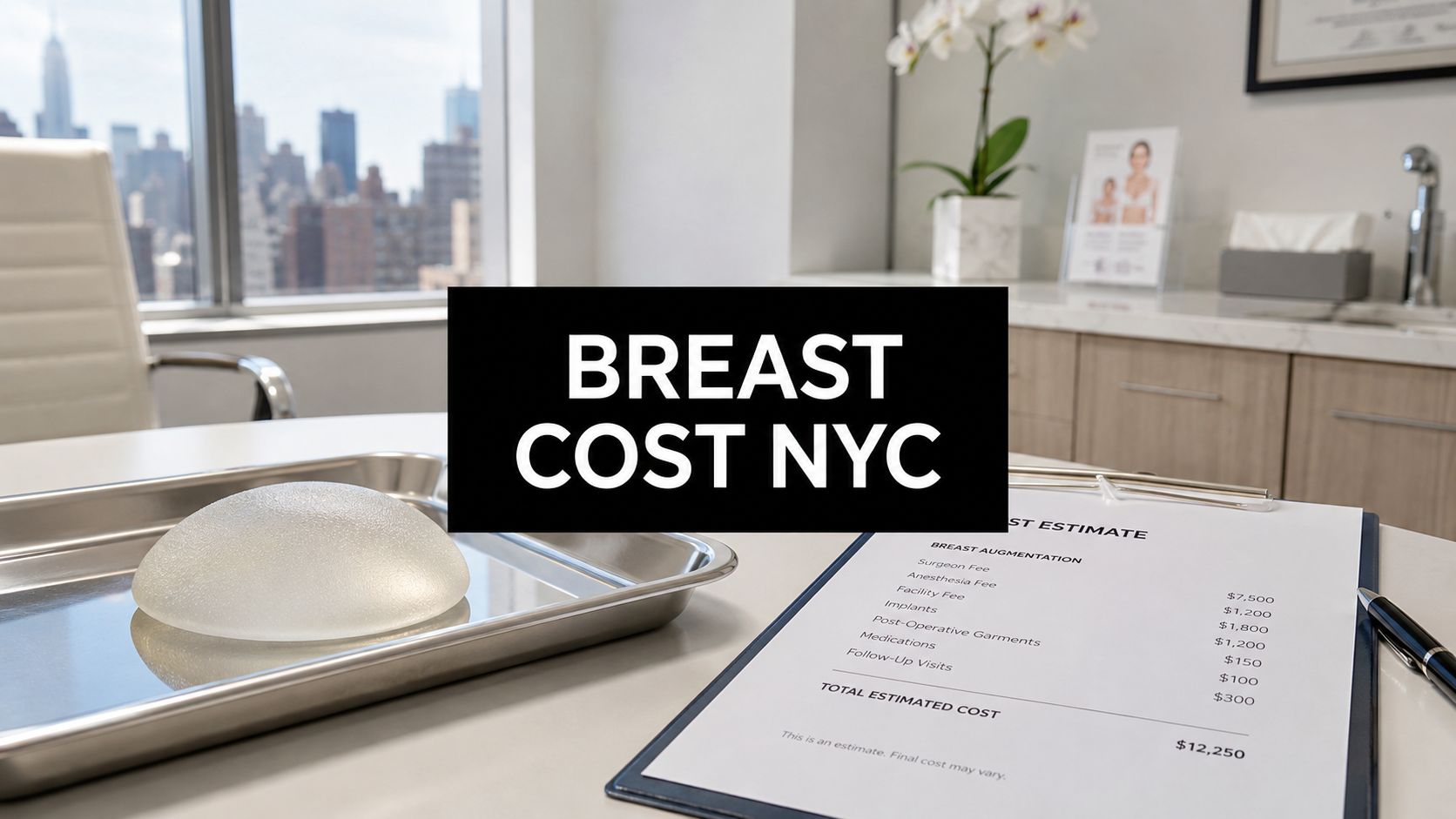
Breast augmentation in NYC typically costs $7,500 to $15,000 all-in, with most patients landing around $9,400 to $11,500 depending on borough, implant type, and facility choice. If a quote looks far below that, it probably leaves out anesthesia, facility fees, or both.
The national comparison is misleading, because New York City is not a normal market. In NYC, the bill is shaped by fixed operating costs, surgeon demand, and the price of running an accredited surgical setting in a high-cost metro, so the core question isn't whether the number is high. The key question is what's hiding inside it.
The honest breast augmentation cost NYC shoppers run into is not one clean number. It is a bundle, and that bundle is what pushes the total above the broader U.S. benchmark of $4,875 for breast augmentation with implants reported by the American Society of Plastic Surgeons. In Manhattan and other high-cost neighborhoods, the quote usually reflects more than the surgeon's work. It also includes the overhead required to keep the case safe and properly staffed.
A realistic NYC all-in quote commonly lands in the $7,500 to $15,000 range, with reported averages around $9,400, $11,500, and $9,580 depending on the source and how the estimate is packaged. That spread is not random. It usually shows whether the quote includes the facility, anesthesia, implants, and follow-up care, or whether those items are added later.
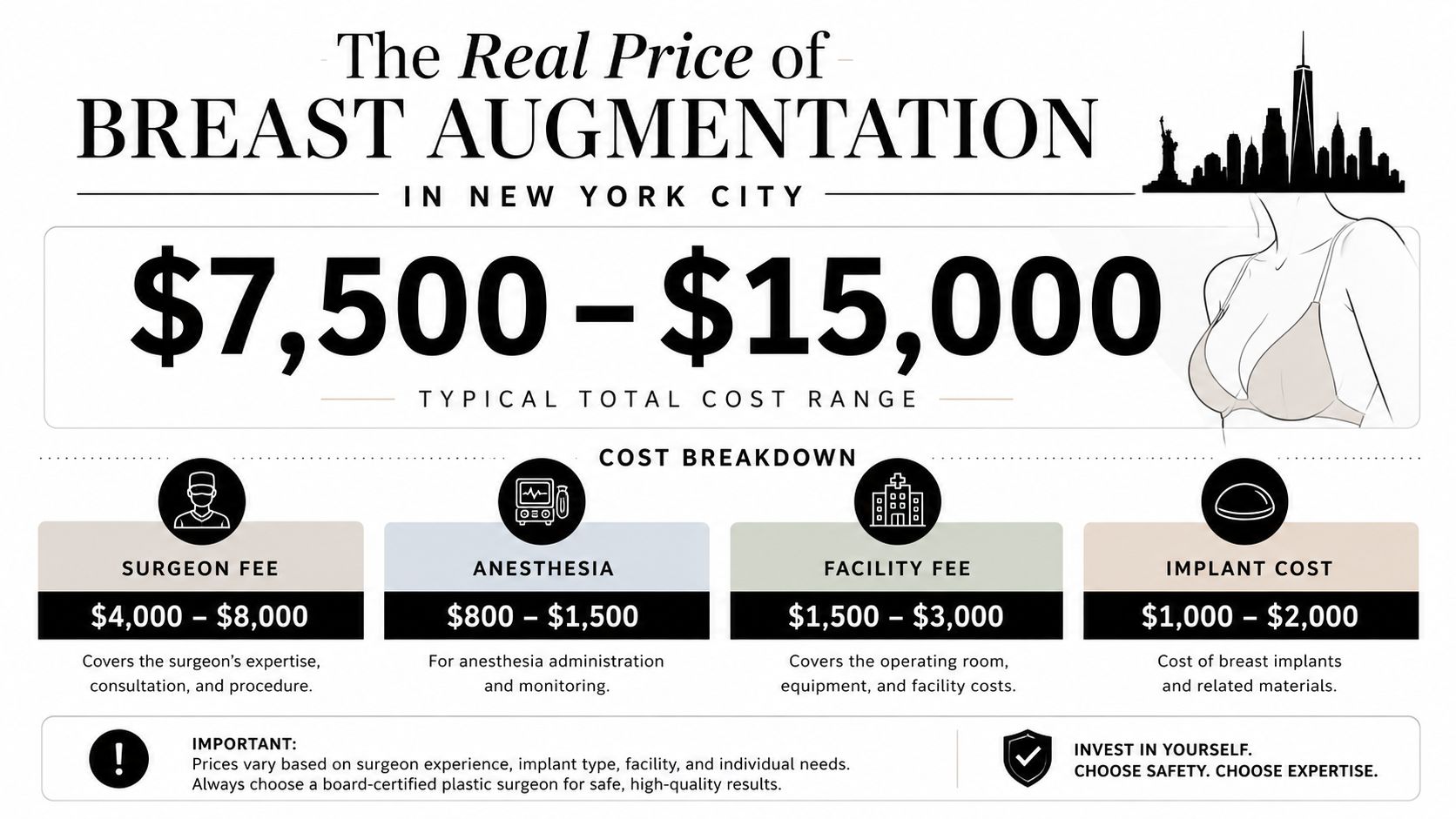
The best way to judge pricing is to treat the quote as a stack of line items. The surgeon's skill matters, but so do the anesthesiologist, the surgical center, and the implant choice. Once you see the structure, the price stops looking mysterious and starts looking like a bill you can audit.
A clear pricing page shows you how a practice separates each charge, and that is what you should demand in your own quote. If you want a practice-level example of how pricing should be presented, review Cape Cod Plastic Surgery's pricing page and compare whether your estimate is equally clear. Clarity is the standard, not a bonus.
Practical rule: If a practice cannot tell you what is included, assume you are only seeing part of the cost.
The bottom line is simple. NYC pricing is higher because the city itself is expensive to operate in, and because a safe cosmetic surgery case needs more than hardware. Anyone shopping breast augmentation in New York should focus less on the first number they hear and more on whether the quote is complete.
The bill breaks into four main parts, and the implant is usually not the part inflating the total most dramatically. In NYC, independent pricing breakdowns commonly show surgeon fees of $3,000 to $8,500, silicone implants around $2,000 to $3,500, saline implants around $1,200 to $1,400, anesthesia around $800 to $1,500, and facility fees of $2,000 to $3,500 from the NYC pricing guide at Cangelosi Plastic Surgery. That is why a quote can jump by thousands of dollars without any change in the implant brand itself.
The bigger cost pressure in New York is overhead. Facility rent, staff, anesthesia coverage, and borough-specific operating costs all push the total upward, and Manhattan pricing tends to sit above outer-borough practices because the practice has to absorb a more expensive operating environment. If you compare a Manhattan quote to one from farther out without accounting for location, you are not comparing equal cases.
| Cost Component | Typical NYC Range | What It Covers |
|---|---|---|
| Surgeon fee | $3,000 to $8,500 | Surgical expertise, planning, and the operation itself |
| Silicone implants | $2,000 to $3,500 | The implant device and related supply cost |
| Saline implants | $1,200 to $1,400 | The implant device and related supply cost |
| Anesthesia | $800 to $1,500 | Anesthesia team and monitoring during surgery |
| Facility fees | $2,000 to $3,500 | Accredited operating room, staff, and recovery space |
The quote can look modest at first and still rise fast once the practice adds the full operating bill. For a second pricing example, see breast implant price ranges explained. Use it as a reference point, not as a substitute for an itemized consultation.
One pricing guide notes that advertised breast augmentation prices can stretch from roughly $7,000 to $22,000+ once geography and added procedures enter the picture, which is why a low ad price is often a partial price, not a real one. The estimate you care about is the one that includes every mandatory charge.
The clearest way to read a quote is to ask what it leaves out. If the surgeon fee looks attractive but anesthesia and facility charges are separate, the quote may be perfectly legal and still misleading. If the practice includes all three in one number, you have something you can compare fairly.
A quote that hides facility or anesthesia fees is not a bargain, it is a delayed invoice.
For a real-world check on how patients evaluate pricing and surgeon transparency, see the Testimonial page for Artful Surgeon. In NYC, the true cost story is professional labor and overhead, not implant hardware alone.
A serious quote should answer one question immediately, is this all-in or partial? If the practice won't state that up front, the price is not transparent enough to trust. The safest consultations are the ones where the patient leaves with a fully itemized breakdown, not a vague promise that “most things are included.”
Start with credentials. Ask whether the surgeon is board-certified in plastic surgery, not just “cosmetic surgery” broadly, and ask where the procedure is performed. Then verify whether the facility is accredited, because the operating room is part of the safety equation, not a side detail.

Use the internal questions guide at what to ask a cosmetic surgeon before every consultation. It keeps the conversation focused on the right issues instead of marketing language.
A quote should also be supported by evidence of consistent results. Ask to see before-and-after photos of patients with similar body frames and goals, not just the most dramatic transformations in the gallery. Then ask how revisions are handled, because a practice that won't discuss revision policy is avoiding a real financial issue.
The Testimonial page for Artful Surgeon is useful as a model for what patient feedback should let you assess, specific experiences, not vague praise. You want that same level of transparency in the consultation room.
If the number sounds unusually low, ask what isn't included before you ask whether it's affordable.
A trustworthy quote is boring in the best way. It lists every major charge, names the facility, and tells you exactly who is doing the work. That's the standard you should insist on.
Patients fixate on saline versus silicone because it feels like the one part they can control. That instinct is understandable, but it's not where most of the money moves. Independent NYC estimates place saline around $7,250 and silicone around $8,250 to $9,250, while broader NYC cosmetic augmentation averages still cluster in the $7,500 to $11,300 or $8,500 to $15,000 range depending on what's bundled into the quote as noted in the earlier NYC pricing breakdowns.
The difference between implant types is real, but it's modest compared with the rest of the stack. A slightly less expensive implant does not erase the effect of a higher facility charge, a longer anesthesia block, or a surgeon's fee shaped by Manhattan overhead. That's why implant shopping alone won't rescue a budget.

Revision augmentation costs more because the surgery is more complicated. So do combined procedures, including augmentation with a lift or fat grafting, because the operating time, anesthesia exposure, and facility use all increase. That's the primary driver, not whether the implant shell is saline or silicone.
If your quote includes more than a primary augmentation, stop comparing it to basic online estimates. A combined case belongs in its own pricing bucket, and trying to squeeze it into a simple surgery budget is how patients get blindsided.
Budget rule: Spend your attention on the total surgical plan, not the implant material by itself.
The cleanest cost-saving decisions are usually structural. Choose a simpler surgical plan, avoid unnecessary add-ons, and pay attention to where the procedure is performed. Those choices affect the final bill much more than obsessing over a narrow implant price gap.
The practical takeaway is blunt. Implant type matters, but it is not the dominant lever in NYC. If you want control over cost, focus on the entire operation, not the hardware sitting inside it.
Cosmetic breast augmentation is usually a cash-pay decision, not an insurance-covered one. That means your financial planning needs to be conservative, because the practice is unlikely to split the bill with a payer. If a clinic implies otherwise without a very specific medical indication, be skeptical.
Financing can still make sense if it's structured carefully. Medical financing programs can spread the cost over time, but the tradeoff is that you need to read the terms before you sign. For a practical comparison framework, the Weight Method guide on out-of-pocket costs is a useful reference for thinking through payment planning without rushing into a monthly amount you can't comfortably handle.

A sane financing plan starts with a complete quote and ends with a payment you can absorb. It does not rely on optimism, and it definitely doesn't rely on a front-desk pitch. If a practice won't slow down long enough to explain the bill, it's not protecting your interests.
There's one more practical point. Don't let the financing conversation distract you from safety. A lower monthly payment is useless if the quote hides an unsafe setup or a surgeon whose credentials aren't easy to verify.
The right move is simple. Compare the total, verify the facility, and finance only after the full plan is clear.
Start with two to three itemized quotes, not ten glossy consultations. You want enough comparison to spot the pattern, not so many opinions that the process turns into noise. Then check the surgeon's credentials, confirm the facility setup, and compare the total surgical plan, not the top-line teaser price.
If you're thinking about leaving NYC to save money, ask whether the savings survive travel, follow-up, and the convenience of local care. A lower sticker price can disappear fast if you need repeated visits or if your surgeon is far away. Local care has value, and you should count it carefully.
Quotes also have a shelf life. Practices can change pricing, especially when overhead shifts or when a quote is tied to a specific operating schedule, so don't assume a number from months ago still applies. Get the estimate in writing and keep the scope clear.
Revision questions matter too. If you're worried about needing changes later, ask how the practice handles revisions and whether those situations are priced separately, because they usually are. That conversation tells you more about the practice's realism than any polished gallery ever will.
One of the best choices a patient can make is to slow down and compare on paper. That keeps the search grounded in facts instead of reacting to the first number that feels manageable.
Good consults leave you with a plan, not pressure.
If you want a baseline for how a transparent practice frames breast surgery pricing and planning, start with Cape Cod Plastic Surgery. Then use the same standards to evaluate every NYC quote you receive before you book.
September 9, 2026
Expert Guide to Proper Surgical Incision Care

Master dermal fillers aftercare with do's and don'ts, swelling tips, activity limits and warning signs to protect your results and heal smoothly.

September 8, 2026
Ensuring Safety: Why Your Surgeon's Credentials Matter Most
Cape Cod Plastic Surgery offers expert cosmetic and reconstructive procedures in a safe, accredited setting. Led by Dr. Marc Fater, we combine advanced techniques with personalized care to help you look and feel your best.
Monday: 9:00 AM – 5:00 PM
Tuesday: 9:00 AM – 5:00 PM
Wednesday: 9:00 AM – 5:00 PM
Thursday: 9:00 AM – 5:00 PM
Friday: 9:00 AM – 5:00 PM