
October 1, 2026
How Body Contouring Enhances Your Natural Shape
Reshaping Your Silhouette: A Guide to Body Contouring
Jul 3, 2026
The all-inclusive breast implants price range in the U.S. for 2026 is typically $6,000 to $15,000. That's the number you should use when budgeting, and the reason the range is so wide is simple: many prices you see online are not the full price.
If you're researching late at night with five tabs open, you've probably already seen the problem. One website says one number, another gives a “starting at” price, and a third lists an average that sounds reassuring until you realize it doesn't include the operating room, anesthesia, or even the implants themselves.
That confusion gets expensive fast.
The phrase breast implants price range sounds straightforward, but most patients are not presented with apples-to-apples pricing. They're being shown fragments. A surgeon's fee. A promotional starting point. A partial estimate that leaves out the full costs until much later. On Cape Cod, where patients often balance convenience, privacy, travel time, and surgeon expertise, that lack of clarity makes decision-making harder than it needs to be.
You deserve a number that reflects what you'll pay, not a number designed to get you through the door.
Many individuals start with the same question: “What do breast implants cost?” That's a smart place to start, but the better question is, “What does the quote include?”
A low number online can be technically accurate and still be misleading. If a practice highlights only the surgeon's fee, you're still missing major parts of the bill. That's why patients end up feeling blindsided after the consultation, even when they thought they had done careful research.
There are a few reasons the numbers vary so much.
Practical rule: If the quote isn't clearly labeled “all-inclusive,” assume it's incomplete until someone walks you through every line item.
For Cape Cod patients, the most useful mindset is this: stop shopping by headline price and start shopping by total financial clarity. A transparent quote should tell you what you're paying for, who is providing your care, where your surgery takes place, and what support is included after surgery.
That's how you compare options responsibly. Not by chasing the cheapest number, but by making sure you're comparing the same thing each time.
The cleanest national benchmark comes from the American Society of Plastic Surgeons. In the United States, the average cost of breast augmentation with implants is $4,875, but that figure is only the surgeon's fee and does not include anesthesia, operating room facilities, or related expenses. A more realistic all-inclusive national average for 2026 is $6,000 to $15,000, as explained by the American Society of Plastic Surgeons cost overview.
That distinction matters more than most patients realize.
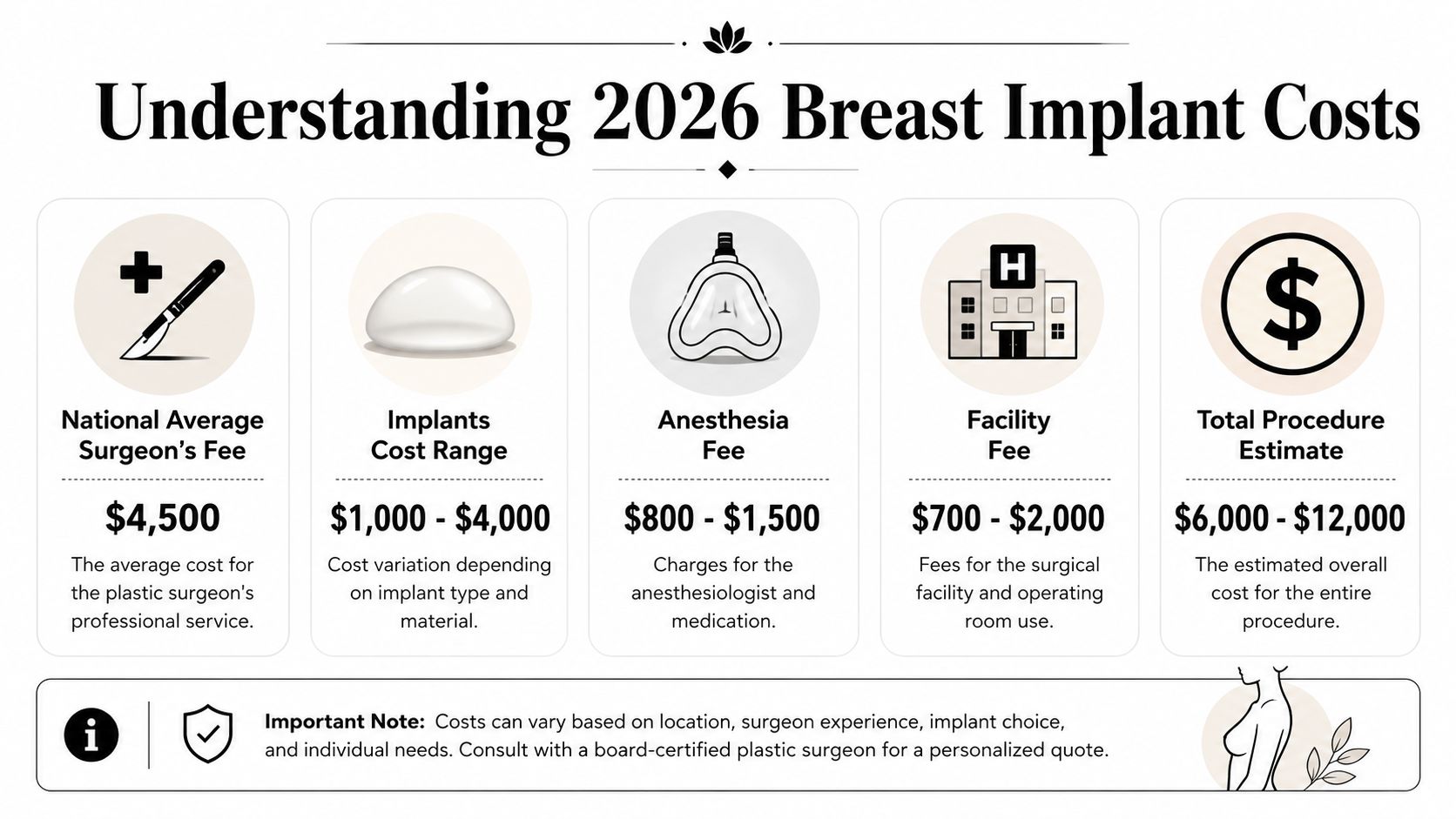
If you remember one thing from this article, make it this: the surgeon's fee is not the procedure price.
A surgeon can quote a professional fee that sounds competitive, but once anesthesia, implants, facility use, and aftercare items are added, the final cost may land much higher than expected. That's why patients who budget using partial pricing often end up frustrated.
For someone researching the breast implants price range in Cape Cod, the national range is useful as a baseline, not a promise. It tells you what's normal in the U.S. market. It does not tell you what your anatomy, implant choice, surgical plan, or local pricing structure will produce.
Use $6,000 to $15,000 as your reality check. If a quote comes in far below that, ask direct questions. If a quote comes in higher, ask what's included and why.
A strong pricing conversation should answer these questions clearly:
If you're comparing estimates, review them side by side against a transparent breast surgery pricing page. You're not just checking cost. You're checking whether the numbers are being presented transparently.
Patients get tripped up because “all-inclusive” doesn't always mean the same thing from one practice to another. Recent data shows national surgeon fees rose to $4,875, yet many quotes still reflect only that surgeon fee while excluding anesthesia, facility fees, implants, and post-op garments. About 40% of patients use financing, which tells you how often people discover the full cost only after they're deep into the process, according to this 2025 breakdown of breast augmentation pricing and hidden costs.
That's why you should ask for a line-by-line quote every time.
Here's the simplest way to think about it: a complete breast augmentation quote usually has four core buckets, plus a few smaller support items.
| Cost Component | What It Covers | Typical % of Total Cost |
|---|---|---|
| Surgeon's Fee | The plastic surgeon's planning, operative skill, surgical execution, and follow-up oversight | Largest share |
| Anesthesia Fee | The anesthesia provider, medications, monitoring, and your comfort and safety during surgery | Moderate share |
| Surgical Facility Fee | Use of the operating room, sterile supplies, equipment, nursing staff, and recovery area | Moderate share |
| Implant Cost | The implants themselves, with pricing affected by saline versus silicone and other design differences | Variable share |
| Post-op Items | Surgical bra or garments, routine recovery supplies, and related support items if included | Smaller share |
The percentages vary by practice and by surgical plan, so don't get stuck looking for a universal formula. Focus on whether each category is present.
The surgeon's fee covers more than time in the operating room. It reflects training, judgment, preoperative planning, technique, and postoperative management. This is not the place to shop blindly for the lowest number.
The anesthesia fee pays for a qualified professional to monitor you throughout surgery. That fee is about safety, not fluff.
The facility fee often gets overlooked, but it shouldn't. You're paying for the surgical environment itself, the support staff, sterile processing, equipment, and recovery setup. A proper operating suite costs money to run well.
If a quote looks low, ask what was left out before you assume you found a bargain.
The implant cost is separate because implant materials don't all cost the same. One patient's quote can differ from another's even when the surgeon and facility stay the same.
Bring these questions to every consultation:
Those questions are practical, not awkward. A transparent office should answer them easily.
Once you understand the basic quote structure, your own decisions become the biggest price driver. The first major variable is implant type.
The base cost of breast implant materials alone ranges from $800 to $3,000 per pair. Saline implants are the lowest-cost option at $800 to $1,200 per pair, standard silicone gel implants range from $1,500 to $2,500 per pair, and cohesive “gummy bear” silicone implants can reach $3,000 per pair, based on this implant material cost breakdown.
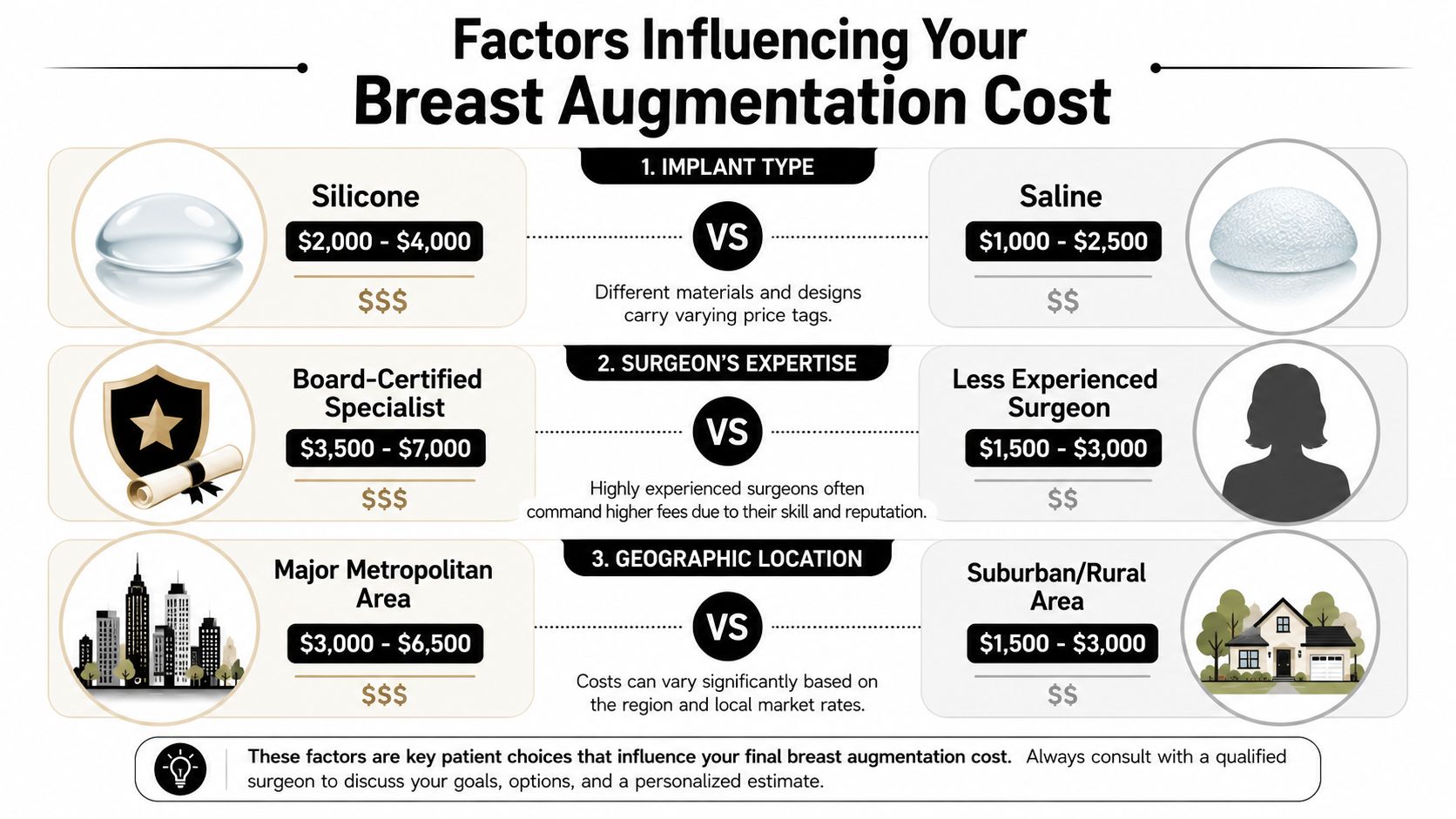
If your budget is tight, implant selection matters immediately.
If you're still weighing the tradeoffs, this guide on choosing between saline and silicone breast implants is a helpful next step.
I'll be blunt. Choosing a surgeon based mainly on price is a mistake.
Higher fees often reflect training, board certification, experience, consistency, and judgment. Breast augmentation isn't a commodity. You're not buying a handbag or booking a hotel room. You're choosing a surgeon to make decisions about symmetry, pocket creation, implant positioning, incision planning, and complication management.
A cheaper fee may mean less experience, a different facility model, or less support before and after surgery. Sometimes that's all. Sometimes it's the warning sign patients ignored.
Cape Cod patients often compare local care with larger city pricing. That's reasonable. Geography can influence total cost because overhead, staffing, and facility expenses differ by market.
Surgical complexity matters too. Some cases are more straightforward. Others require more planning, more operating time, or a more individualized approach. If your surgeon recommends an adjustment to the plan, that can change the quote, and it should be explained clearly.
Pay for judgment, safety, and follow-up access. Those are the parts patients miss when they focus only on the headline number.
For many patients, the financial question isn't whether breast augmentation matters to them. It's how to pay for it without creating stress afterward.
Because cosmetic breast augmentation is generally elective, patients usually plan for it using savings, monthly financing, or a combination of both. That's normal. In fact, many people choose financing to make a predictable payment instead of paying everything at once.

A financing plan is useful when it's clear, simple, and realistic for your monthly budget. It's not useful when it helps you say yes to a surgery price you don't fully understand.
If you're reviewing options, look for:
For patients comparing medical costs more broadly, this article on tips for urgent care without coverage is worth reading because it reinforces the same core principle: ask for transparency before treatment, not after the bill arrives.
If you want to explore structured payment options, review available plastic surgery payment plans before your consultation so you know what kinds of arrangements may fit your budget.
Elective cosmetic augmentation is generally not something health insurance covers. Reconstructive breast surgery can be different, especially after mastectomy, but that's a separate category with its own documentation and coverage rules.
For straightforward cosmetic augmentation, budget as if you are responsible for the full amount. That mindset prevents bad surprises.
The long-term side of budgeting is easy to miss, especially with silicone implants.
The FDA recommends MRIs for silicone implants starting at year 3 to screen for silent ruptures. Those MRIs cost $444 to $1,468 per scan, and over 20 years the cumulative imaging expense can total $3,108 to $10,276, according to this overview of long-term MRI costs for silicone implants.
That doesn't mean silicone implants are wrong for you. It means you should budget realistically.
Here's a short explainer that helps frame the financial conversation:
If you're deciding between implant types and one option adds long-term imaging costs you don't want to carry, factor that in now. Don't leave it for “future you” to solve.
That's what real cost planning looks like.
National averages are useful, but they won't tell you what your surgery will cost. A real quote comes from a real exam, a real conversation about your goals, and a surgeon's recommendation based on your anatomy.
That's especially true on Cape Cod, where convenience and continuity of care matter. Local patients often want privacy, a straightforward process, and easy access for follow-up rather than piecing together care across multiple locations.
A proper consultation should narrow the variables quickly. Once the surgeon evaluates your goals and examines your anatomy, the office can identify the implant approach, explain where your cost is being driven, and clarify what's included.
That quote should feel specific, not vague. It should answer:

I also think patients should look at their broader financial picture before committing to any elective procedure. If you're already working on your credit profile to qualify for better financing terms, this guide on how much credit repair costs can help you understand another part of the process without guesswork.
That kind of preparation matters. Elective surgery feels much better when the payment plan fits your life instead of stretching it.
For Cape Cod patients, the strongest value usually comes from three things working together: surgeon experience, an accredited surgical setting, and easy follow-up access close to home. When those pieces line up, the quote starts making sense in practical terms. You're not just paying for surgery day. You're paying for planning, safety standards, and ongoing support.
A good quote doesn't just give you a number. It gives you confidence that the number is complete.
Because you're not buying the same service from every office.
Training, board certification, surgical judgment, facility quality, and follow-up care all affect pricing. Some surgeons also operate in settings with different overhead and staffing models. The cheapest quote may reflect fewer inclusions, less experience, or both.
If one quote is dramatically lower, ask for the itemized breakdown and compare it line by line.
Usually, no.
Low pricing can be tempting, especially when you're comparing broad breast implants price range estimates online. But surgery done far from home can complicate follow-up care, especially if you have concerns during recovery. It can also make revisions, urgent visits, or routine postoperative checks much harder.
The lower number only helps if the care is comparable. Often, it isn't.
Ask specifically about anything not already listed in writing.
Use this checklist:
If the office can't answer those questions clearly, keep looking.
Not automatically.
Financing changes timing. It doesn't reduce the actual cost. A monthly payment can make surgery workable, but only if you understand the total amount, the terms, and any long-term expenses tied to your implant choice.
Don't compare the headline number first. Compare the structure first.
Look at whether each quote includes the same core elements, whether the surgery will take place in an accredited facility, and whether follow-up care is easy to access. Then compare price. That's the right order.
Ask this exactly: “Is this quote all-inclusive, and if not, what is missing?”
That one question cuts through a lot of vague pricing.
If you want a precise, transparent quote based on your goals, schedule a consultation with Cape Cod Plastic Surgery. Dr. Marc Fater is a board-certified plastic surgeon with over 30 years of experience, and the practice offers care in an on-site AAAASF-accredited surgical suite in Hyannis. That combination gives Cape Cod patients something they should expect from any serious surgical decision: clear pricing, experienced judgment, and dependable follow-up close to home.
October 1, 2026
Reshaping Your Silhouette: A Guide to Body Contouring

October 1, 2026
Your Guide to Protecting Your Investment: Long-Term Skincare After Aesthetic Procedures
October 1, 2026
Sculpting Your Shape: What Liposuction Really Does
Cape Cod Plastic Surgery offers expert cosmetic and reconstructive procedures in a safe, accredited setting. Led by Dr. Marc Fater, we combine advanced techniques with personalized care to help you look and feel your best.
Monday: 9:00 AM – 5:00 PM
Tuesday: 9:00 AM – 5:00 PM
Wednesday: 9:00 AM – 5:00 PM
Thursday: 9:00 AM – 5:00 PM
Friday: 9:00 AM – 5:00 PM