

September 9, 2026
How to Care for Surgical Incisions Properly
Expert Guide to Proper Surgical Incision Care
Aug 8, 2026
In the Massachusetts market, the typical cash-price benchmark for a bilateral mastectomy is about $10,482, while bundled quotes that include reconstruction commonly stretch into the $24,623 to $38,019 range depending on the method. That spread exists because the bill is rarely just one procedure, it's the operation, the facility, anesthesia, pathology, follow-up, and often reconstruction layered on top.
If you're comparing quotes in Cape Cod or Boston right now, you're probably seeing numbers that don't seem to match each other at all. That's normal, and it's exactly why you need to break the bill into pieces before you decide what's affordable and what's not.
A lot of patients ask for a price before they've defined the package. That's like asking what a car costs without saying whether you want the base model or the version with leather seats, extended warranty, and all the dealer-installed extras. The double mastectomy cost works the same way.
The first layer is the surgeon's professional fee, which covers the actual operation. The second layer is the facility fee, charged by the hospital or ambulatory surgery center for the operating room, nursing staff, supplies, and recovery space. The third layer is anesthesia, which is often billed separately by the anesthesia team.
After that, the list keeps going. Pathology review of the removed tissue, postoperative visits, compression garments, drains, and prescriptions can all show up as separate charges depending on how the practice and hospital bill. That's why two patients with the same diagnosis can still get very different totals.
Practical rule: If an estimate doesn't spell out what's included, treat it as incomplete.
The older cost literature makes this point clearly. In a peer-reviewed analysis of contralateral prophylactic mastectomy, adding the second breast removal increased mean total costs by $7,749 over 0 to 24 months, and delayed CPM showed an even higher mean difference of $16,744. The study also found that technical costs accounted for 53.9% of the increase and professional costs for 46.1%, with reconstruction, chemotherapy, and radiation making up much of the rest of the care cost, which shows how the bill expands beyond the operating room itself study on contralateral prophylactic mastectomy costs.
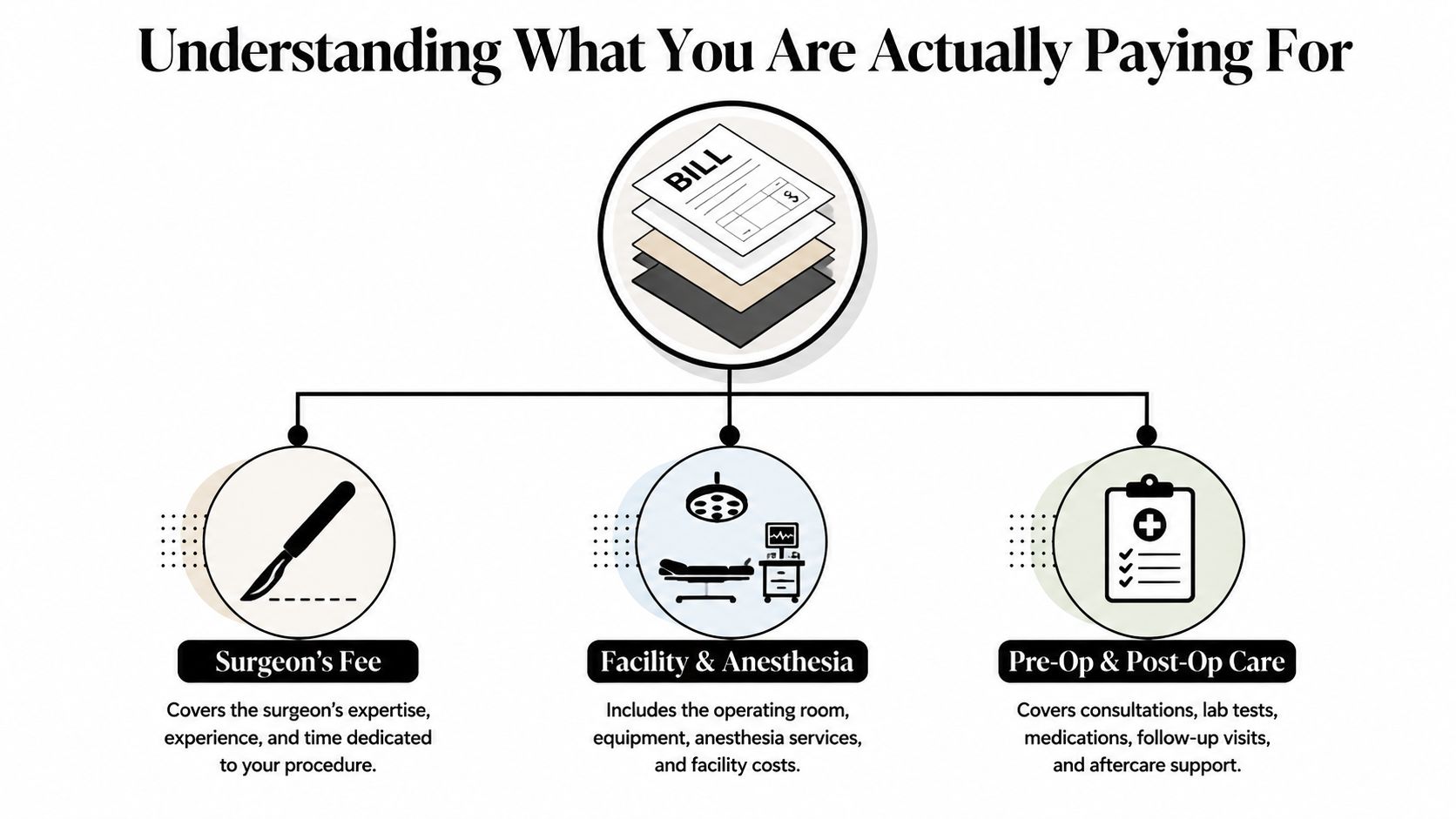
Ask for an itemized written estimate. If the office only gives you a single number, you still don't know whether that figure includes the anesthesia team, pathology, or follow-up. You need every line item.
Ask for the number the way the billing office sees it, not the way a brochure sells it.
Once you start demanding a breakdown, the hidden costs usually become obvious. That's the moment you can tell whether a quote is honest, incomplete, or just not useful.
The national cash-pay market shows a wide spread for bilateral mastectomy, and Massachusetts sits in the middle of it. Sidecar Health's state-by-state cash-price data lists bilateral mastectomy averages from $8,134 in Iowa to $11,564 in Alaska, with Massachusetts at $10,482 and many major states clustered around $9,000 to $10,000 state cash-price data.
That $10,482 Massachusetts benchmark is useful because it gives you a realistic starting point before insurance rules, deductibles, and reconstruction costs enter the picture. It also tells you that Massachusetts is not a bargain-basement market, but it's not the most expensive one either.
MDsave adds another layer of context. Its direct-pay range for double mastectomy runs from $7,559 to $24,161, which is far wider than a simple state average because it reflects different package structures, not just geography MDsave direct-pay range. In plain English, one quote may cover the surgeon only, while another may bundle facility, anesthesia, and immediate postoperative care.
A Boston hospital, a Cape Cod surgery center, and an insurer-negotiated claim are not the same pricing universe. Cash prices can look similar on paper, but the final number changes depending on whether the quote is posted cash, contracted insurance, or an all-in package. The same operation can look cheap until you add the facility and anesthesia, then it isn't cheap anymore.
Here's the clean way to read any quote. If it's a surgeon-only quote, expect more charges later. If it's an all-in package, confirm whether pathology, drains, follow-up, and reconstruction are included. If it's an insurance estimate, expect the deductible and out-of-pocket maximum to drive what you owe.
| State | Average Cash Price (USD) |
|---|---|
| Iowa | 8,134 |
| Massachusetts | 10,482 |
| Alaska | 11,564 |
The useful takeaway is simple. In Massachusetts, a quoted figure around $10,482 is a real benchmark, but it is not the whole story. The moment reconstruction enters the case, the total can move much higher.
The cleanest way to understand a bill is to stop thinking about “the surgery” and start thinking about the vendors involved. One team removes the tissue, another keeps you asleep, another bills the building, and pathology may bill separately for the tissue review. That's why the final number rarely feels intuitive at first glance.
The surgeon's fee is the professional charge for performing the mastectomy. The facility fee is usually the biggest non-surgeon line item, because it covers the room, nursing, supplies, and recovery infrastructure. Anesthesia is its own bill in many cases and can surprise patients who assumed it was included.
Pathology matters too. When tissue is removed, it has to be examined, and if there's lymph node assessment or margin review, the bill can climb. Post-op visits, drain management, and prescriptions are smaller pieces, but they still matter when you're trying to budget accurately.
The older CPM cost study is useful here because it shows where the money goes, not just that it goes up. Technical costs made up 53.9% of the increase and professional costs 46.1% CPM cost analysis. That means the building and technical side of care can matter as much as the surgeon's work.
If you want a useful estimate, ask for the CPT code and the fee split, not just the grand total.
You don't need to be a coder to ask smart questions. Ask whether the quote reflects a bilateral mastectomy, whether pathology is included, and whether anesthesia is billed separately. If the office can't answer those questions cleanly, the estimate isn't ready.
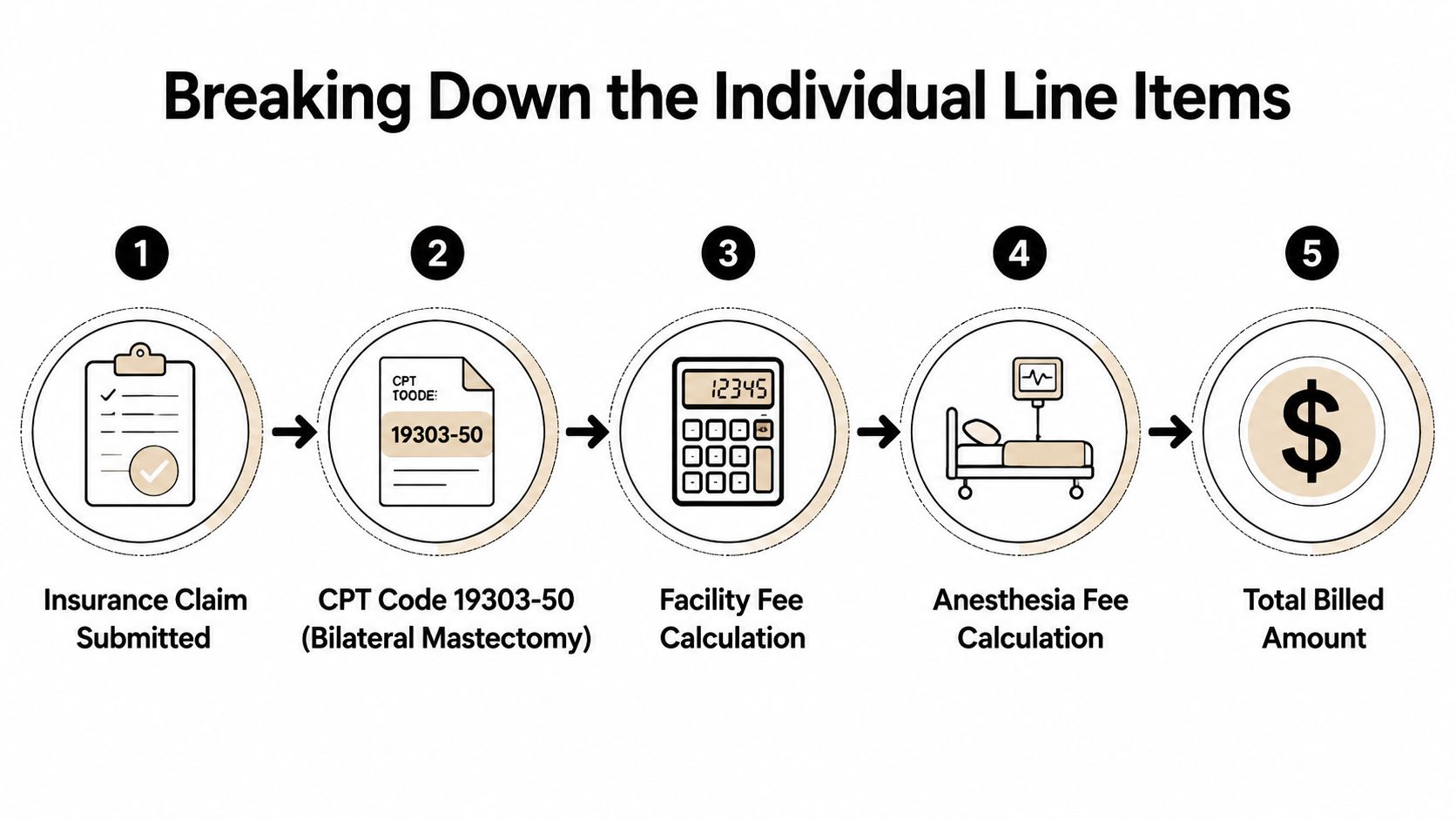
The best move is to request an itemized estimate before scheduling. Once you have that, you can compare like with like instead of mixing surgeon-only quotes with bundled facility packages.
Reconstruction is the biggest cost swing in the whole episode. A mastectomy alone has one financial profile, but the moment you add reconstruction, the procedure becomes a different budget decision. Implant-based and autologous pathways do not price the same, and they shouldn't be treated as interchangeable.
In a cost analysis of breast reconstruction, the median initial surgery cost was about $24,623 for tissue-expander reconstruction and $24,626 for direct-to-implant reconstruction breast reconstruction cost analysis. Those numbers are close enough to tell you that, at the index operation, implant-based paths sit in the same general bracket.
That's the main reason many patients start there. The surgery is generally shorter and less resource-intensive than a flap procedure, and the upfront financial hit is easier to predict.
The same analysis found a median initial surgery cost of $38,019 for autologous reconstruction breast reconstruction cost analysis. That is roughly 50% more expensive at the initial operation than the implant-based paths above, and the reason is straightforward. Flap surgery takes longer, uses more specialized microsurgical resources, and often requires greater inpatient care.
Another nationwide analysis showed that abdominally based bilateral flap reconstructions ranged from $21,886.80 for bilateral pTRAM to $33,784.90 for SIEA flaps breast reconstruction cost analysis. Different flap techniques are not priced the same because they don't consume the same operating-room time or team resources.
A patient choosing implants may face a more predictable initial bill and a simpler scheduling path. A patient choosing a DIEP or other flap-based reconstruction is buying more complex tissue transfer and usually a higher upfront cost. Both are legitimate choices, but they are not the same purchase.
Bottom line: Price reconstruction as part of the mastectomy episode, not as an optional add-on you can ignore until later.
Breast reconstruction options after mastectomy is worth reading if you want a plain-English overview of how surgeons separate implant and flap pathways. The financial decision is tied to the clinical choice, so don't split them in your head.
Here's the honest advice. If you already know you want reconstruction, get the reconstruction quote at the same time as the mastectomy quote. Separating them only creates confusion and usually underestimates the total cost.
If the surgery is medically necessary, insurance can change the whole conversation. Federal protection under the Women's Health and Cancer Rights Act of 1998 requires group health plans that cover mastectomy to also cover reconstruction and prostheses when those services are part of the care plan. That doesn't mean your out-of-pocket cost disappears, but it does mean you should not assume reconstruction is automatically excluded.
Start with pre-authorization. Get the approval in writing before the date is set, and confirm that the insurer has the right surgery, the right side or sides, and the right reconstruction plan on file. If the surgical plan changes later, the billing can change too.
You also need to know the provider status. In-network surgeons, facilities, and anesthesia teams usually matter more than patients expect because each piece may be billed separately. If one part of the episode is out-of-network, that's where the surprise starts.
State protections can extend coverage requirements, but you still have to confirm how your specific plan handles deductibles, coinsurance, and the out-of-pocket maximum. A bilateral procedure can hit multiple claim lines, so the savings from “covered” care still depend on how your benefits are structured.
Practical rule: No written authorization, no assumption.
If medical debt is already part of your stress, read medical bills cause more bankruptcies before you dismiss payment planning as an afterthought. It's a blunt reminder that billing mistakes and delayed action can become expensive fast.
Ask for these documents before you schedule: the surgeon's letter of medical necessity, the insurer's pre-authorization letter, and the facility's itemized quote. If any one of those is missing, your cost estimate is still incomplete. If you want a broader explanation of what insurers tend to cover, see does insurance cover plastic surgery.
The smartest patients don't ask whether insurance “covers it” in the abstract. They ask which codes, which provider networks, and which pre-op approvals control the bill. That's the level where the money is won or lost.
Even when insurance helps, you may still face deductibles, coinsurance, upgraded reconstruction choices, or bills from multiple providers. That's where financing comes in. Use it carefully, because the wrong payment method can turn a medical bill into a long-term debt problem.
Hospital or surgery-center payment plans are the least dramatic option. Many providers let you pay over time directly with them, and that can be the cleanest route if the office is willing to split the balance without high interest. The catch is simple, some plans want a down payment first.
Medical credit cards such as CareCredit can work if you're confident you'll pay the balance during the promo period. They're widely accepted in medical settings, but deferred-interest deals get expensive after the promotional window ends.
Personal medical loans are more straightforward. They usually give you a fixed interest rate and predictable monthly payments, which makes budgeting easier. The downside is that approval depends on credit.
If your practice offers a self-pay discount, compare that against what your insurer would still leave you owing. Sometimes the cash quote is better. Sometimes it isn't. Don't guess.
If you want a practical starting point for billing logistics, streamline collections with Clarity is a useful reference for how payment plans are structured on the provider side. If you want the patient-facing version of the same decision, see how to finance cosmetic surgery.
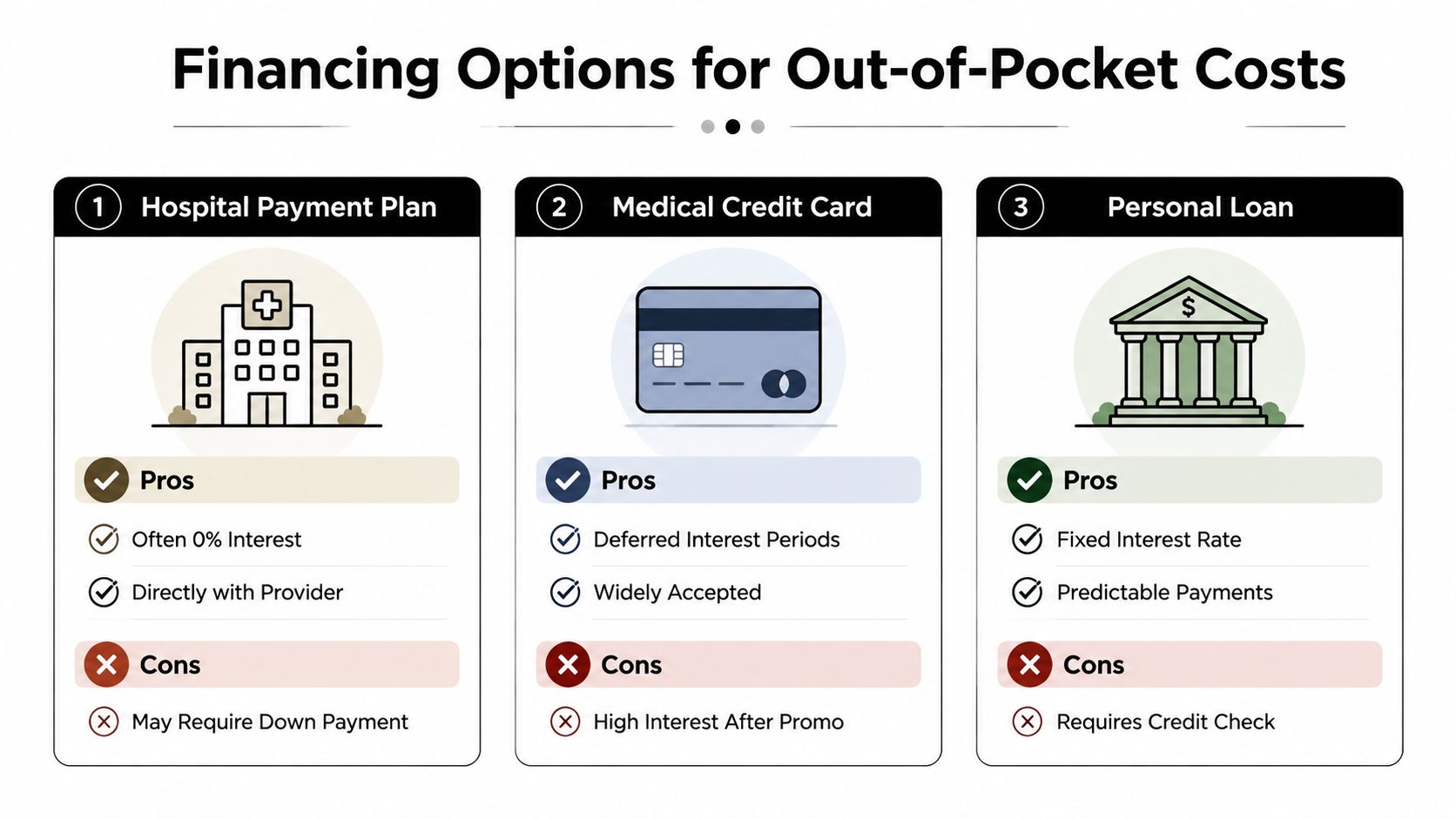
The rule I give patients is simple. Use provider financing first if it's low-cost, use a credit product only if you can kill the balance on schedule, and avoid turning a predictable surgery bill into revolving debt you can't comfortably carry.
You don't need a financial maze. You need a written quote that names each component clearly and stays valid long enough for you to compare options. Call the office and ask for an itemized estimate that separates the surgeon, facility, anesthesia, pathology, and follow-up care.
Ask whether the quote includes one or two breasts, whether reconstruction is included, and whether any revision or delayed reconstruction would be billed separately. Then ask whether the facility is AAAASF-accredited or otherwise accredited, because you want to know the surgical environment is set up properly before money is even part of the conversation.
You should also ask how long the estimate remains valid. These quotes are time-sensitive, and if your surgical plan changes in the operating room, the final bill can change too. Don't assume a number stays fixed forever.
Save the surgeon's medical necessity letter, the insurer's pre-authorization letter, and the practice's itemized quote. Those three documents tell you what was approved, what was promised, and what was billed.
Cape Cod Plastic Surgery can provide breast reconstruction after mastectomy and discuss procedure pricing through its own billing office, which is exactly the kind of conversation patients should have with any surgical practice that handles reconstruction planning. I'd still ask the same hard questions there that I'd ask anywhere else, because a good estimate is never just a headline number.
Don't leave the call without the line-item split and the names of every billing entity involved.
A simple script works well. Say, “I need the surgeon fee, facility fee, anesthesia estimate, pathology estimate, and follow-up charges in writing before I decide.” That sentence forces clarity, and clarity is what keeps the bill manageable.
Most patients want to know whether the estimate expires, and yes, it usually does. If your surgery gets delayed, ask for a fresh written quote before you assume the old number still applies.
Insurance coverage is possible when the surgery is medically necessary, and reconstruction is often part of that protected episode of care under the federal rule mentioned above. Delayed reconstruction can still be covered, but the billing needs to match the actual timing and plan.
If you're nervous about bringing up cost, be direct. Say you're comparing options and need a real itemized estimate, not a rough guess. Surgeons and billing staff hear that all the time.
Cape Cod Plastic Surgery works with patients who need breast reconstruction planning, estimate discussions, and financing conversations before surgery. If you're sorting through double mastectomy cost in Massachusetts, visit Cape Cod Plastic Surgery to ask for a personalized, itemized conversation about your surgical plan and the likely billing structure.
September 9, 2026
Expert Guide to Proper Surgical Incision Care

Master dermal fillers aftercare with do's and don'ts, swelling tips, activity limits and warning signs to protect your results and heal smoothly.

September 8, 2026
Ensuring Safety: Why Your Surgeon's Credentials Matter Most

Cape Cod Plastic Surgery offers expert cosmetic and reconstructive procedures in a safe, accredited setting. Led by Dr. Marc Fater, we combine advanced techniques with personalized care to help you look and feel your best.
Monday: 9:00 AM – 5:00 PM
Tuesday: 9:00 AM – 5:00 PM
Wednesday: 9:00 AM – 5:00 PM
Thursday: 9:00 AM – 5:00 PM
Friday: 9:00 AM – 5:00 PM