

October 7, 2026
What to Expect During Your Breast Surgery Recovery
A Practical Guide to Healing After Breast Surgery
Mar 15, 2026

When you start exploring breast surgery, the most common question we hear is, "Should I get a lift or a reduction?" The answer really comes down to what you want to achieve. Are you mostly looking to change the shape and position of your breasts, or do you need to change their size and weight?
A breast lift is all about restoring a youthful contour, while a breast reduction is designed to decrease the overall volume and, just as importantly, relieve physical discomfort.
While both procedures can give you a perkier, more proportionate bustline, they solve very different problems. It helps to think of it like this: a breast lift is like re-draping and tailoring a dress that fits well but has lost its shape, whereas a reduction is like resizing the entire dress to be smaller and more comfortable to wear.
A breast lift, which we call a mastopexy in the medical world, focuses entirely on shape and position. The main goal is to correct ptosis, the clinical term for sagging. We do this by removing excess, stretched skin and carefully repositioning your natural breast tissue higher up on your chest.
Your nipple and areola are also elevated to a more forward-facing, youthful spot. This is the perfect procedure for women who are generally happy with their breast volume but have noticed drooping from pregnancy, weight changes, or simply the effects of time and gravity.
On the other hand, a breast reduction, or reduction mammaplasty, is about both size and relief. This surgery involves removing a combination of excess breast tissue, fat, and skin.
The primary goal here is to create smaller, lighter breasts that feel more in sync with the rest of your body. This isn't just a cosmetic change; for many women, it's a life-changing procedure that finally ends the chronic pain and skin irritation caused by overly large breasts (macromastia).
The simplest way to put it is this: a breast lift reshapes and elevates the tissue you already have. A breast reduction removes tissue to make your breasts smaller and lighter.
To help you see the differences at a glance, this table breaks down the main goals and outcomes for each surgery.
Ultimately, choosing between a breast lift and a breast reduction is a personal decision based entirely on your goals. Are you hoping for a purely cosmetic enhancement to bring back a youthful contour, or are you seeking real, functional relief from the physical burden of large breasts?
Answering that question is the first step. To dig a little deeper, you can learn more about when and why to consider a breast lift in our detailed guide. The next step is a conversation with a board-certified plastic surgeon, who can assess your anatomy and help you decide on the best path forward.
So, how do you know which surgery is right for you? It really comes down to one thing: what is the main problem you want to fix? Your personal goals—whether you’re looking for a cosmetic refresh, relief from physical discomfort, or a bit of both—are what will point you toward the right procedure.
Thinking about this ahead of time will help you have a much more focused and productive conversation with your surgeon.
This chart breaks down the decision-making process in the simplest terms. It all starts with your primary goal.
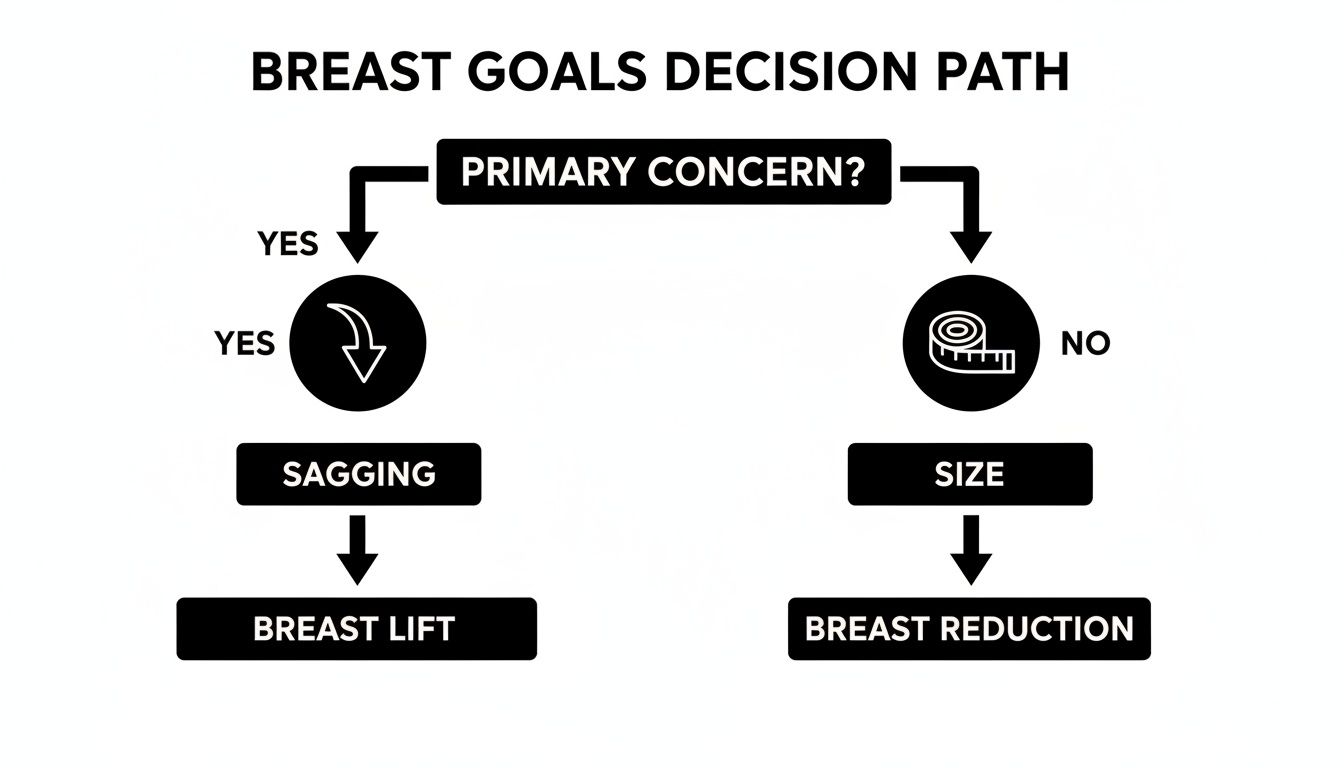
As you can see, if drooping or loss of shape is your main frustration, a breast lift is the clear path. If it’s the physical burden of size and weight causing problems, a breast reduction is the direct solution.
You're likely a strong candidate for a breast lift (mastopexy) if your concerns are mostly about the shape and position of your breasts, not the volume. Women who choose this surgery are often happy with their breast size but feel their breasts have lost their youthful firmness and position.
Does this sound like you?
A breast lift is all about restoring a perkier, more youthful breast contour. We aren’t making your breasts smaller; we’re simply repositioning the tissue you already have to a higher, more aesthetically pleasing spot on the chest wall.
On the other hand, a breast reduction is probably the right choice if the size and weight of your breasts are causing real physical or emotional strain. The driving force for this procedure is almost always relief from the chronic symptoms that come with having overly large breasts (macromastia).
A reduction might be what you need if you deal with these issues daily:
Breast reduction surgery has become increasingly common for good reason. Procedures saw a 7% increase in 2025 alone. The motivation is clear: up to 80% of patients with macromastia suffer from chronic pain before their surgery. Afterward, the relief is profound. One study showed that only 21.1% of women still had any back, shoulder, or neck pain after their procedure.
Ultimately, while both surgeries improve the look of your breasts, the "lift vs. reduction" decision depends on your primary goal: rejuvenation or relief. Many women discover that the life-changing benefits of breast reduction surgery are exactly what they need to live a more comfortable, active life.
While a breast lift and a breast reduction aim for different primary outcomes, the surgical roadmaps—the incision patterns—often look quite similar. It's one of the most common points of confusion for patients, so let's clear it up. Understanding what happens in the operating room, and how my choices as a surgeon will affect your final scars, is a critical part of this conversation.
The technique I choose isn't arbitrary. It’s a strategic decision that depends entirely on your body, how much correction you need, and what we’re trying to achieve together. A patient with just a little bit of sagging requires a completely different plan than someone who needs a significant amount of breast tissue removed to alleviate physical pain.

For a breast lift (mastopexy), my focus is almost entirely on the skin. I remove a precise pattern of excess, stretched-out skin and tighten the remaining "skin envelope." Think of it like a master tailor altering a garment that has lost its shape. The internal breast tissue is then carefully reshaped and secured higher on the chest wall, and the nipple and areola are moved up to a more youthful position.
A breast reduction, on the other hand, is more comprehensive. Yes, I remove excess skin, but I also remove a carefully measured amount of heavy glandular tissue and fat. This is what reduces the breast's physical weight and volume. Only after that reduction is complete do I reshape the remaining tissue and lift everything into its new, more comfortable position.
The real distinction in the surgical process is what's being removed. A lift is almost all about skin. A reduction involves a combination of skin, fat, and glandular tissue, making it a fundamentally more extensive surgery.
During your consultation, we'll likely discuss one of three main incision patterns. Each one represents a different balance between the level of reshaping possible and the extent of the final scars.
A good surgeon always prioritizes the technique that will give you the best, most stable, and longest-lasting result—not just the one with the smallest scar.
Even when the incision patterns look identical on a diagram, how we use them for a lift versus a reduction is quite different.
In a breast lift, the incisions are simply access points. They allow me to get in, remove the excess skin, and reposition the nipple. The amount of internal tissue removed is minimal, if any.
For a breast reduction, these same incisions are gateways for debulking the breast. An anchor incision, for example, lets me remove large wedges of tissue from the lower and outer areas of the breast, which is what truly changes its size and relieves the weight. The reshaping and lifting part comes after.
The table below breaks down how these common techniques are applied in each procedure.
Ultimately, there is no substitute for a one-on-one conversation. During a consultation, a board-certified plastic surgeon can properly assess your anatomy, skin quality, and degree of ptosis (sagging). From there, we can work together to choose the procedure and incision pattern that will deliver the beautiful, natural-looking outcome you deserve.
Knowing what to expect during your healing journey is one of the most important parts of preparing for surgery. It helps you plan, manage your expectations, and set yourself up for a comfortable recovery. While both a breast lift and a breast reduction require you to take dedicated time off to heal, the intensity and timeline for each are quite different.

The reason for this difference really comes down to the scope of the procedure. A breast lift is primarily about reshaping and tightening the skin. A breast reduction, on the other hand, involves removing a significant amount of skin, fat, and dense glandular tissue, which makes it a more extensive operation.
The first couple of weeks are the most intensive part of your recovery. Here’s a realistic breakdown of what that time typically looks like for each procedure.
Breast Lift Recovery (First 2 Weeks):
Breast Reduction Recovery (First 2 Weeks):
The biggest difference is the sheer fatigue and need for rest. Because a reduction is a more involved surgery, patients feel more tired and need significantly more assistance in those crucial first weeks.
It’s helpful to have a general timeline in mind, but remember that everyone heals at their own pace. Your personal health and the specific surgical techniques we use will play a big role.
A breast lift usually has a quicker initial healing phase—think 1-2 weeks before you start feeling more like yourself. For a breast reduction, that initial period is closer to 2-4 weeks. The full recovery for a reduction can also take several months, simply because more tissue was removed and rearranged.
No matter which surgery you choose, being prepared for recovering from surgery at home is key. Having your space ready and support lined up makes a world of difference.
For both procedures, your surgical support bra is your best friend. You'll need to wear it 24/7 for several weeks. This isn’t just for comfort; it’s essential for minimizing swelling, supporting the healing tissue, and ensuring your breasts settle into their beautiful new shape.
After a couple of weeks, we’ll clear you to start light activities like walking. However, you must avoid all strenuous activities, heavy lifting, and high-impact workouts for at least 4 to 6 weeks. This timeline is sometimes longer for a reduction. Following your surgeon's instructions to the letter is the single best thing you can do to protect your results.
We've covered the technical side of a breast lift versus a breast reduction, but let's get to the question that’s really on your mind: What will my results look like, and will I love them years from now? While both surgeries have some of the highest satisfaction rates in all of plastic surgery, the reasons patients are so happy are worlds apart.
For a breast lift, success is all about the visual and aesthetic improvement. We're aiming for a perkier, firmer breast profile that looks fantastic. You can expect a higher nipple position, a rounder, more youthful shape, and smooth, taut skin where there was once sagging. The goal is a rejuvenated contour that makes you feel confident in a tank top, a bathing suit, or anything else you choose to wear.
A breast reduction, on the other hand, offers something more. Of course, you get the aesthetic win of a smaller, more proportionate breast size. But the real game-changer is the physical relief—a profound benefit that a lift alone simply doesn't provide.
The joy patients feel after each surgery really speaks to its unique purpose. After a lift, women often tell me they feel like they’ve turned back the clock. They're celebrating a cosmetic win that restores a youthful energy and confidence in their body's shape.
Reduction patients often describe their results in much more dramatic, life-altering terms. They talk about a newfound freedom. They can finally exercise without debilitating pain, go for a run, or buy a blouse right off the rack without a second thought. These simple daily activities, once a source of struggle, are now sources of joy.
While both procedures are powerful confidence boosters, the satisfaction from a breast reduction is deeply connected to a huge improvement in quality of life. For many women, the end of chronic neck, back, and shoulder pain is the most celebrated result of all.
The numbers back this up. While both surgeries boast patient satisfaction rates over 92%, a major study found that breast reduction truly excels in a unique way. Lifts, or mastopexies, are phenomenal for aesthetic rejuvenation. But reductions shine by easing the physical burden of large breasts, with 78.9% of patients reporting significant pain relief and a major improvement in their ability to be active. You can read the full study on breast surgery satisfaction on pmc.ncbi.nlm.nih.gov to see the data for yourself.
Getting a beautiful result is the first step; keeping it is the next. The longevity of your outcome really hinges on a few key lifestyle factors.
Key Factors for Long-Term Success:
In the end, whether you’re seeking the rejuvenating boost of a lift or the profound relief of a reduction, our goal is the same: to give you a result you’ll love for many, many years. By understanding what to expect and committing to these simple maintenance factors, you can ensure your investment in yourself provides a lasting return on happiness and well-being.
Once you start seriously considering breast surgery, practical questions about cost and insurance naturally come to the forefront. This is actually one of the biggest differences between a breast lift and a breast reduction, and understanding it will shape your entire journey.
A breast lift is almost always considered a cosmetic procedure. Since its goal is to improve the shape and position of the breasts for aesthetic reasons, you should plan for this to be an out-of-pocket expense. Insurance companies simply don't cover surgeries performed only to enhance appearance.
A breast reduction is a different story. It often straddles the line between a cosmetic choice and a medically necessary procedure. Because overly large breasts can cause very real physical problems, insurance providers will often cover the surgery, provided you meet their specific criteria.
Getting approval requires a good amount of documentation to prove that the surgery is needed to relieve physical symptoms. Insurers will typically want to see:
It’s important to be realistic: insurance will not cover a reduction if your primary complaint is sagging or cosmetic appearance. The path to coverage is built entirely on proving that the surgery will alleviate documented physical health issues.
Costs can vary widely, and getting a sense of the global market can be helpful. For instance, you can get a general idea by looking at guides on breast surgery costs in Switzerland. For a deeper dive into how U.S. insurance policies work, our own guide on whether insurance covers plastic surgery is a great resource.
Your consultation is the single most important meeting you’ll have. This is where you get personalized, expert advice and can truly start to feel confident in your path forward. Walking in prepared helps you make the most of this time with your surgeon.
Here’s a checklist of questions to bring with you:
This is the meeting where everything clicks into place. A board-certified plastic surgeon, like our own Dr. Fater at Cape Cod Plastic Surgery, will work with you to align your personal goals with the right surgical plan, ensuring you get a result you’ll love.
It’s completely normal to have a lot of specific questions when you're weighing a breast lift against a breast reduction. Making a confident decision comes from getting clear, honest answers. Let's walk through some of the most common concerns we hear from our patients every day.
You can expect some temporary changes to nipple and areolar sensation after either procedure. Most of our patients report numbness or even hypersensitivity in the weeks following surgery, but this almost always resolves over a few months as the nerves heal and reconnect.
Permanent loss of sensation is rare. Modern surgical techniques are designed specifically to preserve the nerve pathways to the nipple. That said, the risk is slightly higher with a breast reduction—especially a significant one—simply because more tissue is being removed. We'll discuss your personal risk profile based on your anatomy and the specific surgical plan during your consultation.
This is a huge consideration for anyone planning to have children in the future. The honest answer is that your ability to breastfeed could be affected, particularly with a breast reduction. During a reduction, some of the milk ducts that lead to the nipple are inevitably disrupted or removed with the surrounding tissue.
While many women do go on to breastfeed successfully after a reduction, it's not a guarantee. A breast lift, on the other hand, focuses on reshaping and removing excess skin, so it generally has much less impact on the milk duct system.
If you're thinking about future pregnancies, it’s vital to have a detailed conversation with your surgeon about your goals.
Absolutely. In fact, combining a breast lift with implants is an incredibly common procedure known as an augmentation-mastopexy. This is the perfect solution for women who are dealing with two separate issues: sagging skin (ptosis) and a lack of breast volume.
This combined approach gives us the ability to restore a full, rounded shape while also lifting the entire breast to a more youthful, upright position on the chest. It's an ideal choice for patients who feel their breasts look both "empty" and "droopy," which is a very common result of pregnancy, breastfeeding, or major weight loss.
Scarring is an unavoidable reality of any surgery, but a skilled plastic surgeon knows how to place incisions so they are camouflaged within the natural breast crease or easily hidden by a bra or bikini.
Scars change dramatically over time. They’ll start out pink or red, but over the course of 12 to 18 months, they will mature and fade into thin, pale lines that are far less conspicuous. Following your surgeon's scar care instructions to the letter is the single best thing you can do to ensure your scars heal as discreetly as possible.
At Cape Cod Plastic Surgery, Dr. Marc Fater is committed to giving you the personalized guidance you need to navigate these options with confidence. If you're ready to explore whether a breast lift or breast reduction is the right path for you, we invite you to schedule your consultation with us today.
October 7, 2026
A Practical Guide to Healing After Breast Surgery

October 6, 2026
Your Safety Guide: What to Look for When Choosing a Plastic Surgeon

October 5, 2026
Why Our On-Site Accredited Facility Matters for Your Safety

Cape Cod Plastic Surgery offers expert cosmetic and reconstructive procedures in a safe, accredited setting. Led by Dr. Marc Fater, we combine advanced techniques with personalized care to help you look and feel your best.
Monday: 9:00 AM – 5:00 PM
Tuesday: 9:00 AM – 5:00 PM
Wednesday: 9:00 AM – 5:00 PM
Thursday: 9:00 AM – 5:00 PM
Friday: 9:00 AM – 5:00 PM