

September 9, 2026
How to Care for Surgical Incisions Properly
Expert Guide to Proper Surgical Incision Care
Jun 24, 2026
You're probably here because you've been thinking about doing something for a while. Maybe it's a facelift you've postponed for years, breast surgery after weight changes or pregnancy, or Botox that feels less like vanity and more like wanting your reflection to match your energy. You're excited. You're nervous. And once you start searching Cape Cod plastic surgeons, the internet gets glossy fast.
Every practice looks polished. Every website says “natural results.” Every surgeon seems experienced. That's exactly why people get stuck.
Selecting a plastic surgeon on Cape Cod is not just about liking before-and-after photos. It's about choosing someone safe, clear, responsive, and prepared for the realities of getting surgery in a seasonal coastal region. That means thinking beyond aesthetics. You need to know who will operate, where they'll operate, what happens during recovery, and what the financial conversation looks like before you commit.
This isn't a decision to rush. But it also doesn't need to feel overwhelming. New England saw approximately 220,700 cosmetic procedures in 2023, representing 14 percent of all cosmetic procedures performed in the U.S. according to the American Society of Plastic Surgeons. That tells you something important. You're not unusual for asking these questions. You're one of many people trying to make a careful, informed choice in a very active regional market.
A lot of people begin with the same private thought: “Am I really going to do this?”

It might happen while getting ready for work. It might happen after a major life event, weight loss, pregnancy, divorce, retirement, or just a birthday that lands differently than you expected. You look in the mirror and think, “I still feel like me, but I don't quite look like me.” That feeling is more common than people admit.
On Cape Cod, there's another layer. This is a place where people know each other, where privacy matters, and where healthcare logistics can feel different than in Boston or Providence. Some patients want a small, local experience. Others worry that local means limited. Both reactions make sense.
Practical rule: Don't start by asking which procedure is best. Start by asking which surgeon is safe, qualified, and realistic about your goals.
That question immediately cuts through the marketing.
If you're comparing Cape Cod plastic surgeons, remember the market is busy. As noted by the American Society of Plastic Surgeons, the broader New England market accounted for approximately 220,700 cosmetic procedures in 2023, or 14 percent of the U.S. total. A high-volume region gives you options, but it also means you need a filter.
Most patients don't start with the technical details of surgery. They start with quieter concerns:
Those are the right concerns. Not shallow. Not dramatic. Just smart.
You don't need to decide on a procedure today. You need to build a shortlist the right way. That means credentials first, communication second, planning third.
The best patients aren't the ones who say yes fastest. They're the ones who ask better questions before they say yes.
That mindset will protect you more than any sales pitch ever will.
If a surgeon doesn't clear the safety bar, stop there. Don't get distracted by beautiful branding or social media charisma.
The baseline matters more than the pitch. You want a board-certified plastic surgeon, a valid medical license, relevant hospital privileges, and a facility that meets recognized safety standards if surgery is being done on site.
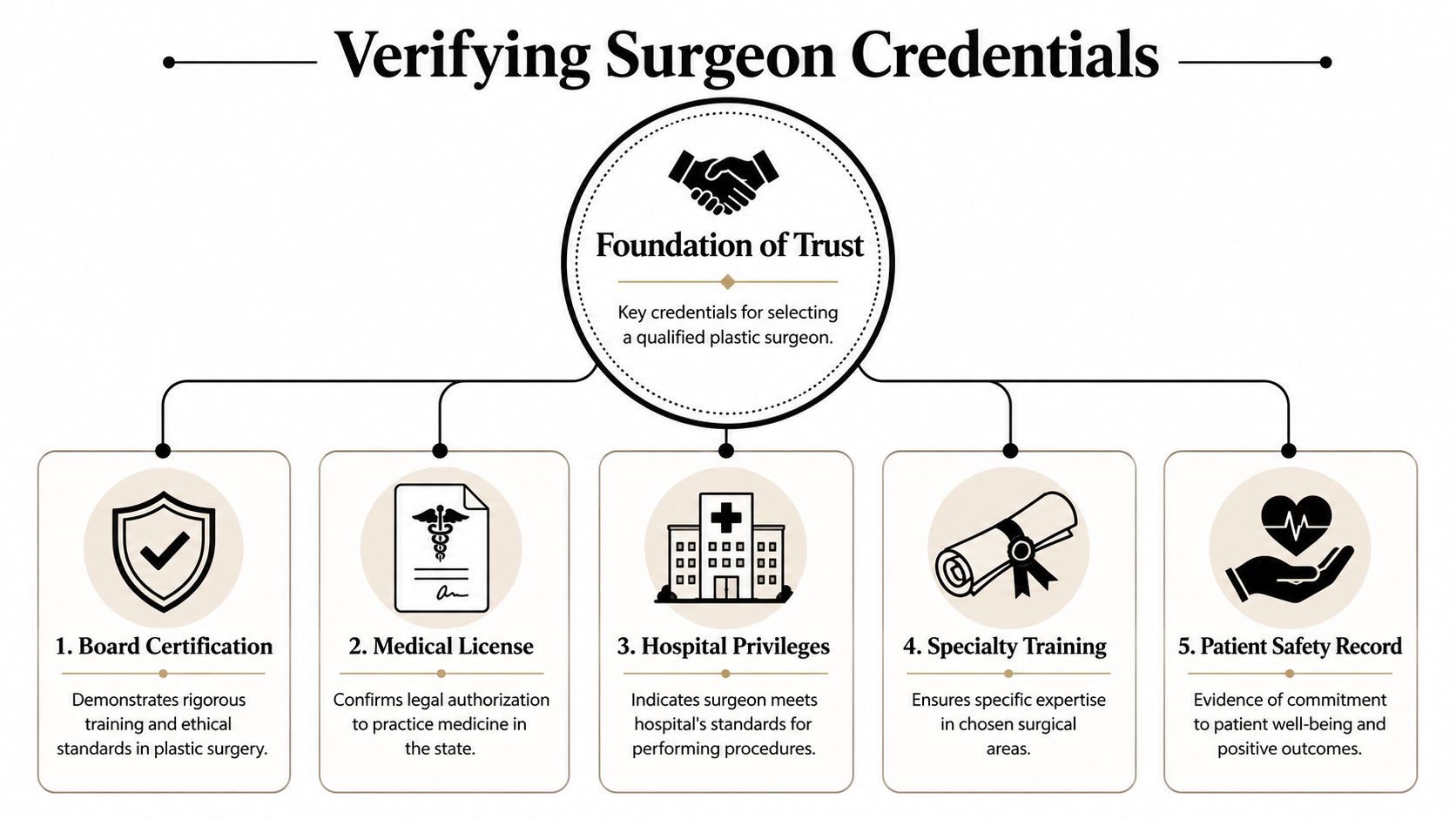
Patients often hear terms like “cosmetic surgeon,” “aesthetic expert,” or “board eligible” and assume they all mean roughly the same thing. They don't. You need to verify what board is being referenced and whether the surgeon has completed that process.
If you want a helpful breakdown of the distinction, this article on board-eligible vs board-certified plastic surgeons is worth reading before you book consults.
When you call a practice, don't dance around this. Ask directly:
A qualified office should answer clearly and without defensiveness.
A lot of patients focus on the surgeon and forget the room, the staff, and the systems around that surgeon. That's a mistake.
An accredited surgical suite means the environment itself is being held to recognized standards for safety and operations. That includes protocols, equipment, staffing expectations, and emergency readiness. In plain language, it means you're not just trusting one person. You're trusting a whole system that should function properly under pressure.
Cape Cod patients should pay close attention here because on-site surgery can be convenient and efficient, but only if the facility is held to a serious standard. According to Cape Cod Plastic Surgery, the practice has an on-site surgical suite accredited by AAAASF, and Dr. Marc Fater has maintained that standard for over 30 years in Hyannis.
That's the kind of concrete detail you should look for when evaluating any local option.
Use this as your first-pass filter before looking at photos or pricing:
If a practice makes it hard to verify basic credentials, that's your answer.
On Cape Cod, people sometimes lean too hard on familiarity. “I've heard the name for years” is not enough. A good reputation can be a starting point, not the final proof.
You need documentation, direct answers, and a facility standard you can trust. That's the floor. Not the ceiling.
A surgeon can be qualified on paper and still be the wrong fit for you. That's where judgment comes in.
Once your shortlist is down to properly credentialed surgeons, start studying how they think, how they communicate, and whether their aesthetic style matches your goals. This is the part many patients rush because it feels subjective. It is subjective, but it's not random.
Don't just react to dramatic transformations. Look for consistency.
Ask yourself:
You're not choosing a generic service. You're choosing a surgeon's eye.
If you want a useful companion read while comparing options, this piece on the top indicators of a board-certified plastic surgeon's expertise helps sharpen what you should notice.
Here's the part I wish more people understood early. A technically fine result does not guarantee a satisfied patient.
Industry studies show 76.8% of patients cite inadequate empathy or involvement in decision-making as a primary driver of dissatisfaction, even when the technical outcome is satisfactory. That means poor communication wrecks trust fast.
So pay attention during every interaction. Did the surgeon interrupt you? Did they reshape your goal into theirs? Did you leave more confused than when you arrived? If yes, don't talk yourself into it.
A surgeon who doesn't listen before surgery usually won't feel easier to reach after surgery.
Online reviews can help, but only if you read them with discipline. Don't get hypnotized by all-positive language. Look for specifics.
Helpful reviews usually mention things like:
The strongest patient experience usually feels organized, not flashy.
If this process feels surprisingly detailed, that's because it should be. Choosing among Cape Cod plastic surgeons has a lot in common with high-stakes planning where details matter more than glossy promises. That's one reason some people like using a structured decision approach similar to a guide to luxury travel planning. The point isn't travel. The point is that premium experiences only go well when the planner handles logistics, contingencies, and fit, not just appearances.
Plastic surgery is the same. You're not buying a pretty destination. You're choosing a team for a medical event.
Some of the best signs are quiet:
“I don't think that procedure will give you the result you want.”
That's a green flag. So is a surgeon who recommends waiting, revising the plan, or choosing a less aggressive approach.
You want honesty. Not enthusiasm at any cost.
Walk into a consultation like you're interviewing a professional for an important job. Because you are.
The consultation should feel calm, detailed, and respectful. You should never feel rushed to schedule, pushed toward a bigger procedure, or made to feel silly for asking practical questions. If that happens, leave.
Start paying attention in the waiting room and at the front desk. Offices tell on themselves.
Notice whether the staff seems organized. Notice whether paperwork is clear. Notice whether anyone discusses private information too casually. In surgery, operational sloppiness rarely stays confined to one part of the practice.
Then watch the surgeon. Do they sit down? Do they ask what bothers you, or do they start selling a package? Do they explain tradeoffs?
What matters most: You should leave a consultation feeling informed, not flattered.
| Category | Question to Ask |
|---|---|
| Credentials | Are you board-certified in plastic surgery, and where can I verify that? |
| Procedure experience | How often do you perform the specific procedure I'm considering? |
| Surgical setting | Where would my procedure take place, and is that facility accredited? |
| Candidacy | Am I a good candidate for this procedure, and why or why not? |
| Alternatives | Is there a less invasive option that could address part of my concern? |
| Aesthetic planning | What result do you think is realistic for my anatomy? |
| Risks | What are the most important risks in my case? |
| Recovery | What will the first days and weeks of recovery actually look like? |
| Complications | If I have a problem after hours, who responds and how quickly? |
| Follow-up | How many follow-up visits are typically involved? |
| Costs | What is included in the quote, and what might be billed separately? |
| Revision policy | If the result needs revision, how does your office handle that conversation? |
If you want a patient-friendly prompt list before your appointment, this article on questions to ask a cosmetic surgeon is a useful starting point.
Patients usually remember to ask about scars and downtime. They often forget the harder questions that reveal how a surgeon actually practices.
Ask these clearly:
Those questions matter more here than in a large urban center because local access can tighten during busy months.
A good answer has structure. It includes steps, timing, and who is responsible.
A weak answer sounds like this: “Don't worry, complications are rare.”
That response is not reassuring. It's evasive.
A better answer sounds like a plan: who you call, what symptoms trigger concern, where you go, and how the surgeon coordinates next steps. You want specifics. Not charm.
Most patients divide plastic surgery into two buckets. Surgical and non-surgical. That's useful, but not enough.
A better way to think about it is this: some procedures mainly ask for planning, and others ask for planning plus a serious recovery commitment. On Cape Cod, that distinction matters because recovery isn't happening in a vacuum. It's happening in a region where traffic, seasonal staffing, ferry schedules, and summer congestion can affect access to care.
People often research the operation and under-research the recovery. That's backwards.
Whether you're considering facial surgery, body contouring, breast surgery, or injectables like Botox and fillers, the result depends heavily on what happens after treatment. That includes rest, wound care, activity limits, transportation, and follow-up. If your schedule, job, or home setup can't support recovery, you're not ready yet. That's not judgment. That's practical medicine.
Here's the local reality. A frequently unaddressed question is how to manage post-operative complications in a seasonal healthcare environment. Data indicates 27% of rural coastal surgical centers can face delays due to seasonal staffing shortages, which is exactly why a surgeon's contingency plan matters so much in this setting.
Different procedures ask different things from you:
The biggest mistake I see is treating surgery on Cape Cod like surgery in a dense metro area with endless backup options nearby.
If you live in Hyannis and have local support, your planning may be straightforward. If you're coming from the South Shore, the Islands, or farther away, your plan should be tighter. You need to know:
Don't accept “call us if you need anything” as the whole plan. Ask what happens if you need care at night, on a weekend, or during peak tourist traffic.
That's not being difficult. That's being prepared.
A well-run practice should be able to explain the practical mechanics of follow-up in plain English. Not just “we're here for you,” but actual logistics.
Look for answers to these points:
Those details matter because they reduce uncertainty at the exact moment patients feel most vulnerable.
Even the best surgeon can't recover for you.
Ask yourself:
A lot of complications don't begin in the operating room. They begin when patients underestimate recovery, skip support planning, or assume they'll “just push through.”
That approach is especially risky in a seasonal region. Build slack into your schedule. Give yourself more support than you think you'll need. Choose a surgeon with a real local presence and a real system for follow-up.
Let's talk about the issue almost everyone cares about and too few practices address clearly. Cost.
Data shows 64% of potential patients in coastal New England regions delay surgery due to cost uncertainty. That tracks with what I hear all the time. People aren't always saying no to surgery. They're saying no to vague pricing, missing details, and the fear of being financially cornered after they've emotionally committed.
You want a written breakdown. Not a polished estimate with big blank spaces.
Ask what is included in the fee and what could be separate. That might involve the surgeon's fee, facility fee, anesthesia, garments, medications, follow-up visits, or revision-related costs. Don't assume. Ask.
Also ask whether financing is available and how that process works. A good office should be able to explain options without making you feel pressured to “make the numbers work” on the spot.
Cost transparency is part of ethical care. If the money conversation feels slippery, the rest of the experience probably will too.
If you've done the work above, your next step is simple. Book a consultation with a surgeon who meets your safety standards, answers direct questions clearly, and has a plan for recovery in the Cape Cod environment.
Don't choose based on marketing polish. Don't choose based on convenience alone. Don't choose the cheapest option just to stop comparing. Choose the surgeon and setting you'd trust if everything went smoothly, and if it didn't.
If you want clear answers about credentials, surgical safety, recovery planning, and what treatment may fit your goals, schedule a consultation with Cape Cod Plastic Surgery. You'll be able to discuss your concerns one-on-one, review realistic options, and get practical guidance from a practice with an on-site AAAASF-accredited surgical suite and decades of experience in Hyannis.
September 9, 2026
Expert Guide to Proper Surgical Incision Care
Master dermal fillers aftercare with do's and don'ts, swelling tips, activity limits and warning signs to protect your results and heal smoothly.

September 8, 2026
Ensuring Safety: Why Your Surgeon's Credentials Matter Most
Cape Cod Plastic Surgery offers expert cosmetic and reconstructive procedures in a safe, accredited setting. Led by Dr. Marc Fater, we combine advanced techniques with personalized care to help you look and feel your best.
Monday: 9:00 AM – 5:00 PM
Tuesday: 9:00 AM – 5:00 PM
Wednesday: 9:00 AM – 5:00 PM
Thursday: 9:00 AM – 5:00 PM
Friday: 9:00 AM – 5:00 PM