

October 7, 2026
What to Expect During Your Breast Surgery Recovery
A Practical Guide to Healing After Breast Surgery
Apr 23, 2026

You may be in a familiar place right now. Your weight is stable, you eat reasonably well, you exercise, and yet the same areas still bother you. The lower abdomen that never quite flattens. The love handles that hold on no matter how consistent you are. The loose skin after pregnancy or major weight loss that makes fitted clothing sit differently than you want.
That’s where body contouring enters the conversation.
People often ask me some version of the same question: how does body contouring work if diet and exercise already reduce fat? The short answer is that body contouring is designed for the parts of the body that don’t always respond predictably to healthy habits alone. It reshapes, tightens, and refines. Sometimes that means removing tissue directly. Sometimes it means triggering your own body to clear damaged fat cells gradually over time.
The key is understanding the biology first. Once you know what happens to the cells, the machines and procedures make a lot more sense.
Body contouring is a broad term for treatments that reshape specific areas of the body. It can reduce localized fat, tighten loose skin, improve definition, or combine those goals in one treatment plan. What it does not do is function as a primary weight loss method.
That distinction matters. If someone wants to lose a substantial amount of weight for health reasons, the right conversation may start elsewhere. For people comparing medical weight loss and surgery, this guide to weight loss surgeries can help clarify how those options differ from cosmetic contouring. Body contouring is usually the finishing step after weight has stabilized, not the first step in the process.
Most candidates fall into one or more of these groups:
Practical rule: Body contouring works best when the goal is shaping, not scale change.
A patient near their goal weight with one or two specific concerns often does very well. A patient hoping a contouring treatment will replace weight management is more likely to feel disappointed, even if the procedure itself is technically successful.
Think of body contouring like tailoring a well-made jacket. The fabric is already there. The tailor improves fit, proportion, and silhouette. The tailor doesn’t build a new wardrobe from scratch.
That’s why the best results usually come from matching the right tool to the right problem. Some patients need direct tissue removal. Others need gradual fat reduction without surgery. Many need a careful assessment of both skin quality and fat distribution before any decision makes sense.
A common patient scenario goes like this: you look at one area, usually the abdomen, flanks, arms, or under the chin, and ask a reasonable question. “Do I need surgery, or can a device handle this?”
The answer starts with biology, not branding. Body contouring follows two different pathways inside the body. One pathway removes or repositions tissue directly. The other injures fat cells in a controlled way so your body can gradually process and clear them.
A simple comparison helps. Surgical contouring works like removing material by hand and reshaping the structure at the same time. Non-surgical contouring works more like marking selected fat cells for disposal, then waiting while your body’s cleanup system does the work.
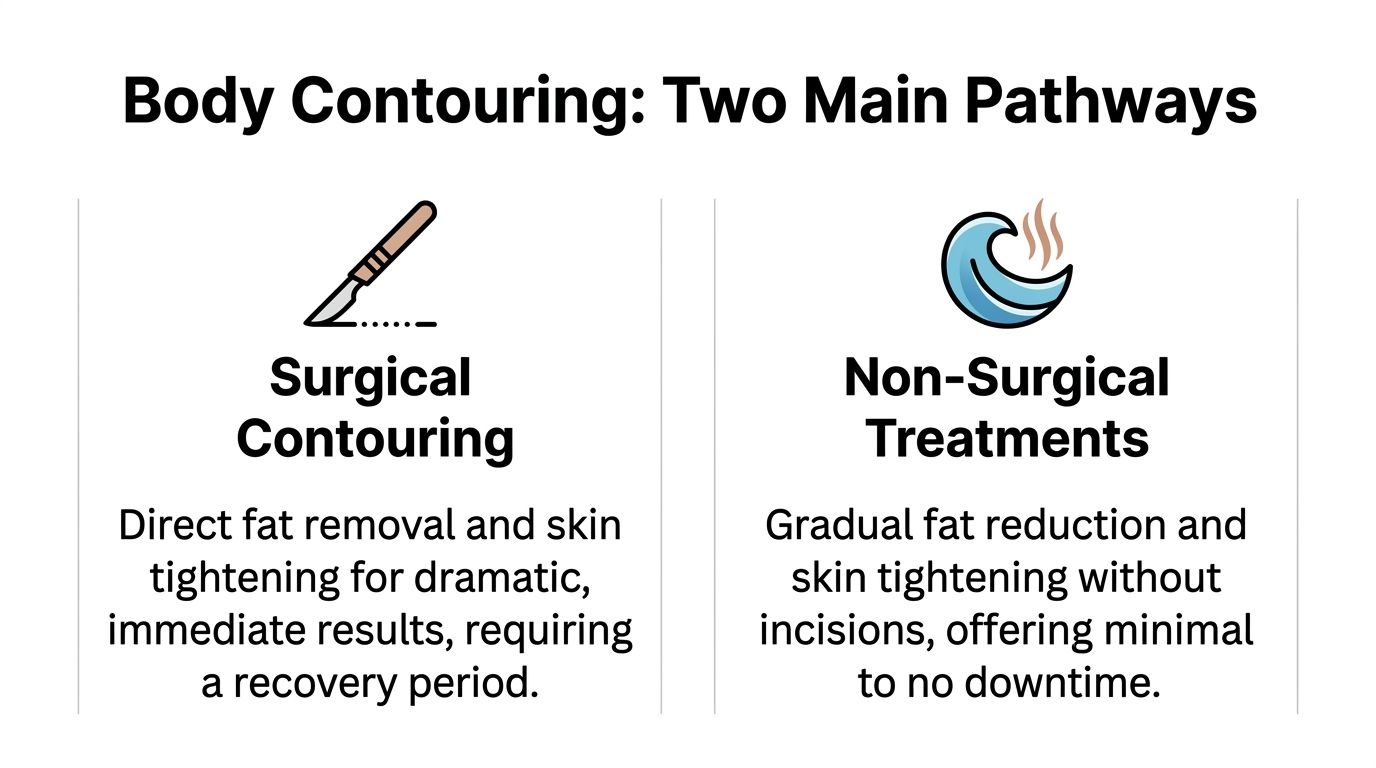
Surgery changes shape by immediate mechanical action. With liposuction, fat cells are physically removed. With a tummy tuck, excess skin is excised, and the abdominal wall may also be repaired or tightened. The contour changes right away, even though swelling and healing temporarily blur the final result.
This pathway usually fits patients who need more than small-volume refinement. It is often the better option when there is significant skin laxity, a larger amount of tissue to address, or a structural problem such as stretched abdominal support after pregnancy or weight loss.
Non-surgical treatments work differently at the cellular level. The device delivers cold, heat, sound energy, or electromagnetic energy to a targeted area. That energy stresses or damages fat cells more than the surrounding tissue. After that, the lymphatic system and normal metabolic processes gradually carry away the cellular debris.
That timeline explains a lot of patient confusion. You may leave the office looking much the same because the treatment result is not based on immediate removal. It depends on your body recognizing injured fat cells, breaking them down, and clearing them over time.
Some devices can also stimulate muscle or encourage a modest degree of skin tightening, but the core principle is the same. The machine creates the condition. Your body creates the visible change.
Recovery matters, but it is only one part of the decision. The bigger distinction is how each option creates change, how much change it can create, and which tissue problem it can solve.
| Pathway | What changes the contour | Speed of visible change | Best suited for |
|---|---|---|---|
| Surgical | Tissue is removed or tightened directly | Earlier visible change, with refinement over healing | Larger changes, skin excess, structural reshaping |
| Non-surgical | Fat cells are damaged and cleared gradually | Gradual change over time | Smaller pockets of fat, subtle refinement, minimal downtime |
This is why two treatments can both be called “body contouring” and still behave very differently. One is direct tissue management. The other is controlled tissue response.
If you want a broader overview of options, this roundup of best body contouring procedures is a helpful companion.
Surgery changes contour by direct removal or repair. Non-surgical treatment changes contour by triggering a biologic cleanup process.
You can often tell who needs a surgical solution before a single incision is made. A patient pinches loose lower abdominal skin that will not shrink. Another points to fullness at the waist that has stayed despite weight loss. A third says, “My stomach still looks pushed forward after pregnancy.” Those concerns may sound similar, but the tissue problem underneath each one is different. Surgery works by identifying the exact layer causing the contour change, then correcting that layer directly.
The key idea is simple. Surgical body contouring changes shape by removing tissue, tightening tissue, or both. The biology still matters, because your skin, blood supply, scar response, and healing capacity affect the final result, but the procedure itself creates the structural change in real time.
Liposuction is controlled fat removal, not broad suctioning. Before surgery, the surgeon marks the body while you are standing because gravity reveals where fullness begins, where it fades, and how one area blends into the next. That map guides the contour plan once you are on the table.
During the procedure, the surgeon places tumescent solution into the fat layer. This fluid expands the space, reduces bleeding, and helps the cannula move more smoothly through the tissue. The cannula is a narrow hollow instrument designed to remove fat through small incisions.
The process works like careful vacuuming beneath a fitted rug. Remove too little and the bulk remains. Remove too aggressively or too close to the surface and the top can look uneven. Good liposuction is not about taking out the maximum amount of fat. It is about removing fat in the right depth, in the right pattern, with smooth transitions from one zone to the next.
Patients usually benefit from keeping three points in mind:
A tummy tuck addresses a different problem set. In many patients, especially after pregnancy or major weight loss, the abdomen changes in three separate ways at once. The skin stretches. Fat may collect in the lower abdomen. The abdominal wall can widen, which creates a rounded or protruding look even when body fat is low.
That widening is often called muscle separation, though the issue is usually the connective tissue between the muscles. During a tummy tuck, the surgeon can bring the abdominal wall back toward the midline with sutures, a step called plication. The result is a firmer internal support layer.
A tummy tuck works like tailoring a garment that has lost its structure. The internal support is tightened. The extra outer fabric is removed. The surface then lies flatter because the deeper framework and the skin envelope have both been corrected.
Given that skin excess is a mechanical problem, devices cannot remove hanging skin or repair significant abdominal wall laxity. If the tissue itself is stretched beyond what it can retract, surgery addresses the cause rather than trying to camouflage it. For a more procedure-specific explanation, this overview of what body contouring surgery involves gives additional context.
Surgical contouring produces an immediate structural difference because tissue has already been removed or tightened in the operating room. What you see in the first few weeks, however, is still filtered through swelling, firmness, bruising, and the slow process of skin settling into its new position.
That is why early improvement and final outcome are not the same thing.
Over the following months, swelling declines, scars soften, and the treated tissues relax into a more natural contour. Liposuction areas can refine gradually. Tummy tuck scars mature and fade. The abdomen may look flatter early on, then look even better as residual swelling resolves and the skin envelope adapts.
Here’s a visual walkthrough that helps make the surgical approach less abstract:
Surgery still fills a role that non-surgical treatment cannot replace. It is often the better match when the problem involves excess skin, larger-volume fat removal, abdominal wall repair, or a need for a more substantial shape change.
In practical terms, surgery is often the best option for:
Those procedures remain common because many contour concerns are structural. If the issue is extra tissue that needs to be removed, or support tissue that needs to be tightened, the most direct solution is often the most honest one.
A patient comes in frustrated by a small area of fullness at the lower abdomen or flanks. Their weight is stable. Their clothes almost fit the way they want. What they do not want is surgery, scars, or weeks of recovery. That is the setting where non-surgical body contouring often enters the conversation.
What makes these treatments medically interesting is not the machine itself. It is the biology underneath it.
Non-surgical contouring works by creating a controlled injury in a specific layer of tissue, most often fat. The device provides the stimulus. Your body carries out the result over time. That point is easy to miss, and it explains both the appeal of these treatments and their limits.
The key biologic process is apoptosis, or programmed cell death.
That phrase sounds technical, but the idea is straightforward. A healthy fat cell can keep storing energy for years. A stressed or damaged fat cell can enter a shutdown program. Once that happens, the body identifies it as tissue to clear away. In other words, the treatment starts the process, and your immune system finishes it.
This is the part patients need to understand before they choose a treatment. Nothing is physically removed that day. There is no instant emptying of the area, as there is with liposuction. The visible change comes later, because the body needs time to break down and clear the affected cells.
A useful comparison is a branch that has been pruned from a tree. The cut happens in one moment, but the tree still has to seal the area and remodel itself afterward. Non-surgical contouring follows that same sequence. Treatment first, remodeling later.
That delayed response is why these procedures are best for gradual refinement, not immediate debulking.
Cryolipolysis is the best-known example. CoolSculpting belongs to this category. The applicator cools the targeted fat layer to a temperature range that fat cells tolerate poorly compared with nearby tissues.
According to this explanation of cryolipolysis and body contouring, cooling the subcutaneous fat can trigger apoptosis in adipocytes. Over the following months, the body gradually clears those injured fat cells, which can reduce the thickness of the treated fat layer.
The science matters because it answers a common question. Patients often ask whether the fat is "frozen away" in one visit. The better explanation is that cold places selective stress on fat cells. Those cells then enter a delayed death pathway, and the body removes them bit by bit.
If you want a treatment-specific overview, this guide on how CoolSculpting works explains that process in more detail.
Many patients use "CoolSculpting" as shorthand for all non-surgical contouring, but the category is broader than that. Different devices use different forms of energy. The goal is similar. Create a precise tissue response without surgery.
These devices use heat. In the fat layer, thermal energy can injure fat cells. In the skin, heat can stimulate collagen remodeling. That combination can help patients who have a modest fat pocket plus mild skin looseness.
The result is not a melted-away area of fat. It is a gradual tissue response. Some fat cells are damaged, the body processes them over time, and the skin may tighten as collagen reorganizes.
Ultrasound uses sound waves delivered below the surface of the skin. Depending on the platform, that energy may disrupt fat cells directly or heat deeper tissue in a controlled way.
From the patient’s perspective, these devices may feel quite different from a cooling treatment. Biologically, though, the principle is familiar. Targeted energy affects a specific tissue layer, and the body then remodels that area over the following weeks.
Some devices change contour by working on muscle more than fat. Emsculpt NEO is one example. It uses electromagnetic energy to create powerful muscle contractions, which can improve the shape of the underlying muscular layer and contribute to a firmer appearance.
That distinction matters. A flatter or more athletic contour does not always come from removing fat alone. In some patients, part of the visible improvement comes from strengthening what sits underneath it.
Non-surgical body contouring is often cumulative. One treatment can start the process, but repeated exposure may produce a stronger response if the tissue and treatment plan are appropriate.
That does not mean every patient needs a series, and it does not mean every area responds the same way. It means these treatments are dose-dependent. The amount of change depends on the device, the anatomy being treated, the thickness of the fat layer, skin quality, and how your body responds to the stimulus.
This is also why consultation matters so much. Two patients can have the same complaint, "I want this bulge gone," while having very different tissue problems underneath.
The misunderstandings tend to be predictable:
A small, pinchable pocket of fat with good skin elasticity is often a good setup for non-surgical treatment. Loose skin, significant laxity, or a need for a larger change usually calls for a different plan.
That is the deeper truth behind non-surgical body contouring. The machine matters, but the biology matters more. Once you understand what happens to the cells first, the choice of device becomes much easier to understand.
A patient may point to the abdomen and say, “I want this flatter,” but that single concern can come from very different problems underneath. One person has a pocket of fat that sits above strong muscle and skin with good recoil. Another has stretched skin after pregnancy or weight loss. A third has muscle separation, where the abdominal wall has widened and lost support. The outside complaint sounds the same. The treatment plan should not.
That is why comparing body contouring options starts with biology, not brand names or device menus. Body contouring changes shape by removing fat, tightening skin, repairing support, or combining those steps. Once you know which layer is creating the contour problem, the differences in results, recovery, and candidacy become much easier to understand.
| Procedure | Best For | Typical Results | Downtime | Invasiveness |
|---|---|---|---|---|
| Liposuction | Localized fat deposits when skin has enough elasticity to redrape | More visible volume reduction and sharper reshaping | More recovery than office treatments | Surgical |
| Tummy Tuck | Loose abdominal skin, lower abdominal fullness, muscle separation | Flatter abdomen, smoother skin envelope, tighter midsection | More recovery than liposuction alone | Surgical |
| Cryolipolysis | Small to moderate pockets of pinchable fat | Gradual reduction over months, often subtle to moderate | Minimal downtime | Non-surgical |
| Radiofrequency | Mild fat with mild skin laxity | Gradual refinement plus some tightening | Minimal downtime | Non-surgical |
| Laser contouring | Mild fullness and surface tightening goals | Gradual improvement, especially in contour and skin quality | Minimal downtime | Non-surgical |
| Ultrasound contouring | Targeted fat reduction or deeper tissue remodeling | Gradual change rather than immediate reshaping | Minimal downtime | Non-surgical |
Surgical and non-surgical contouring can both improve shape, but they do not create the same scale of change.
Surgery physically removes tissue or repairs anatomy in a single procedure. If liposuction removes fat cells, that volume is gone at the time of surgery. If a tummy tuck removes loose skin and tightens separated muscles, the abdominal wall is changed directly. Swelling can hide the final outcome for a while, but the structural work has already been done.
Non-surgical treatment works more like sending a signal and waiting for the body to carry it out. The device cools, heats, or otherwise stresses the target tissue. Then your body clears injured fat cells or remodels collagen over weeks to months. That delayed timeline is normal. It is part of the mechanism.
So the comparison is not “which one works better?” The better question is “how much change do you want, and what tissue has to change to get you there?”
Recovery reflects how much the treatment asks your body to repair.
A non-surgical session usually causes temporary swelling, soreness, numbness, or tenderness, but many patients return to normal routines quickly. The tradeoff is patience. Improvement develops gradually, and some treatment plans require more than one session.
Surgical recovery is more demanding because the change is more direct. After liposuction or abdominoplasty, the body has to heal incisions, internal tissue planes, swelling, and bruising. Garments, activity limits, and time away from full exercise are common parts of that process. In return, the improvement is often more visible and more efficient for the right candidate.
Neither path is universally easier. Each asks for something different. Non-surgical contouring asks for time and modest expectations. Surgery asks for recovery time and a higher level of commitment up front.
Three questions usually bring the decision into focus.
What is causing the contour issue?
If the main issue is excess fat, liposuction or selected non-surgical fat reduction may help. If loose skin is the dominant problem, surgery is often the more accurate answer. If the abdomen projects because of muscle separation, fat treatment alone may leave you disappointed because the support problem remains.
How much change do you want to see?
A patient looking for a small reduction in fullness may be very happy with gradual, non-surgical refinement. A patient hoping for a clear reset in body shape usually needs a surgical plan.
What kind of recovery fits your life right now?
Some patients can plan around downtime. Others need to stay close to work, caregiving, or travel responsibilities. That practical piece matters because the best technical option is not always the best fit for the moment.
The right procedure matches the anatomy being treated, the scale of change you want, and the recovery you can reasonably accept.
Patients use that word in very different ways. “Smaller” is not the same as “tighter.” “Flatter” is not the same as “more defined.” “I want this bulge gone” can mean less fat, firmer skin, repaired muscles, or all three.
A helpful way to picture it is to think about tailoring a jacket. If the issue is extra padding inside, removing that padding changes the fit. If the fabric itself is stretched out, you have to tighten or remove fabric. If the internal seams have pulled apart, the garment needs structural repair. The body works the same way. Good contouring starts by identifying which layer is responsible, then choosing the treatment built to correct that layer.
That is also why a treatment can perform exactly as designed and still feel disappointing if it was matched to the wrong problem. The best outcomes come from an honest diagnosis first, then a procedure that fits the tissue, the goal, and the recovery plan.
A thoughtful body contouring journey usually starts with a conversation that’s more detailed than people expect. Most patients arrive talking about one visible concern, such as a lower abdominal bulge or fullness at the flanks. During a careful evaluation, the deeper question becomes clear: is that caused by fat, loose skin, weakened support, or some combination of all three?
At Cape Cod Plastic Surgery, that first visit is centered on diagnosis, not guesswork. Dr. Marc Fater is a board-certified plastic surgeon with over 30 years of experience, and that experience matters because body contouring often requires pattern recognition. Two patients may describe the same complaint and need completely different solutions.

A typical planning discussion includes:
Sometimes the answer is straightforward. A patient with loose abdominal skin and muscle separation may be best served by surgery. A patient with a small, pinchable fat pocket and good skin quality may be an excellent non-surgical candidate. Sometimes the best plan combines approaches, either at the same time or in sequence.
The technical side of treatment matters, but so does the environment in which care is delivered. Cape Cod Plastic Surgery features an on-site, AAAASF-accredited surgical suite, which gives patients the reassurance of a setting designed around safety, consistency, and comfort.
That support continues after the procedure. Swelling, healing, garment use, activity restrictions, and follow-up assessments all influence how smoothly recovery goes and how well the final contour settles.
Good body contouring doesn’t end when the procedure ends. Results depend on planning, healing, and long-term habits.
This is one of the most overlooked parts of body contouring. Patients often hear that results are permanent, but that word needs context. Removed fat cells do not regenerate in the exact same way, yet bodies still change with time, aging, and weight fluctuations.
A review focused on long-term outcomes reported that 15% to 30% of users describe partial fat regain within 3 years, which is why sustained results require more than the procedure itself, as discussed in this article on whether body contouring really works. That’s one reason Dr. Fater’s approach may include broader guidance such as metabolic monitoring and comprehensive planning rather than treating contouring as an isolated event.
For many patients, that’s the difference between a short-lived improvement and a result that still looks balanced years later.
Not because the body is trying to “compensate” in a simple one-for-one way. If fat cells are removed surgically or cleared after a non-surgical treatment, that treated area can remain improved. But your body can still store fat elsewhere if your weight increases. The more accurate way to think about it is this: contouring changes the map, but weight change can still affect the whole body.
Yes, and in many cases that’s the smartest approach. A patient may need liposuction for one area and skin tightening for another. Someone else may benefit from surgery first, then a non-surgical treatment later for refinement. Combination planning works best when each procedure is solving a different tissue problem rather than duplicating the same job.
That depends on the method. Surgical procedures involve anesthesia and a recovery period that includes soreness, swelling, and temporary activity limits. Non-surgical procedures tend to be more tolerable in the moment, but “non-invasive” doesn’t mean sensation-free. Cooling can feel intensely cold and numb. Heat-based devices can create a hot, tight feeling. Muscle stimulation treatments can feel surprisingly strong.
With surgery, you’ll usually see an early shape change soon after the procedure, even though swelling hides the final contour at first. With non-surgical treatments, the visible change is slower because your body needs time to remove damaged fat cells and remodel the area.
No. Body contouring is for shape change, not broad weight reduction. It’s best for people who are already close to a stable, manageable weight and want to improve proportion, smoothness, or definition.
If you want another example of how clinics answer practical patient concerns, you can read more FAQs from a clinic's perspective. It’s useful for seeing the kinds of questions people commonly ask before scheduling a consultation.
If you’re thinking about body contouring and want a personalized recommendation based on your anatomy, goals, and recovery preferences, Cape Cod Plastic Surgery offers consultations with Dr. Marc Fater, a board-certified plastic surgeon with over 30 years of experience. Whether you’re considering surgery, a non-surgical option, or a combination plan, the next step is a careful evaluation that matches the treatment to the problem you want to solve.
October 7, 2026
A Practical Guide to Healing After Breast Surgery

October 6, 2026
Your Safety Guide: What to Look for When Choosing a Plastic Surgeon
October 5, 2026
Why Our On-Site Accredited Facility Matters for Your Safety

Cape Cod Plastic Surgery offers expert cosmetic and reconstructive procedures in a safe, accredited setting. Led by Dr. Marc Fater, we combine advanced techniques with personalized care to help you look and feel your best.
Monday: 9:00 AM – 5:00 PM
Tuesday: 9:00 AM – 5:00 PM
Wednesday: 9:00 AM – 5:00 PM
Thursday: 9:00 AM – 5:00 PM
Friday: 9:00 AM – 5:00 PM