
September 9, 2026
How to Care for Surgical Incisions Properly
Expert Guide to Proper Surgical Incision Care
Aug 5, 2026

Surgical glue typically stays on for about 5 to 10 days on most incisions, and on certain body areas or with deeper procedures it can remain intact for 2 to 4 weeks. If you're staring at your incision and wondering whether that longer stretch is normal, it usually is.
The first day or two after surgery can feel oddly unfinished. The skin is closed, the glue looks shiny or slightly stiff, and you're left trying to decide whether it should be doing more, less, or nothing at all.
The first thing patients usually notice is that surgical glue looks like a thin, clear coating over the incision. That's the point, it works like a liquid bandage, sealing the skin while the deeper layers start repairing themselves. A good after-visit note often helps here, and an after visit summary guide can be useful if you want a simple place to keep the surgeon's instructions in one spot.
The glue sets quickly and is meant to stay put while the wound edges remain supported. You should expect the area to look a little unfamiliar at first, especially if the incision is in a place you can't easily see.
A few practical points matter on day one. The glue is there to protect the incision, not to decorate it, and the less you disturb it, the better it can do its job. If your discharge instructions mention incision care, the basics in this surgical incision care guide line up with the usual post-op approach, gentle handling, clean skin, and no picking.
Practical rule: if the incision edges are together, the glue is dry, and you're not seeing drainage, the glue is probably behaving the way it should.
The hardest part for many patients is the uncertainty. A little anxiety is normal, because the glue often looks temporary even while it's still doing important work underneath.

Surgical glue is usually a cyanoacrylate adhesive, the same general family of medical skin adhesives used to close superficial incisions. Once it touches the skin, it forms a waterproof film that acts like a seal over the wound, which is why it doesn't rinse away with a casual shower or dissolve immediately on contact with moisture. For people who want a more general waterproof barrier for skin, a waterproof bandage spray option is a different kind of product entirely, but it helps illustrate the idea of a protective outer layer.
Think of it as a temporary shell. The glue bonds to the top layer of skin and holds the edges together while the body starts rebuilding stronger tissue underneath.
That bond is deliberate. It's designed to stay intact during the early healing phase, when the incision is still vulnerable to stretch, rubbing, and contamination.
Because the adhesive is meant to cling, scrubbing it off or peeling at lifted edges can do real harm. A patient might think they're “cleaning up” the incision, but pulling on glue can reopen skin that hasn't finished sealing yet.
The simpler the behavior around the incision, the better. Gentle cleansing, dry patting, and leaving the adhesive alone usually do more good than any aggressive attempt to speed up the process.
Let the glue flake off on its own. If you start trying to help it along, you can end up helping the wound open instead.
That's also why glue often feels more stubborn than people expect. It's not failing to come off, it's holding steady until the skin underneath is ready.
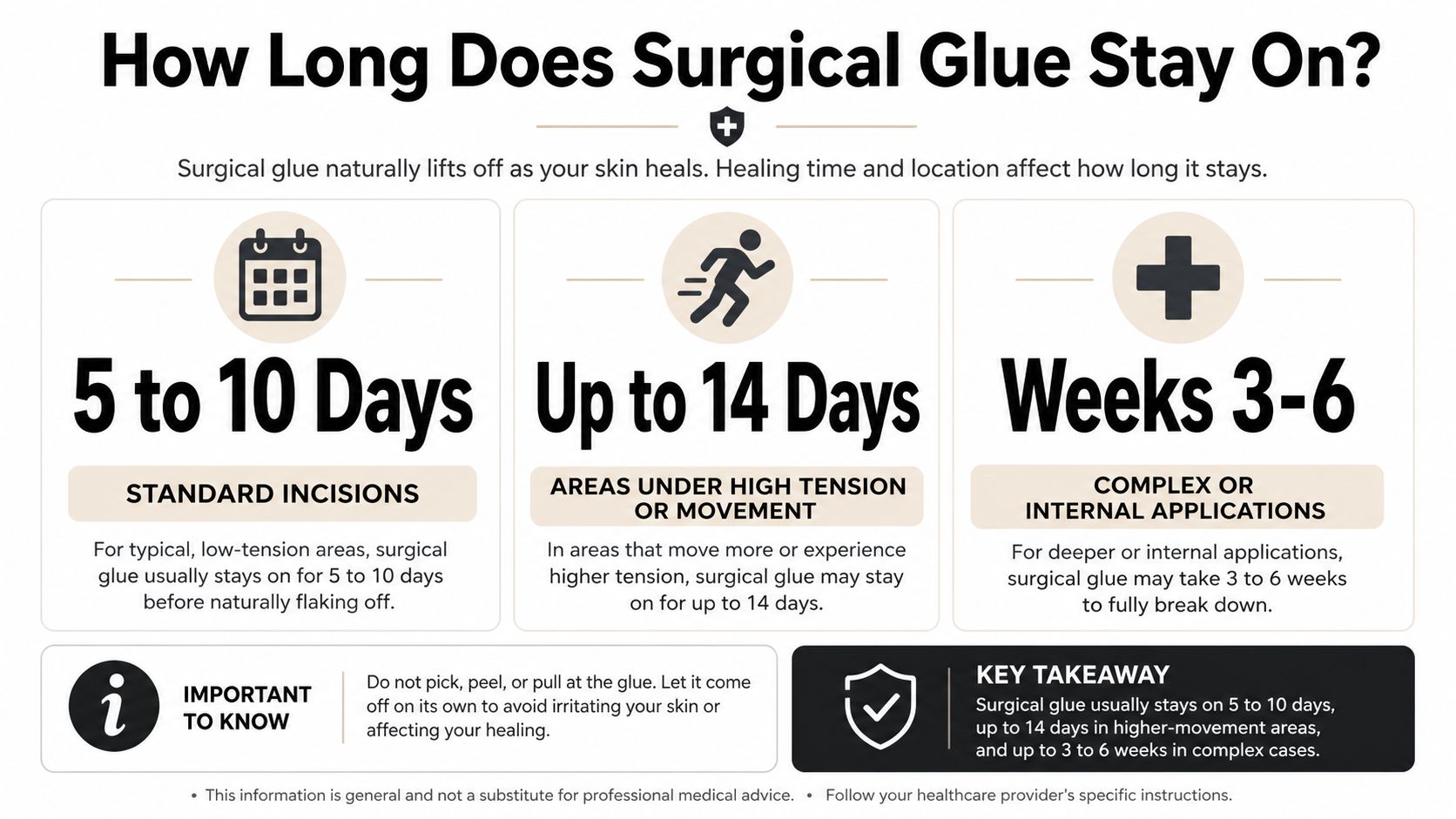
The most common answer is still 5 to 10 days for many incisions, and that's the range patients hear most often because it fits a typical healing pattern (REN Skin). Some guidance broadens that to 5 to 14 days, which is still within the normal window for many straightforward closures (REN Skin).
But that isn't the whole story. External glue can separate 2 to 4 weeks after surgery in some aftercare instructions, and Dermabond is sometimes expected to remain for 4 to 6 weeks before it flakes off with natural skin shedding (Regional Hand Surgery). That longer stay doesn't automatically mean something is wrong.
The bigger issue is that many patients are told one timeline when real healing behaves more like a range. A short, flat incision on low-movement skin may loosen earlier, while a deeper or less mobile site may hold on much longer.
If you're comparing glue to other closure methods, the key difference is that it isn't there to be removed on a set date. It is meant to detach when the skin has done enough of the early repair work to support itself. An internal review of the suture removal timeline is helpful for understanding how different closure methods follow different schedules.
The practical takeaway is simple. Longer-lasting glue is often normal, especially when the incision is in a high-motion or hard-to-heal area. The timeline matters, but the incision's appearance matters more.
If you're comparing glue duration with pain relief duration from medications, a separate lidocaine pain relief duration guide can help keep those two ideas distinct, since pain control and adhesive lifespan aren't the same thing.
A belly-button incision and a flat incision on a low-friction area don't behave the same way. Location changes everything, because some sites tug, trap moisture, or stay hard to inspect, and those conditions tend to keep glue in place longer (Mod Dermatology).
A deep navel incision, a skin fold, or any area exposed to constant movement may hold the adhesive for two to three weeks or longer in real-world aftercare instructions and patient reports (Mod Dermatology). That's the kind of variation generic timelines miss.
| Body Location | Expected Glue Duration |
|---|---|
| Flat, low-movement incision | Often near the shorter end of the usual range |
| Areas with friction or motion | Often stays longer than expected |
| Deep belly-button or skin-fold sites | Can remain for two to three weeks or longer (Mod Dermatology) |
| Higher-moisture or hard-to-see areas | Often lasts longer than a single generic timeline suggests |
The reason is mechanical. Every bend, rub, or damp environment works against early peeling, so the adhesive hangs on until the skin is stable enough to take over.
Some incisions shed glue sooner because the skin underneath closes efficiently. Others hold on longer because the area is under tension, the dressing stays in place, or the site is more difficult to keep dry.
That variation is exactly why a single “normal” number causes stress. Patients compare their own incision to a friend's, or to a generic instruction sheet, and assume the mismatch means trouble.
It usually doesn't.
What matters most is whether the incision edges stay closed, dry, and calm while the glue is still attached. If those things are true, time alone isn't a warning sign.
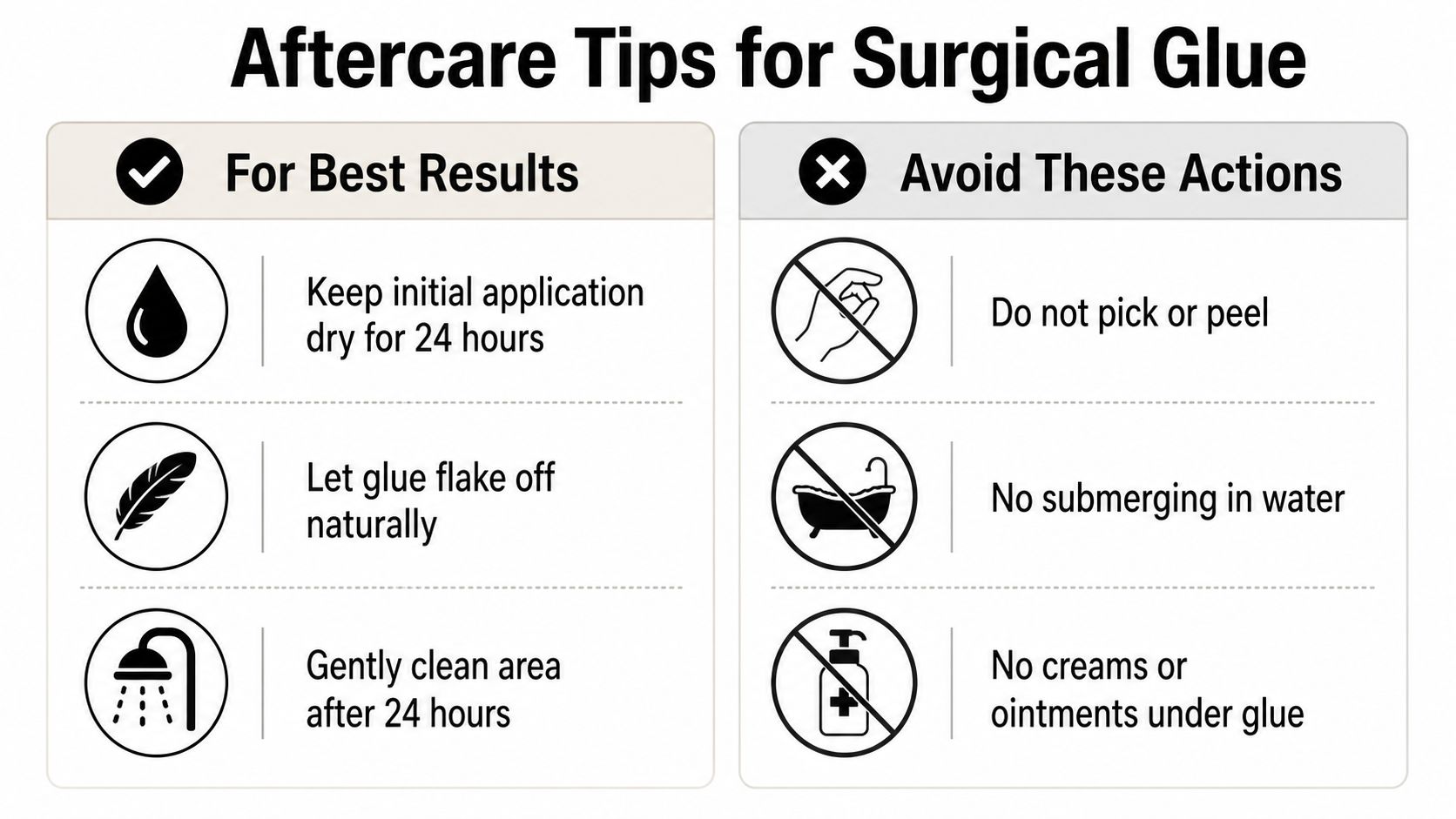
The best aftercare is usually the least dramatic. Keep the incision clean, protect the glue, and let the adhesive come off when it's ready.
If the glue is still hanging on after 2 weeks, patient-care instructions note that an ointment such as petroleum jelly may be used to help loosen it, but only under clinician guidance (REN Skin). That's a useful fallback, not a home remedy to try casually.
For scar-related follow-up care, a post-operative scar care guide can help once the glue has started to come off and the skin is closed.
Best practice: if the incision still looks sealed and comfortable, waiting is usually safer than forcing the glue off.
One option patients sometimes use when they want direct aftercare guidance is Cape Cod Plastic Surgery, which provides postoperative wound-care instructions for glue-closed incisions and guidance on when to call for help if the adhesive stays in place too long.
Call your surgeon if the glue is coming off and the wound edges are pulling apart, because that's no longer just a cosmetic issue. The same goes for redness that spreads beyond the incision, increasing pain, warmth, pus, or a bad smell.
If the glue stays on longer than you expected but the incision is closed, dry, and not worsening, that alone usually isn't an emergency. The goal is to separate normal lingering adhesive from a wound that is no longer supported.
A good rule is to look at the incision, not the calendar. If the skin underneath looks calm, you can usually wait and follow the surgeon's instructions.
If you're unsure, call the office. Questions about glue are routine, and it's better to ask early than guess wrong.
Contact your surgical team promptly if the glue lifts early and the incision looks open, if there's drainage, or if the area becomes increasingly tender. Those signs deserve a real person's assessment, not a wait-and-see approach.
Cape Cod Plastic Surgery offers postoperative wound-care guidance for incisions closed with surgical glue, including what to expect as the adhesive loosens and when to call if it lingers or lifts too soon. If you're recovering from surgery and want clear, practical instructions from a team that manages this every day, visit Cape Cod Plastic Surgery.
September 9, 2026
Expert Guide to Proper Surgical Incision Care

Master dermal fillers aftercare with do's and don'ts, swelling tips, activity limits and warning signs to protect your results and heal smoothly.

September 8, 2026
Ensuring Safety: Why Your Surgeon's Credentials Matter Most

Cape Cod Plastic Surgery offers expert cosmetic and reconstructive procedures in a safe, accredited setting. Led by Dr. Marc Fater, we combine advanced techniques with personalized care to help you look and feel your best.
Monday: 9:00 AM – 5:00 PM
Tuesday: 9:00 AM – 5:00 PM
Wednesday: 9:00 AM – 5:00 PM
Thursday: 9:00 AM – 5:00 PM
Friday: 9:00 AM – 5:00 PM