

September 9, 2026
How to Care for Surgical Incisions Properly
Expert Guide to Proper Surgical Incision Care
Jun 25, 2026
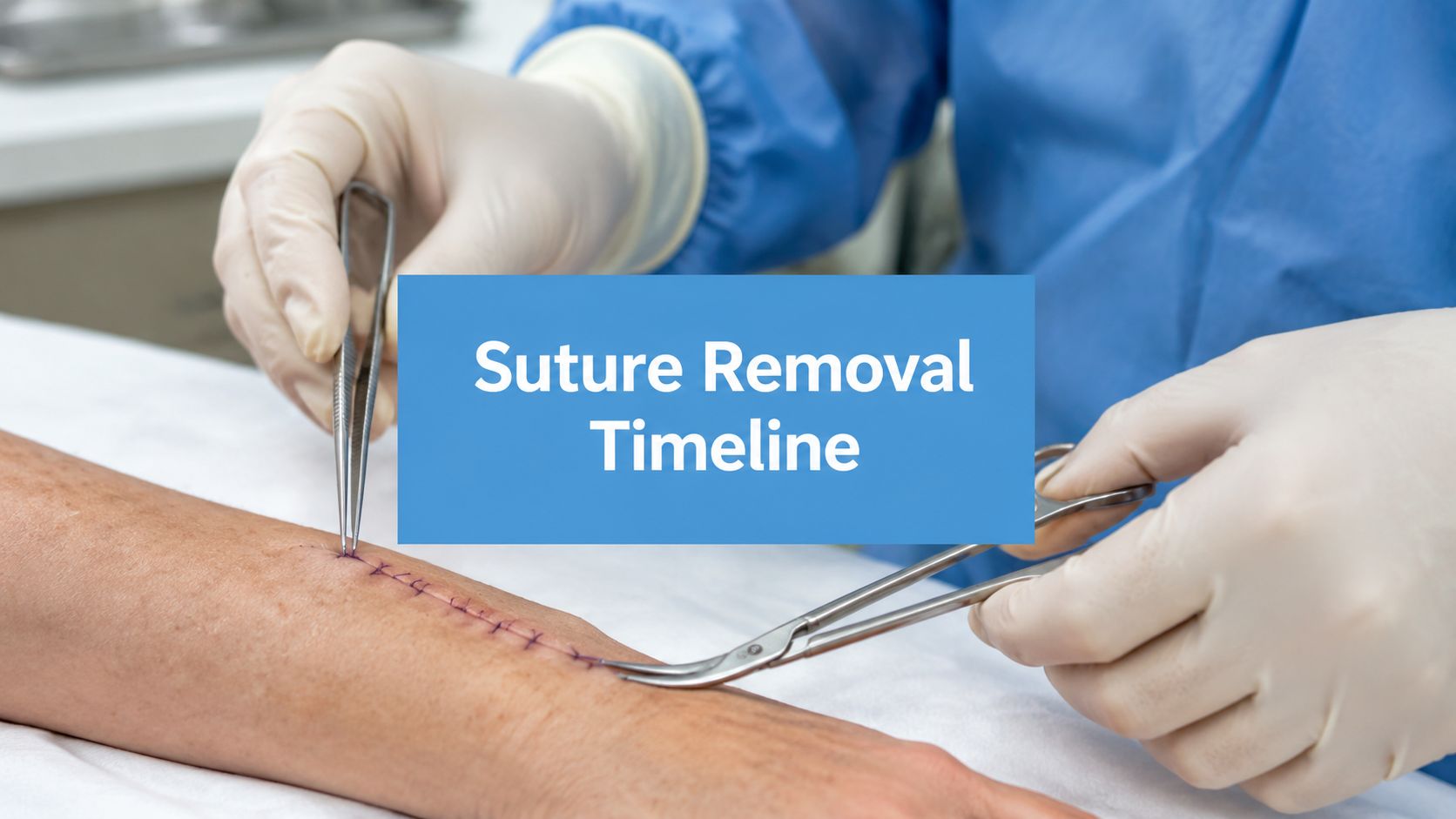
You've had surgery, you've made it through the procedure itself, and now your attention shifts to the incision. For many patients, the next question comes quickly. When do the stitches come out, and what happens if they stay in too long or come out too soon?
That concern is completely reasonable. In cosmetic and reconstructive surgery, the healing period isn't a side note. It's part of the result. A beautifully placed incision can still heal poorly if the wound is stressed, neglected, infected, or if sutures remain in place longer than the skin really needs them.
The right suture removal timeline isn't a fixed rule that applies to every patient and every body area. It's a judgment call based on location, tension, blood supply, the type of closure used, and how your tissue is behaving in real time. My job is to protect two things at once. I want the wound to stay closed, and I want the scar to mature as cleanly as possible.
Right after surgery, many patients look at their incision and focus on the visible stitches. That makes sense, because they're the part you can see. But the more important healing work is happening underneath the surface, where your body is rebuilding support layer by layer.
Think of sutures as a temporary scaffold. They hold the skin edges together while your body creates its own strength. If that scaffold comes down too early, the wound can separate. If it stays up too long, the skin can start to heal around the threads and leave more visible suture marks.
That's why the timeline matters so much in aesthetic surgery. Patients often assume there must be one standard day when stitches should be removed. In reality, the schedule is chosen to balance scar quality with wound security.
Cosmetic patients usually aren't just asking when removal happens. They're asking a more personal question. Will this affect how I look in the long run?
That's the right question to ask. A fine-line scar usually comes from a series of small decisions made well. Precise closure. Good wound support. Thoughtful aftercare. Proper timing of suture removal.
Practical rule: Sutures should stay in long enough to support healing, but not so long that they leave unnecessary track marks.
In my practice, patients do best when they understand that the appointment for stitch removal isn't just routine. It's part of scar management. If you want to learn more about the broader picture, this guide on how to minimize scarring after surgery is a helpful companion to the timing discussion.
Patients sometimes expect the incision to feel “done” once stitches are out. It isn't. Removal is a transition point, not the finish line.
After the skin sutures are removed, the wound still needs protection. It's stronger than it was on day one, but it's not yet strong enough to tolerate unnecessary pulling, friction, sun exposure, or aggressive activity. That's why a good surgeon doesn't treat stitch removal as a quick task. We treat it as a checkpoint in a longer healing process.
The body doesn't heal at the same speed everywhere. Areas with better blood supply and less tension usually support earlier removal. Areas that move more, carry more force, or heal more slowly need longer support.
Historical surgical guidance places facial sutures at 3 to 5 days, trunk sutures at 10 to 14 days, and some joints as long as 21 days according to body-site suture removal guidance published by Dr. Manzar Ali.
| Body Area | Typical Removal Time (Days) |
|---|---|
| Face | 3 to 5 |
| Neck | 5 to 7 |
| Scalp | 7 to 10 |
| Trunk | 10 to 14 |
| Extremities | 10 to 14 |
| Joints or high-tension areas | 14 to 21 |
These are guidelines for non-absorbable skin sutures, not promises. A patient's actual day can shift if the wound is under more tension than expected, if circulation is limited, or if healing is slower.
Facial incisions often heal quickly because the face has a rich blood supply. In plastic surgery, that's helpful, but it also creates urgency. If visible facial sutures stay in too long, the skin can form obvious little marks where the threads cross the incision.
That's why facial sutures are usually removed earlier than body sutures. On the face, one of the main goals is to avoid those classic “railroad track” marks while still keeping the wound secure.
On the face, earlier removal often protects the cosmetic result. On the body, longer support may protect the closure.
The trunk, arms, legs, and especially joints deal with more mechanical stress. A chest incision expands with movement and breathing. A back incision experiences tension with posture and twisting. A knee or elbow is repeatedly bending, which puts extra stress across the healing line.
Those wounds often need more time before external support can be removed safely. This is particularly important after body contouring procedures, where the skin may look calm on the surface but still be carrying significant tension underneath.
A practical point patients appreciate is this: the timeline reflects what the wound is doing, not just where it is. Two abdominal incisions may not behave the same way if one is small and low-tension while the other is part of a larger contouring procedure.
A lot of confusion comes from the fact that patients may have more than one type of stitch from the same operation. Some are meant to come out. Others are meant to stay in place and break down over time.
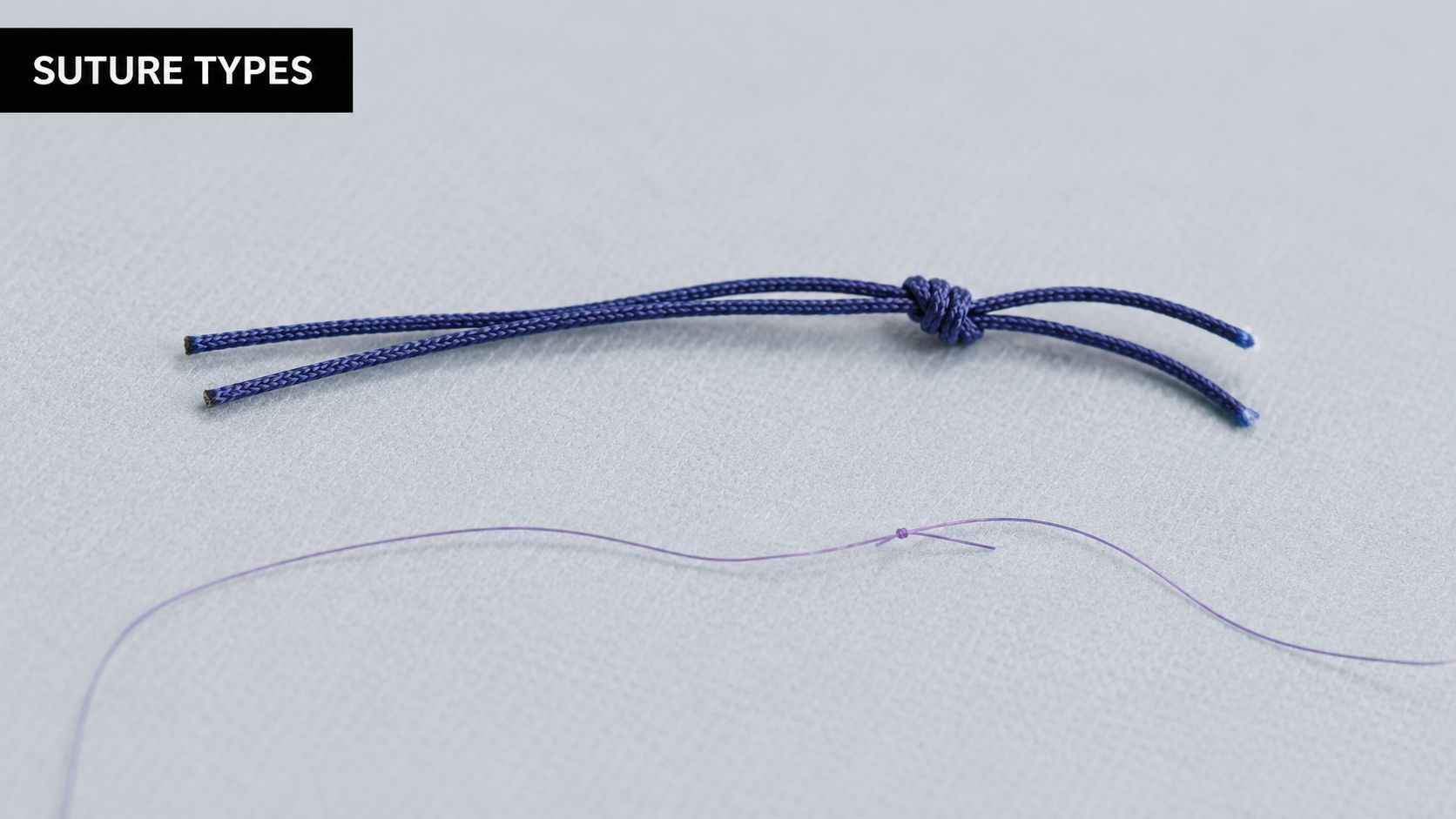
Non-absorbable sutures are the stitches that usually need to be physically removed. These are often used at the skin surface and require a follow-up visit for extraction.
Absorbable sutures are designed to break down in the body over time. Technical guidance distinguishes these clearly. Non-absorbable sutures require mechanical removal, while absorbable sutures are engineered for hydrolytic degradation over 30 to 60 days without intervention.
That difference matters because many patients assume every stitch they feel or notice must eventually be removed. That's not true.
Non-absorbable sutures are like exterior scaffolding. They support the visible edge of the wound and are taken down when the skin can hold itself.
Absorbable sutures are more like internal support beams. They hold deeper tissues together while healing progresses underneath the surface. You don't usually need an appointment to “take them out” because the body gradually handles that process.
If your surgeon says some stitches won't need removal, that usually means they're buried deeper and designed to dissolve on their own.
Patients recovering from facial surgery, breast surgery, or body contouring often have both types at once. That's normal. The important thing is not to judge the whole repair based only on what you can see on the outside.
A standard chart is useful, but it doesn't replace bedside judgment. The actual suture removal timeline is determined after looking at the wound itself. A surgeon is weighing two competing risks at every follow-up visit. Leave sutures in too long and scarring may worsen. Remove them too early and the wound may open.
This balancing act is especially important in cosmetic surgery. A clean scar line depends on timely removal, but a stable scar depends on enough tissue strength. Those goals don't always point to the same day.
For trunk wounds, preliminary clinical data suggest that earlier can sometimes be better cosmetically. In a study summarized by the NHS, patients in the 10-day removal group reported significantly worse scar outcomes than the 7-day group, particularly with regard to suture marks, in the NHS summary of timing of suture removal to reduce scarring in skin surgery.
That doesn't mean every trunk incision should automatically be treated at 7 days. It means the old habit of waiting longer isn't always better for appearance.
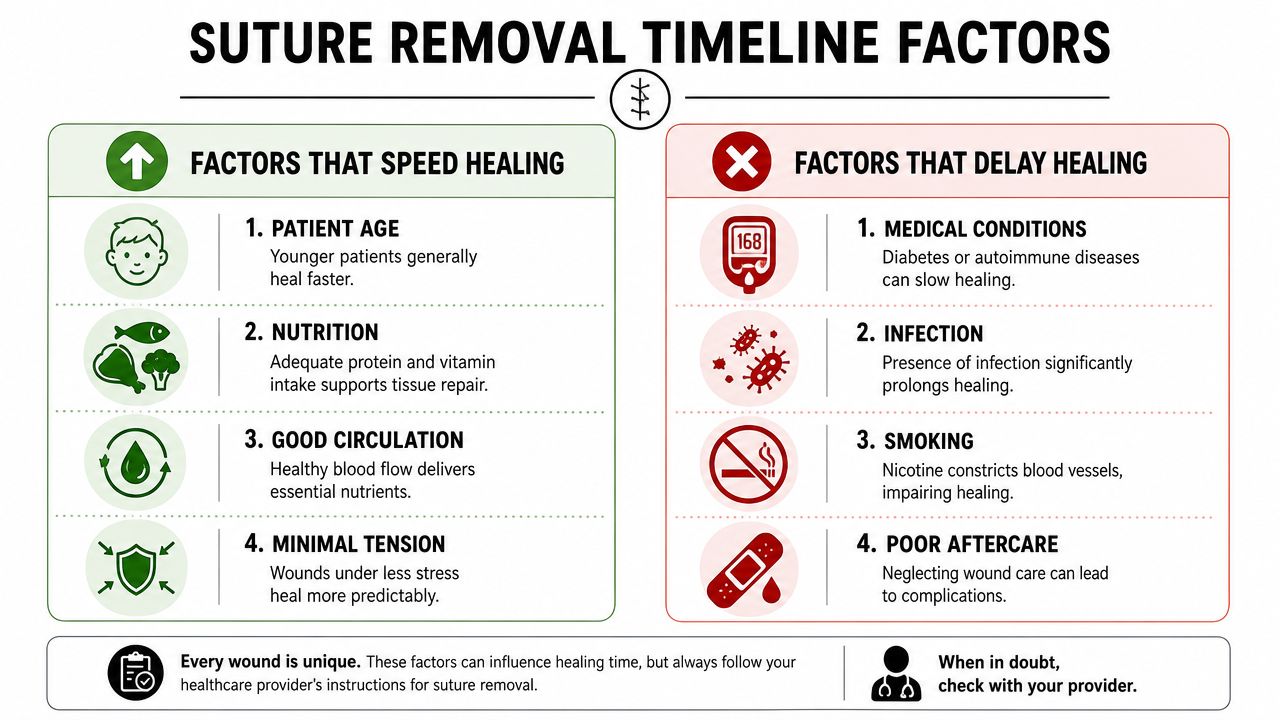
Some factors make me more cautious because they can slow the development of wound strength.
Patients often ask what they can do to help. Good wound care, protecting the incision from friction, avoiding strain, and following instructions consistently all matter. This practical guide on how to speed up healing after surgery covers the habits that support a smoother recovery.
For a visual overview of what influences timing, this short video is useful:
What doesn't work is using the calendar alone. If a patient says, “It's day five, so they must come out,” that's too simplistic. The wound has to earn removal.
What also doesn't work is leaving visible sutures in place “just to be safe” without thinking about scar quality. In aesthetic surgery, overtreatment can create its own problem.
Most patients are pleasantly surprised by how quick suture removal is. The visit begins with an inspection of the incision. I'm looking for edge alignment, dryness, redness, swelling, crusting, and signs that the skin can hold together once the sutures are gone.
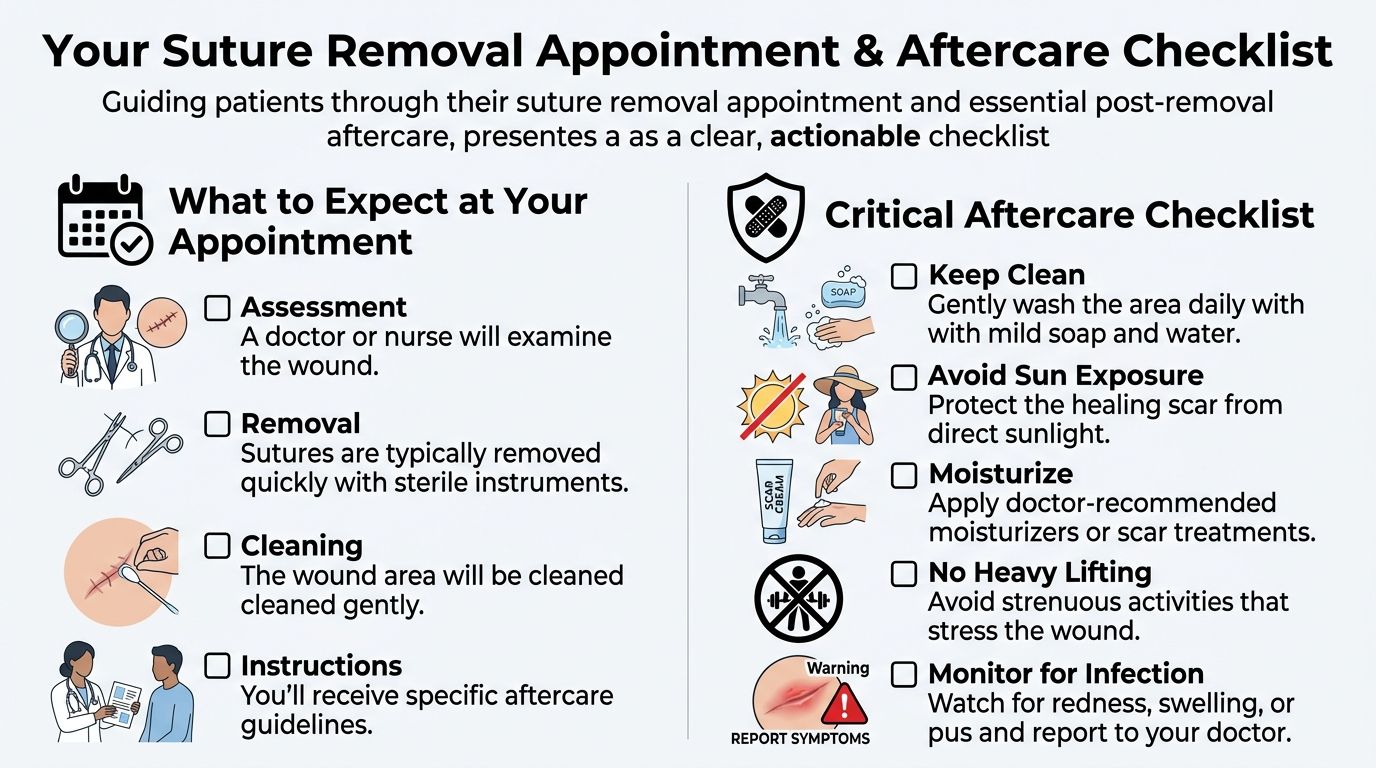
Removal itself is usually straightforward. The suture is lifted gently, cut near the knot, and pulled in a way that minimizes trauma to the healing skin. Most patients describe a light tugging sensation more than actual pain.
If the incision looks borderline in one area, I may remove some stitches and leave others a bit longer, or reinforce the line immediately with adhesive strips. That kind of adjustment is common and often wise.
If the wound shows early separation before or during removal, the right response is caution. Technical guidance for non-absorbable suture removal recommends stopping removal if dehiscence appears, then supporting the wound with sterile adhesive strips or butterfly bandages and covering it until the closure stabilizes.
If infection or pus is present, all sutures in the affected area may need to be removed rather than partially removed. Infection changes the priority from cosmetic planning to source control and wound protection.
Once sutures are out, the wound still benefits from support. Adhesive strips are often kept on for an additional 5 days, and technical guidance also recommends protecting the area from trauma and sun exposure for 30 days to reduce hyperpigmentation and scarring.
Good aftercare usually includes:
If the surrounding skin becomes irritated from tape, dryness, or cleansing products, a soothing skin barrier can help. This overview of ALODERMA skin relief offers practical advice on calming irritated skin without being harsh on a healing area.
Detailed day-to-day incision guidance is also covered in this resource on how to care for surgical incisions.
Not always. Facial skin often supports early removal, but reconstructive complexity matters. A small low-tension facial closure is different from a larger repair where tissue quality, flap movement, or local tension make support more important.
For some facial and oral procedures, a 5-day interval has been described as a strong benchmark for minimizing scarring while preserving wound integrity, with better results than shorter or longer intervals in the observational data summarized in the verified information. That's why experienced surgeons don't apply the shortest possible window automatically to every face.
The best cosmetic result doesn't come from the earliest possible removal. It comes from the right removal for that exact wound.
Usually not. This is one of the biggest sources of confusion.
Most public resources blur together superficial skin sutures and deep-layer sutures used in procedures such as body contouring. That leaves patients unsure whether hidden stitches need a second removal visit. As noted in the clinical trial protocol discussing percutaneous sutures and patient confusion about internal closures, patients are often unclear about the difference between visible skin closure and deeper support layers.
Deep sutures may stay in place for healing support over weeks, or they may be absorbable and never require removal at all. So if you feel firmness, tightness, or small internal irregularities early on, that doesn't automatically mean “stitches were missed.”
Those factors matter because they can slow healing. In practical terms, they may justify a longer external support period. This is one reason a surgeon may deviate from a textbook timeline even when the incision looks acceptable at first glance.
The point isn't to make you wait unnecessarily. The point is to avoid a wound that opens after the stitches are removed.
Call promptly if you notice:
A small concern addressed early is far easier to manage than a larger problem ignored for several days.
It can make the scar harder to optimize, especially if visible track marks develop. It doesn't mean the outcome is ruined, but it can create marks that take longer to settle and may remain noticeable.
That's why the timing isn't cosmetic trivia. It's part of the treatment plan.
If you're preparing for surgery or have questions about your own suture removal timeline, Cape Cod Plastic Surgery offers expert cosmetic and reconstructive care with a personalized approach. Patients in Hyannis and across Cape Cod can schedule a consultation to discuss healing, incision care, and the details that shape a refined final result.
September 9, 2026
Expert Guide to Proper Surgical Incision Care

Master dermal fillers aftercare with do's and don'ts, swelling tips, activity limits and warning signs to protect your results and heal smoothly.

September 8, 2026
Ensuring Safety: Why Your Surgeon's Credentials Matter Most

Cape Cod Plastic Surgery offers expert cosmetic and reconstructive procedures in a safe, accredited setting. Led by Dr. Marc Fater, we combine advanced techniques with personalized care to help you look and feel your best.
Monday: 9:00 AM – 5:00 PM
Tuesday: 9:00 AM – 5:00 PM
Wednesday: 9:00 AM – 5:00 PM
Thursday: 9:00 AM – 5:00 PM
Friday: 9:00 AM – 5:00 PM