

October 5, 2026
The Value of an On Site Accredited Facility
Why Our On-Site Accredited Facility Matters for Your Safety
Jan 3, 2026
For most people, the sweet spot for scheduling Botox appointments falls right around the three-to-four-month mark. It’s not an arbitrary number; it’s the typical timeframe it takes for the body to naturally metabolize the product and for muscle activity to gradually return.
Think of it as a maintenance schedule. Sticking to a consistent rhythm helps keep those expression lines from fully reforming, so you maintain a smooth, refreshed look without interruption.
While 3 to 4 months is a great rule of thumb, it's far from a one-size-fits-all answer. Your perfect Botox schedule is as unique as you are. Factors like your individual metabolism, the strength of your facial muscles, and your personal aesthetic goals all play a major role in determining how long your results will last.
This conversation about timing is more relevant than ever. Botox has seen a massive surge in popularity, with search interest nearly doubling between 2016 and 2024. In 2024 alone, over 9 million Botox treatments were performed worldwide, and the number of yearly injections saw a staggering 459% increase between 2024 and 2025. The United States is at the heart of this trend, with nearly 3.95 million procedures performed back in 2022. You can explore the global growth in Botox searches and see the data for yourself.
It's helpful to remember that not all facial muscles are created equal. The muscles around your eyes that cause crow's feet, for example, are in almost constant motion, so results in that area might fade a bit faster than in the forehead.
Below is a simple breakdown of what you can generally expect for the most common treatment spots.
This table is a fantastic starting point, but it's just that—a start. It helps you get a feel for the rhythm of treatments, but your provider will fine-tune it based on your results. And while Botox is the gold standard for many, it’s always good to know your options. For anyone curious about alternatives with different timelines, our guide comparing Daxxify vs. Botox is a great resource.
The real goal is to find a predictable cadence that keeps wrinkles at bay without ever looking "overdone." A truly personalized plan means you get treated at the perfect moment—not too soon, but just before the full muscle movement returns.
Ultimately, the best way to map out your treatment plan is to sit down with an experienced injector. Here at Cape Cod Plastic Surgery, we can assess your specific needs and create a schedule designed just for you.
To get a real handle on how often you should schedule your Botox appointments, it’s helpful to understand what’s actually happening under your skin. The journey from the moment of injection to the slow return of muscle movement is a predictable one. I like to think of it as a dimmer switch—right after treatment, the light is turned way down, and over a few months, it gradually brightens back up.
This isn’t an overnight process. While some patients tell me they see small changes within 24 to 48 hours, the full effect doesn't just pop up instantly. It takes a little time. Over the first two weeks, the neurotoxin gets to work, binding to nerve endings and telling them to stop sending those "contract!" signals to the muscles we're targeting.
By about day 10 to 14, you'll be looking in the mirror and seeing the final, smooth result. This is what we call the "peak" of your treatment cycle. The targeted muscles are at their most relaxed, and those pesky dynamic wrinkles have softened beautifully. The dimmer switch has hit its lowest setting.
This is the period where you really get to enjoy the full benefits. Any slight unevenness from the first few days will have settled, leaving you with that refreshed, natural look you were hoping for. If you want a more detailed breakdown of this initial period, we have a whole guide on how long before Botox kicks in.
Once you hit the three-month mark, your body starts its natural repair process. It begins to build new nerve endings, slowly reconnecting the communication lines to those treated muscles. This is a really gradual transition, not an abrupt one. You won’t wake up one morning and find all your lines have returned with a vengeance; it’s more of a subtle, gentle return of movement that you’ll start to notice.
This visual timeline gives a great overview of the typical retreatment schedule for the most popular Botox areas—the forehead, those "11s" between the brows, and the crow's feet.
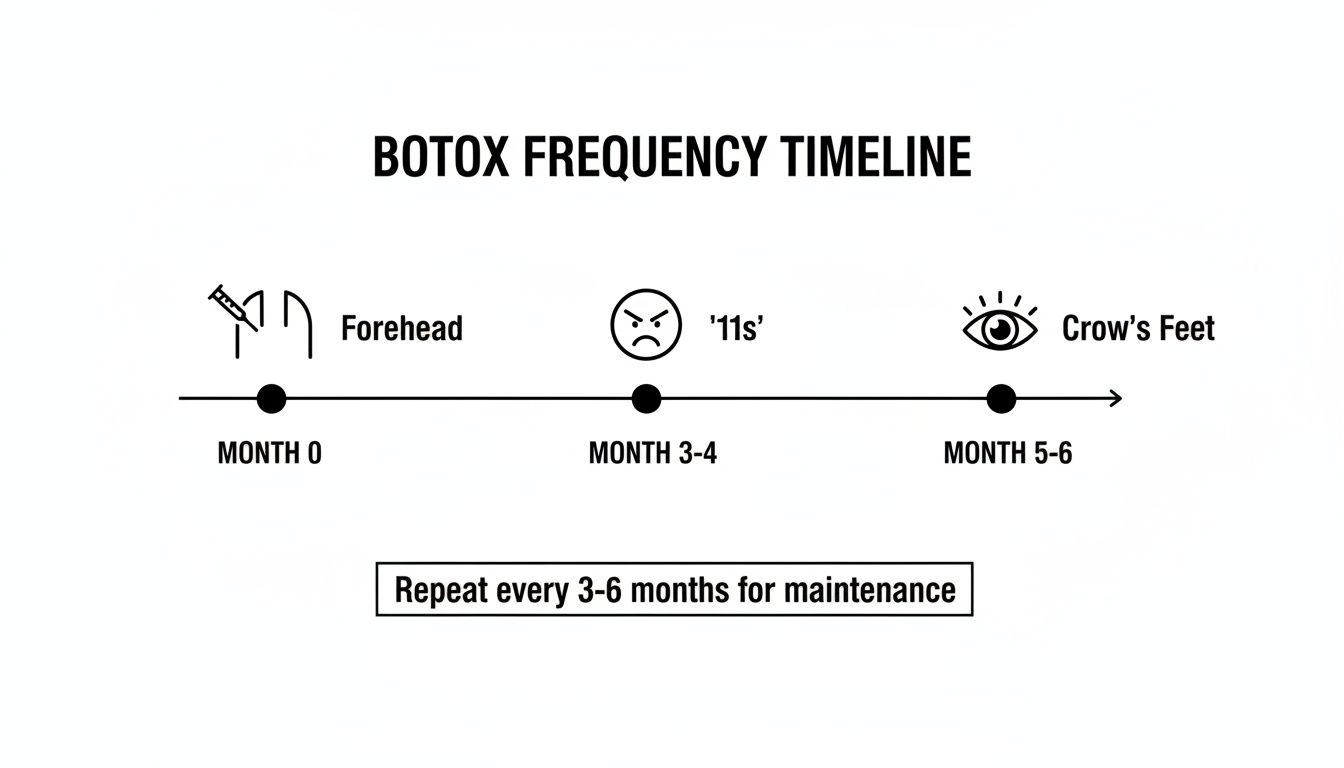
As you can see, the timing can vary slightly. More expressive areas, like the muscles around the eyes that are always crinkling when you smile, might need a touch-up a bit sooner than other spots.
The key is to book your next appointment when you first notice that gentle return of muscle activity, but before the lines have completely reappeared and settled back in. This strategy is what keeps the muscles trained and prevents those wrinkles from etching themselves deeper into your skin.
By the fourth month, most of my patients find that enough muscle function has returned that they're ready for their next treatment to maintain that smooth look. It’s this predictable cycle that makes the three-to-four-month schedule the gold standard for most people. Once you understand this lifecycle, your follow-up appointments stop feeling like random dates on a calendar and become a smart, strategic part of keeping your results consistent and beautiful.
Ever wonder why your friend’s Botox seems to last a full four months while yours starts to fade closer to three? While the standard 3-4 month schedule is a great rule of thumb, it’s not a one-size-fits-all timeline. Your personal results are shaped by a unique mix of your body’s biology and your day-to-day lifestyle.
Think of it like metabolism. Some people burn through calories faster than others, and the same principle applies here. If you have a high metabolic rate, your body might simply process the neurotoxin more quickly. This is perfectly normal and just means your ideal schedule might lean closer to the three-month mark.
This kind of individual variation is something we see across the board. While women have long been the primary users of Botox, men are catching up, with participation expected to grow from 12.3% in 2018 to 17.1% by 2025. The average patient is around 43 years old, but we're seeing more and more younger people interested in preventative treatments. The most consistent schedules often belong to middle-aged individuals, who made up nearly half of all procedures in 2022.
Your facial anatomy and how you use your muscles are huge factors. If you have naturally stronger facial muscles—maybe you're very expressive or you’re a serious athlete—those muscles can "work through" the Botox faster than less powerful ones. It’s a simple case of strength versus the product.
Your daily habits also make a difference. Here are a few key things to keep in mind:
The amount of Botox you receive—the dosage—is another critical piece of the puzzle. An experienced injector tailors the dose to your specific muscle strength. A lighter dose might create a very subtle, natural look that wears off a bit sooner, which can be perfect for a first-timer. A dose that’s properly matched to your anatomy, however, will give you more durable results.
The good news? Over time, consistency pays off. Many patients find that after several regular treatments, they can actually start to extend the time between appointments. The muscles become "trained" to stay relaxed and don't contract as forcefully even after the Botox wears off. The age you start can also influence this, which is something we explore in our guide on what age to start Botox.
The bottom line is this: your ideal Botox schedule isn't set in stone. It’s a dynamic plan that should evolve based on how your body responds and what your lifestyle demands.
Knowing these factors helps you and your provider work together to create a treatment plan that’s truly customized for you, ensuring you get the beautiful, lasting results you’re looking for.
While that three-to-four-month window is a great rule of thumb for scheduling your next Botox appointment, you have more say in the matter than you might realize. Think of it this way: your Botox treatment is the main event, but what you do afterward can absolutely help you get a longer, better result from your investment.
A few smart habits can protect your results and help you enjoy that smooth, refreshed look for as long as possible. These aren't complicated changes, either. They’re all about creating the best possible environment for Botox to do its job effectively.
This is the big one. The number one enemy of smooth, youthful skin—and your Botox results—is the sun. Daily UV exposure relentlessly breaks down collagen, the protein that gives your skin its structure and firmness. As collagen degrades, it actively works against the muscle-relaxing effects of your treatment, which can make your lines reappear sooner than they should.
The solution is simple but non-negotiable: make a broad-spectrum sunscreen of SPF 30 or higher part of your morning routine. Every single day. Rain or shine, inside or out.
Beyond sun protection, a solid, consistent skincare regimen makes a huge difference. You want products that complement what Botox is doing under the surface.
By taking care of your skin every day, you’re not just going through the motions; you're actively reinforcing the benefits of your treatment.
Think of it like this: Botox works on the muscles underneath the skin, while your skincare routine takes care of the skin's surface. When you combine the two, you get a powerful synergy that makes your results look even better and last longer.
A few other lifestyle tweaks can also have a surprising impact. Staying well-hydrated is key for maintaining skin elasticity, and a balanced diet full of antioxidants supports overall skin health. Some studies even suggest that zinc supplements can help enhance Botox's effectiveness, but you should always run any new supplements by your provider first.
These small, consistent efforts really do add up, helping you get the most out of every single treatment.
Knowing all the factors that affect how long Botox lasts is great, but applying that information to your own face is a totally different ballgame. This is precisely why a professional consultation isn't just a good idea—it's the most critical step in your journey. It’s where we move past the general advice and create a strategic plan that’s built just for you.
It's a lot like hiring a personal trainer instead of just following a workout app. The app gives you a decent starting point, sure, but a trainer analyzes your specific strengths, mobility, and goals to build a routine that gets you far better results. A Botox consultation operates on the same principle.
The demand for this kind of personalized approach is skyrocketing. In 2024, the global botulinum toxin market hit USD 6.73 billion, with over 8.8 million injections administered around the world. And it's not slowing down; the market is expected to surpass USD 13.74 billion by 2032, which really shows how many people are sticking with consistent, well-planned treatments. You can learn more about the future outlook of the Botox market and see why it continues to grow.
When you come in for a one-on-one consultation at Cape Cod Plastic Surgery, our expert injectors conduct a thorough evaluation. Think of this as a collaborative conversation, not a sales pitch. We're here to listen and plan with you.
We’ll take a close look at a few key things:
The end result of this assessment is your personalized treatment roadmap. It’s a clear, actionable plan that details exactly how often you should get Botox, the precise dosage for each area, and what you can do at home to keep your results looking fantastic.
This expert guidance is the key to getting natural-looking results that are consistent and easy to maintain. It’s how we take the guesswork out of the equation and help you achieve that refreshed, confident look you’re after.
Once you start seeing those great results from Botox, it’s only natural to have questions about keeping them up. Timing is everything, and figuring out the right schedule can feel a little tricky at first. Let's clear up some of the most common questions we hear from patients.
Life gets busy, and sometimes appointments get pushed back. The good news? There’s absolutely no harm in waiting longer between Botox sessions.
If you stretch the time between treatments, the effects will just gradually fade away. You'll notice your muscles slowly regaining their movement, and those dynamic lines will eventually return to how they looked before you started.
The real advantage of sticking to a schedule is prevention. Keeping those muscles relaxed stops them from repeatedly creasing the skin, which helps prevent lines from becoming deeper and more permanent. It’s like pressing the pause button on the wrinkle-forming process.
A common myth we need to bust: Your wrinkles will not get worse if you stop getting Botox. That's completely false. Your face will simply return to its natural baseline, just as it was before you ever had a treatment.
We strongly advise against getting Botox injections more frequently than every three months. It's not a matter of immediate danger, but it’s simply not effective and can work against you in the long run.
The biggest reason is your body's own immune system. Getting injections too close together can slightly increase the risk of your body developing antibodies to the protein. If that happens, future treatments might not work as well. Sticking to a schedule of at least 12 weeks between appointments is the smartest way to ensure you get great, consistent results for years to come.
This is one of our favorite questions because the answer is often a welcome surprise. For most people who stick with regular treatments, they find they can actually start spacing their appointments out a bit more.
Think of it like muscle memory. Over time, the treated muscles learn to stay more relaxed, even as the Botox wears off. They don't jump back into those strong, repetitive contractions that caused the wrinkles in the first place. While everyone's experience is a little different, it's a fantastic long-term benefit of consistent treatment.
Ready to create a Botox plan that’s perfectly aligned with your goals? The expert team at Cape Cod Plastic Surgery is here to provide a personalized assessment and help you achieve the natural, lasting results you deserve. Schedule your consultation today.
October 5, 2026
Why Our On-Site Accredited Facility Matters for Your Safety

October 2, 2026
Beyond the Calendar: How to Know You’re Truly Ready for Plastic Surgery

October 2, 2026
Exploring Your Breast Augmentation Options: Implants, Shapes, and What to Expect

Cape Cod Plastic Surgery offers expert cosmetic and reconstructive procedures in a safe, accredited setting. Led by Dr. Marc Fater, we combine advanced techniques with personalized care to help you look and feel your best.
Monday: 9:00 AM – 5:00 PM
Tuesday: 9:00 AM – 5:00 PM
Wednesday: 9:00 AM – 5:00 PM
Thursday: 9:00 AM – 5:00 PM
Friday: 9:00 AM – 5:00 PM