

September 9, 2026
How to Care for Surgical Incisions Properly
Expert Guide to Proper Surgical Incision Care
Apr 30, 2026

You notice them in a bright bathroom mirror first. Fine lines at the corners of your eyes that stay faintly visible after you stop smiling. A soft crease across the forehead that didn’t used to be there. Maybe makeup starts settling differently, or your skin looks tired even when you aren’t.
That moment often sends people in two unhelpful directions. One is panic buying. The other is doing nothing because the options feel confusing. Both usually waste time.
If you want to know how to get rid of fine lines, the answer isn’t one miracle cream or one injectable. It’s a plan. The right plan starts with understanding what kind of lines you have, then matching the treatment to the cause. For some people, that means disciplined skincare and better sun habits. For others, progress starts when they stop expecting topicals to fix movement-based wrinkles or deeper texture changes.
The good news is that fine lines are treatable. The better news is that you don’t need to guess your way through it.
Fine lines usually develop gradually, but patients often experience them as a sudden change. One day your skin looks familiar. Then one morning, the lines around your eyes, mouth, or forehead seem harder to ignore.
That reaction is understandable. It’s also where many people make the wrong move. They search for isolated fixes instead of building a treatment strategy that fits their skin, age, goals, and tolerance for downtime.
The most reliable approach is tiered. Start with your foundation, which includes daily skincare and sun protection. Add supportive measures, such as habit changes and carefully chosen at-home tools. Then consider in-office treatment when the line type or skin quality calls for more than a surface-level solution.
That structure matters because fine lines don’t all form for the same reason.
Practical rule: If you treat the wrong cause, you get disappointing results even with a good product or procedure.
Patients often want to know whether fine lines can be erased quickly. In most cases, improvement is very possible, but it comes from combining the right tools in the right order. Topicals need time. Professional treatments need realistic expectations. Prevention needs daily follow-through.
A thoughtful plan is more effective than chasing trends. It’s also safer.
By the end, you should be able to look at your own skin more clearly and understand where to start, what’s worth your money, and when it makes sense to move beyond home care.
Fine lines are not just “aging.” That explanation is too broad to be useful. When you understand what is creating the lines, treatment choices become much easier.

Your skin changes over time even if you do everything right. That’s intrinsic aging. Genetics, natural collagen decline, and slower cell turnover all play a role. Skin gradually becomes less resilient and less able to bounce back from repeated motion.
Then there’s extrinsic aging, which is what the environment adds on top. Most preventable damage stems from these environmental influences. Sun exposure is the major driver. It accelerates texture changes, pigment irregularity, collagen breakdown, and that thin, crepey quality many people notice around the eyes and cheeks.
Other daily habits matter too. Squinting outdoors, inconsistent sunscreen use, harsh skincare, and irritation can all make lines show up faster or appear more obvious.
This is the distinction that shapes almost every treatment decision.
Dynamic lines appear with movement. Think crow’s feet when you smile, horizontal forehead lines when you raise your brows, or the “11s” between your eyebrows when you frown. These lines are formed by repeated muscle contraction.
Static lines are visible when your face is at rest. They may start as faint etched lines and become more noticeable over time. Static lines are usually tied to collagen loss, sun damage, thinning skin, and repetitive movement that has left a mark even when the muscle is relaxed.
A simple way to check at home:
If a line shows up only when you move, it’s more likely dynamic. If it stays when your face is relaxed, it’s more likely static or mixed.
It’s crucial to distinguish between dynamic lines from muscle contractions, like crow’s feet, and static lines or crepey texture, which are better suited for collagen-inducing treatments. Over-relying on topicals alone often fails to address static lines, which is why professional assessment matters, as noted by UT Southwestern’s guidance on eye rejuvenation.
A patient with early crow’s feet from smiling may do very well with a neuromodulator. A patient with fine crepey lines under the eyes may need collagen stimulation instead. A patient with hollowing or folds may need volume restoration, not another serum.
Here’s the quick comparison:
| Line type | What causes it | Often responds best to |
|---|---|---|
| Dynamic | Repeated muscle movement | Neuromodulators such as Botox |
| Static | Collagen loss, sun damage, texture change | Retinoids, microneedling, resurfacing |
| Volume-related folds | Fat loss and structural change | Fillers or other volume-restoring approaches |
| Mixed lines | Movement plus skin aging | Combination treatment |
Self-diagnosis can often be inaccurate. Patients may focus on the visible crease, but the actual issue may be muscle pull, textural damage, volume loss, or a combination of all three.
That’s why a strategic plan works better than a generic list of anti-aging products. Fine lines aren’t one category. They’re a symptom of different processes. If you match the treatment to the process, results are more predictable and usually more natural-looking.
If your daily routine is inconsistent, every advanced treatment becomes less effective. Skin responds best when the basics are handled well. That means cleansing gently, using ingredients with a clear purpose, supporting the barrier, and protecting against UV exposure every single day.

Morning skincare should defend the skin and prepare it for the day ahead. It doesn’t need to be elaborate.
A strong morning routine usually looks like this:
Nighttime is where corrective products do most of their work. This is the better time for ingredients that can be irritating or make skin more sun-sensitive.
The key evening steps are simple:
Retinoids are one of the few topical categories that deserve their reputation. Retinoids, especially prescription-strength tretinoin, are a cornerstone topical treatment for fine lines. Clinical studies show they boost collagen production and accelerate skin cell turnover, leading to measurable improvement in photodamaged skin, as explained in this review of wrinkle treatments that really work from GoodRx.
That’s why retinoids belong in so many long-term anti-aging plans. They don’t freeze muscles or replace lost volume, but they do improve skin quality over time.
Start lower and slower than you think you need to. Irritated skin rarely becomes smoother skin.
A practical way to begin:
The eye area deserves caution. Thin skin around the eyes can become irritated quickly. If you’re using retinol near that area, use it conservatively rather than treating it like the rest of the face.
If you want a broader look at treatment pathways that support skin structure, this guide on how to stimulate collagen can help connect home care with in-office options.
Patients sometimes spend heavily on actives and then use a weak moisturizer. That often backfires.
A well-formulated moisturizer won’t erase fine lines on its own, but it can make the skin look smoother by improving hydration and reducing surface roughness. Its primary contribution is helping you tolerate your active ingredients.
Look for products that focus on:
| Ingredient type | What it helps with |
|---|---|
| Ceramides | Barrier support |
| Hyaluronic acid | Hydration and surface plumping |
| Glycerin | Water retention |
| Soothing agents | Reducing irritation from actives |
Many patients want to focus on correction. Prevention is less exciting, but it matters more.
If sun exposure is driving collagen breakdown and texture change, then sunscreen is not a cosmetic extra. It’s part of treatment. Reapplying matters, especially if you’re outdoors, driving often, or living in a bright coastal environment.
This video offers a useful visual overview of wrinkle-focused skincare basics and treatment thinking:
A few common mistakes delay progress:
A foundational routine won’t solve every fine line. It does create healthier skin, better prevention, and a stronger base for any future procedure.
Patients often assume the next step after skincare is a gadget. Sometimes that helps. Sometimes it just adds expense and irritation.
The better question isn’t whether a device is popular. It’s whether it matches the problem and whether it can be used safely at home.

LED light therapy has drawn more attention recently, and for good reason. Non-invasive light-based devices are appealing because they don’t rely on needles, heat injury, or peeling to support skin quality. Emerging at-home technologies like Celluma LED light therapy are gaining traction for stimulating collagen non-invasively, and daily habits such as makeup choices can also make lines more noticeable, as discussed in this video discussion of fine lines, makeup, and home care trends.
That doesn’t mean every LED mask or panel is equally useful. It means the category is more credible than many of the harsher at-home treatments people try.
Reasonable options for home support include:
Here, people often overshoot.
Home microneedling and aggressive peel kits are commonly marketed as shortcuts, but technique and depth matter. The risk is not just irritation. It’s worsening inflammation, creating uneven results, or damaging sensitive skin with repeated misuse.
If a treatment works by controlled injury, control matters.
For patients curious about collagen-inducing treatments, professional microneedling is a different category from rolling devices bought online. This overview of the benefits of microneedling explains why office-based treatment tends to be more appropriate when texture and early static lines are the concern.
Not every wrinkle issue comes from skincare failure. Small daily habits can exaggerate fine lines even when your routine is solid.
Consider the practical culprits:
If you’re looking at imported skincare as part of your home routine, a curated guide to best Japanese anti-aging creams can be useful for comparing texture, barrier-supportive formulas, and ingredient styles before you buy.
Lifestyle won’t replace treatment, but it affects how your skin behaves. Better hydration, a nutrient-dense diet, and consistent sleep won’t erase fine lines, yet they often improve the way skin looks and recovers. Patients also tend to do better with procedures when their skin barrier and baseline habits are already in good shape.
At-home care should support your plan, not distract from it. If you’re buying more devices than sunscreen, the plan is off balance.
A good home routine can improve early fine lines. It cannot relax an overactive frown muscle, replace lost facial support, or resurface more established textural change. That is usually the point where an office evaluation becomes useful.
The first question is not which procedure is best. The first question is what is creating the line. Dynamic lines form from repeated facial movement. Static lines remain visible at rest because collagen has thinned, sun damage has accumulated, or the skin has started to crease permanently. Some patients also have volume loss that makes a line look deeper than it really is.
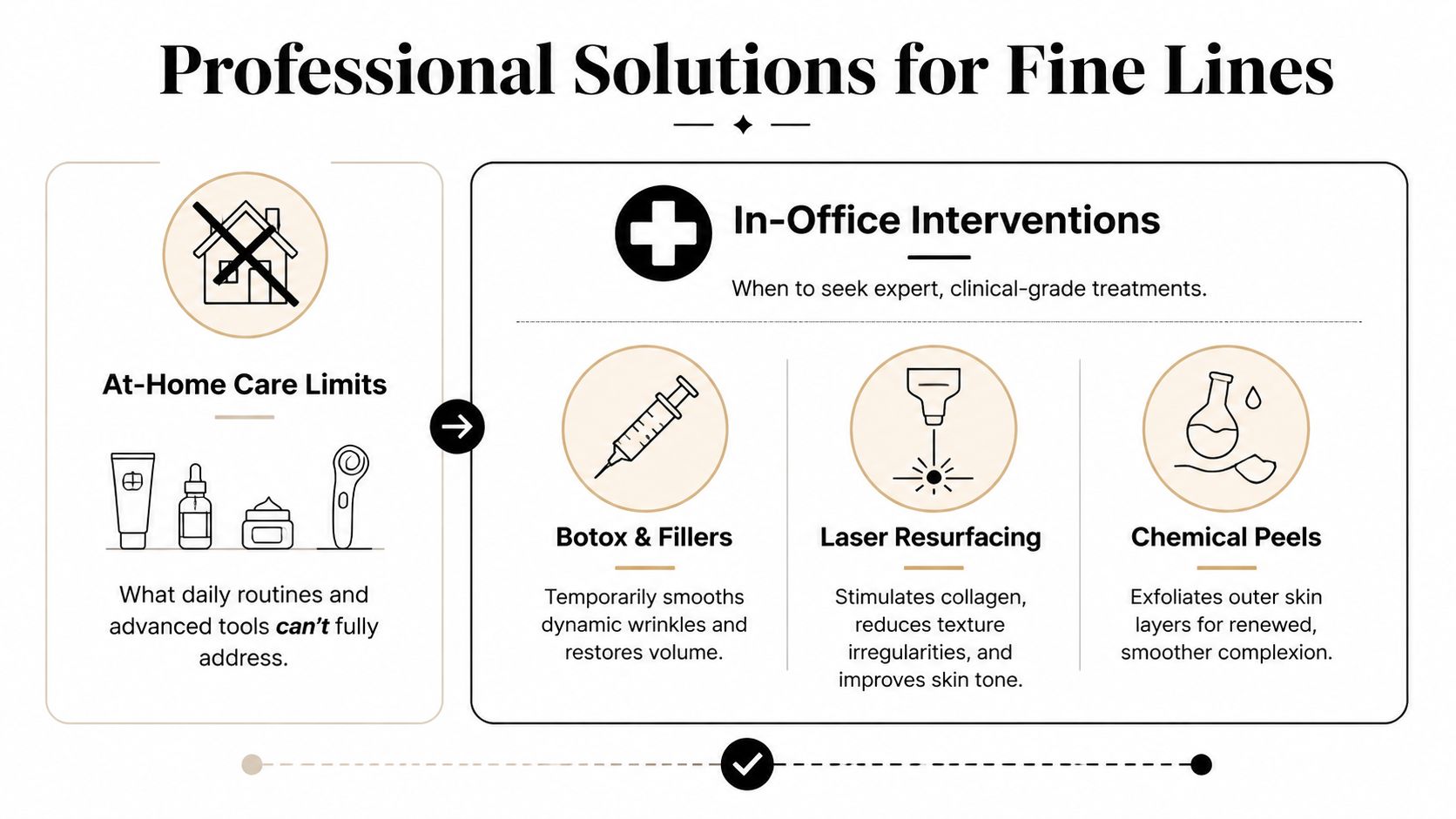
Botox remains one of the most predictable treatments for movement-based wrinkles. It temporarily relaxes selected facial muscles, which reduces repeated creasing of the skin.
It is commonly used for:
For the right patient, Botox works well because it treats the cause of a dynamic wrinkle rather than only softening the surface. The American Academy of Dermatology's overview of wrinkle treatments notes that botulinum toxin is used to soften wrinkles caused by repeated muscle movement.
In practice, the goal is controlled softening, not a stiff or expressionless result. Dose, injection pattern, and restraint matter. Static etched lines may improve with neuromodulators, but they often need resurfacing or collagen stimulation as well.
A few practical expectations help:
Fillers solve a different problem. They do not weaken a muscle. They restore support where age-related volume loss, bone remodeling, or tissue descent has changed facial contours.
That matters around the mouth, in early hollows, and in lines that deepen because the surrounding structure has flattened. A wrinkle caused by loss of support usually needs a different approach than a wrinkle caused by expression.
The trade-off is precision. Filler can look very natural when it is placed conservatively and in the right plane. It can also look heavy when too much product is used to chase a surface line that calls for skin treatment or muscle treatment.
Microneedling is often a good fit when the skin itself needs remodeling. It creates controlled micro-injuries that stimulate repair and collagen production over time.
| Best for | Less effective for |
|---|---|
| Crepey texture | Deep folds from volume loss |
| Early static fine lines | Strong muscle-driven wrinkles |
| Mild textural roughness | Severe laxity |
Patients usually choose microneedling when they want gradual improvement in texture with shorter downtime than more aggressive resurfacing. Redness and sensitivity are common for a few days. Results are cumulative, which is an advantage for patients who want subtle improvement and a limitation for patients expecting an immediate change.
Some patients considering radiofrequency microneedling also review Morpheus8 treatment options when they want collagen stimulation plus additional skin tightening.
Chemical peels improve the outer layers of the skin. They are useful for rough texture, dullness, mild pigment irregularity, and fine lines linked to sun exposure.
Strength matters. A lighter peel usually involves a series of treatments and modest downtime. A deeper peel can produce more visible change, but recovery is longer and aftercare becomes more important.
Peels are most helpful when the problem sits near the surface. They do not correct facial movement or restore lost support.
Laser resurfacing is often the better tool when fine lines are accompanied by visible sun damage, uneven texture, or more advanced skin aging. It can improve the skin more dramatically than topical products and lighter office treatments, but it asks more of the patient.
Recovery is the main trade-off. Even less aggressive laser treatments usually require careful sun avoidance, a healing period, and disciplined aftercare. For patients who want meaningful textural improvement and accept downtime, that trade can be reasonable. For patients who need a quick return to work or social events, a lighter option may be smarter.
Many patients are treating more than one type of aging at the same time. A forehead line may be dynamic. The skin under the eyes may be crepey. Lines around the mouth may reflect both surface change and volume loss.
In those cases, one procedure rarely solves the whole problem. A balanced plan may include:
Cape Cod Plastic Surgery offers non-surgical treatments such as Botox and fillers alongside skin-focused and surgical options. That range is helpful when a patient’s concerns do not fit neatly into a single category.
Procedure selection should be specific. So should expectations.
Ask direct questions during a consultation:
The most natural results usually come from matching the treatment to the cause, not from choosing the most aggressive option available.
The most effective fine-line treatment plans are personalized because faces don’t age in a uniform way. One patient needs stronger prevention and retinoid guidance. Another needs dynamic wrinkle treatment. Another has reached the point where texture, crepiness, and volume change all need to be addressed together.
That’s why piecemeal treatment often disappoints. If you buy products without understanding the line type, or choose a procedure without understanding the trade-offs, you may spend money without getting meaningful improvement.
A consultation with an experienced, board-certified plastic surgeon should clarify several things quickly:
This matters even for common treatments. According to clinical trial data, Botox injections at 20 to 64 units show a peak effect at 10 to 14 days, and under-dosing can lead to a 20 percent retreatment rate, which is one reason experienced administration matters, as outlined in this discussion of procedures to reduce fine lines and wrinkles.
A good consultation should never feel like pressure to do everything. It should feel like clarity. The right plan might be conservative. It might involve skincare first, then a procedure later. Or it might show that the concern you thought needed filler is better treated with collagen stimulation or neuromodulators.
The goal isn’t to chase a younger face. It’s to build a treatment plan that makes sense for your skin and looks like you.
Usually, no. They can often be softened significantly, and early lines may become much less noticeable, but “erased” is not the right expectation. Skin quality can improve, dynamic wrinkles can relax, and texture can be refined, but every treatment has limits.
There isn’t one correct age. The better question is when your skin starts showing changes that matter to you. For some people, prevention begins with sunscreen and retinoids well before lines are established. For others, the first step is a consultation once movement lines begin lingering longer.
Natural remedies can support skin comfort and hydration, but they usually don’t address the core causes of fine lines as effectively as proven skincare and professional treatment. If a line is caused by muscle movement, collagen loss, or volume change, oils and home masks won’t do much beyond temporary surface improvement.
It depends on the line. Botox is generally used for movement-related lines, while fillers are used where loss of volume or support is contributing to the problem. If you’re comparing injectable categories, this guide to understanding anti-aging injectables is a helpful companion resource for seeing how different neuromodulator options fit into treatment planning.
Many patients need neither “Botox for everything” nor “filler for everything.” They need the right treatment matched to the right problem.
If you’re ready for a plan that goes beyond guesswork, schedule a consultation with Cape Cod Plastic Surgery. A personalized evaluation can help you determine which fine lines may respond to skincare, which need in-office treatment, and how to build a strategy that fits your features, timeline, and goals.
September 9, 2026
Expert Guide to Proper Surgical Incision Care

Master dermal fillers aftercare with do's and don'ts, swelling tips, activity limits and warning signs to protect your results and heal smoothly.

September 8, 2026
Ensuring Safety: Why Your Surgeon's Credentials Matter Most

Cape Cod Plastic Surgery offers expert cosmetic and reconstructive procedures in a safe, accredited setting. Led by Dr. Marc Fater, we combine advanced techniques with personalized care to help you look and feel your best.
Monday: 9:00 AM – 5:00 PM
Tuesday: 9:00 AM – 5:00 PM
Wednesday: 9:00 AM – 5:00 PM
Thursday: 9:00 AM – 5:00 PM
Friday: 9:00 AM – 5:00 PM