
September 9, 2026
How to Care for Surgical Incisions Properly
Expert Guide to Proper Surgical Incision Care
Mar 26, 2026

So, you're committed to your diet and workout plan, but that stubborn fat on your sides just won't budge. It’s a classic story. The truth is, slimming down your waistline requires a full-body approach because you simply can't spot-reduce fat. It's about creating a caloric deficit, building lean muscle all over, and getting your lifestyle in check.

If you feel like the fat on your flanks is the first to show up and the very last to leave, you’re not imagining things. This area is famously stubborn, and it's not just about willpower. There are some real biological reasons why that fat clings on for dear life. Once you understand why it's so difficult, you can build a smarter plan to finally get rid of it.
The most common mistake people make is trying to crunch their way to a smaller waist. While doing hundreds of side bends and twists will definitely strengthen your oblique muscles, it won't do much to burn the layer of fat that's covering them up. Fat loss is a systemic process; your body draws energy from all its fat stores, not just the part you're working out.
Your genetics play a huge part in where your body decides to store extra fat. For many people, particularly men, the flanks are a primary, genetically programmed storage depot. Your body just has a natural tendency to deposit fat there first.
Hormones are another major piece of the puzzle. Cortisol, the "stress hormone," is a big one. When you're dealing with chronic stress or not getting enough sleep, your cortisol levels spike. This signals your body to hold onto fat, especially around your midsection—love handles included.
Key Takeaway: High cortisol from stress and poor sleep actively promotes fat storage around your waist. Getting stress under control is just as important as diet when you're trying to lose your love handles.
Finally, it comes down to the fat cells themselves. The fat in this area has a high concentration of alpha-2 receptors and a lower concentration of beta-2 receptors.
Here’s an easy way to think about it:
Since your love handles have more "stop" signals and fewer "go" signals, they release fat much more slowly than other parts of your body. This biological reality is what makes them so incredibly stubborn, often being the last area to lean out. It's why a consistent, patient, and holistic approach is the only thing that truly works.

Genetics and hormones certainly have their say when it comes to stubborn fat, but your daily habits hold the real power to reshape your body. Let’s be clear: the battle against love handles isn't won with quick fixes or magic pills. It's won with a consistent, intelligent approach to what you eat and how you live. This is your foundation—get it right, and everything else falls into place.
It all boils down to one core principle: creating a sustainable calorie deficit. This just means you need to burn more calories than you eat, day in and day out. But here's the catch—slashing calories too drastically can backfire, slowing your metabolism and spiking stress hormones. A much smarter path is a moderate, steady deficit of about 300-500 calories per day. This is the sweet spot for lasting fat loss without feeling miserable and deprived.
What you put on your plate is just as critical as how much. A diet built around whole, unprocessed foods gives your body the high-quality fuel it needs to function well and burn fat efficiently. So, let’s forget the restrictive fad diets and focus on building a balanced plate.
Your macronutrient mix is a huge piece of the puzzle. Here’s how to think about it:
By prioritizing protein and fiber-rich vegetables, you naturally crowd out less nutritious, higher-calorie options. A simple plate formula is half vegetables, one-quarter lean protein, and one-quarter complex carbs.
I've seen it time and time again: you can have the perfect diet and a killer workout plan, but if your lifestyle is a mess, you'll struggle to see results around your midsection. The connection between stress, sleep, and belly fat is not just talk; it's hard science.
When you're constantly stressed and sleep-deprived, your body pumps out the hormone cortisol. As we mentioned, high cortisol levels are a direct signal for your body to store fat—especially visceral fat around your abdomen and flanks. It also cranks up your cravings for high-sugar, high-fat "comfort foods," sabotaging even the best of intentions.
To stop this hormonal cycle from working against you, it’s time to get serious about these lifestyle factors:
Once your nutrition and lifestyle are heading in the right direction, exercise becomes the real catalyst for change. But here's the thing about exercise and love handles: you can't just crunch them away. I see so many people spending hours on side bends, hoping to melt the fat off their waist. It just doesn't work like that.
True fat loss is a whole-body process. To get rid of stubborn fat on your flanks, you need a smart, two-pronged attack. First, you burn fat all over with intense, metabolically demanding workouts. Then, you build a strong, defined core underneath, which creates that tight, sculpted look as the overlying fat disappears.
To really start chipping away at stubborn fat, you have to get your metabolism firing on all cylinders. The most effective way to do this is by focusing on workouts that recruit multiple large muscle groups at once—think legs, back, glutes, and chest.
These compound movements are your best friends in the fight against love handles. They're "metabolically expensive," meaning your body has to burn a massive amount of energy (calories!) to perform them. This not only torches calories during your workout but also keeps your metabolism elevated for hours afterward, something often called the afterburn effect.
For maximum efficiency, nothing beats High-Intensity Interval Training (HIIT). It’s a game-changer. The entire concept is built around short, all-out bursts of effort followed by brief recovery periods. Research consistently shows that HIIT can burn more fat in less time than traditional, steady-state cardio.
A quick but brutal HIIT circuit could look something like this:
Run through that circuit 3-4 times, and you’ve got an incredibly potent fat-burning session. The key is to push your limits during those work intervals.
While HIIT is busy burning off the fat layer, targeted core work is what will give your waistline its shape and definition. A strong core is much more than just a six-pack—it includes your obliques (the muscles on your sides) and the stabilizing muscles of your lower back.
Expert Tip: Think of it like this: A strong, well-developed core provides the solid foundation for a lean silhouette. As your body fat percentage drops, the firm muscles you’ve built in your midsection will finally get a chance to show through, creating that tapered, athletic look.
Focusing on specific exercises for obliques is a great way to strengthen and tone the sides of your waist.
Try working these core-defining movements into your routine 2-3 times per week.
The table below outlines some of the best exercises for building a solid midsection as part of your overall plan.
| Exercise | Type | Primary Benefit | How It Helps With Love Handles |
|---|---|---|---|
| Russian Twists | Core (Obliques) | Rotational Strength | Directly targets the oblique muscles on the sides of your torso, helping to firm up the area. |
| Bicycle Crunches | Core (Obliques/Abs) | Total Core Engagement | Hits the upper abs and the obliques simultaneously for a comprehensive core workout. |
| Plank Hip Dips | Core (Obliques/Stabilizers) | Core Stability | Challenges the obliques to control the side-to-side motion, building deep core strength. |
| Side Planks | Core (Obliques) | Isometric Strength | Builds endurance and strength in the obliques, crucial for creating a tight and stable midsection. |
| Kettlebell Swings | Full Body (HIIT) | Metabolic Boost | A powerful compound movement that burns a huge number of calories and engages the entire core for stability. |
| Burpees | Full Body (HIIT) | Max Calorie Burn | The ultimate full-body exercise for elevating your heart rate and accelerating fat loss across the board. |
By weaving these exercises into your weekly schedule, you ensure you're not just hoping for the fat to disappear—you're actively building the strong, defined physique that lies beneath. This combined approach of burning fat and building muscle is the only one that delivers real, lasting results.
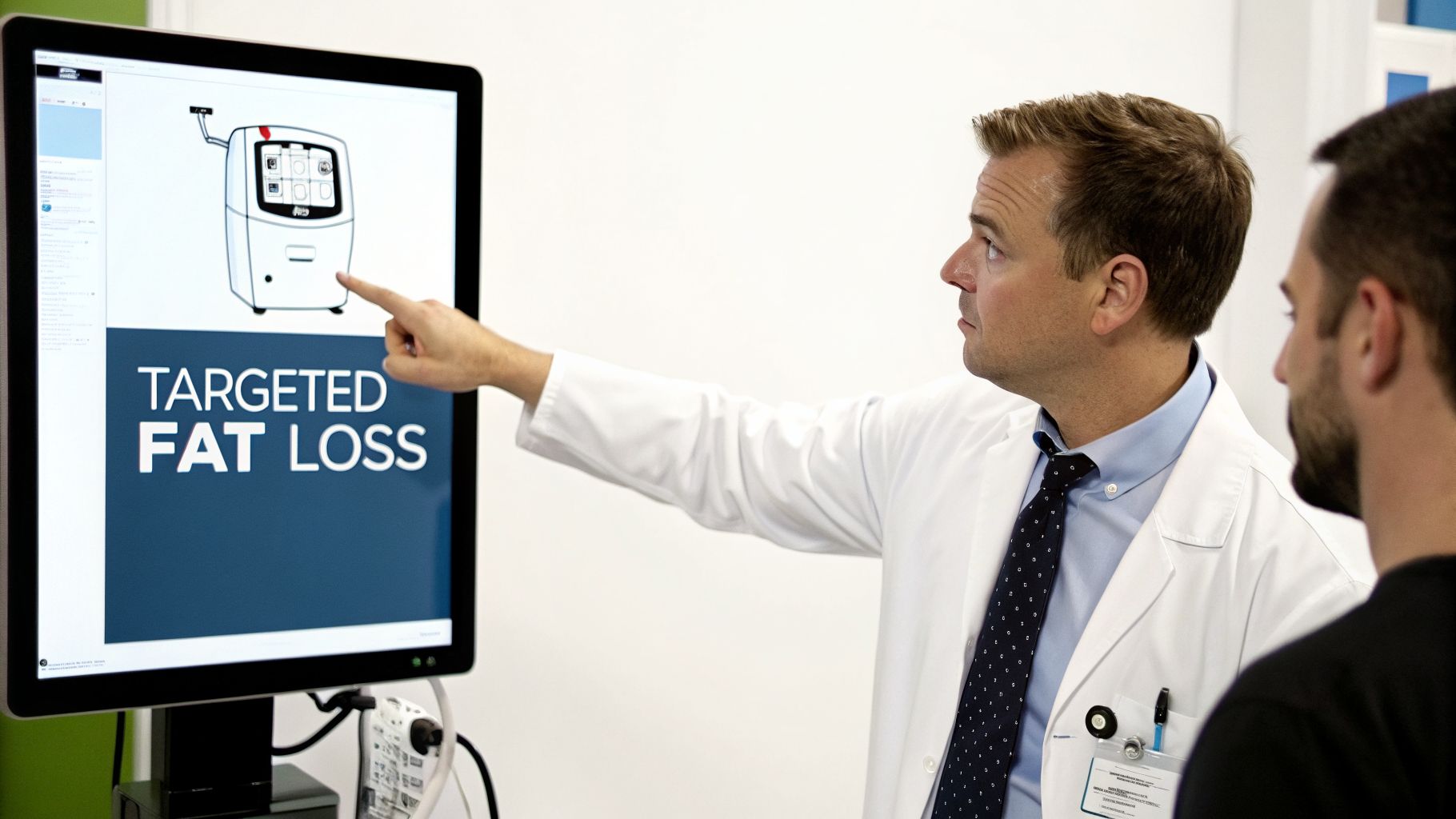
It’s a story I hear all the time. You’ve put in the work—cleaning up your diet and staying committed to your fitness routine—but those stubborn pockets of fat on your flanks just won't budge. This is incredibly common, and it's precisely where modern aesthetic treatments can make a real difference, letting you target specific areas without going under the knife. For people who are close to their ideal weight but can't seem to shake their love handles, these options can be a game-changer.
You're not alone in considering it. Non-surgical body contouring has exploded in popularity. The number of these minimally invasive procedures skyrocketed from about 857,000 per year in the early 2000s to nearly 4.25 million annually by 2018. More recently, the total number of aesthetic procedures jumped 42.5% in just four years, showing just how many people are using these treatments for that final bit of sculpting.
One of the most trusted names in this space is CoolSculpting. It’s an FDA-cleared procedure built on a fascinating science called cryolipolysis—which is really just a technical way of saying "fat freezing." The concept is surprisingly simple: fat cells are much more sensitive to cold than your skin, muscles, and other surrounding tissues.
CoolSculpting uses this to its advantage by applying controlled cooling directly to the love handle area. This targeted cold essentially freezes and crystallizes the underlying fat cells. Your body then does the rest, naturally processing and clearing away these dead cells over the next few weeks and months. And the best part? Once those fat cells are gone, they're gone for good.
The whole process is quite straightforward and is designed with patient comfort in mind. It all begins with a simple conversation.
First, you'll have a detailed consultation with a qualified provider. This is our chance to assess the area, talk about your goals, and make sure you're a good candidate. The ideal person for this has "pinchable" fat on their flanks and a realistic understanding of what the treatment can achieve.
On the day of your treatment, a protective gel pad is placed on your skin, and the CoolSculpting applicator is positioned over your love handles. You'll feel a strong suction as the device draws the tissue into the applicator.
For the first few minutes, you’ll feel a sensation of intense cold and pulling. Most of my patients report that this quickly fades as the area goes numb. From there, you can pretty much just relax—read a book, catch up on emails, or even take a nap during the 35-60 minute session.
Right after the applicator is removed, your provider will perform a quick, two-minute massage on the treated area. Don't skip this! This step is crucial for breaking up the crystallized fat cells and has been shown to improve the final outcome by up to 68%.
One of the biggest draws of CoolSculpting is that there's virtually no downtime. You can head right back to your normal routine, including workouts, immediately after your appointment. You might notice some temporary redness, swelling, minor bruising, or numbness in the area, but these side effects are normal and usually fade on their own within a few days to a couple of weeks.
The results appear gradually, not overnight. This is because your body needs time to flush out the treated fat cells.
A single session often leads to a noticeable fat reduction of about 20-25% in the treated area. However, depending on your goals, we might recommend a second session to achieve the best possible contour. If you're interested, you can learn more about the specifics of CoolSculpting to see if it’s the right fit for you.
So, you’ve put in the work with diet and exercise, but those stubborn love handles just won’t budge. This is a common story, and it’s often the point where people start looking for a more direct solution. When lifestyle changes have taken you as far as they can, surgery offers the most definitive way to get the smooth, contoured shape you're after.
Liposuction is, without a doubt, the go-to procedure for permanently removing flank fat. The numbers speak for themselves. In 2023, liposuction was the most popular cosmetic surgery in the U.S., with an incredible 347,782 procedures performed. That's a 7% jump from the previous year, which tells you a lot about its reliability and the high satisfaction people have with their results. You can discover more insights on these global surgical trends to see just how common this choice has become.
Here’s the thing about liposuction: it’s a body contouring tool, not a weight-loss method. The best results are seen on people who are already at or very close to their target weight but can't seem to shake those specific, localized pockets of fat.
A great candidate typically shares these traits:
A board-certified plastic surgeon is the only person who can truly determine if you're a good fit. They'll assess your anatomy, skin quality, and overall goals during a one-on-one consultation.
The goal of liposuction isn't just to remove fat; it's to sculpt. We aim to create a smooth, natural taper from the waist to the hips, enhancing your body's proportions without leaving any aggressive or unnatural-looking indentations.
The procedure itself is far more advanced and artistic than most people imagine. Using sophisticated techniques, a surgeon carefully loosens and suctions out the fat through tiny, well-hidden incisions. The entire process is about artful sculpting to ensure the final result is symmetrical and beautiful.
Recovery happens in stages, and most of my patients are back to a desk job within about a week.
While liposuction permanently removes fat cells in the treated area, maintaining a healthy lifestyle is key to preserving that new shape for years to come. If this sounds like the right step for you, exploring our comprehensive liposuction guide will give you an even deeper dive into what you can expect.
Alright, you've seen what’s possible—from foundational diet and exercise to advanced clinical procedures. Now comes the hard part: deciding which path is right for you. There's no single magic bullet for getting rid of love handles; the best approach is always the one that fits your goals, budget, and real-life schedule.
It can feel like a tough choice between a lifestyle-first approach and a clinical intervention. Committing to diet and exercise is fantastic for your overall health, and it costs very little to get started. But the results can be slow, and let’s be honest, sometimes diet and exercise alone just won’t touch that genetically stubborn fat. A solid understanding of how to reduce belly fat in general is a great starting point, as it complements any specific work you do on your flanks.
On the flip side, procedures like liposuction or CoolSculpting offer targeted, predictable results. The trade-off? They come with a higher price tag and, in the case of surgery, a necessary recovery period.
So, how do you make the call? It really comes down to weighing a few key factors against what matters most to you.
This decision tree can help you visualize where you fall on the spectrum of options.

As you can see, the flowchart makes it clear: if you’ve given diet and exercise your all and still aren't seeing the results you want, a procedure like liposuction often becomes the most direct path to a definitive change.
"The most successful outcomes I see are in patients who have realistic expectations and choose a path that aligns with their lifestyle," notes Dr. Marc Fater. "Whether it's refining results with a procedure or committing to a health regimen, the goal is a result you can happily maintain."
Ultimately, if you're looking for the most dramatic and precise sculpting possible, nothing beats a direct conversation. Exploring the best body contouring procedures with a board-certified plastic surgeon will give you the clarity and confidence to make the right choice for your body.
Even with a solid plan, it's normal to have a few lingering questions. Let's tackle some of the most common ones we hear from people who are ready to finally address the stubborn fat on their flanks.
This is probably the most common question we get, and the honest answer is: it varies. Your results depend on your starting body composition, your genetic predispositions, and, most importantly, how consistently you stick to a calorie deficit.
That said, many people start to notice their clothes fitting a bit better within 4-6 weeks. More visible, defined changes in your love handles usually take a bit longer, often becoming apparent after 3-4 months of dedicated diet and exercise. Remember, this is a marathon, not a sprint. Sustainable changes are the ones that last.
This really comes down to your personal goals and anatomy. Think of it this way: liposuction is a surgical procedure that delivers more dramatic, immediate results by removing a larger volume of fat. It's often the better choice for those seeking a significant change.
On the other hand, CoolSculpting is completely non-invasive, meaning zero downtime. It offers a more subtle reduction, typically clearing about 20-25% of the targeted fat per session.
The only way to know for sure which path is right for you is to have a direct conversation. A consultation with a board-certified plastic surgeon will give you a clear recommendation based on your body and your desired outcome.
Here’s the good news: procedures like liposuction and CoolSculpting permanently destroy fat cells. Once those cells are removed, they are gone for good.
However, that doesn't mean you're immune to future weight gain. If your weight increases, the remaining fat cells in your body—including any left in the treated area—can still expand. Maintaining a stable weight through a healthy lifestyle is the key to protecting your investment and enjoying your new contours for years to come.
It’s time to think about a consultation when you feel like you've done all you can on your own. If you’ve been at a stable, healthy weight and have been consistent with diet and exercise for at least six months but are still frustrated by that persistent fat on your flanks, you're the perfect candidate to explore your options.
A board-certified plastic surgeon can give you a professional assessment and map out the most effective treatment plan to help you finally achieve the shape you've been working toward.
Ready to see what's possible for you? The team at Cape Cod Plastic Surgery is here to help guide your decision. Schedule your one-on-one consultation with Dr. Marc Fater today to discuss your goals and find the best path forward.
September 9, 2026
Expert Guide to Proper Surgical Incision Care
Master dermal fillers aftercare with do's and don'ts, swelling tips, activity limits and warning signs to protect your results and heal smoothly.

September 8, 2026
Ensuring Safety: Why Your Surgeon's Credentials Matter Most

Cape Cod Plastic Surgery offers expert cosmetic and reconstructive procedures in a safe, accredited setting. Led by Dr. Marc Fater, we combine advanced techniques with personalized care to help you look and feel your best.
Monday: 9:00 AM – 5:00 PM
Tuesday: 9:00 AM – 5:00 PM
Wednesday: 9:00 AM – 5:00 PM
Thursday: 9:00 AM – 5:00 PM
Friday: 9:00 AM – 5:00 PM