

October 2, 2026
When Is the Right Time for Plastic Surgery
Beyond the Calendar: How to Know You’re Truly Ready for Plastic Surgery
Apr 5, 2026

After all the hard work of losing weight, it can be disheartening to look in the mirror and see loose, sagging skin. It’s a common frustration, but it doesn't have to be the end of your story. The key is to be patient and work with your body, giving your skin the time and support it needs to adapt. While some laxity is often unavoidable, combining smart at-home habits with the right professional treatments can make a huge difference in firming things up.

So, what's actually going on here? Your skin is an incredible organ that stretched to accommodate your larger size. The "snap-back" quality of your skin comes down to two powerhouse proteins: collagen, which provides structure and firmness, and elastin, which gives it that stretchy, resilient quality.
When you carry extra weight for an extended period, these protein fibers are held in a stretched-out position. Over time, this can damage them, much like a rubber band that's been overstretched for too long. It loses its ability to shrink back to its original shape, and you're left with excess skin.
How much your skin tightens up depends on a handful of factors. Some are within your control, while others are simply part of your unique makeup.
This is why gradual weight loss is so crucial. Aiming for a slow and steady pace of 1-2 pounds per week gives your skin a fighting chance to adapt. Dropping weight too fast—say, over 3 pounds a week—overwhelms the collagen and elastin fibers, which are already declining by about 1% every year after age 20. A 2026 study found that women who focused on these gradual changes saw a noticeable improvement in mild skin laxity over 1-2 years. Discover what real women learned about slow and steady changes on CTCD.edu.
It’s vital to be realistic from the start. For mild to moderate looseness, lifestyle adjustments and non-surgical treatments can work wonders. But for large amounts of excess skin, especially after massive weight loss, these methods can only do so much.
For anyone dealing with significant skin sagging, surgery is often the most direct and effective path forward. That said, it's incredibly important to give your body at least one year at a stable weight before making any decisions.
This waiting period is non-negotiable. It allows your skin to retract as much as it's going to on its own, giving you a clear picture of your body's new baseline. Only then can you make an informed choice about what, if any, next steps you want to take to achieve your goals.
Congratulations on your weight loss—that's a huge achievement. Now, let's tackle the next step: helping your skin catch up. While there are powerful clinical treatments available, the real work starts at home. These foundational habits are what support your skin’s natural ability to firm up and create a strong base for any other treatments you might consider.
One of the best things you can do for loose skin has very little to do with the skin itself. It’s all about what lies just beneath it. When you lose a significant amount of weight, you lose the fat that once held your skin taut. Strength training is your secret weapon here, helping you build lean muscle to fill that void from the inside out.
Think of it like this: your muscle is the "cushion" and your skin is the "upholstery." A plump, firm cushion makes the fabric over it look smooth and tight. A deflated one, not so much. This isn't just a helpful analogy; we have solid science to back it up.
A groundbreaking 2023 study vividly demonstrated the power of resistance training. After just 12 weeks, female participants saw significant improvements in skin elasticity, upper dermal structure, and even dermal thickness, proving that building muscle directly enhances skin quality. You can read the full research about these skin improvements to understand the compelling results.
For those looking to supplement their routine, tools like electric muscle stimulator workouts can also help enhance muscle tone and contribute to that firm foundation we're aiming for.
What you eat literally becomes your skin. The proteins that give your skin its bounce and structure—collagen and elastin—are built from the nutrients you consume. You simply can't expect your skin to repair itself without the right raw materials.
Here’s where to focus your grocery list:
Think of good nutrition as the fuel for both your workouts and your skin's cellular repair team.
While you're working on the inside, you can give your skin some much-needed support from the outside, too. It’s a two-pronged attack.
First, hydration. Drinking plenty of water is essential for keeping your skin cells plump and elastic from within. But you also need to lock that moisture in. A high-quality daily moisturizer creates a protective barrier on the surface, preventing dehydration and shielding your skin from daily environmental damage.
To take it a step further, look for specific ingredients that can make a real, visible difference over time:
If you’re seeing a fine, tissue-paper-like texture, it might be helpful to understand what causes crepey skin and how it’s different from other types of skin laxity. Just remember, these at-home strategies are a marathon, not a sprint. Consistency is everything.
So, you’ve put in the hard work at home, but your skin isn't quite catching up to your new physique. That’s perfectly normal, and it’s often the point where we need to look beyond surface-level fixes. When you're dealing with mild to moderate looseness, minimally invasive treatments can be a fantastic middle ground between topical creams and a full surgical procedure.
The science behind most of these treatments is pretty clever. We use controlled energy—typically heat—to create a tiny, targeted "injury" deep within the skin's layers. This doesn't damage the surface, but it does send a powerful signal to your body's natural repair crew. In response, your body ramps up production of new, healthy collagen and elastin, the very proteins that keep your skin firm and bouncy.
One of the most trusted technologies in my practice for this is radiofrequency, or RF. It works by sending gentle heat deep into the dermis. You won't feel much on the surface, but underneath, that thermal energy is causing two things to happen.
First, it makes your existing collagen fibers contract, which can give you a subtle, immediate tightening effect. But the real magic happens over the next few months. The heat stimulates specialized cells called fibroblasts to get back to work building a brand-new collagen framework. As this support structure is rebuilt, you’ll see the skin become progressively smoother and firmer. We often use advanced options like Morpheus8 Body treatments, which pair microneedling with RF to get an even more dramatic collagen-boosting response across larger areas like the abdomen or thighs.
A Common Scenario: I often see patients who've lost around 50 pounds and are now left with some crepey, loose skin on their lower stomach or inner thighs. For them, a series of RF treatments can be a game-changer. It helps firm up those specific areas with virtually no downtime, so they can get right back to their lives.
Another excellent tool is focused ultrasound. While RF heats a broader area, ultrasound devices like Ultherapy deliver pinpoint energy to very specific depths. This precision lets us target the same deep foundational tissue that a surgeon would address in a facelift, but without a single incision.
This energy creates tiny thermal points that, just like with RF, kickstart a major collagen-building response. Because it can reach deeper than many other non-surgical options, ultrasound is incredibly effective for creating a noticeable lift, especially on the face, neck, and chest, but it’s also used on the body to improve laxity.
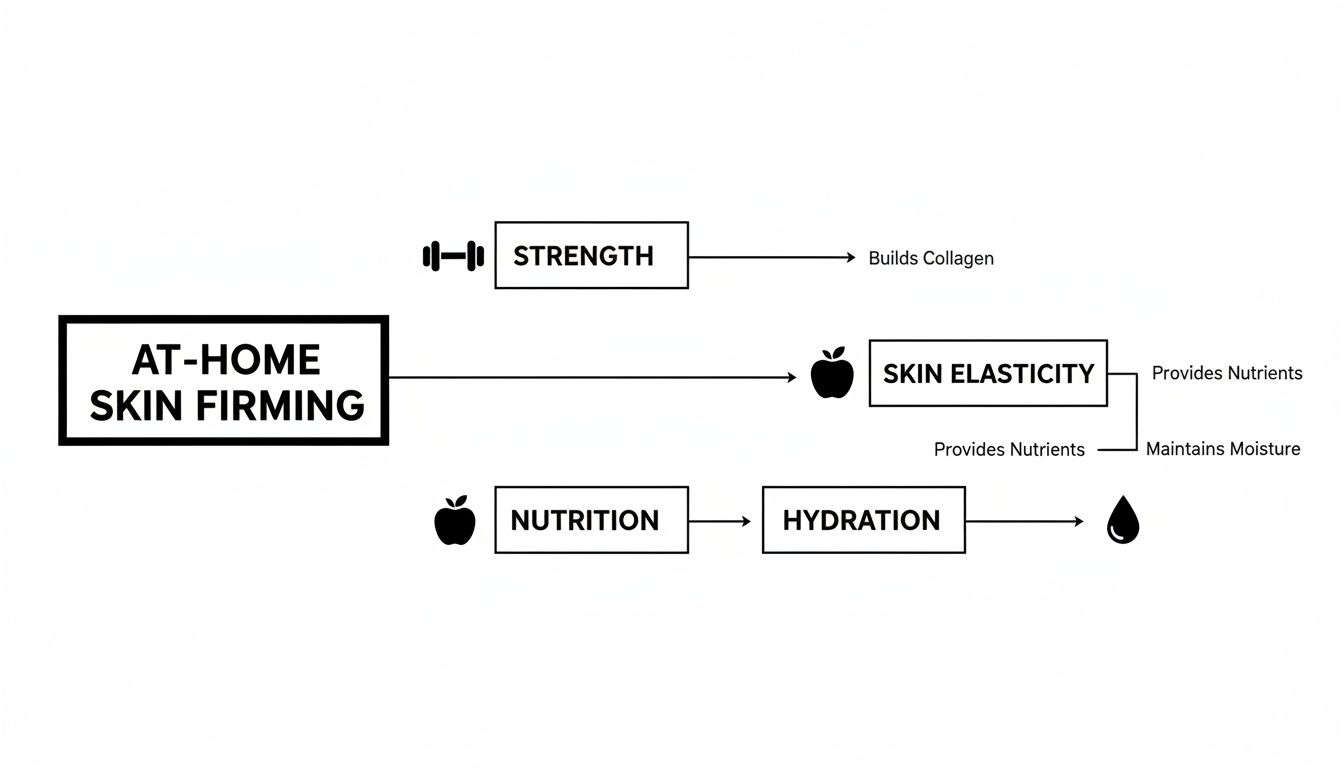
It’s important to remember that these professional treatments work best when you're also supporting your skin from the inside out with good nutrition, hydration, and exercise.
Choosing the right procedure can feel overwhelming, as each technology has its own strengths. This table breaks down some of the most popular options to help you understand how they differ.
| Treatment | How It Works | Best For | Downtime | Results Timeline |
|---|---|---|---|---|
| Radiofrequency (RF) | Uses electrical energy to create heat in the dermis, stimulating collagen production. | Mild to moderate skin laxity, fine lines, and improving overall skin texture on the face and body. | Minimal; usually just 1-2 days of mild redness. | Gradual improvement over 3-6 months. |
| RF Microneedling | Combines RF energy with tiny needles to deliver heat deeper and more precisely. | Moderate skin laxity, texture issues, acne scars, and stretch marks. Firming larger body areas. | 2-5 days of redness and minor swelling. | Noticeable results after a few weeks, with full effect at 3-6 months. |
| Ultrasound | Uses focused sound waves to heat deep foundational tissue layers (SMAS). | Lifting and tightening sagging skin on the face, neck, and brow. Mild body laxity. | None to minimal; some patients have slight redness or tingling. | Full results develop over 3-6 months. |
| Laser Skin Resurfacing | Removes the outer layer of skin (ablative) or heats the underlying skin (non-ablative) to stimulate collagen. | Surface-level concerns like sun damage, fine lines, and texture, with some tightening benefits. | Varies from a few days (non-ablative) to 2 weeks (ablative). | Varies by laser; can be seen in weeks or develop over months. |
Ultimately, the best choice depends on your specific goals, the degree of skin laxity, and the treatment area. A consultation is the only way to know for sure which path is right for you.
I always tell my patients that while these treatments are powerful, they aren't a magic wand. Here’s a realistic look at what you can expect from the process:
These non-surgical options are ideal for people with mild to moderate skin laxity. If you've had massive weight loss and are dealing with significant hanging skin, these methods can still improve skin quality but won't replace a surgical lift. To get a better sense of all the available technologies, this overview of non-invasive skin tightening is a great resource. The best first step is always to chat with a board-certified plastic surgeon or dermatologist to create a plan that aligns with your anatomy and your goals.

When you've tried all the at-home strategies and even explored non-surgical treatments without getting the results you want, it might be time for an honest conversation about surgery. Body contouring is typically for people dealing with moderate to severe skin laxity—something we often see after a weight loss of 100 pounds or more.
At this point, the problem isn't just a loss of firmness. We're talking about a significant amount of excess skin that simply has nowhere to go. It's crucial to see these procedures for what they are: they aren't a shortcut to weight loss. They are the final, restorative step for removing the skin and stubborn fat left behind after you've already done the incredible work of reaching a healthy, stable weight.
Making the leap to surgery is a major, deeply personal choice. While it's often the most definitive solution for significant sagging, it's not a decision to be made on a whim.
I always tell my patients that the right time to start thinking seriously about surgery is when the excess skin becomes more than just an aesthetic issue. Ask yourself: is it actively interfering with your life?
If you're nodding along, surgery could dramatically improve your quality of life. There's also the emotional side of things. If you look in the mirror and feel frustrated instead of proud of what you've accomplished, surgery can finally help your physical appearance match all the hard work you’ve put in.
We're looking for candidates who have kept their weight stable for at least six to twelve months. This waiting period is non-negotiable. It allows your body to settle and your skin to retract as much as it naturally can, which means your surgical results will be more predictable and last for the long haul.
"Body contouring" isn't a single operation. It’s a collection of different surgical procedures, each designed for a specific area. A skilled surgeon can also combine them to create a more balanced and harmonious result across multiple parts of the body.
Abdominoplasty (Tummy Tuck)
This is one of the most requested procedures after massive weight loss. A tummy tuck does more than just remove excess skin and fat from the abdomen. Crucially, it also tightens the underlying abdominal muscles that often become stretched and separated, helping restore a flatter, stronger core.
Panniculectomy
This is a more focused procedure to remove the "pannus"—a large apron of skin that hangs from the lower abdomen and can sometimes cover the pubic area. Unlike a full tummy tuck, a panniculectomy is strictly about removing this overhang and is often deemed medically necessary when it causes health problems like rashes and infections.
Brachioplasty (Arm Lift)
If you're dealing with "bat wings," that loose, sagging skin on the upper arms, an arm lift is the answer. We make an incision along the inner arm to remove a section of skin and fat, which results in a tighter, more defined arm shape.
Thigh Lift
Much like an arm lift, this procedure addresses loose skin on the inner or outer thighs. Incisions are carefully hidden in the groin crease or along the inner thigh to remove excess tissue, leaving you with smoother, firmer legs.
For a closer look at how these procedures work together, our guide to body contouring after weight loss breaks down the planning process in more detail.
It's vital to go into this with your eyes wide open about the recovery process and the reality of scarring.
The Recovery Timeline
Recovery really depends on how extensive your surgery is. You should plan for several weeks of taking it easy. You might have temporary drains to manage fluid buildup, and you’ll need to wear a compression garment to support the area and keep swelling down. A full, unrestricted return to your normal routine, including intense workouts, usually takes about 6 to 12 weeks.
The Reality of Scars
There's no way around it: body contouring surgery leaves permanent scars. However, a board-certified plastic surgeon is an expert in placing them strategically. We design incisions to hide within your body’s natural creases or in places easily concealed by most swimwear and underwear. With proper care, these scars fade beautifully over time, becoming a faint reminder of your journey.
Deciding on body contouring is a huge step, but for the right person, the results are nothing short of life-changing. It’s the final chapter that allows you to fully step into and enjoy the new, healthy body you’ve worked so hard for.
Deciding to meet with a board-certified plastic surgeon is a huge milestone. This is where all your research gets real, and you start building an actual plan for your body. The first consultation is everything—it’s your chance to find a surgeon you connect with and get an honest, professional opinion on what's truly possible.
Think of this first meeting as a conversation, not an examination. You'll share your story—the incredible weight loss journey you've been on, your frustrations with the loose skin left behind, and what you hope to see in the mirror. In turn, the surgeon should listen intently, offer their expert perspective, and lay out your options in a way that makes perfect sense to you.
The more you prepare for this meeting, the more you'll get out of it. Walking in with a clear idea of what you want to discuss turns a potentially overwhelming appointment into an empowering one.
Before you go, try to pull together a few things:
This prep work gives the surgeon a window into your world and helps them start building a strategy that actually matches your vision.
Your first consultation is much more than a physical check-up. It's about building trust. You need to feel heard, respected, and 100% comfortable asking anything on your mind, no matter how small it seems. That surgeon-patient relationship is the foundation of a great outcome.
Once you've talked through your goals, the surgeon will do a physical exam. This is where they get a hands-on feel for the amount and quality of your excess skin, along with any stubborn fat deposits. They're assessing your skin's elasticity (or lack thereof) and the condition of the muscle underneath.
This isn't just a quick look. The surgeon will feel the tissue to understand how it behaves. For instance, on your abdomen, they'll check for muscle separation (diastasis recti), a common issue after major weight changes. Finding this would likely point toward a full tummy tuck instead of a less invasive procedure. This hands-on evaluation is what allows a surgeon to tell you which options are anatomically right for you.
Remember, you are interviewing them for a very important job. A skilled and confident surgeon will appreciate your diligence and answer every question without hesitation. Don't be shy.
Here’s a list of non-negotiable questions to bring with you:
Making the final call on surgery is a major life decision. This first meeting is your single best opportunity to make sure you're in the right hands, setting you on the path to finally loving the body you’ve worked so incredibly hard for.
Once you've explored all the ways to improve your skin—from at-home care to professional treatments and surgery—you're bound to have some specific questions. This is where the general advice gets personal. Let's walk through some of the most common questions we hear every day from patients in our office.
Getting clear, honest answers is the best way to move forward with confidence. These are the details that help you feel empowered, not overwhelmed, as you decide what's next.
This is probably the most frequent question we get, and it's so important to be realistic here. While a great skincare routine with high-quality creams—especially those with ingredients like retinoids or hyaluronic acid—can absolutely improve your skin's texture and glow, they won't significantly tighten moderate to severe loose skin.
Think of it this way: topical products work on the surface, making skin smoother and more hydrated. But the kind of laxity you see after major weight loss is a structural issue. The problem lies much deeper, where the skin’s foundational collagen and elastin fibers have been stretched beyond their limits.
To get meaningful tightening, you need treatments that either kickstart new collagen growth in those deep layers (like radiofrequency or ultrasound) or surgically remove the excess skin. Creams are a fantastic supporting actor, but for major skin laxity, they can't be the star of the show.
I know how hard it is to be patient after you’ve worked so tirelessly to lose weight, but waiting is absolutely critical for a successful outcome. Almost any board-certified plastic surgeon will tell you to wait until your weight has been completely stable for at least 6 to 12 months before having a surgical procedure.
This waiting period isn't arbitrary; there are two crucial reasons for it:
Yes, any surgical procedure that removes skin will leave a permanent scar. There's no getting around that fact. However, a huge part of a plastic surgeon’s expertise is not just in removing the skin, but in placing the incisions so the resulting scars are as hidden as possible.
A skilled surgeon is an artist when it comes to scar placement. For instance:
With proper scar care, these lines will fade over time from red or pink to a much paler, less obvious mark. Most of our patients feel it's a very small trade-off for the incredible difference in their body's shape, comfort, and confidence.
This is a great question. Because minimally invasive treatments like radiofrequency and ultrasound are actually prompting your body to build its own new, strong collagen, the results are very long-lasting. It's not a temporary fix; the collagen you build is yours.
That said, these treatments don't stop the clock on aging. Your skin will naturally continue to age and lose collagen over the years. To counteract this, many patients find that a single maintenance treatment every one to two years is perfect for keeping their results looking fresh and staying ahead of the curve. Of course, a healthy lifestyle is key to protecting your investment and making that great result last.
At Cape Cod Plastic Surgery, we're here to help you understand every option and find the plan that feels right for you. If you have more questions or you're ready to talk about your personal journey, we invite you to schedule a consultation with us today.
October 2, 2026
Beyond the Calendar: How to Know You’re Truly Ready for Plastic Surgery

October 2, 2026
Exploring Your Breast Augmentation Options: Implants, Shapes, and What to Expect
October 1, 2026
Reshaping Your Silhouette: A Guide to Body Contouring

Cape Cod Plastic Surgery offers expert cosmetic and reconstructive procedures in a safe, accredited setting. Led by Dr. Marc Fater, we combine advanced techniques with personalized care to help you look and feel your best.
Monday: 9:00 AM – 5:00 PM
Tuesday: 9:00 AM – 5:00 PM
Wednesday: 9:00 AM – 5:00 PM
Thursday: 9:00 AM – 5:00 PM
Friday: 9:00 AM – 5:00 PM