

September 9, 2026
How to Care for Surgical Incisions Properly
Expert Guide to Proper Surgical Incision Care
May 18, 2026
Jaw surgery can cost about $3,000 with strong insurance coverage or as much as $150,000 without it, and the average reported price is $30,623. If you're staring at a treatment recommendation and wondering how the same surgery can land in such different financial territory, the short answer is that insurance classification and procedure complexity drive most of the gap.
That's the part most patients don't hear clearly at first. They're told they need jaw surgery, they start searching, and they find broad ranges that don't explain what they'll personally owe. A number by itself isn't very helpful when one quote includes bundled hospital care, imaging, plates, anesthesia, and follow-up, while another leaves several of those items outside the estimate.
Patients usually aren't asking a theoretical question. They're asking a budgeting question. Can I afford this, what exactly am I paying for, and what can I do before surgery to keep the final bill from becoming a surprise?
A patient comes in expecting one number and leaves with three very different possibilities. One estimate assumes medical insurance approval. Another reflects the same operation if the carrier classifies part of it as cosmetic. A third rises because the case involves both jaws, longer operating time, and hospital-based care. That is why jaw surgery pricing feels confusing at first. The label sounds simple. The billing rarely is.
The first question is not just, “How much is jaw surgery?” The better question is, “Why does this particular plan cost what it costs?” In practice, two factors usually drive the biggest difference in out-of-pocket expense: how insurance classifies the surgery, and how complex the operation is.
“Jaw surgery” covers a wide range of treatment plans. A single-jaw correction for a functional bite issue is not billed the same way as a double-jaw operation with extensive planning, longer anesthesia time, and a hospital stay. Even before insurance enters the picture, those cases use different amounts of operating room time, staff, hardware, and postoperative support.
Insurance then changes the picture again. If the procedure is documented and approved as medically necessary, the patient may owe deductibles, coinsurance, and noncovered items instead of the full surgical episode. If part or all of the treatment is treated as cosmetic, the patient may be responsible for far more of the surgeon fee, facility fee, anesthesia, imaging, and related costs.
That distinction explains why broad online price ranges are often frustrating. They mix together insured and self-pay cases, simpler operations and highly complex ones, and quotes that may or may not include the same services.
Patients make better decisions when they review the quote through four practical filters:
This is the part patients should slow down and review carefully. A lower quote is not automatically the better value if it leaves out major billable items or assumes insurance coverage that has not been confirmed.
For patients comparing options, our jaw surgery pricing and consultation information can help frame the questions to ask before committing to treatment.
A jaw surgery quote works a lot like the sticker price on a car. The total matters, but what matters more is what's inside it. If you only look at one top-line number, you can't compare estimates intelligently.
Orthognathic surgery pricing guidance from AEDIT notes that the total cost is usually built from the full perioperative episode, including surgeon fees, hospital or ambulatory facility charges, anesthesia, imaging, and postoperative medications, with total costs typically bundled in the $20,000 to $40,000 range.
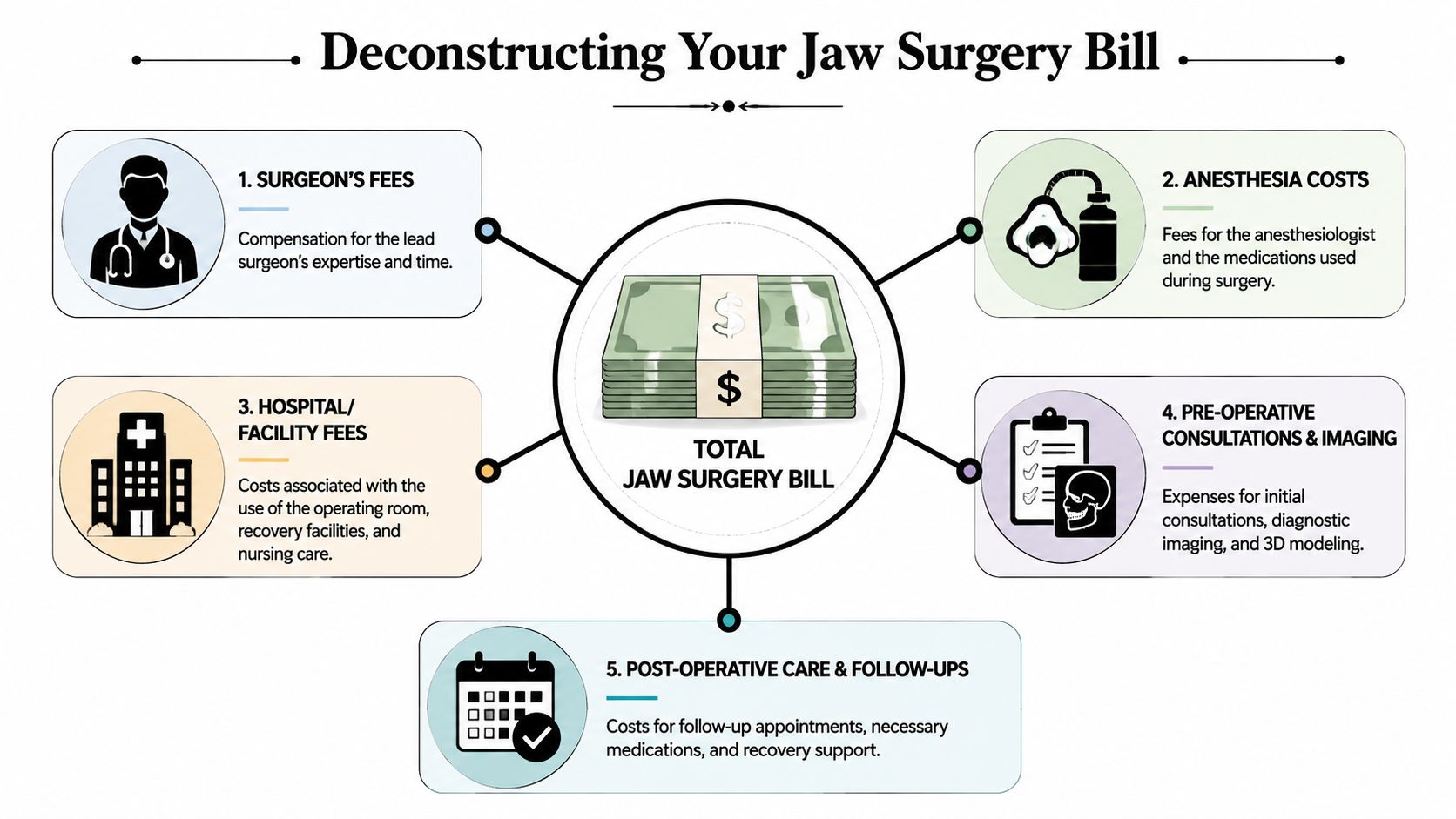
Here's what usually sits inside a full jaw surgery cost estimate:
| Cost component | What it usually covers | Why it matters |
|---|---|---|
| Surgeon's fee | The operating surgeon's planning, technique, and surgical time | Experience, case difficulty, and geography can change this substantially |
| Anesthesia | Anesthesiologist or anesthesia provider fees, medications, monitoring | Longer and more complex surgery usually means higher anesthesia cost |
| Facility fee | Operating room use, recovery area, nursing support, equipment | Hospital-based care often prices differently than ambulatory settings |
| Imaging and planning | X-rays, scans, records, surgical planning | These aren't optional extras in most jaw surgery cases |
| Post-op care | Follow-ups, medications, and immediate recovery support | Some quotes include this. Others bill parts separately |
A patient who gets a low-sounding quote sometimes learns later that imaging or facility charges were never included. A patient who gets a high quote may be seeing a more honest all-in estimate.
Patients can save themselves real confusion by doing the following: Don't compare two jaw surgery estimates until you've asked the same set of questions about both.
If you want to see how some practices present cosmetic and procedure pricing in a more transparent format, reviewing a structured surgical pricing page can help you understand what a clearer fee conversation looks like.
A useful quote doesn't just tell you the total. It shows you what the total is made of.
That distinction matters because jaw surgery cost isn't one fee. It's a sequence of coordinated services delivered around one operation.
Some variables shift the cost a little. Two variables tend to shift it a lot: how complex the surgery is and where, by whom, and in what setting it's performed.
The biggest clinical divider is whether the surgeon is repositioning one jaw or both. My Specialty Dentist's jaw surgery cost guide places single-jaw surgery around $20,000 to $30,000 total, while dual-jaw surgery is typically $30,000 to $40,000 or more.
This isn't just a billing distinction. It reflects a different level of resource use.
Double-jaw surgery generally requires more operating-room time, more anesthesia, more fixation hardware, and often a more involved recovery plan. That's why patients shouldn't assume the cost difference is arbitrary or based only on a surgeon's preference. The total usually rises because the case itself demands more coordinated care.
Here is a simple explanation:
Jaw surgery cost isn't uniform from one market to another. Major metropolitan areas often carry higher facility and professional fees than smaller markets. The care setting matters too. A hospital-based operation may include a different fee structure than a procedure performed in an accredited ambulatory environment.
That doesn't mean cheaper is automatically better, or that higher cost always signals better care. It means you need to understand what the setting includes. Privacy, access to support staff, recovery logistics, and billing structure all affect the final number.
Patients understandably focus on the bill first. But with jaw surgery, experience matters because planning quality affects everything that follows, from efficiency in the operating room to coordination of recovery.
Here's a useful lens for evaluating value:
A quote only becomes meaningful when it's attached to a clear surgical plan.
For most patients, this is the hinge point. The single biggest factor in out-of-pocket jaw surgery cost is often not the operation itself. It's whether the insurer classifies that operation as medically necessary or cosmetic.
Brace Yourself's jaw surgery overview makes that point directly: the biggest driver of out-of-pocket cost is insurance classification, and many guides fail to explain what a patient will personally pay based on whether the procedure is approved as medically necessary.

Insurers generally don't cover jaw surgery because a patient wants a stronger profile or a more balanced facial shape alone. They're far more likely to review coverage when the documentation shows functional impairment.
That often means records supporting issues such as:
The key is documentation. Patients often assume the diagnosis itself is enough. It usually isn't. Insurers tend to want imaging, clinical notes, and a record that explains why surgery is functionally necessary.
For a broader look at how insurance tends to approach procedures that blend functional and aesthetic concerns, this overview of insurance coverage for plastic surgery gives helpful context.
A short visual explanation can also help clarify the distinction:
Approval often comes down to how well the case is assembled before surgery, not how strongly the patient feels they need it.
What works: A coordinated packet with clinical notes, imaging, diagnoses, and a clear statement of functional impairment.
What doesn't work is vague language. If the documentation sounds aesthetic-first, or if it doesn't clearly connect anatomy to daily limitations, the insurer may classify the request unfavorably.
Patients should ask the treating office:
This catches many patients off guard. Even when a jaw surgery case is approved as medically necessary, the patient may still owe deductibles, co-insurance, out-of-network balances, or separate charges tied to related parts of care.
That's why I tell patients to separate two questions. First, “Will insurance cover this?” Second, “What will I still owe if insurance does cover it?” Those are not the same question, and the second one is where financial planning becomes real.
Once you know what insurance may do, the next step is building a payment plan around the parts it won't cover. That matters because BetterCare's jaw surgery cost guide notes that costs in major U.S. markets can range from $7,000 to over $30,000, with pre-operative tests adding about $500 to $2,500.
Before patients think about financing the operation itself, they should identify the early expenses that often arrive before surgery day.
If you're comparing ways practices explain installment structures and financing expectations, a resource like Advanced Dentistry DE payment options can be useful as a model for what to ask any office about timing, financing, and accepted payment methods.
Patients usually do better when they layer options instead of relying on one source.
Medical insurance first
Confirm whether the procedure will be reviewed under medical benefits and whether major providers are in network.
Tax-advantaged funds next
If you have an HSA or FSA, ask which medically related charges can be paid from those accounts.
Practice payment plans or third-party financing
Some offices work with installment options that spread out larger expenses. Reviewing available payment plan options before your consultation helps you ask better questions about timelines and approval requirements.
Personal recovery reserve
Keep separate funds for transportation, food changes, and time away from work. Patients often underestimate these more than the surgery itself.
Don't build your financing plan around the best-case insurance scenario. Build it around the most realistic one.
That approach reduces stress. If approval is broader than expected, that's good news. If not, you're still prepared.
A strong financial discussion only works when it's tied to a real patient experience. In practice, the most helpful consultations are the ones where the medical question and the budgeting question happen together.
At Cape Cod Plastic Surgery, that process begins with a detailed consultation and a plan built around the patient's anatomy, concerns, and whether the problem is functional, cosmetic, or a combination of both. That distinction matters early because it affects not only treatment design but also how the financial conversation should be handled from the start.

Most patients arrive with a blend of questions. They want to know whether surgery is appropriate, whether their concerns are mainly functional or aesthetic, what setting the procedure would require, and how the cost conversation should begin.
That's where experience helps. Dr. Marc Fater brings over 30 years of experience and board certification, which matters when evaluating facial structure, procedural fit, and the level of surgical planning a case may require. Patients usually benefit from direct answers on whether they're looking at a simpler correction, a more involved plan, or a referral pathway if another specialty should be involved.
The practice's AAAASF-accredited on-site surgical suite changes the patient experience in practical ways. Patients often care about privacy, continuity, and knowing where their procedure and recovery support will happen. An accredited on-site environment can make the process feel more coordinated and easier to go through from consultation through postoperative care.
That doesn't replace the need for a clear financial review. It supports it. When the care setting is defined early, patients can ask better questions about what's included, how follow-up works, and which parts of treatment may be billed separately.
Good cost counseling starts with clinical honesty. The office should tell you what kind of case you have before it tells you what kind of payment plan you need.
That's the standard patients should expect anywhere they seek evaluation.
A common budgeting mistake happens after the surgical quote is signed. A patient plans for the surgeon, anesthesia, and facility bill, then gets home and realizes recovery brings its own set of expenses.
Time away from work is often the first pressure point. The amount depends on the operation, your job duties, and how your swelling, diet, and energy level progress in the first few weeks. A desk job and a physically demanding job do not create the same financial strain, even with the same procedure.
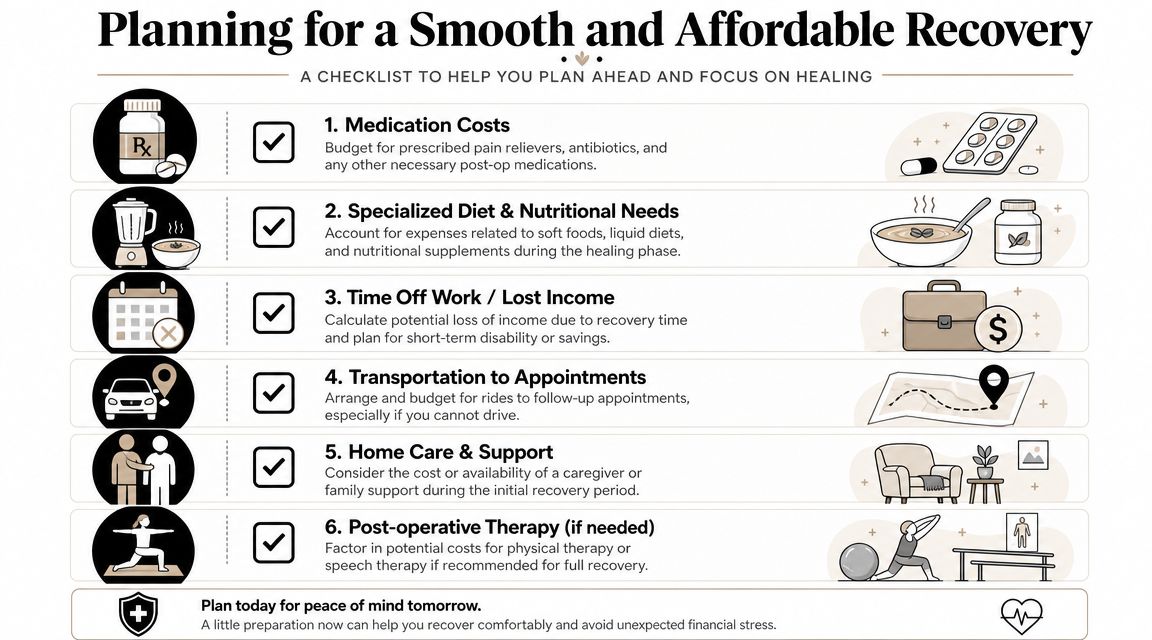
Recovery spending is usually less dramatic than the surgery bill, but it is still real.
The bigger point is planning for function, not just payment. If insurance classifies surgery as medically necessary, that may reduce the procedure bill, but it does not replace your need for time, support, and cash reserves during healing. If a case is treated as cosmetic, patients usually need to prepare for both the full procedure cost and the same recovery expenses.
Keep two separate numbers in mind. One budget gets you into surgery. The other gets you through recovery without financial stress.
I usually tell patients to review four practical questions before they commit: How much work can you miss, who can help at home, what expenses are likely to continue during recovery, and what part of your treatment is still your responsibility even after insurance processes the claim. That approach makes the total cost easier to manage because it reflects how recovery works.
If you're considering jaw surgery and want a clearer understanding of what your treatment plan may involve financially, Cape Cod Plastic Surgery offers consultations that can help you sort through procedure details, care setting, and the practical cost questions that matter before you commit.
September 9, 2026
Expert Guide to Proper Surgical Incision Care

Master dermal fillers aftercare with do's and don'ts, swelling tips, activity limits and warning signs to protect your results and heal smoothly.

September 8, 2026
Ensuring Safety: Why Your Surgeon's Credentials Matter Most
Cape Cod Plastic Surgery offers expert cosmetic and reconstructive procedures in a safe, accredited setting. Led by Dr. Marc Fater, we combine advanced techniques with personalized care to help you look and feel your best.
Monday: 9:00 AM – 5:00 PM
Tuesday: 9:00 AM – 5:00 PM
Wednesday: 9:00 AM – 5:00 PM
Thursday: 9:00 AM – 5:00 PM
Friday: 9:00 AM – 5:00 PM