

October 2, 2026
When Is the Right Time for Plastic Surgery
Beyond the Calendar: How to Know You’re Truly Ready for Plastic Surgery
Apr 4, 2026

It all boils down to one simple distinction: liposuction removes stubborn fat, while a tummy tuck removes excess skin and repairs separated muscles. Understanding which problem you're trying to solve is the first and most important step in choosing the right procedure.
Many patients who visit us at Cape Cod Plastic Surgery want to improve their midsection, but they’re often unsure whether liposuction or an abdominoplasty (tummy tuck) is the right path. While both are powerful body contouring procedures, they are engineered to achieve very different outcomes.
Think of it this way: liposuction is a sculpting tool, while a tummy tuck is a foundational repair. The "best" choice isn't universal—it's completely personal, depending on your unique anatomy and what you hope to achieve.
Liposuction is fantastic for people who are already close to their ideal weight but can’t seem to shake specific pockets of diet-and-exercise-resistant fat. For this to be the right fit, you need to have good skin elasticity. That means your skin has enough rebound to snap back and hug your new, slimmer contours after the fat is gone.
A tummy tuck, on the other hand, is designed for a more dramatic transformation, often sought after pregnancy or significant weight loss. It's the only procedure that can correct three issues liposuction simply cannot touch:
"Patients often ask which procedure is 'better,' but the right question is 'Which is better for me?' If you can pinch stubborn fat, liposuction is a possibility. If you can grab a handful of loose skin, a tummy tuck is likely the necessary solution," notes Dr. Marc Fater.
Here's an at-a-glance summary comparing the core differences between liposuction and an abdominoplasty to help you quickly identify the right path.
| Feature | Liposuction | Tummy Tuck (Abdominoplasty) |
|---|---|---|
| Primary Goal | Removes stubborn, localized fat deposits | Removes excess skin and tightens abdominal muscles |
| Best For | People with good skin elasticity and isolated fat | People with skin laxity and muscle separation |
| Invasiveness | Less invasive; small, targeted incisions | More invasive; long incision plus muscle repair |
| Recovery | Shorter; back to a desk job in a few days | Longer; 1-2 weeks off work, 4-6 weeks of restricted activity |
| Scars | Very small, often well-hidden scars | A horizontal scar from hip to hip, designed to be hidden by swimwear |
Ultimately, this table highlights the trade-offs. Liposuction offers a quicker recovery for fat reduction, whereas a tummy tuck requires a more significant recovery but delivers a complete restoration of the abdominal contour.
When patients come to me asking about liposuction versus a tummy tuck, the first thing we clarify is what liposuction is truly designed to do. Think of it less as a weight-loss method and more as a precision sculpting tool. It’s for those frustrating, localized pockets of fat that refuse to disappear, no matter how disciplined you are with diet and exercise. This procedure is all about refinement.
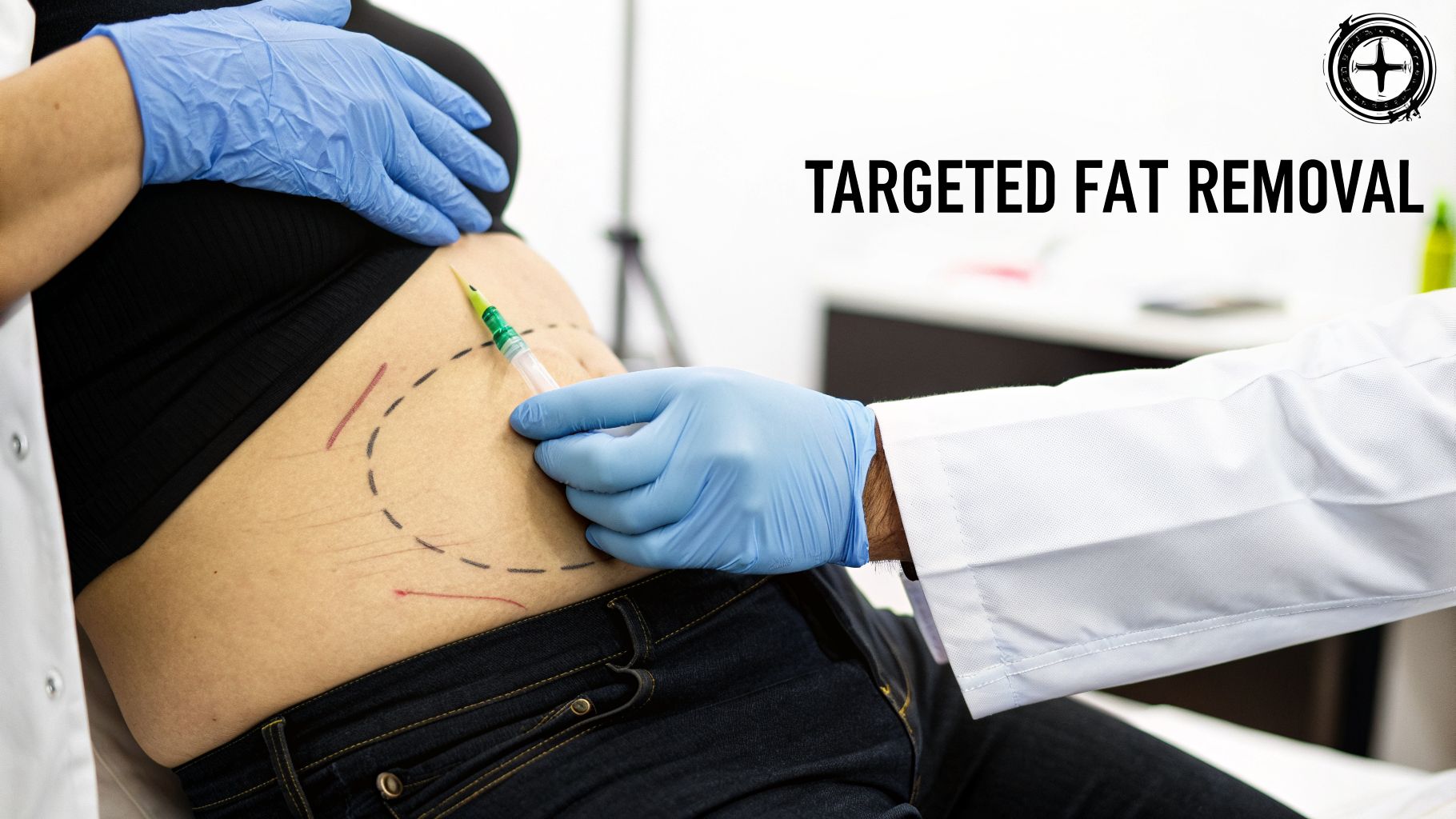
The technique itself is straightforward. Through a few very small, well-hidden incisions, I insert a thin, hollow tube called a cannula. This device allows me to gently and precisely suction away the targeted fat cells, literally reshaping the contours of the body from the inside out.
The best candidate for liposuction is someone who is already close to their target body weight but is bothered by specific areas of excess fat. I often see patients who are fit and healthy but can't seem to slim down their flanks (“love handles”), shed a small pouch on their lower abdomen, or contour their thighs. A crucial factor here is skin quality—the ideal candidate has firm, elastic skin that will naturally retract and conform to the new, sleeker shape once the underlying fat is gone.
Liposuction is incredibly effective for areas like:
This targeted fat removal provides a level of detail and sculpting that no amount of general weight loss can ever achieve. To get a better sense of the process, you can find more information about liposuction at Cape Cod Plastic Surgery and see if it sounds like the right fit for your body goals.
Liposuction’s success is fundamentally tied to skin quality. It removes the underlying volume, but it relies on your skin’s natural elasticity to shrink-wrap around the new, leaner shape. Without good skin tone, removing fat can sometimes worsen the appearance of loose skin.
It’s just as important to understand what liposuction doesn't do. This procedure is purely for fat removal. It does not address issues with loose skin or separated muscles, which are common concerns after pregnancy or significant weight loss.
Specifically, liposuction will not improve:
While liposuction is a surgical gold standard, it's worth knowing about other options on the market. For instance, non-surgical fat dissolving injections can target very small fat pockets without surgery. However, if your main concern is loose skin or muscle laxity, it’s time to shift the conversation toward a tummy tuck.
Where liposuction is about refining, a tummy tuck—or abdominoplasty—is about rebuilding. Think of it as a structural repair for your midsection. It’s designed to correct issues that diet, exercise, and even liposuction simply cannot touch, offering a complete reset for your abdomen.

A tummy tuck is far more comprehensive than liposuction. In one operation, we address three distinct problems: removing significant amounts of loose, hanging skin; taking out stubborn fat deposits; and, crucially, repairing weakened or separated abdominal muscles. This muscle repair is the true foundation of the procedure, creating the firm, flat core that patients are looking for.
The best candidates for a tummy tuck are those whose main concern is loose skin and a change in their core's underlying structure, not just excess fat. These changes almost always happen after major life events that stretch the abdominal wall beyond its ability to snap back.
We often see patients who are excellent candidates for these reasons:
Here's a quick way to think about the liposuction vs. tummy tuck question for your own body. If you can pinch an inch (or more) of stubborn fat, liposuction could be the answer. But if you can grab a handful of loose skin, a tummy tuck is almost always what’s needed to get the job done right.
While liposuction is a fantastic tool for precise fat removal, a tummy tuck delivers a much more dramatic transformation. It’s especially powerful for patients dealing with loose skin, stretch marks, and a weakened core. A tummy tuck is the only procedure that can physically remove stretched skin, especially the skin covered in stretch marks between the belly button and the pubic area.
Because an abdominoplasty is a more involved surgery, it creates a flatter, firmer, and smoother abdomen than liposuction ever could on its own. It's a classic trade-off: a more significant procedure and a longer recovery in exchange for a truly profound and lasting result. You can learn more about the possibilities with an abdominoplasty at Cape Cod Plastic Surgery.
Thinking about your recovery is just as important as thinking about your results. The downtime for liposuction versus a tummy tuck is worlds apart, and being realistic about what you can handle is key to making the right choice. Your job, your family life, and the help you have at home will all play a big role in which recovery path fits your life.
Liposuction recovery is far more manageable for most people. You can expect to be back to a desk job and light daily routines within a few days. The main things you'll be dealing with are swelling and bruising, which we manage by having you wear a compression garment for a few weeks.
A tummy tuck, on the other hand, is a much bigger deal. This isn't something you can bounce back from over a long weekend. Because we're repairing the underlying abdominal muscles, your body needs significant time to rest and heal properly.
With liposuction, the recovery process is pretty straightforward. We'll want you up and walking around shortly after your procedure to get your circulation going, but anything strenuous is off the table for a little while.
A smooth recovery is what everyone wants. Learning how to recover faster by focusing on things like good sleep and nutrition can make a real difference during this period.
Recovering from a tummy tuck takes patience and a solid support system. Since the procedure involves repairing the abdominal wall, your movements will be very restricted at first. Bending, lifting, and even standing up completely straight will be difficult for the first week or so.
You’ll likely have temporary surgical drains for the first 1-2 weeks to keep fluid from building up. You absolutely must plan to take 1-2 weeks off from work and avoid all strenuous exercise for at least 4-6 weeks. This is critical for protecting the internal sutures as they heal. We’ve put together a helpful guide on what to expect when recovering from plastic surgery with more tips.
The difference in downtime is a deciding factor for many patients. When asked about their post-op experience, patients rated tummy tuck pain at an average of 7.5 out of 10, compared to a 6 out of 10 for liposuction. That 25% increase in reported pain really highlights the more invasive nature of a tummy tuck.
The trade-off here is crystal clear: a tummy tuck’s more difficult and lengthy recovery is the price for its dramatic, structural results. It’s a different level of commitment for a completely different level of change.
Let's be upfront: the cost of any cosmetic procedure is a big part of the conversation. When we talk about liposuction and tummy tucks, it’s important to understand that the final price isn't just one number—it breaks down into a few key parts: the surgeon's fee, the anesthesia cost, and the operating room facility fees.
At Cape Cod Plastic Surgery, we're fortunate to have our own on-site, AAAASF-accredited surgical suite. This setup not only meets the highest safety standards but also helps manage facility costs, which is a direct benefit for our patients. But the most important discussion we'll have isn't about the price tag, it's about long-term value.
While liposuction typically has a lower upfront cost, choosing a procedure based on price alone can be a recipe for disappointment. According to the American Society of Plastic Surgeons, the national average for liposuction is about $3,548, whereas a tummy tuck averages around $6,154.
That's a difference of nearly 74%, which reflects just how much more complex and time-intensive a tummy tuck is. If you'd like to dig deeper into these figures, the Plastic Surgery Group of New Jersey offers some great insights on the cost differences.
This flowchart is a helpful tool for thinking through which procedure aligns with your main concerns—are you looking to remove stubborn fat, tighten loose skin, or a little of both?
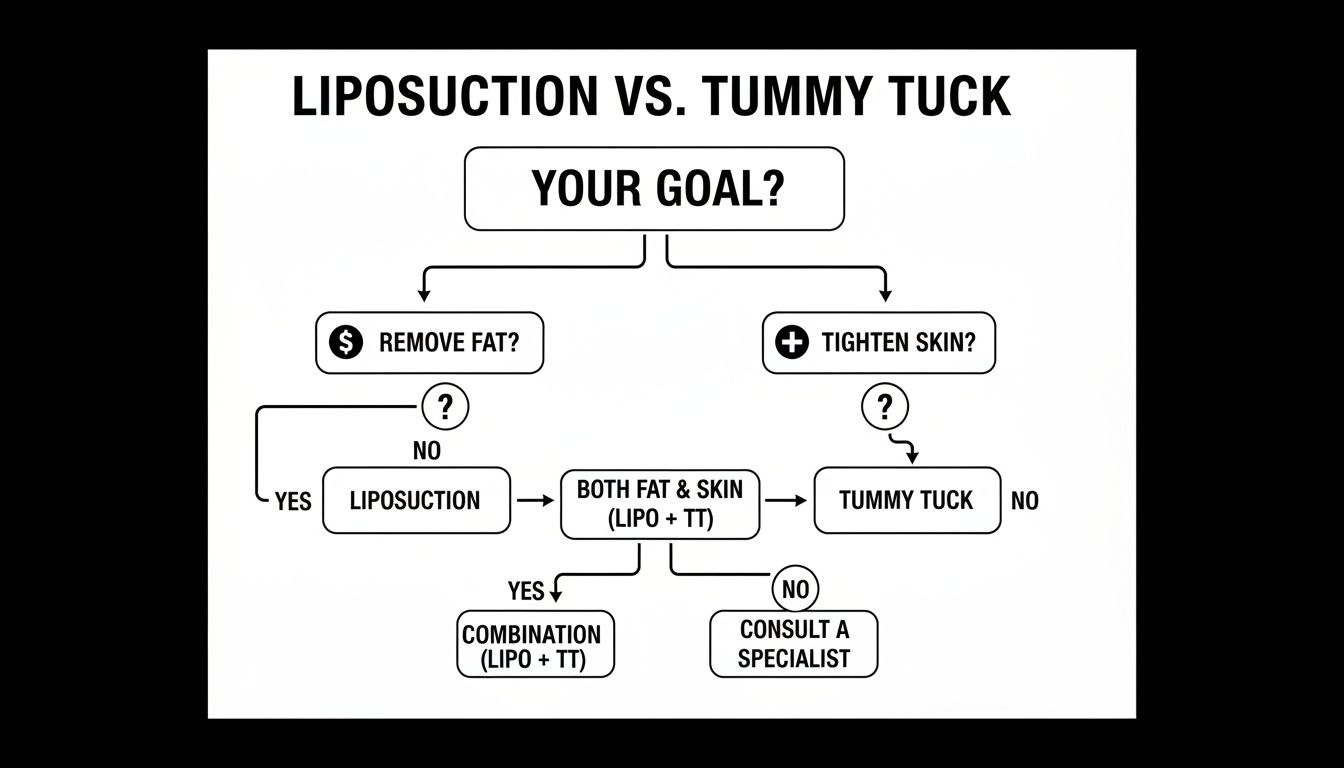
As you can see, if loose, sagging skin is your primary issue, a tummy tuck is the procedure designed to fix it. Opting for a less expensive but inappropriate surgery won't get you the results you want.
The real value isn't found in the cheapest option. It’s in choosing the procedure that correctly addresses what’s actually going on with your body. For a patient with significant skin laxity, the higher investment in a tummy tuck delivers far greater satisfaction than an inadequate liposuction procedure ever could.
For many of my patients, the ideal result comes from tackling both stubborn fat and loose skin at the same time. This is where a combined procedure, often called a lipoabdominoplasty, really shines. By performing a tummy tuck with liposuction in one operation, you get a comprehensive transformation with a single recovery period and one set of surgical fees.
This approach truly is the most efficient way to get complete results:
Ultimately, my goal is to sit down with you and create a personalized surgical plan. We’ll work together to align your aesthetic goals with the most effective approach, ensuring your investment leads to results you’ll love for years to come.
The first step in choosing between liposuction and a tummy tuck isn’t in our office—it’s in front of your own mirror. Before we ever meet, taking a few minutes to honestly assess your own body can bring incredible focus to our conversation. This isn't about self-diagnosing; it’s about coming to your consultation prepared and empowered.
Think of it as gathering your notes. When you can articulate what you see and what bothers you, it helps us move from a general discussion of "which is better" to a specific plan for what's best for you.
Ask yourself these questions. Your answers will give us a fantastic starting point for your consultation.
Having thought through these points makes you an active partner in your own surgical planning.
Your personal assessment is the perfect first draft. The final, detailed plan comes from a professional evaluation. An experienced surgeon can assess factors you can't, like your skin's true elasticity and the exact degree of muscle laxity, ensuring the procedure we choose can actually deliver the results you're hoping for.
Here at Cape Cod Plastic Surgery, your consultation with Dr. Marc Fater is a true collaboration. He’ll start by listening carefully to what you want to achieve. Then, after a thorough physical exam, he’ll walk you through how your specific anatomy lines up with what each procedure can accomplish.
The final decision is never a one-size-fits-all solution. It's a highly personalized surgical strategy we design together, ensuring you feel confident in your choice for years to come.
It's completely normal to have more questions as you get closer to a decision. Sorting through the details of recovery, cost, and results is a big part of the process. To help you find clarity, we've compiled answers to the questions we hear most often from our patients here at Cape Cod Plastic Surgery.
Absolutely. In fact, combining liposuction with a tummy tuck is one of the most powerful ways to reshape the entire midsection. We often recommend this combination, known as a lipoabdominoplasty, for patients who want a truly comprehensive result.
Think of it this way: the tummy tuck is the foundational work—it repairs separated abdominal muscles and removes loose, hanging skin. Then, we use liposuction as a high-definition sculpting tool to refine the waistline, hips, and flanks. This integrated approach gives you a more defined, natural-looking silhouette with the benefit of a single surgery, one anesthesia fee, and one recovery period.
This is probably one of the biggest distinctions between the two procedures, and it's a trade-off you'll want to consider carefully.
While a tummy tuck scar is more substantial, it’s the necessary price for achieving the dramatic tightening and flattening that the procedure provides. With good scar care after your surgery, the incision line will lighten and soften considerably over the first year.
The permanence of results is a common concern, and the answer is a partnership between surgeon and patient. While we permanently remove fat and skin, your long-term lifestyle choices are what protect that investment for years to come.
The results can be incredibly long-lasting, but it's a two-way street. The fat cells and excess skin we remove are gone for good—they don't grow back.
The catch is that your body can still change. If you experience significant weight gain after your procedure, the remaining fat cells in the area (and elsewhere) can swell, which will affect your new contours. Similarly, a future pregnancy can re-stretch the skin and abdominal muscles, potentially undoing the repairs from a tummy tuck.
The key to making your results last for decades is maintaining a stable weight through a healthy diet and regular exercise. Patients who commit to this find their results are remarkably durable.
This really comes down to the specific ways pregnancy has changed your body. If your only issue is a stubborn pocket of fat but your skin has bounced back well, liposuction alone might be all you need.
For most women, however, pregnancy leaves behind a trio of issues: stretched skin, weakened or separated abdominal muscles (diastasis recti), and some lingering fat. In that very common scenario, a tummy tuck is by far the better choice. It's the only procedure designed to tackle all three of those concerns in a single operation.
A mini tummy tuck can be a great option with its shorter scar and faster recovery, but it’s important to know that it's designed for a very specific patient. This procedure only addresses a small amount of loose skin and fat located below the belly button.
It won't do anything for loose skin on the upper abdomen, and it doesn't typically include the extensive muscle repair of a full tummy tuck. During your consultation, a physical exam is the only way to know for sure. We'll assess your anatomy and goals to determine if your concerns are limited enough for a mini, or if a full abdominoplasty is what you truly need.
Ready to move from questions to answers for your own body? The team at Cape Cod Plastic Surgery is here to provide the expert guidance you need. Schedule your personalized consultation with Dr. Marc Fater today.
October 2, 2026
Beyond the Calendar: How to Know You’re Truly Ready for Plastic Surgery

October 2, 2026
Exploring Your Breast Augmentation Options: Implants, Shapes, and What to Expect

October 1, 2026
Reshaping Your Silhouette: A Guide to Body Contouring

Cape Cod Plastic Surgery offers expert cosmetic and reconstructive procedures in a safe, accredited setting. Led by Dr. Marc Fater, we combine advanced techniques with personalized care to help you look and feel your best.
Monday: 9:00 AM – 5:00 PM
Tuesday: 9:00 AM – 5:00 PM
Wednesday: 9:00 AM – 5:00 PM
Thursday: 9:00 AM – 5:00 PM
Friday: 9:00 AM – 5:00 PM