

October 7, 2026
What to Expect During Your Breast Surgery Recovery
A Practical Guide to Healing After Breast Surgery
Aug 25, 2026

You're 48 hours out from a tummy tuck, standing in front of the mirror and wondering whether the puffy, uneven lower abdomen means something has gone wrong. The skin feels tight, one side looks fuller than the other, and every online search seems to recommend lymphatic drainage after surgery as though recovery depends on booking a massage immediately.
Postoperative swelling is common, but not every swollen area needs massage. Lymphatic drainage can sometimes improve comfort, heaviness, and the way swelling settles. It hasn't been proven to prevent lymphedema for every patient or guarantee a smaller final result. The safest plan matches the treatment to your procedure, symptoms, healing stage, and surgeon's instructions.
Your lymphatic system is a network of vessels, nodes, and fluid pathways that helps return excess fluid, proteins, and cellular waste from tissues to the bloodstream. Unlike the cardiovascular system, it doesn't rely on one central pump. Breathing, muscle movement, and pressure from surrounding tissues help move lymph.
Surgery temporarily interrupts that process. A tummy tuck, liposuction procedure, breast operation, facelift, or reconstructive surgery passes through skin and soft tissue and may disturb tiny lymphatic channels. The body also sends inflammatory fluid to the surgical area as part of healing. For a short time, more fluid enters the tissues than the lymphatic pathways can clear.
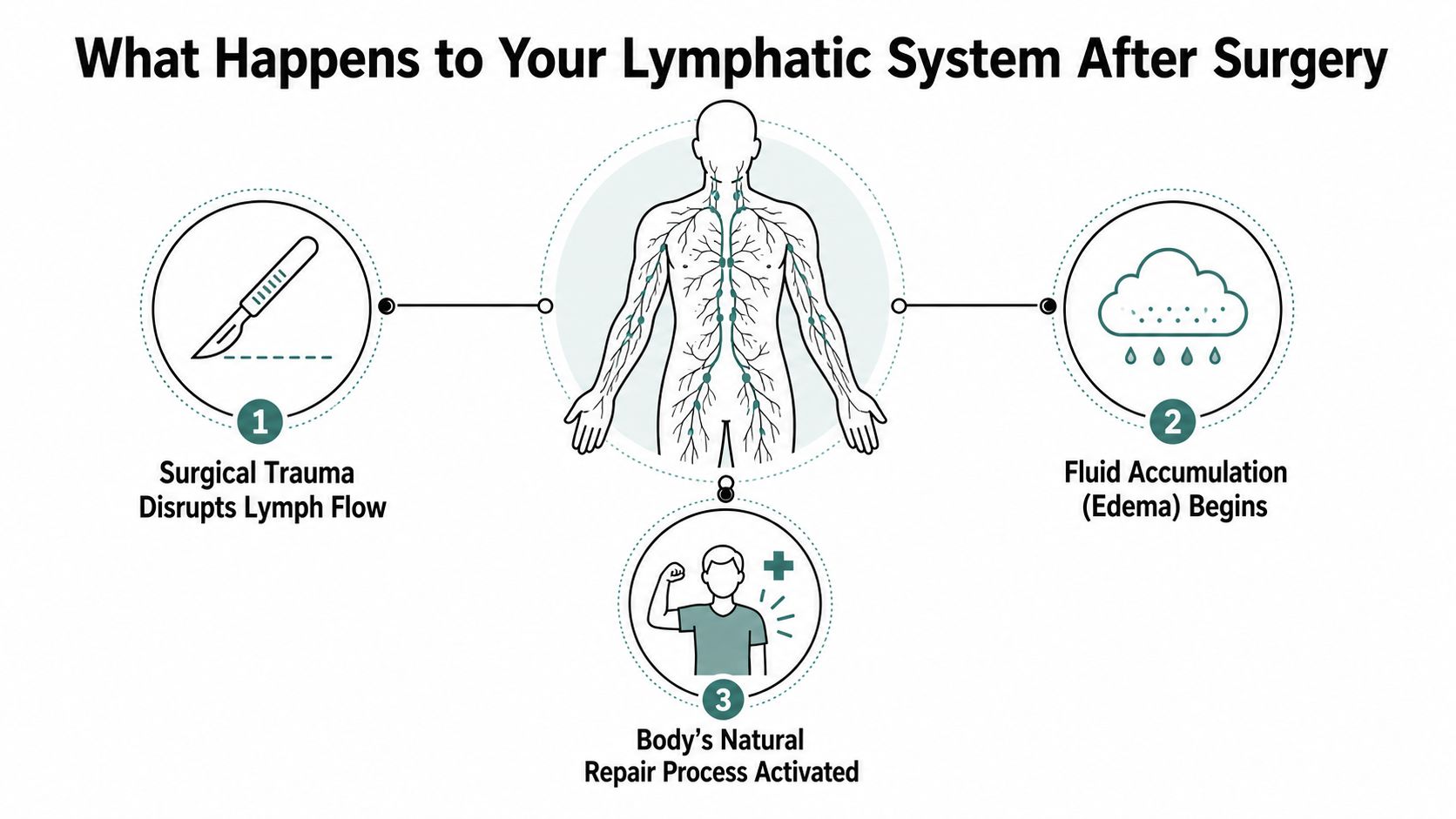
Normal postoperative edema can feel firm, heavy, tight, or uneven. It may create rippling or areas of fullness that change with position. Those changes can be unsettling, especially after body contouring, but they often reflect inflammation, disrupted fluid pathways, compression, and limited movement rather than permanent lymphatic disease.
A seroma is a collection of fluid in a surgical space. It may feel soft, fluctuant, or like fluid is shifting under the skin. A hematoma contains blood and may cause a rapidly enlarging area of swelling, bruising, pressure, or pain. Neither should be treated by increasing massage. Contact your surgical team so they can determine what's happening.
True lymphedema is a chronic failure of lymphatic drainage. It's more commonly associated with significant lymph-node disruption, such as cancer-related node removal, than with the temporary fluid overload many cosmetic-surgery patients experience. Persistent or worsening output from a drain also deserves attention. Postoperative lymphatic leakage is generally managed with a step-up strategy, with conservative care often continued for several weeks and sometimes up to about two months before surgery is considered. The literature also describes escalation when leakage persists beyond two weeks, exceeds one liter after one week, or produces metabolic complications, so surgical drain removal guidance should come from your own team.
Practical rule: Swelling that gradually settles can be part of healing. Sudden expansion, increasing pain, fever, or a new fluid sensation calls for a surgical assessment, not stronger pressure.
Lymphatic care isn't one treatment. It's a group of tools, and each tool has a different job.
Manual lymphatic drainage, or MLD, is performed with light, rhythmic skin-stretching strokes. A trained therapist works around the surgical area and toward functioning lymphatic pathways rather than pressing into fresh tissue. Patients often describe a session as gentle and relaxing, with a temporary sense of lightness or reduced tightness. MLD should be modified around incisions, drains, bruising, and tender areas.
Pneumatic compression uses inflatable sleeves, boots, or garments that cycle pressure. The changing pressure can support fluid movement and is commonly considered when swelling affects both legs, the trunk, or broad areas after liposuction and body contouring. A clinician determines whether the device is appropriate and what pressure or treatment pattern is safe.
Compression garments provide steady external support between appointments. They're fitted to the treated area and worn according to the surgeon's instructions. A garment shouldn't cause numbness, skin discoloration, sharp pain, breathing difficulty, or pressure over an incision that your team hasn't approved.
Gentle movement recruits the body's own pump. Diaphragmatic breathing, ankle pumps, and short walks may be introduced early when medically cleared. Movement is usually taught by the surgical team, while a physical therapist or lymphatic therapist may help adapt it around pain, drains, and activity restrictions. Patients looking for broader mobility guidance can also review this Shawnee KS after surgery care guide from LifeWorks Integrative Health.
| Technique | Primary Purpose | What It Feels Like | Who Provides It |
|---|---|---|---|
| Manual lymphatic drainage | Support localized fluid movement and comfort | Light, slow skin stretches | Qualified lymphatic therapist or trained clinical professional |
| Pneumatic compression | Apply cycling pressure across a larger region | Repeated, graduated squeezing | Surgical team, therapist, or prescribed device program |
| Compression garments | Maintain steady external support | Firm, consistent pressure | Surgical team or qualified garment fitter |
| Gentle movement | Activate breathing and muscle-assisted fluid movement | Mild activity without straining | Surgeon, nurse, or physical therapist |
No technique should be painful. Deep kneading, forceful work over a fresh incision, or treatment sold as a requirement for preserving your result deserves caution.
Recovery doesn't follow a single calendar, but a phased model helps patients understand what to expect.
During the first several days, swelling often builds before it improves. Drains may still be present, and the operated tissue is vulnerable. If your surgeon approves treatment, sessions are typically short and gentle, with attention to areas that can accept fluid rather than direct pressure over the operation itself.
The priority at this stage is protection. Your team may focus on drain care, incision observation, prescribed compression, breathing, and brief walks. MLD isn't a substitute for checking a drain, evaluating a collection, or contacting the office about a change in symptoms.
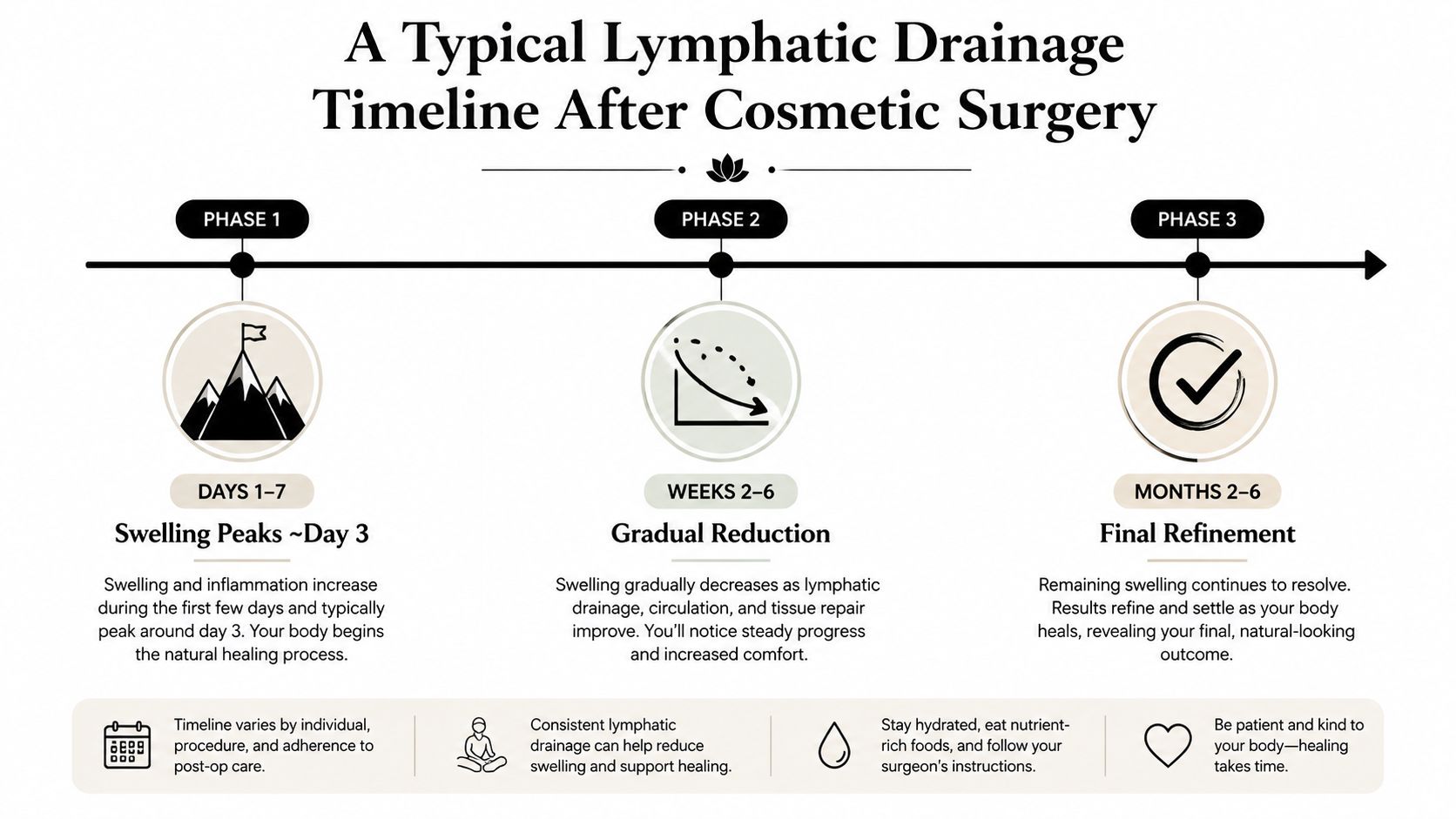
Over the following weeks, swelling may become less diffuse and more concentrated in firm or dependent areas. Drains may be removed when output and healing meet the surgeon's criteria. Garment instructions can also change as the body settles.
Some patients benefit from occasional MLD during this stage because it reduces feelings of pressure or helps them move more comfortably. Others improve without formal treatment. A liposuction recovery timeline can help you place swelling, activity, and garment changes in the context of your specific operation.
A 2020 meta-analysis of 12 randomized trials after breast cancer surgery found that MLD didn't significantly reduce or prevent lymphedema overall, as reported in this systematic review of manual lymphatic drainage. That finding addresses prevention and measurable lymphedema outcomes. It doesn't mean a carefully selected patient can't experience symptom relief.
Later recovery usually emphasizes observation, movement, garment use when prescribed, and selective treatment for stubborn symptoms. Residual swelling can be uneven, especially after extensive body contouring, and visible refinement may continue after structured therapy ends.
Patients recovering from a Brazilian butt lift also need procedure-specific positioning, pressure, and activity guidance. This essential BBL recovery guide can provide general recovery context, but your surgeon's instructions take priority.
The embedded video offers a visual introduction to recovery concepts:
Patients often ask for a price comparison before choosing lymphatic care. The evidence supplied for postoperative lymphatic drainage doesn't establish reliable cost ranges, so a responsible comparison can't assign universal session prices or package totals. Fees vary by provider, location, treatment area, qualification, and whether care is part of a surgical program.
The more useful comparison is clinical. MLD is hands-on and adaptable, which makes it attractive when one region feels tight, tender, or unusually firm. Pneumatic therapy covers a broader area with programmed pressure, but it still requires screening and shouldn't be used to push fluid through a problem that hasn't been diagnosed.
Compression is often the daily foundation when the surgeon prescribes it. It supports the treated area between appointments, but fit matters. A garment that rolls, digs into skin, or creates excessive pressure can become a problem rather than a solution. For a plain-language overview of how compression aids recovery, patients can review guidance from MedEq Fitness while confirming garment instructions with their surgical team.
| Method | Typical Cost | Evidence Strength | Best Use Case |
|---|---|---|---|
| Manual lymphatic drainage | Varies by therapist and treatment plan | Mixed for prevention and volume, more useful as a symptom-focused adjunct | Localized tightness, heaviness, or persistent edema after appropriate clearance |
| Pneumatic compression | Varies by device access and prescription | Procedure-specific and dependent on proper screening | Broader or bilateral swelling when a clinician recommends cycling pressure |
| Medical-grade compression | Varies by garment and fitting service | Commonly used as supportive postoperative care | Daily support for breast, trunk, limb, and body-contouring recovery when prescribed |
| Guided movement | Usually no separate treatment fee | Strong practical value as part of safe rehabilitation | Breathing, walking, and gradual activity after clearance |
Stacking modalities may make practical sense because they address different parts of recovery. That doesn't mean every patient needs every tool. The right combination is the smallest plan that supports healing, comfort, mobility, and safety.
No, every postoperative patient needs lymphatic drainage. The most defensible role is procedure-specific and symptom-focused. It may ease heaviness, tightness, or persistent swelling, and it may help tissues settle visibly sooner. Evidence does not support presenting it as a universal way to prevent lymphedema or guarantee volume reduction.
After extensive liposuction or abdominoplasty, a broad area of edema, prolonged tightness, or early firmness can make movement uncomfortable. Once the surgeon confirms that the incisions, drains, and fluid pattern are suitable, a qualified therapist may support comfort and tissue mobility. The goal is to help a difficult phase of healing, not to force fluid out or change the final contour.
Facelift and neck-lift patients may feel frustrated by facial puffiness or uneven settling. The face and neck need especially gentle treatment that respects incisions, skin flaps, bruising, and surgical restrictions. If mild swelling is already improving, extra appointments may add little.
Reconstructive procedures require more individualized planning. Flap surgery, altered drainage routes, or lymph-node work can change how fluid moves through the tissues. Coordination between the surgeon and a therapist familiar with the operative anatomy may matter more than following a generic massage schedule. Drainage mapping and observation can help determine whether treatment fits the patient's anatomy and recovery stage.
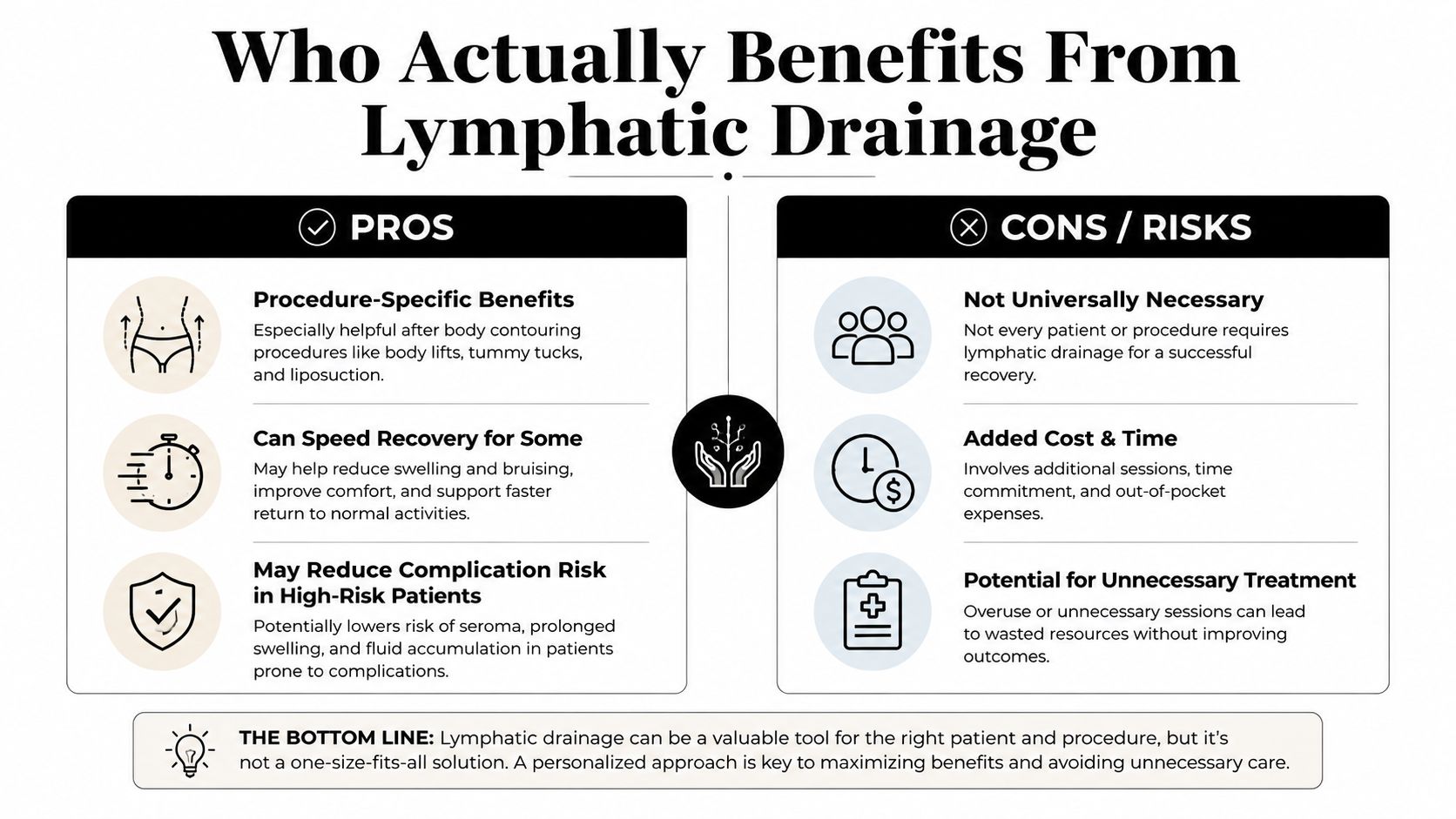
Someone recovering from a small in-office procedure may have limited swelling and no clear reason to schedule formal MLD. The same may apply when swelling is steadily resolving with prescribed compression, walking, and routine follow-up.
Evidence reviews remain contradictory. Available analysis does not support claiming that MLD reliably prevents lymphedema in low-risk cosmetic patients. It also does not justify warning that skipping massage will ruin a surgical result.
A useful decision test: Ask whether treatment has a defined goal, such as easing heaviness or addressing persistent edema. If the only goal is avoiding a guaranteed complication that evidence has not established, pause before purchasing a package.
Overtreatment costs more than money. It can make normal healing seem abnormal and encourage dependence on repeated services instead of confidence in a clear home plan.
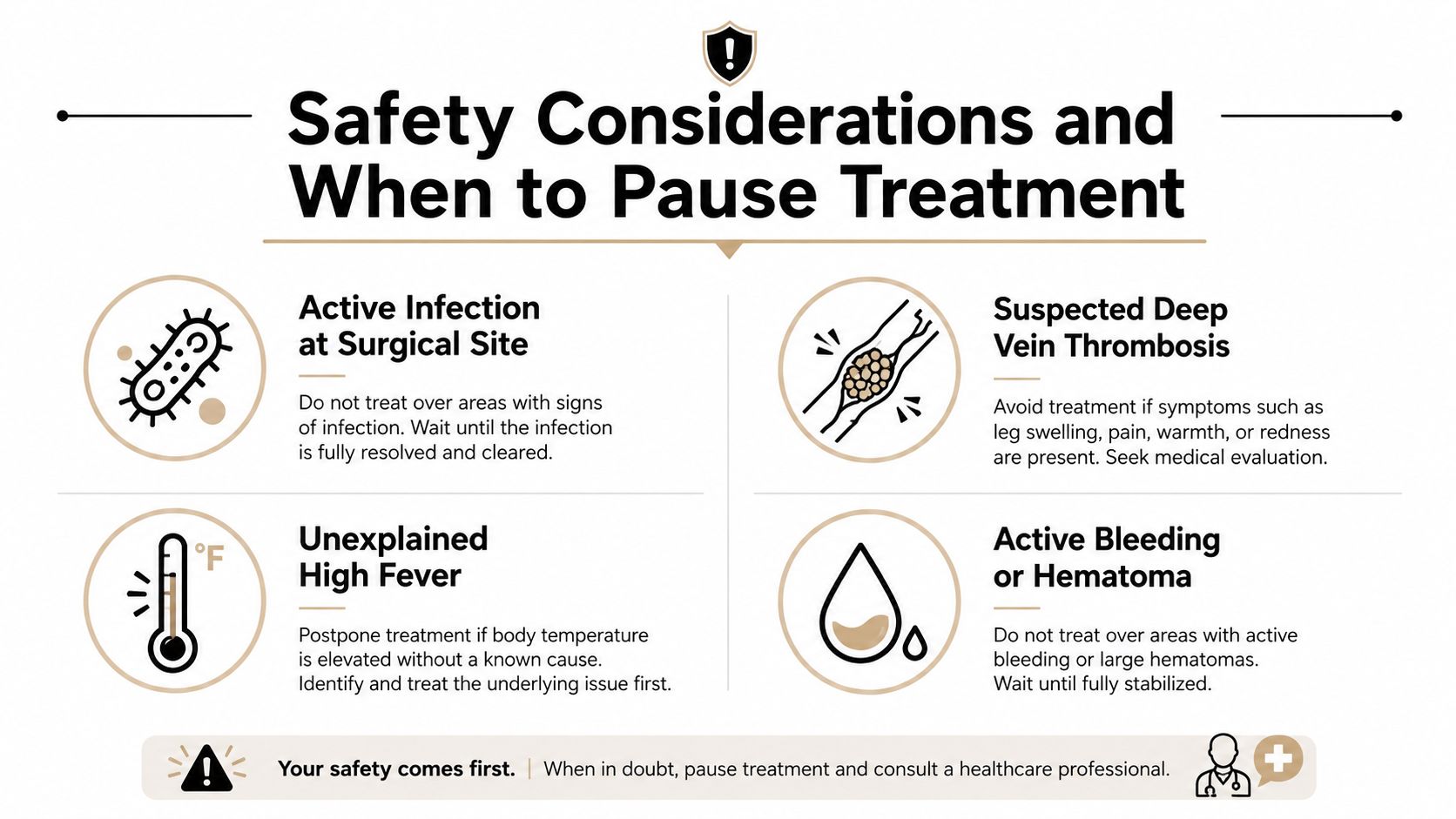
Lymphatic work should begin with screening, not a sales package. A therapist or nurse may pause treatment when the surgical site shows infection, when a fluid collection needs evaluation, or when the patient reports symptoms that could indicate a serious complication.
Avoid or delay treatment until the medical team evaluates:
Patients should also report fever over 101.5°F, as well as sudden breathing difficulty or asymmetric calf swelling. Suspected pulmonary embolism or deep vein thrombosis is not a massage problem. Seek urgent medical care when those symptoms appear.
Before treatment, the provider should review the operation performed, the operative note when available, drain output, medications including anticoagulants, incision status, pain pattern, and relevant heart or kidney history. The provider should also ask what has changed since the previous visit.
You should never feel pressured to continue because you prepaid. If a session hurts, increases swelling, causes new drainage, or leaves you feeling unwell, stop and contact your surgical team. Review ways to help prevent blood clots after surgery as part of your broader recovery education.
At Cape Cod Plastic Surgery, Dr. Marc Fater's postoperative recommendations can be adjusted to the procedure, operative findings, amount and location of swelling, medical history, and healing progress. The plan may include observation alone, prescribed compression, gentle movement, pneumatic compression, MLD, or a combination of these options when the expected benefit outweighs the burden.
Treatment may be performed by trained clinical staff or an appropriately qualified lymphatic-therapy professional, with communication maintained across the care team. Garments should match the treated area and be fitted as carefully as possible. Pressure and frequency can change as swelling softens, drains are removed, incisions close, and activity increases.
Patients can use this checklist during preoperative planning:
The team also screens for infection, blood clots, uncontrolled pain, open wounds, heart or kidney concerns, and other contraindications before treatment. This coordinated approach supports symptom relief and visible settling without promising that lymphatic drainage prevents every case of lymphedema or eliminates normal postoperative swelling.
If you're preparing for cosmetic or reconstructive surgery on Cape Cod, discuss lymphatic drainage, compression, movement, drains, and warning signs with your surgical team before booking outside treatment. Visit Cape Cod Plastic Surgery to learn how Dr. Marc Fater and the care team can help create a recovery plan matched to your procedure and healing needs.
October 7, 2026
A Practical Guide to Healing After Breast Surgery

October 6, 2026
Your Safety Guide: What to Look for When Choosing a Plastic Surgeon
October 5, 2026
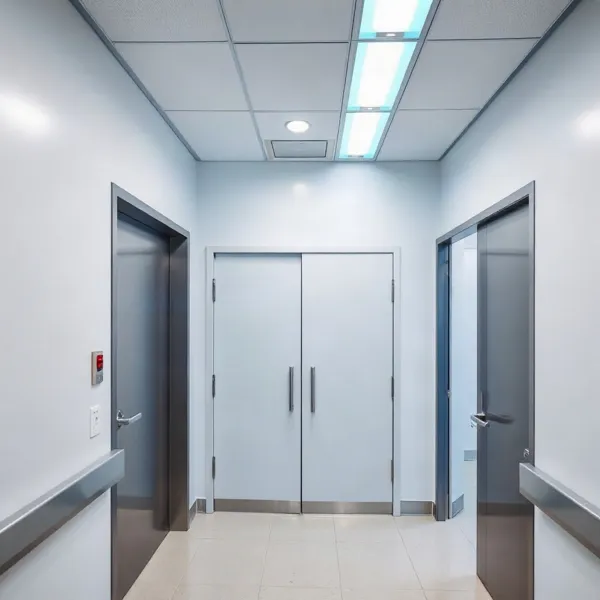
Why Our On-Site Accredited Facility Matters for Your Safety

Cape Cod Plastic Surgery offers expert cosmetic and reconstructive procedures in a safe, accredited setting. Led by Dr. Marc Fater, we combine advanced techniques with personalized care to help you look and feel your best.
Monday: 9:00 AM – 5:00 PM
Tuesday: 9:00 AM – 5:00 PM
Wednesday: 9:00 AM – 5:00 PM
Thursday: 9:00 AM – 5:00 PM
Friday: 9:00 AM – 5:00 PM