
September 9, 2026
How to Care for Surgical Incisions Properly
Expert Guide to Proper Surgical Incision Care
Jun 20, 2026
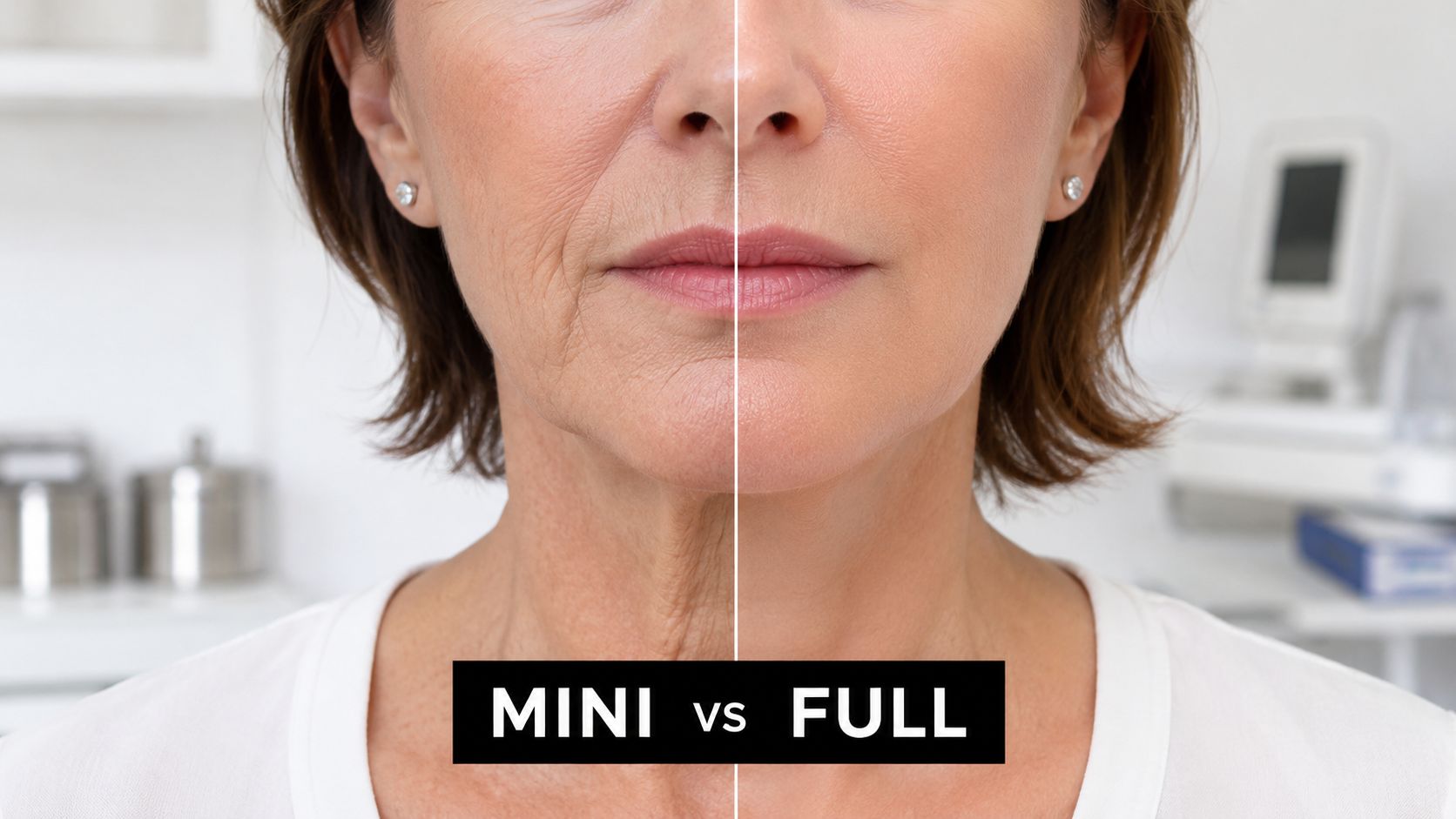
You may be looking in the mirror and seeing a version of yourself that still feels like you, but more tired, a little heavier through the jawline, or less defined in photos than you expected. That's often how this conversation starts. Not with a dramatic change, but with small shifts. Makeup sits differently. Zoom angles become strategic. The neck and jawline begin to matter more than they used to.
Some people arrive at a facelift consultation after trying skin care, lasers, fillers, or collagen-stimulating treatments first. Others are still early in that process and want to understand where surgery fits compared with less invasive options. If you're still sorting through that broader spectrum of facial rejuvenation, it can help to see microneedling before after photos and compare what skin-focused treatments can improve versus what surgery is designed to lift.
The important point is this. A mini facelift and a full facelift are not interchangeable procedures. They solve different problems. One is a focused lower-face operation meant for earlier aging changes. The other is a broader tissue-repositioning procedure for more advanced descent in the face and neck. Choosing well means matching the operation to your anatomy, not choosing the procedure with the easier name or the shorter recovery headline.
In practice, I see two common patient stories.
The first is the person who says, “I still look good from the front, but when I catch my profile, I see jowls.” The second is the person who says, “My lower face, cheeks, and neck all seem to be dropping together, and nothing non-surgical is really fixing it.” Those are different presentations, and they usually lead to different surgical recommendations.
Individuals aren't deciding whether they want to look younger in some abstract way. They're deciding what level of change fits their life.
A patient with early jawline laxity may want a more limited operation, shorter scars, and a quicker return to routine. Another patient may be willing to accept a more involved recovery because the neck, lower face, and midface all need attention at the same time. Both goals are reasonable.
The best facelift is the one that treats the aging you actually have, not the one that sounds less intimidating online.
Patients sometimes misunderstand this distinction. A mini facelift can be excellent surgery when used for the right face. It is not a diluted version of a full facelift. It is a targeted lift. Likewise, a full facelift isn't “too much” when someone has aging across the cheeks, jawline, and neck. It is the operation that matches the problem.
If you're comparing mini facelift vs full facelift, don't think in terms of better versus worse. Think in terms of precision versus scope. Precision matters when aging is limited. Scope matters when aging is more diffuse.
A mini facelift is generally a lower-face, shorter-scar procedure that focuses on early jowling and jawline laxity. Compared with a full facelift, it uses shorter incisions, involves less undermining of the skin, and typically has minimal neck dissection. A full facelift addresses the face below the lower eyelids and the neck, making it a more extensive tissue-repositioning operation, as described in this facelift comparison by Anthony Macquillan.
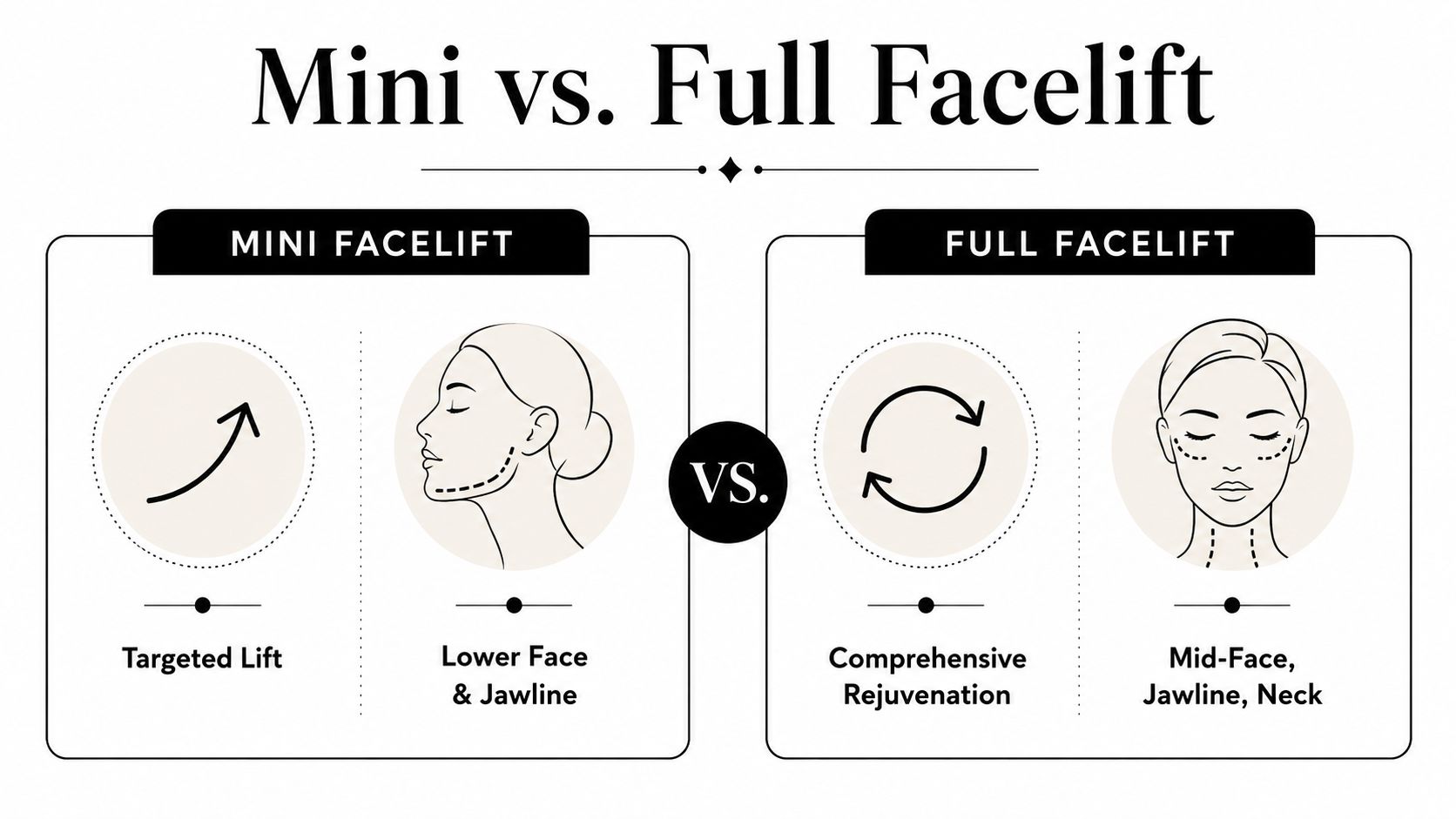
| Feature | Mini Facelift | Full Facelift |
|---|---|---|
| Primary treatment area | Lower face, jawline, early jowls | Face below the lower eyelids and neck |
| Incisions | Shorter scars, usually around the ears | Longer incisions to allow broader correction |
| Skin undermining | Less extensive | More extensive |
| Neck treatment | Minimal or limited | Commonly included as part of the operation |
| Overall goal | Targeted refresh | Comprehensive rejuvenation |
A concise patient-friendly overview of the limited-lift approach is also available in this explanation of what a mini facelift is.
When patients search mini facelift vs full facelift, they often focus first on downtime. That matters, but it shouldn't be the first filter. The first question is where is the aging happening.
Clinical reality: Smaller surgery is only better when it's enough surgery.
A mini facelift and a full facelift differ in more than incision length. They differ in what the surgeon can reach, how much tissue can be repositioned, and how much of the face and neck can be improved in one operation.
University of Utah Health describes the mini facelift as targeting the lower face from the cheekbone to the jowls, usually with small incisions near the ears, and notes that it usually takes about 60 to 90 minutes. It's often referred to as a “weekend facelift” because patients can resume normal activities within a couple of days, with full recovery in about a week, according to University of Utah Health's comparison.
In plain terms, that means the operation is designed for focused correction. The lift is concentrated where early descent usually shows up first. The jawline softens. Jowls begin to form. The lower face loses crispness.
A more detailed patient education resource on operative planning is this overview of facelift surgery techniques, recovery, and results.
A full facelift gives the surgeon broader access. The procedure is performed under general anesthesia, takes several hours, and addresses upper midface, lower midface, and neck, as noted by University of Utah Health in the same comparison linked above.
That wider scope matters because aging doesn't always stay confined to the jawline. In a more advanced face, the cheeks descend, folds deepen, skin laxity becomes more diffuse, and the neck contributes heavily to the overall aged appearance. A full facelift is built for that pattern.
The result of surgery depends on what can be safely repositioned.
Patients usually don't regret choosing the “bigger” or “smaller” procedure. They regret choosing the wrong scope.
Candidacy is about anatomy first, age second. Age can be a clue, but it doesn't decide the operation. I've seen younger patients who need more extensive correction because the neck ages early, and older patients whose concerns remain surprisingly localized.
The strongest candidate for a mini facelift is someone with mild to moderate lower-face aging. The jawline has softened. Early jowls are visible. Skin quality is still reasonably supportive. The neck may show some change, but it is not the dominant issue.
For patients in their 40s and 50s with moderate signs of aging, a mini facelift can deliver results lasting 5 to 10 years, which challenges the idea that only a full facelift offers meaningful longevity. In the right patient, this is less about “short-term” surgery and more about precision-long-term correction.
That's why broad articles on different types of facelifts can be useful early in the decision process. They help patients see that there isn't one facelift category. There are several procedures designed for different aging patterns.
A full facelift becomes the better choice when aging is no longer isolated.
Common signs include:
Some patients assume a mini facelift is the “easy version” of a full facelift. That's not accurate. If your aging is limited, a mini lift may be the most elegant procedure for you. If your aging is more advanced, it may leave you under-corrected.
Here's the better way to consider it:
| Patient pattern | Better fit |
|---|---|
| Early jawline softening and small jowls | Mini facelift |
| Combined cheek, jawline, and neck aging | Full facelift |
| Wants subtle lower-face refinement | Mini facelift |
| Wants broader facial and neck rejuvenation | Full facelift |
The right candidate isn't the person in the “correct decade.” It's the person whose facial aging pattern matches the operation.
The recovery difference often becomes clear the night of surgery, not two weeks later. A patient who has a mini facelift may be home the same day, eating a light dinner, walking around the house, and feeling tired but fairly clearheaded. A patient who has a full facelift usually needs to plan for a slower first evening and a quieter first few days because the operation is broader and the anesthesia is often heavier.
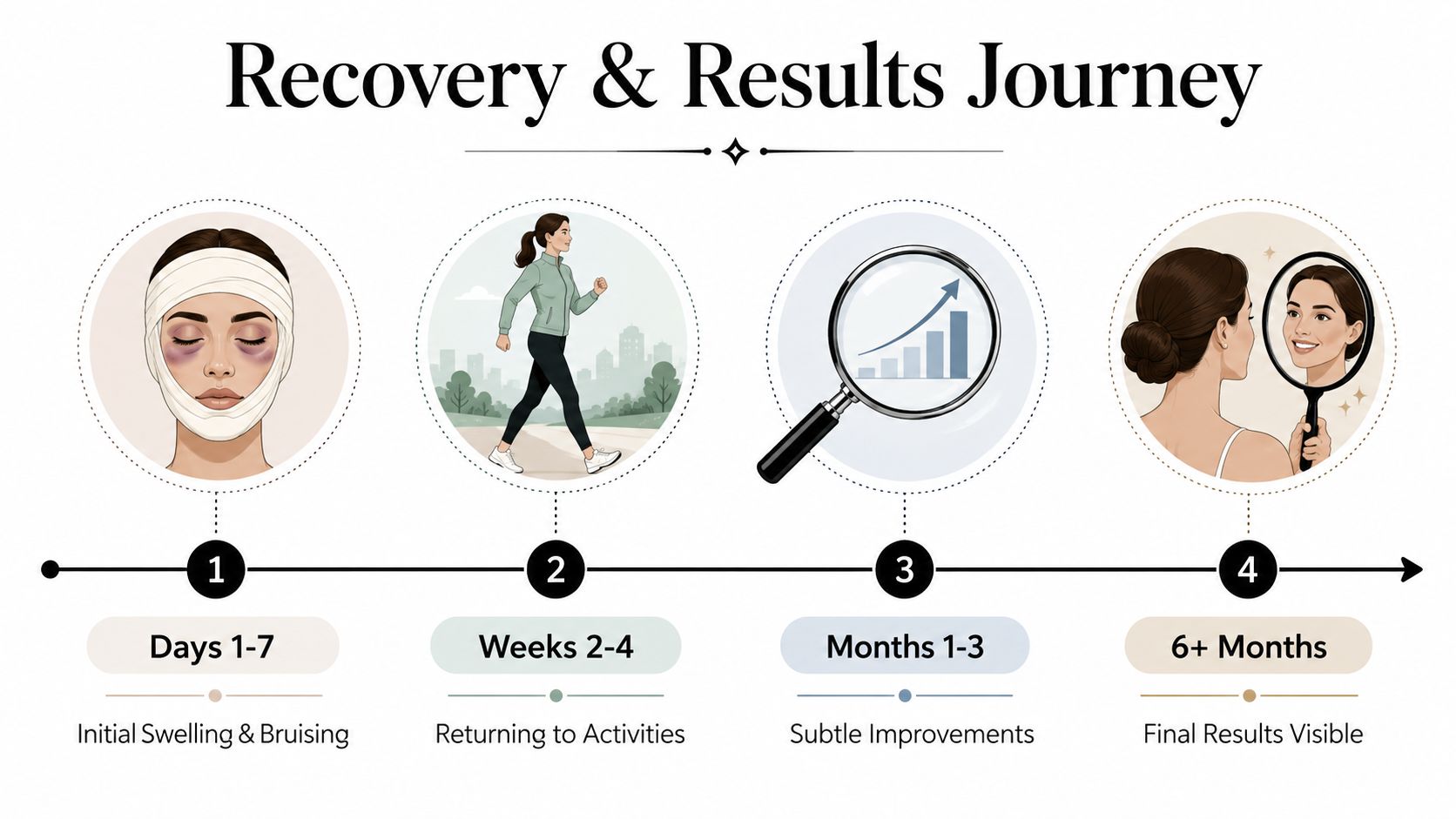
Mini facelifts are often performed with local anesthesia and sedation. In practical terms, that can mean less grogginess, less nausea, and an easier transition back to basic daily activities such as showering, preparing simple meals, answering email, or taking a short walk.
A full facelift usually involves more operating time and, in many practices, general anesthesia. That changes the early experience. Swelling and bruising matter, but so does the simple reality that patients often feel slower, more fatigued, and less interested in doing much for the first several days.
I tell patients to separate two questions: when will you feel functional, and when will you feel comfortable being seen socially? Those are different milestones.
Mini facelift recovery is usually more manageable because the surgical dissection is limited and the disruption to routine is smaller. Many patients can handle light household activity quickly, but they still need help with errands, childcare, driving, and anything that raises blood pressure in the first part of recovery.
That distinction matters. Being able to sit at home and feel reasonably well does not mean being ready for lunch with friends, work meetings on camera, or a full day out of the house.
This visual walkthrough may help if you want to see the general flow of healing and milestones:
A full facelift asks for more planning. Patients often need a real recovery setup at home, a dependable adult with them early on, and more calendar protection from work, social events, travel, and exercise. The first week is usually structured around rest, follow-up visits, head elevation, garment use if recommended, and patience with swelling that changes from day to day.
The trade-off is scope. If the jawline, lower face, and neck all need correction, the broader operation usually gives a result that looks more balanced than doing a smaller lift and hoping it reaches areas it cannot fix.
For patients preparing questions about these practical details, this guide on what to ask a cosmetic surgeon before surgery can help frame the conversation.
Results from either procedure should look refreshed, not artificially tight. A mini facelift usually creates a more modest change centered on early jowling and lower-face definition. A full facelift generally produces a larger improvement across the jawline and neck, with a stronger effect when tissue descent is more advanced.
Longevity also differs, but exact timelines are never guaranteed. The result depends on skin quality, facial structure, weight stability, sun exposure, and how much correction was needed before surgery. In my practice, the better question is not “How many years will it last?” It is “Will this operation match the amount of aging I have?” When the procedure fits the anatomy, the result tends to age more naturally and remain satisfying longer.
A strong facelift consultation should answer a practical question: what will this choice look like in your real life, not just in photos six months later. Patients often arrive focused on scars or cost, then realize the harder decision is whether they can handle the first 24 hours, the first week, and the limits of a smaller operation if their neck or jawline needs more correction.
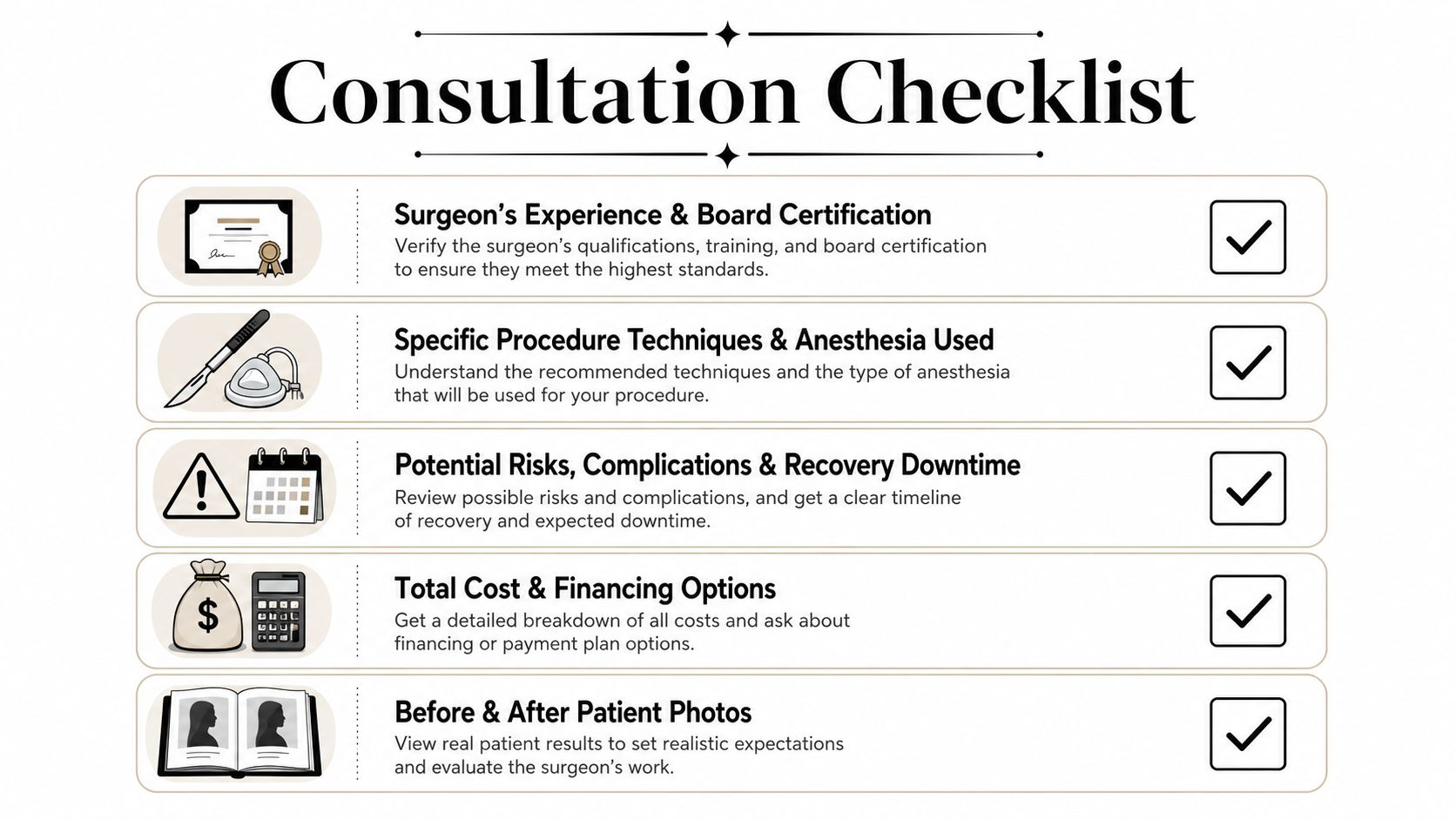
Bring your questions in writing. After any surgical consultation, even very attentive patients forget details.
Ask the surgeon to walk you through the plan in plain language:
If you want help organizing that discussion, this guide on questions to ask a cosmetic surgeon before surgery is a useful place to start.
A consultation should also define the scale of change. A mini facelift usually offers a more limited correction of early lower-face laxity. A full facelift usually addresses a broader area and is more likely to create a balanced improvement when the jawline and neck are aging together.
That difference affects expectations. Some patients are happiest with a smaller operation because they want less downtime and accept a subtler result. Others become disappointed when they choose the shorter procedure for convenience, then find that it did not meaningfully improve the neck or provide the degree of change they had in mind.
I tell patients to ask one direct question: If I choose the smaller lift, what am I giving up? The answer often clarifies the decision faster than any discussion about labels.
Credentials and setting matter. So does the surgeon's willingness to discuss risk without minimizing it.
Ask about:
| Consultation checkpoint | Why it matters |
|---|---|
| Board certification | Confirms specialty training in plastic surgery and ongoing professional standards |
| Accredited surgical facility | Adds oversight for equipment, staffing, and patient safety protocols |
| Experience with facial surgery | Judgment improves with repetition, especially when choosing between limited and more extensive lifting |
| Anesthesia team and plan | Helps you understand monitoring, recovery, and what support you may need the first day |
| Recovery support | Clear postoperative instructions often make the first week easier and safer |
For patients considering surgery on Cape Cod, Cape Cod Plastic Surgery is one example of a practice that offers facial procedures in an on-site, AAAASF-accredited surgical suite. That is the kind of detail worth confirming wherever you have surgery.
Choose the surgeon who can explain the trade-offs clearly, including what the operation will not do.
Usually, yes. A mini facelift is generally a shorter-scar procedure, so incision length is typically more limited. That said, scar quality depends on placement, closure technique, healing, and your skin characteristics. The goal in either operation is to place incisions where they heal as inconspicuously as possible.
Usually not to the same degree as a full facelift. A mini facelift is mainly a lower-face operation with minimal neck dissection. If the neck is a major concern, a full facelift or a combined plan is often more appropriate.
There isn't a single correct age. The right timing depends on how your face is aging. Some patients in their 40s and 50s are excellent mini facelift candidates because the aging is still localized. Others need a fuller correction earlier because the neck and midface are aging together.
Yes, sometimes. Common pairings may include eyelid surgery or skin-focused treatments, depending on the patient's goals. The key is balance. The plan should treat the areas that are aging without creating a mismatch between the eyes, face, jawline, and neck.
Cost varies by surgeon, facility, anesthesia plan, and procedure scope. A mini facelift generally costs less than a full facelift because it is more limited. The more useful question is not “Which is cheaper?” but “Which procedure gives me the right correction without under-treating or over-treating my face?”
If you're weighing a mini facelift against a full facelift and want a recommendation based on your actual anatomy, schedule a consultation with Cape Cod Plastic Surgery. A careful in-person evaluation can clarify what your face needs, what recovery would look like in your daily life, and which option is most likely to give you a natural result.
September 9, 2026
Expert Guide to Proper Surgical Incision Care

Master dermal fillers aftercare with do's and don'ts, swelling tips, activity limits and warning signs to protect your results and heal smoothly.

September 8, 2026
Ensuring Safety: Why Your Surgeon's Credentials Matter Most

Cape Cod Plastic Surgery offers expert cosmetic and reconstructive procedures in a safe, accredited setting. Led by Dr. Marc Fater, we combine advanced techniques with personalized care to help you look and feel your best.
Monday: 9:00 AM – 5:00 PM
Tuesday: 9:00 AM – 5:00 PM
Wednesday: 9:00 AM – 5:00 PM
Thursday: 9:00 AM – 5:00 PM
Friday: 9:00 AM – 5:00 PM